Apple's contempt case against Epic has entered the substantive stage at the Supreme Court: the zero-commission policy for external links is only temporary
On September 14, 2026, Apple submitted a merits brief to the U.S. Supreme Court in the Apple v. Epic Games case, challenging the "contempt of court" ruling in this case. Ostensibly a continuation of the App Store's "external link commission" dispute, this case essentially only addresses a narrow yet crucially important issue for all antitrust injunctions: is it legal for a court to rule that an enterprise is in contempt based on the "spirit" of an injunction? In another dimension, when a company complies with a court injunction, will it still bear further legal liability for its chosen compliance solutions?
For developers, the most intuitive question is: Since April 30, 2025, U.S. regulations allow users to be directed to third-party payment channels via external links within apps, with no commission charged by Apple. However, Apple's current lawsuit has turned the zero-commission baseline into an uncertainty. Should they invest in building external payment capabilities?
I. Background: The Supreme Court Will Not Re-examine Whether Apple Holds a Monopoly
In 2020, Epic Games was removed from Apple's App Store for circumventing Apple's in-app purchase mechanism with Fortnite, and subsequently filed a lawsuit against Apple. The U.S. District Court generally dismissed Epic's core federal antitrust claims, but ruled that Apple's anti-steering rules violated California's Unfair Competition Law, and issued a key injunction in 2021: Apple shall not prohibit developers from placing buttons, external links or other call-to-action language within apps to direct users to purchase channels outside the App Store.
After that, the case entered an "enforcement battle": although Apple allowed external links, it charged a 27% commission for any purchase completed through an external system within 7 days after the user clicked the link, while the standard in-app purchase commission was 30%. Epic then claimed that the 27% charge almost offset the cost savings brought by external links, rendering the court's injunction ineffective.
In April 2025, Judge Gonzalez Rogers of the U.S. District Court for the Northern District of California found Apple in "civil contempt", pointing out issues such as testimony from its senior executives and the timeline of internal decision-making, and once comprehensively banned Apple from charging any commission for purchases made via external links. At the same time, the judge even referred relevant materials of senior executives to the U.S. Attorney for the Northern District of California to investigate potential "criminal contempt". As of September 15, 2026, this referral is still pending and no public results have been announced.
On December 11, 2025, the Ninth Circuit Court of Appeals upheld the "contempt" ruling, based on the so-called "spirit" of the injunction — Apple's 27% commission for external links completely violated the original intention of the order, and even if it did not technically violate the text of the order, it constituted blatant defiance. However, it revoked the "full ban on commissions" ruling, allowing Apple to charge fees based on "genuinely and reasonably necessary" coordination costs, and remanded the rate revision to the district court.
Therefore, the Supreme Court only accepts the issue of the "civil contempt standard" in this case, and will not retry the substantive issues of antitrust and the scope of the injunction.
II. Dual-Track Parallel System: Why Apple's Commission Rate Cannot Be Finalized
At present, the App Store fee issue is governed by two coexisting legal tracks that are structurally intertwined, making the outcomes of the two interdependent.
1. Supreme Court Review of Contempt of Court: The merits brief submitted by Apple on September 14 officially launched the debate. Epic's reply is due on November 13, and the final ruling will not be available until at least June 2027. Although the Supreme Court only judges "whether contempt of court is established", if the Supreme Court supports Apple's position and overturns the Ninth Circuit's ruling, the evidence record being established by the district court may become meaningless.
2. Oakland District Court: Judge Gonzalez Rogers is proceeding with another procedure to determine what fees (if any) Apple may charge for purchases via external links in accordance with the "cost necessity" standard set by the Ninth Circuit Court of Appeals. The guidance from the Ninth Circuit on the district court's fee investigation is exactly the standard that Apple asks the Supreme Court to overturn. At present, the rate hearing and evidence discovery are both in a semi-stagnant state. If the Supreme Court modifies the standard, the district court's criteria will also be adjusted accordingly.
In this case, the "zero-commission" rule for external links in the U.S. since April 2025 is a temporary status quo under the suspension of litigation, rather than a confirmed permanent rule. The Ninth Circuit has made it clear that zero commission is not appropriate, and the rate should be re-formulated based on actual coordination costs; if the Supreme Court supports Apple's claims, Apple will have more room to advocate for a higher rate.
III. The Real Legal Dispute: How to Define "Contempt"?
At the beginning of its merits brief, Apple wrote:
As the Ninth Circuit held, may a court adjudge a party in civil contempt for violating the "spirit" of an injunction that does not mention the conduct that allegedly constitutes contempt; or, conversely, must a court, as other Circuits have done, rest a civil contempt finding on a violation of an order that expressly prohibits the conduct at issue?
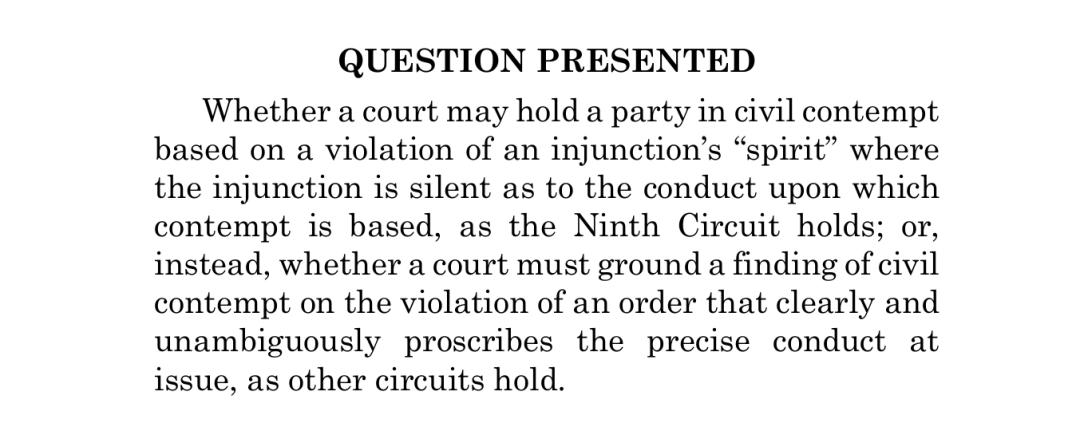
Apple claims that the 2021 injunction only allows external links, and does not prohibit charging commissions for transactions via external links. According to the 2019 U.S. precedent of Taggart v. Lorenzen, "civil contempt" should be bounded by whether the injunction "explicitly prohibits the specific conduct", and if there is a reasonable doubt, the conduct should not be characterized as "contempt".
Apple's argument and logic are as follows: The commission is not mentioned in the injunction, so Apple is entitled to charge commissions.
However, both the U.S. District Court and the Court of Appeals ruled that the way Apple enforced the injunction — the 27% commission plus restrictions on link styles — made external links economically and experientially unfeasible, which constituted "substantial circumvention through formal compliance". Therefore, some of its restrictive measures (such as restrictions on buttons and link designs) directly violated the "literal text" of the injunction, and some violated the "implied obligation" of the injunction — that is, no actions should be taken to frustrate the purpose of the injunction. Combined with the improper intent revealed by Apple's internal documents, Apple's so-called "compliance" should in fact be deemed as "contempt".
How the Supreme Court will finally define "contempt" — whether to interpret it based on the "literal text" or the "spirit" of the injunction — will be the core highlight of this case.
IV. Why the Impact Goes Far Beyond Apple and U.S. Developers
"Civil contempt" is the "teeth" of antitrust injunctions. If the Supreme Court adopts an extremely strict literal standard, all industry injunctions will face the same problem: enterprises will find loopholes in the text to build technical compliance models, and it will be difficult for courts to impose penalties based on the substantive purpose of the injunction afterwards, failing to guarantee the actual effectiveness of court orders.
If the scope of contempt of court is narrowed to only rulings on violations of the text, it will actually require plaintiffs and courts to foresee all possible alternative arrangements in the original text of the injunction. This will undoubtedly significantly increase the administrative cost of antitrust litigation, and in effect make antitrust injunctions more likely to fail, even if the defendant does not technically violate any rules.
Conversely, if the "spirit/purpose" standard is widely allowed, enterprises will criticize that the court has excessive discretion, and will treat all commercial arrangements that are not clearly specified in the settlement or judgment as "contempt".
It is worth noting that Apple's position has received official support from the amicus curiae brief of the CCIA Alliance, which is put forward by associations including the Computer & Communications Industry Association, Progressive Policy Institute, SIIA and NetChoice. They believe that extending the scope of injunctive relief beyond the specific plaintiffs in the case — in this case, more than one million developers unrelated to the Epic lawsuit — violates the principle that relief should not exceed the damages proven by the court.
In addition, Apple admitted in its Supreme Court filing that international regulators are following this case to determine the commission rates Apple may charge in markets outside the United States. This is a fact. Although the rulings of U.S. courts have no legal effect in other regions, the European Union, the United Kingdom, Japan, India, Brazil, as well as China are all conducting litigation or administrative regulatory procedures related to the "Apple Tax". Both plaintiffs and regulators may refer to the economic model of the Oakland District Court on the issue of "how to calculate the cost of external links reasonably".
Original link: https://www.techtimes.com/articles/327527/20260915/app-store-commission-limbo-enters-new-phase-apples-epic-merits-brief-opens-scotus-fight.htm
This article is from the WeChat official account "Internet Law Review", author: Mark Rutherford, authorized for release by 36Kr.