Google doubles down on learning scenarios: Gemini Notebook turns notes into AI tutors
In Google's latest round of intensive updates, the learning scenario is a clear key direction for resource allocation.
Recently, Google rolled out a batch of new features for Gemini Notebook (formerly NotebookLM, renamed in July this year), the core of which is one core highlight: users can directly "speak" to hold conversations with their own notes.
Just last month, Google also integrated a large number of learning tools into the Search and Gemini main applications.
Google has always attached great importance to the education scenario and has a solid foundation. The Classroom product page on Google for Education shows that more than 150 million people around the world use Google Classroom, which is a free classroom management tool for schools and teachers, and teachers and students open this page every day to attend classes and submit assignments.
From the August update of search learning tools to the voice integration of Gemini Notebook in September, it can be seen that Google is increasing its investment in the learning scenario, with the core goal of building a complete ecosystem to make AI a learning partner for learners.
01
Enhance voice learning interaction to connect all learning materials
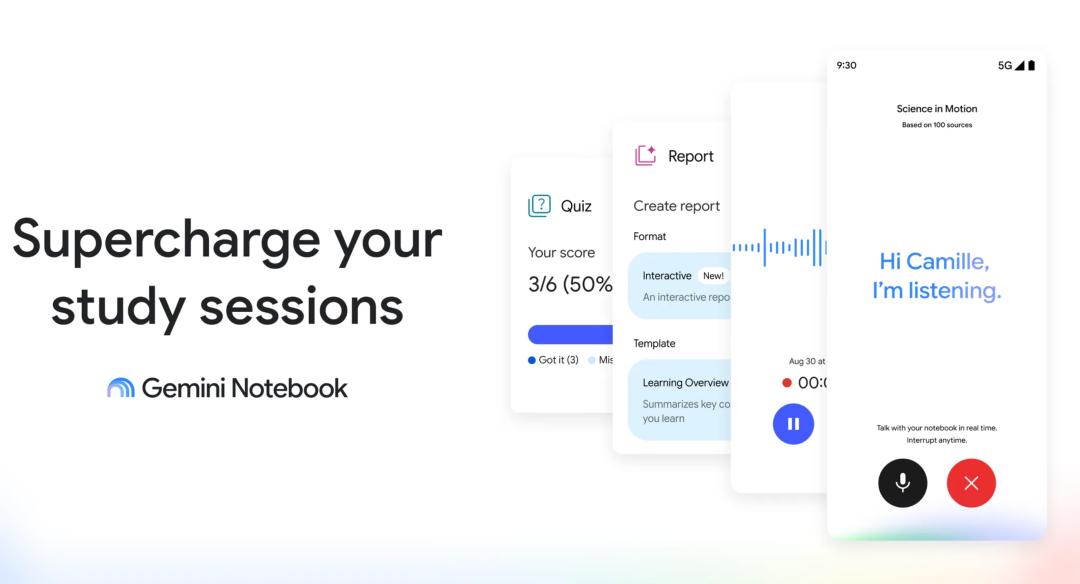
The core feature of this Gemini Notebook update is the integration of Gemini Live.
What does that mean? Previously, when users used NotebookLM, they uploaded a bunch of materials and then typed to ask questions, and it replied with text. Now, users can directly talk to it via voice, and all its responses are strictly based on the notes and materials uploaded by users.
Now, users can interrupt it at any time while it is speaking, ask it to explain in another way, or follow up on a specific step. This experience is more like "discussing with someone who has read all your materials", and is similar to the form of voice tutoring.
Voice-first AI tutoring platforms have been favored by capital this year. Behind Gemini Notebook, there is a design logic different from other voice tutoring tools: if the AI deviates from the user's materials when answering, it will easily become an "encyclopedia" that can talk about everything but go deep into nothing. Google's choice to anchor voice conversations on users' private materials is essentially strengthening the barrier of "personalized learning". Users' class notes, courseware and recordings are all the boundaries of conversations.
According to the introduction, this feature supports nearly 100 languages, but is first available to Google AI Ultra subscription users.
Another feature update connects materials of different formats in the learning scenario.
Students can directly use Gemini Notebook to record class lectures or their own oral notes, and the recordings will be automatically transcribed into text and integrated into the notebook as a new "source of materials". They can also take photos to upload learning materials or notes, which means that after recording a teacher's explanation of a certain concept in class, users can directly ask questions about this recording or note in the Notebook after class, let it generate quizzes, or discuss with it.
It can be seen that Google is trying to make Gemini Notebook a "container" to hold all these learning traces, so that class recordings, handwritten notes, and courseware PDFs are no longer fragmented, allowing AI to help users digest knowledge. However, the current speech-to-text function only supports English.
02
Build a complete closed loop for the learning scenario
This Gemini Notebook update is not a single action, but more like a continuation of Google's actions targeting the learning scenario.
In August this year, Google launched a batch of learning tools in Search and Gemini: searching for "pH value" can generate interactive visual charts, searching for SAT vocabulary can generate customized quizzes, Gemini can generate rotatable and zoomable 3D DNA models, and Gemini Live supports the "Deep Research" mode — you can ask it to research a topic, and it will keep working in the background even if you close the chat window, and notify you to come back to discuss the results via voice after finishing the task.
Connecting all these updates together, what Google is doing is transforming AI learning from "one-time query" to "continuous conversation".
The interactive visualization on the search side solves the problem of "understanding at a glance". Gemini's 3D simulation solves the problem of "visualizing abstract concepts". The Deep Research of Gemini Live solves the problem of "letting AI run errands to look up materials for you, and you are responsible for discussing with it". The voice conversation of Notebook solves the problem of "in-depth interaction with your own learning materials". These four levels combined cover the complete closed loop from shallow understanding to deep knowledge absorption.
A noteworthy signal is that when Google generates quizzes on the search side, it has integrated content from test preparation institutions such as The Princeton Review, Careers360, and PhysicsWallah. This shows that Google is taking the professionalism of the "learning" scenario very seriously, with a question bank as the underlying support.
This round of updates of Google's learning tools is matched with a very "aggressive" pricing strategy: college students in the United States get one year of Google AI Pro for free, and students in more than 140 markets outside the United States get one year of Google AI Plus for free.
One year of free access is in exchange for user habits. When a student finishes organizing a semester's notes with Gemini Notebook, discusses paper topics with it, and prepares for final exams using it, the migration cost of switching to another platform will become extremely high.
But Google's real hidden card is not the free strategy, as students are already using its products. According to Google's introduction, more than 150 million people around the world use Google Classroom. This means Google does not need to convince schools to adopt a new platform, nor does it need to ask students to download a new app to use its AI learning tools. It can directly embed capabilities such as Gemini Notebook and Gems into the page that teachers and students already open every day. This step is already underway: teachers can create notebooks in Classroom, select course materials as sources, and assign them to students with one click. When students open the assignment, they enter an AI learning space that can have conversations about course content.
This is the biggest difference between Google and other AI learning products.
The learning scenario is one of the highest-frequency and most rigid demand usage scenarios for AI assistants. Google judged at the beginning of this year that students and educators are becoming super users of AI. Now it is using successive product updates to firmly capture this group of users.
This article is from the WeChat official account "Duozhiwang" (ID: duozhiwang), written by Wang Shang, and published with authorization from 36Kr.