Physical AI Inflection Point: Why Zidong Taichu, the domestically developed spatial embodied intelligent base, has been noticed by the public
At present, multimodal large models are being deployed in factories and laboratories, and a limitation has quickly emerged: they can understand images, but struggle to judge orientation, occlusions and perspective changes in real on-site scenarios, let alone plan actions accordingly. This is also a necessary threshold that Physical AI must cross to achieve real industrial application.
Overseas, Google, NVIDIA and World Labs founded by Li Fei-Fei have successively increased their investment in Physical AI and world models; domestically, two types of technical paths have gradually taken shape: one focuses on vertical embodied large models, concentrating on spatial embodied understanding and control for robots; the other starts from general multimodal large models, and continuously expands comprehensive cognitive capabilities covering text, images, audio and video. The former is closer to real physical tasks, while the latter has a stronger general cognitive foundation. However, how to truly unify the two capabilities in one model remains an unsolved problem in the industry.
On September 15, ZDTaichu, a national-level enterprise incubated by the Institute of Automation of the Chinese Academy of Sciences, open-sourced ZDTaichu5.0-9B, a general multimodal large model oriented to the physical world. According to the public horizontal evaluation results released by the team, the model maintains the first-tier level of general capabilities, and is also the leading general multimodal large model in spatial embodied capabilities within the 10B parameter scale, winning the first place in 8 of the 9 international spatial embodied understanding benchmarks in its group.
Benchmark scores can only reflect part of the capabilities. This open source release also includes a spatial multimodal data production pipeline, and the model has completed landing tests in scientific research experiments and intelligent manufacturing tasks. This model continues ZDTaichu's years of native multimodal route, and further pushes the boundary of AI capabilities to the physical world.
This breakthrough has also given rise to two propositions worthy of in-depth exploration: When AI evolves from understanding the digital world to understanding, planning and intervening in real physical sites, what kind of independent and controllable AI foundation does China need to build? And why can ZDTaichu become a noteworthy player on this track?
The Inflection Point of Physical AI
Spatial Embodied Intelligence Foundation Becomes a Key Competitive Area
Large models in the past mainly processed relatively stable digital content. After entering physical sites, the models face a continuously changing environment that cannot be fully preset. Robots need to recognize the objects in front of them, judge where they are, what the relationship is with other objects, and what to do next.
Spatial embodied understanding has become a basic capability that today's AI must make up for to move from the digital world to the physical world.
Taking the manufacturing industry as an example, according to statistics from the International Federation of Robotics (IFR), about 295,000 new industrial robots were installed in China in 2024, accounting for 54% of the global total, and the total number of robots in service exceeded 2 million units.
However, on production lines dominated by preset programs, robots are good at performing repetitive tasks. Once the workpiece is changed or the process is adjusted, engineers often need to re-teach, calibrate and debug, which is a long-standing unsolved pain point of flexible production, and also the most direct industrial value of spatial embodied intelligence.
But there is still a clear gap between model capabilities and real industrial sites.
Open source weights are only the starting point. Enterprises also need to convert industrial and scientific research data into trainable samples, and then use these data to iterate the model. Many projects also lack physical task verification, and the performance of the model outside the simulation environment remains to be tested. Therefore, the industry needs a set of spatial embodied intelligence solutions that can continuously understand the site, process spatial relationships and generate task plans.
Benchmarks can only verify partial capabilities. The competition of spatial embodied intelligence depends on whether the model can move from "seeing" to "understanding - planning - execution". Whoever can truly run through this whole process is likely to become the general intelligent foundation behind robotics, flexible manufacturing and scientific research automation.
ZDTaichu5.0-9B is exactly the practical solution given by ZDTaichu for this industrial problem.
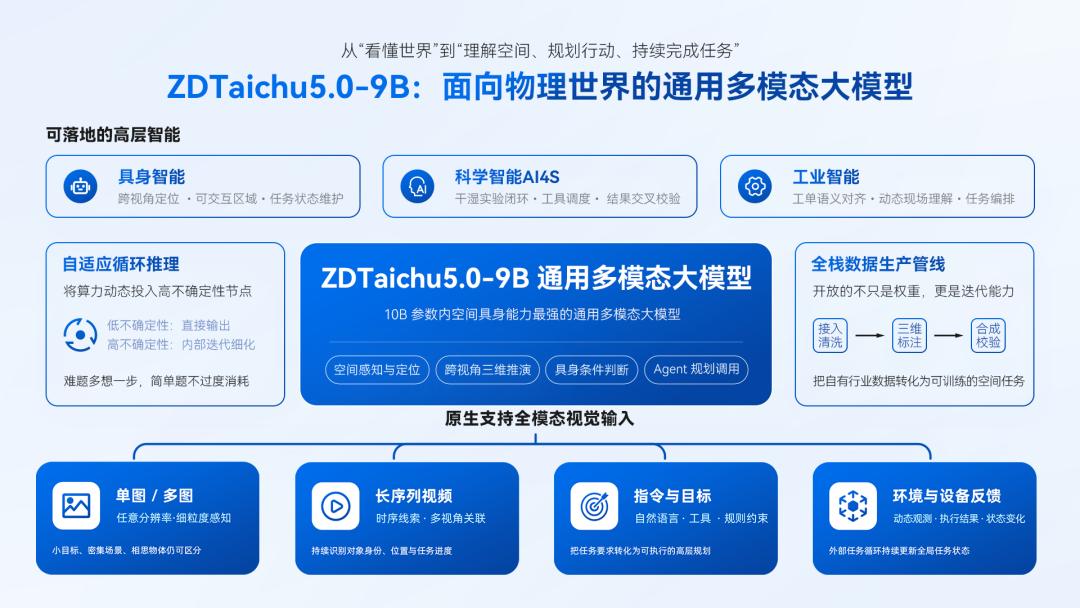
ZDTaichu: A Spatial Embodied Intelligence Player Grown from Native Multimodal Models
To understand this model, we first need to break a common misunderstanding: ZDTaichu5.0-9B is not a brand new project developed separately for hot topics, but a milestone in the evolution of ZDTaichu's long-term technical route.
This company, founded in 2024 and incubated by the Institute of Automation of the Chinese Academy of Sciences, as a national-level enterprise, aims to build an independent and controllable general artificial intelligence foundation for China.
Its technical route can be traced back to 2021: at that time, the Institute of Automation of the Chinese Academy of Sciences released "ZDTaichu", a trillion-parameter multimodal large model covering images, texts and audio, which enabled the unified representation of images, texts and speech in the same model. This layout predates the industry's multimodal boom.
The subsequent 2.0 version added video, sensor signals and 3D point cloud; the 4.0 version evolved from multimodal understanding to in-depth multimodal reasoning; for ZDTaichu5.0-9B, the capability focus is further placed on spatial perception, cross-view reasoning, task state maintenance and embodied condition judgment.
In other words, spatial embodied capability is a natural extension of ZDTaichu's native multimodal route.
This integrated technical route brings a key difference: while the spatial embodied reasoning capability is improved, general capabilities such as text and image understanding, OCR, visual mathematics, coding and Agent still remain at the first-tier level. This is crucial for the industry: in real industrial sites, it is necessary to not only clarify the position of objects and spatial relationships, but also understand work orders, identify instruments and comprehend experimental documents, so general capabilities and spatial capabilities must work at the same time.
According to the public horizontal evaluation results released by the team, among general multimodal large models at the 10B parameter level, ZDTaichu5.0-9B won the first place in the general group of 9 internationally authoritative spatial embodied understanding benchmark tests, making it the general multimodal model with the strongest spatial embodied capability at this parameter level. In the complex spatial reasoning task with the largest gap, the ViewSpatial score for cross-view positioning investigation reached 62.5, while the score of other comparable models in the same group was 48.2; on MindCube-tiny for 3D spatial deduction investigation, its score was 20.67 points higher than others.
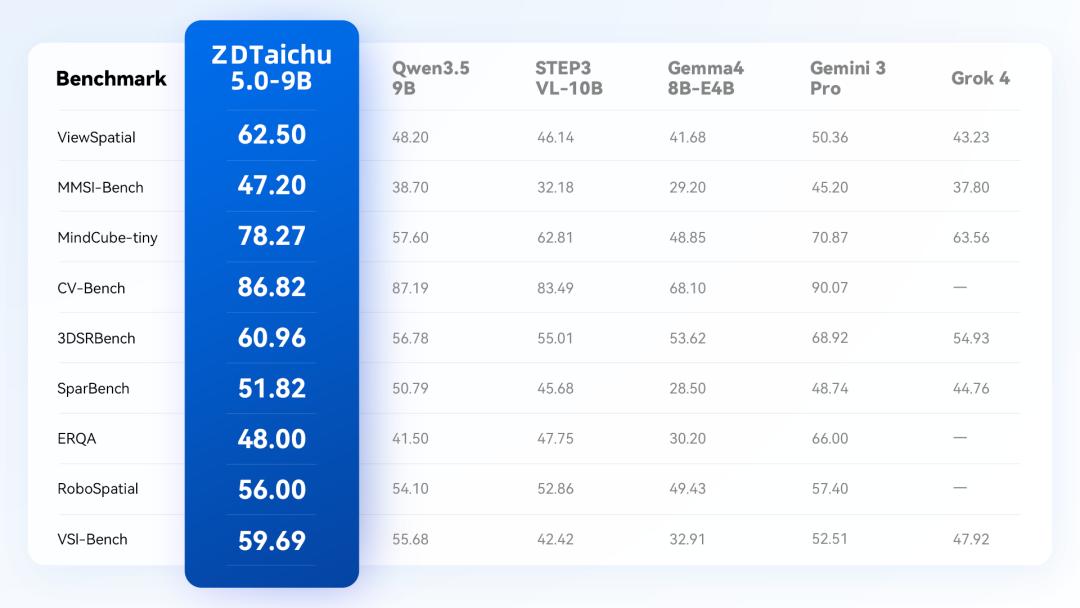
These results show that it does not obtain higher spatial benchmark scores by sacrificing general capabilities. Its self-developed adaptive cyclic reasoning mechanism will make the model evaluate the confidence of each step of output first, add several rounds of internal calculation for uncertain links such as spatial transformation, object relationship and operation conditions before outputting answers, tilt computing power to difficult problems, keep the average reasoning cost controllable, and be more suitable for industrial deployment.
Two Scarce Moats
Widening the Gap with Ordinary Open Source Models
The ranking list only reflects the performance of the model in specified tasks. Enterprises still need to solve two practical problems: how to continue training with their own data, and whether the model can work continuously after being deployed to devices. The ZDTaichu5.0-9B open source release covers both the data pipeline and physical task verification at the same time.
Moat 1: Not Only Open Source Weights, But Also Full Access to the Complete Data Production Pipeline
The vast majority of open source models on the market only release weights. The most common pitfall for enterprises after obtaining them is that they have accumulated a large amount of on-site factory videos, simulation data and experimental records, but do not know how to clean, label and construct these raw materials into high-quality spatial task samples, and finally cannot complete the fine-tuning and iteration with their own data.
The differentiation of ZDTaichu is that while opening the model weights, it also open sourced a set of verified spatial multimodal data production pipeline solutions: from data access and cleaning, spatial embodied capability labeling, to task trajectory construction and sample verification, which prepares data for fine-tuning and reinforcement learning.
If the weight is a factory-calibrated device, this pipeline is more like a complete process document attached to the device: after enterprises change workpieces, they can follow the process to prepare materials, proof and inspect again.
Its significance is not limited to delivering a basic model, but responds to the widespread pain point of the industry that "obtaining the model but being unable to iterate with own data", lowering the threshold for the whole industry to enter the spatial embodied intelligence field. ZDTaichu has also converted its years of accumulated data engineering experience into reusable development methods for the industry, which is a capability that ordinary open source models in the past can hardly provide.
Moat 2: Rejecting "Benchmark Score as the Endpoint", Completing Closed-Loop Verification in Physical Scenarios
The industry is often alert to "model companies that only brush benchmark scores". ZDTaichu's solution is not to stay in simulation tests, but to have promoted its capabilities to two high-value tracks of scientific research intelligence and intelligent manufacturing, and completed the verification of real physical tasks.
In scientific research scenarios, ZDTaichu5.0-9B has been connected to ZDTaichu's scientific research agent platform ScienceClaw for testing. This platform covers 8 disciplines, and has verified dry experiment and wet experiment tasks.
In dry experiments, researchers put forward a damped oscillator problem in natural language, ZDTaichu5.0-9B calls mathematics and programming tools in ScienceClaw to solve the problem, cross-compares the analytical solution and numerical solution, and then outputs an analysis report. In wet experiments, the model is brought to the experimental bench: in tasks such as placing test tubes on the rack in sequence and transferring liquid with droppers, the model needs to continuously track the position of objects and judge the task progress, which is a necessary capability for the upper-layer task scheduling of automated experimental platforms.
In manufacturing scenarios, the model has verified the connection between work orders and equipment capabilities: starting from work order instructions such as "place the basket on the red rack on the conveyor belt", it completes object recognition, spatial relationship understanding, high-level task planning, and confirms task completion based on execution feedback. In cooperation with an advanced manufacturing enterprise, the model reads process drawings and converts them into executable welding codes for robots, generates welding paths according to the real-time captured weld gap and misalignment, and currently supports 25 welding processes.
It can be seen that many models are still in laboratory simulation stage, while ZDTaichu has completed the full-link verification of "spatial embodied understanding and reasoning - embodied task planning - physical execution feedback".
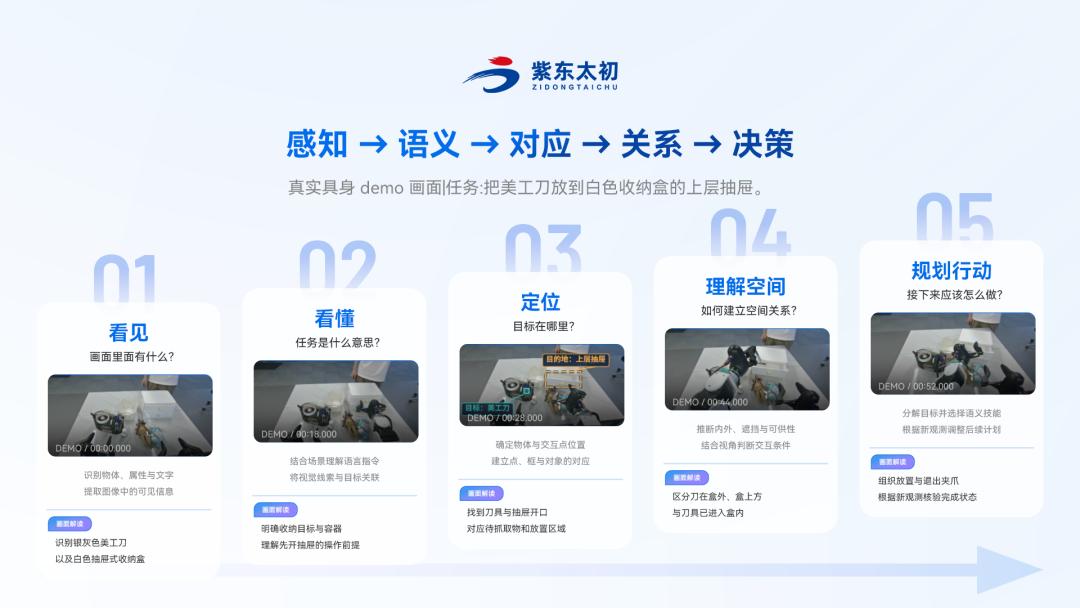
In terms of strategic choices, it does not engage in robot complete machine hardware, but adapts to more than 50 types of robot bodies through the "one brain, multiple forms" embodied intelligence platform: the model is responsible for high-level understanding and planning, and the underlying navigation, grasping, gripper control and safety logic are still handed over to mature systems, thus protecting the existing hardware and control investment of factories and lowering the threshold for production line transformation. This industrial position as a "foundation platform" also opens up greater imagination for its commercial space.
Standing on the Wave of Physical AI
Looking at ZDTaichu's Industrial Space
ZDTaichu5.0-9B is a phased presentation of ZDTaichu's "model - data - scenario" system.
The model layer provides a native multimodal foundation that takes into account both general capabilities and spatial embodied capabilities; the data layer solves the most difficult "data engineering" problem of Physical AI with self-developed data production pipeline; the scenario layer continuously verifies through scientific research, intelligent manufacturing and robotics, which in turn feeds back model iteration.
In the future, the robotics industry, flexible intelligent manufacturing and scientific research automation all need spatial embodied intelligence foundations, and the demand for domestic independent and controllable solutions is particularly strong. The 9B parameter level where ZDTaichu5.0-9B is located balances performance and deployment cost, is suitable for large-scale landing in privatized, end-side and industrial scenarios, and has a clear commercial implementation path.
Looking at the current AI competition, the competition of large models has gone through the stage of simply comparing parameter quantity and benchmark scores. In the Physical AI era, the real hard power depends on whether the model can go out of the laboratory and land in real factories and industrial scenarios. Many domestic players only occupy one link in the "model - data - scenario" chain, while ZDTaichu is one of the few domestic foundation enterprises that have run through the three links at the same time.
The value of ZDTaichu5.0-9B open source release has gone beyond a single open source model itself. What it shows to the industry is ZDTaichu's complete capability map of evolving from a native multimodal large model to spatial embodied intelligence. Relying on the technical source of the Institute of Automation of the Chinese Academy of Sciences, through the closed-loop layout of "model - data - scenario", ZDTaichu is providing a set of independent, controllable and implementable foundation solutions for China's Physical AI industry.
When the robotics, intelligent manufacturing and scientific research automation industries usher in an explosion, the value of the underlying foundation will continue to be released. Whether a test tube is accurately placed back on the rack, or a basket is safely placed on the conveyor belt - the final answer of spatial embodied intelligence will be confirmed in these specific real scenarios.