After DeepSeek Harness Goes Open Source: The Publicization of Execution Frameworks and the Engineering Boundary of Industrial Agents
On August 13, DeepSeek officially open-sourced its Agent execution framework DeepSeek Harness. This microkernel framework, built on the concept of "Model + Harness = Agent" and designed under the principle of "Everything is a Plugin", garnered nearly 100,000 GitHub Stars within two days of its public open beta, becoming one of the fastest-growing open-source projects in this field.
When the news came out, many market participants' first reaction was nervous: model manufacturers are getting directly involved in developing execution frameworks, will they drive all companies focused on Agent implementation out of the market? Our judgment is exactly the opposite — this is not the beginning of threats, but the beginning of validation, and even more the beginning of market expansion.
In the middle of this year, we systematically discussed in the article *The Harness Era: How Hai Zhi Technology Defines the "Steering Engineering" of AI* that the deciding factor for industrial-grade AI does not lie in the "horsepower" of the model, but in the "harness" that steers the model. The model is a wild horse, and the Harness is the reins. The model determines the upper limit of intelligence, while the Harness determines the bottom line for the stable operation of the system. Later in the article *Graph Engineering*, we further answered the question of "what the model should trust" — build a credible, inferable and evolvable knowledge base through graph engineering.
Nowadays, the top players who know the models best are directly engaged in developing the "harness" and choose to open source it. This means that the most core party in the industry has put a product and ecological verification from the model layer on this set of assertions. For Hai Zhi, this is a direction confirmation and an acceleration: it validates the path we chose two years ago. Hai Zhi did not start answering the question of "the layer beyond the model" today, but has long continued to invest in Harness engineering, ontology, graph-model integration and FDE. The open-sourced underlying chassis will not weaken these accumulations, but make their value more visible.
This article will be expanded from three aspects: what this open source confirms, what it cannot achieve, and how Hai Zhi builds an irreplaceable engineering layer on top of the standardized chassis.
01 Paradigm Establishment: When "the layer beyond the model" is endorsed by top players
The bounden duty of model manufacturers is to make models stronger. Why would they invest valuable resources in the execution framework beyond the model?
There is only one reasonable explanation: in the Agent era, "out-of-the-box availability" does not exist. To convert model capabilities into executable actions at the customer site — task planning, tool invocation, permission control, result verification, and secure operation — there must be an engineering layer to carry them. This framework is so important that model manufacturers cannot delegate it to others, and it is important enough to compete for ecological standards through open source.
This open source brings two confirmations:
First, Harness is confirmed as an independent value layer. "Agent = Model + Harness" has evolved from a consensus in the engineering circle to the product roadmap of top model manufacturers. In 2026, the AI engineering field is completing a paradigm shift from model competition to system competition. As the operating system of Agent, Harness undertakes core responsibilities such as state management, tool execution, feedback verification and security constraints, and converts the probabilistic reasoning of models into deterministic action sequences.
Industry data also confirms this judgment: the failure rate of Agent in production environments ranges from 70% to 95%, but 60% of failures are attributed to data quality, context gaps and lack of governance, rather than the model itself. In other words, what determines whether an Agent can be implemented is not how smart the model is, but how solid the engineering around the model is.
Second, Harness is confirmed as public infrastructure. What deserves special attention is not the release itself, but the action of "open source": DeepSeek Harness is built on the Cordis meta-framework, adopts a microkernel architecture, and runtime components operate in the form of isolated and mutually replaceable plugins. Functional units such as model adapters, tool registries, sandbox environments, session state processors, event dispatchers and user interfaces are all loaded as independent extensions, and the execution workflow can be replaced by updating the declarative configuration file. The design of microkernel plus full plugins shows that DeepSeek has no intention of making Harness a closed stack, but to make it the "chassis standard" in the Agent era.
Looking back at the history of the information industry, the open source of Linux did not eliminate system manufacturers, but turned the operating system from a competitive barrier into public infrastructure, pushing competition to upper-layer applications and in-depth industry scenarios. A similar "split" is taking place in the Agent technology stack: The execution infrastructure is transforming from a monolithic framework to a modular, decoupled architecture. After the chassis is standardized, value will not disappear, but will shift above the chassis — industry knowledge, trusted data, and result accountability will become the new pricing benchmarks.
02 Boundary Analysis: What problems Harness cannot solve
The most responsible assessment of a new technology is to clarify its boundaries.
DeepSeek Harness provides a set of high-quality general-purpose execution frameworks. However, from the perspective of the industry practice of Agent engineering in 2026, more than half of the items on the industrial AI implementation list have nothing to do with it — and these items are precisely the core bottlenecks for Agent to move from Demo to production systems.
First, industry knowledge will not come with the framework. Harness can ensure that the Agent "executes correctly", but cannot guarantee that "what is executed is the right thing". The temperature difference threshold between supply and return water for heating enterprises, the correlation of business items in government scenarios, and the quality attribution links in manufacturing enterprises — these knowledge stored in the minds of industry experts and deposited in customer accounts and systems cannot be preset by any general framework, and must be obtained through interviews one by one, modeled into ontologies, and precipitated into machine-inferable rules. The judgment of Professor Wang Haofen from Tongji University is worth quoting: The stronger the large model, the more important the ontology and knowledge graph become — they are exactly the "reins" that AI Agent needs. Large models perform correlation inference, while serious decisions require causal chains — which step leads to which step must be clear and traceable.
Second, the enterprise environment will not be simplified by the framework. Compliance requirements for data not leaving the domain, the IT status quo of a large number of heterogeneous systems, multi-level approval organizational processes, and accountability chains that must be auditable — under these constraints, Agent implementation is not "running a Demo", but a systematic project including data engineering, ontology modeling, permission governance, and on-site operation. In our practice, the development volume of cross-system data integration for a manufacturing customer once accounted for more than 60% of the total project, and this part of the work has nothing to do with models and frameworks, relying on people's understanding of enterprise systems.
Third, neutrality is a structural blind spot of model manufacturers. The Harness of model manufacturers is naturally designed and tuned around their own models. However, in the actual procurement list of enterprises, there is never only one model: information technology application innovation scenarios require domestic adaptation, cost-sensitive scenarios need to balance inference prices, and capability-sensitive scenarios need to learn from each other's strengths between different models. In 2026, multi-model routing has evolved from a high-end feature to the standard configuration of enterprise Agent platforms. The more Harnesses centered on a single model, the more vigorous the demand for multi-model neutral scheduling.
Fourth, the memory bottleneck of long-horizon tasks has not been solved by any general framework. A joint survey released by CMU, Yale and Amazon points out: "The harness is becoming the binding constraint" — the execution framework is becoming the bottleneck restricting Agent capabilities, rather than the underlying model. In the seven-level ETCLOVG classification method sorted out in this survey, the execution environment and sandbox layer already have 20 main projects, which is the most mature part of the infrastructure layer; while the context and memory management layer is almost the thinnest of the seven layers, with very few independently released components. Agent is moving from short tasks that run for a few minutes to long-term tasks that run for several hours, but the environment is destroyed after each task ends, and the next start starts from scratch — it can never accumulate experience. This problem cannot be solved by the general Harness itself.
Clarifying the boundaries will make the industrial division of labor clearer than ever before:
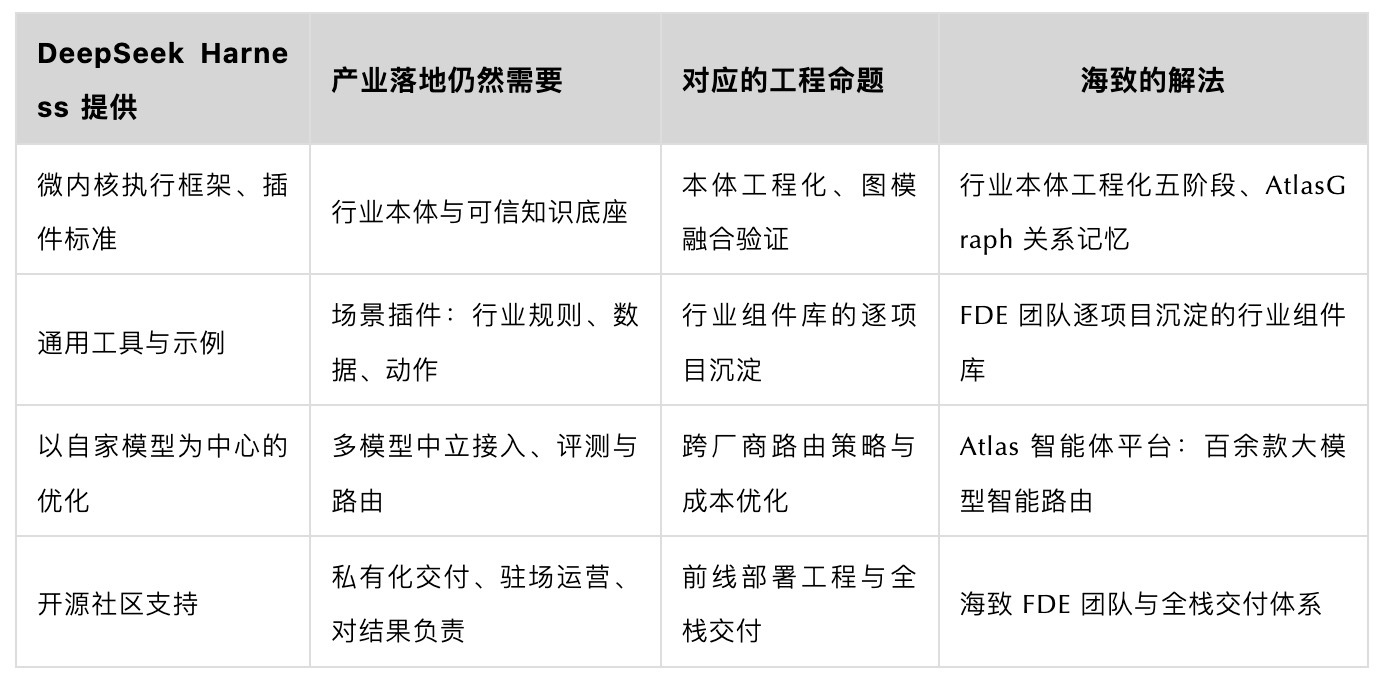
In a nutshell: DeepSeek has open-sourced the best chassis, but the work of driving the car to the customer's destination and coping with all road conditions along the way is still the business of professional transportation companies.
03 Where is the industry heading: Three technology trends
Understanding the boundaries of general Harness can help you see the technological evolution direction of industrial Agent.
Trend 1: From single Agent loop to multi-agent graphical orchestration. A single Agent does planning, execution and verification at the same time, the context will soon be overwhelmed, and the long task will start to "target drift" after running 10-15 steps. The answer given by the industry is to organize multiple full-time Agents into a directed state graph: one is responsible for disassembling tasks, one for research, one for writing code, one for running code, one for review, and then the orchestrator collects the results to decide the next step.
A controlled experiment in 2025 shows that the proportion of single Agent generating executable suggestions in the incident response task is 1.7%, while that of multi-agent orchestration is 100%. In 2026, the architectural momentum has clearly shifted to graphical orchestration, LangGraph 1.0 is officially GA, and OpenTelemetry has become the default link tracing format. The core primitives of graphical orchestration are clear: nodes (each node is an Agent running its own loop), edges (defining data flow and dependencies), typed states, checkpoints, interruptions and recovery.
Trend 2: The protocol layer converges, and competition shifts to the application layer. The MCP protocol completed its largest revision in history in July 2026 — shifting from a stateful bidirectional protocol to a request/response model, introducing a stateless core and a standardized extension framework. Anthropic then launched an advanced tool invocation suite to fill the gaps in the MCP in tool discovery, selection and assembly.
The protocol competition is basically over, the pattern of "MCP manages tools, A2A manages agents" has taken shape, and competition has shifted to the application layer and in-depth industry scenarios. This means that the higher the standardization of general tool invocation, the more prominent the differentiated value of industry rules, data constraints and business semantics.
Trend 3: Ontology evolves from "static map" to "dynamic navigation". The early ontology was a static map, showing who and what are in an organization. But in the Agent era, a map alone is not enough — it has to be navigable. The ontology needs to be connected with interfaces and various functions, to link the underlying services and processes, so that AI can follow them to complete tasks.
Snowflake has practiced ontology-aware reasoning schemes in Cortex Agents, combining industry standard ontologies with knowledge graphs and GraphRAG to bridge the modeling gap between relational data and domain semantics. In serious scenarios that require deterministic causal chains — anti-money laundering, quality attribution, and fault root cause analysis — the model-first approach can only provide correlation, while the ontology-first approach can trace causality.
04 Hai Zhi's Engineering Response
Under the above three trends, Hai Zhi's engineering path is clear.
The first dimension: Delivery leverage — the overall downward shift of FDE's cost curve
In 2026, the demand for FDE (Forward Deployed Engineer) positions increased by 729% year-on-year. AWS invested 1 billion US dollars to build an FDE team, and this model is being verified worldwide as the key path for Agent implementation. Hai Zhi is one of the earliest domestic teams to systematically implement the FDE model in China. The core leverage of FDE efficiency has never been manpower density, but engineering leverage: AI Coding increases the daily output per person from thousands of lines to tens of thousands of lines, and the standardized POC tool chain continuously shortens the pre-sales cycle.
After DeepSeek Harness is open-sourced, this leverage is further extended. In the past, we built Agent scaffolding for each project ourselves — task planning, tool invocation, result verification — now we have a high-quality open source chassis, and the focus of FDE's work has shifted from "building wheels" to "installing industry modules": ontology construction, rule base calibration, and scenario joint debugging.
Take the Beijing Heating Data Agent project we delivered as an example — the layered architecture of L0 total scheduler, L1 rule engine, and L2 data invocation agent can significantly reduce the engineering volume when reconstructed on the Harness standard chassis. The more standardized the chassis, the more valuable the industry modules; and the industry modules are exactly the family property that Hai Zhi has accumulated through one project after another.
The second dimension: System integration — the integration of Atlas Agent and open source framework
Atlas Agent is Hai Zhi's core platform for industrial-grade Agent, and it is also a product line that the company has publicly disclosed and achieved large-scale revenue: in the first half of 2026, revenue increased by 135.6% year-on-year, accounting for 38.8% of the company's total revenue. Its position in this change is worth explaining clearly from the technical architecture level.
First, the architectural concept of Atlas is naturally isomorphic with Harness. The orchestration layer encapsulates enterprise APIs, databases, and business systems into tools that can be invoked by Agent, manages complex task processes with state machines, and retains the final decision-making power of humans at key decision points; the control layer relies on industry ontology and graph-model integration technology to "eliminate AI hallucinations" — verifying whether the model output conforms to ontology facts through graph queries, and triggering forced re-inference when conflicts occur; the memory layer provides inferable relational memory through AtlasGraph. This three-tier system of "control-memory-orchestration" is exactly two implementations of the same proposition as the microkernel of DeepSeek Harness.
Second, neutral routing is the inherent position of Atlas. Atlas is compatible with more than 100 large models, and the Agent dynamically routes to the most suitable engine according to the task type, so that customers will not be locked by any single model. In fact, Atlas Agent is built based on open source large models such as DeepSeek and Tongyi Qianwen — DeepSeek has long been our first-class citizen, not a new competitor.
Third, our roadmap is therefore clearer: build the next generation of Hai Zhi's own Harness based on the framework and ideas of DeepSeek Harness. The chassis layer leverages the open source community — plugin mechanism, tool standards, and operating kernel, no longer develop in-house for reusable parts; the industry layer insists on independent development — ontology constraints, graph-model integration verification, industry plugins and component libraries, these are parts that open source frameworks cannot provide and customers are willing to pay for. At the same time, Hai Zhi's self-developed multi-model Agent engine will continue to serve as a neutral supplement: in scenarios where customers need cross-vendor evaluation, private protocol adaptation or deeply customized execution logic, it provides an elastic kernel under the Atlas platform. Running self-developed industry modules on an open source chassis is the most cost-effective approach in this open source wave.
The third dimension: Market expansion — the threshold shifts from the tool layer to the knowledge and responsibility layer
The open source of DeepSeek model has reduced the cost of enterprise-level inference by an order of magnitude, and the open source of DeepSeek Harness has reduced the engineering threshold of Agent by another order of magnitude. The direct consequence of the superposition of the two orders of magnitude is that a large number of government and enterprise customers who were originally waiting and seeing have started to set up projects in real terms this year.
Heating, government affairs, power grid, manufacturing — in the list of projects we delivered this year, the typical profile of new customers is exactly "first time using Agent, budget available, lacking a partner who can take responsibility for the results".
The expansion of the market will certainly attract more competitors, but the competition threshold is shifting in a direction favorable to Hai Zhi: when "building an Agent Demo" is accessible to everyone, customers' selection criteria will change from "can you demonstrate" to "do you understand my industry, dare you take responsibility for the results, and who will maintain it after mass production". The threshold has not disappeared, it has just moved from the tool layer to the knowledge and responsibility layer.
The tool layer is becoming a public good — general Harness standardizes capabilities such as task planning, tool invocation, permission control, and result verification. The knowledge and responsibility layer corresponds to industry ontology, rule base, graph-model integration verification, on-site delivery and long-term operation and maintenance capabilities. These capabilities cannot be obtained through a single open source release, and can only be precipitated in one project after another: transform the judgment of industry experts into inferable rules