Claude "leads" 26% of Anthropic's AI R&D, with 30,000 Agents running simultaneously: when AI starts to "build AI", the RSI routes of leading companies are diverging.
AI is increasingly deeply involved in the R&D of next-generation AI, and the speed may be faster than the outside world imagines.
On September 17 local time, Anthropic released a rare set of internal data, attempting to quantify to what extent AI has already participated in its own R&D.
The results show that as of August 2026, Claude has been able to "lead" about 26% of Anthropic's AI R&D work; more than 90% of AI R&D work has at least reached the "AI collaboration" level. On Anthropic's most widely used internal Agent platform, about 30,000 Agents are simultaneously carrying out research and engineering tasks.
What is even more notable is the speed of change. The chart released by Anthropic shows that in February this year, the proportion of model R&D tasks that Claude was able to complete at the "leading" level was less than 1%, and it rose to 26% half a year later. Anthropic directly linked this measurement system to RSI, which means that an AI system can eventually autonomously build its own successor.
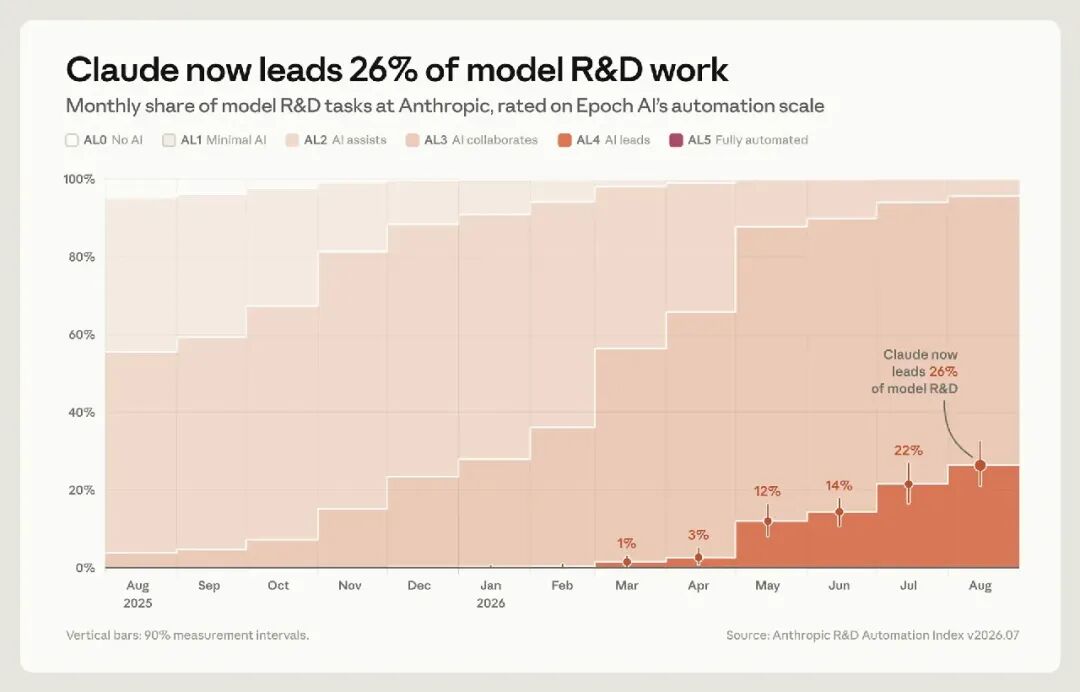
The term "leading" here requires special explanation. Anthropic has built an internal "R&D Automation Index". It adopts the six-level automation standard proposed by Epoch AI: measuring the degree of AI's involvement in a work from AL0 to AL5. Among them, AL3 is called "collaboration": AI can undertake large chunks of work under the close guidance of humans; AL4 is "leading": engineers only need to give a high-level goal, and AI can complete most of the end-to-end work of a task, with humans mainly responsible for supervision and final decision-making; the highest AL5 means fully autonomous operation without human intervention.
Therefore, "26%" does not mean that "26% of Anthropic's R&D has been completely unmanned", nor does it mean that "26% of researchers have been replaced by Claude". More accurately, it means that roughly a quarter of Anthropic's AI R&D has entered the stage of "humans set goals and supervise, and Claude completes most of the execution".
To obtain this figure, Anthropic first sampled employees from various departments participating in the model R&D cycle. Every week in July 2026, the company randomly selected 20% of employees in these departments, and the Claude Research Agent read their Slack and internal documents, finally sorting out about 15,000 fine-grained model R&D tasks. Then Claude organized these tasks into a task tree containing 542 nodes, of which there were 378 final leaf nodes, covering pre-training, reinforcement learning, evaluation platform fault diagnosis, RL sandbox network strategy, and inference service incident review. Anthropic then weighted the data according to the human time consumed by different tasks.
This method itself also has limitations. For example, the "referee" used to evaluate Claude's automation level is also Claude. Anthropic also arranged cross-validation by internal employees responsible for the corresponding work areas: the full consistency rate between model and human ratings is 59%, while the full consistency rate between different human evaluators is only 35%; the consistency rate reaches 97% when the difference between model and human ratings is no more than one level. However, Anthropic still acknowledges that there is a certain space for subjective judgment between "AI collaboration" and "AI leading".
In order to manage these 30,000 "AI employees" working at the same time, Anthropic has introduced two designs for internal Agents.
The first is independent identity. Each Agent has its own identity, and all data and behavior records are bound to this identity. Even if the underlying model is upgraded, the identity can still exist; the second is open communication, where Agents communicate through a shared messaging system instead of passing information privately. Each message is bound to the sender's identity and linked to the original materials, so other Agents can view, correct errors and collaborate. Anthropic also cross-correlates these messages with the complete operation trajectory of Agents, so that the monitoring system can track the collaborative behavior across Agents.
The reason for testing this data is that as cutting-edge AI labs increasingly use AI to build future AI models, Anthropic hopes to judge how far the world is from RSI through these indicators.
Anthropic Wants to Automate the Entire AI Lab
In June this year, Anthropic presented its evolution roadmap: from 2021 to 2023, humans were mainly responsible for writing code; from 2023 to 2025, Chatbots began to be used for assistance; from 2025 to 2026, it entered the Coding Agent stage; today, Autonomous Agents that can run code and delegate hours of work to other Agents have emerged. In the subsequent stage, Agents may be powerful enough to build and train models by themselves, allowing future versions of Claude to be continuously improved by Claude.
At that time, Anthropic said that "we have not reached that stage yet", and emphasized that RSI is not inevitable. What has actually happened is that several intermediate steps leading to this closed loop have begun to be engineered.
In May this year, Anthropic stated that more than 80% of the code merged into the official codebase that can be attributed to Claude; in the second quarter, the number of lines of code merged by a typical engineer per day was about 8 times that of 2024. However, Anthropic immediately reminded that the number of lines of code only measures quantity, not quality, so the "8 times" almost certainly overestimates the real productivity increase.
In a small model training optimization experiment with pre-set fixed goals and success criteria, Opus 4 could only accelerate the initial code by about 3 times on average last May, while Mythos Preview in April this year has reached about 52 times; Anthropic uses this example to illustrate that in research links with "clear goals and continuous experimentation", model capabilities are improving very rapidly.
Anthropic believes that the areas where humans still have obvious comparative advantages are research taste and judgment, that is, deciding what problems are worth studying, which results are credible, and when a route has reached a dead end.
Therefore, the data disclosed by Anthropic now can be regarded as an attempt to measure how much of the work in an AI lab that must be completed by humans is left.
Looking at the entire industry, Anthropic is not the only company that has begun to seriously answer this question.
OpenAI has set up a dedicated RSI team; Google DeepMind officially lists RSI as one of the potential paths from AGI to ASI; Recursive, which was just publicly unveiled this year and co-founded by Tian Yuandong and others, directly wrote "Recursive self-evolving superintelligence: automating knowledge discovery" on its official homepage.
Although the goals are the same, several companies are not actually taking exactly the same path.
OpenAI is Scaling "AI Researcher"
The routes of OpenAI and Anthropic are very similar, but their focuses are not exactly the same. OpenAI's current goal is very clear: to build an automated AI researcher.
In September this year, OpenAI stated that the company has reached the previously set goal of automating "AI research interns". The so-called AI research intern refers to a system that can complete well-defined research tasks under human guidance, including work that used to take skilled researchers several days to complete. OpenAI's next stage goal is to further move towards automated AI researchers by March 2028.
This change has already begun to be reflected in the internal workload. Before June this year, the total running time of Agents in OpenAI's research organization was less than the human workload; by mid-August, if converted on the basis of 8 working hours per day, for every 1 day that humans work, AI Agents will run in parallel for about 24.8 hours. More and more researchers are also starting multiple Agents at the same time. However, OpenAI's own data also shows that high-level planning currently only accounts for a very small part of the Agent's output Tokens.
OpenAI also emphasized that it is still humans who set research priorities, judge which ideas and results are worth pursuing, and decide whether a system should be scaled, paused or deployed. This is similar to the situation of Anthropic.
At present, OpenAI is still pushing forward. OpenAI's official RSI team spans research, engineering, product and infrastructure. Its official description is to build AI systems that can "accelerate and eventually carry out high-quality OpenAI research", and its evaluation capabilities include research judgment, hypothesis generation and verification, and long-cycle experiment execution.
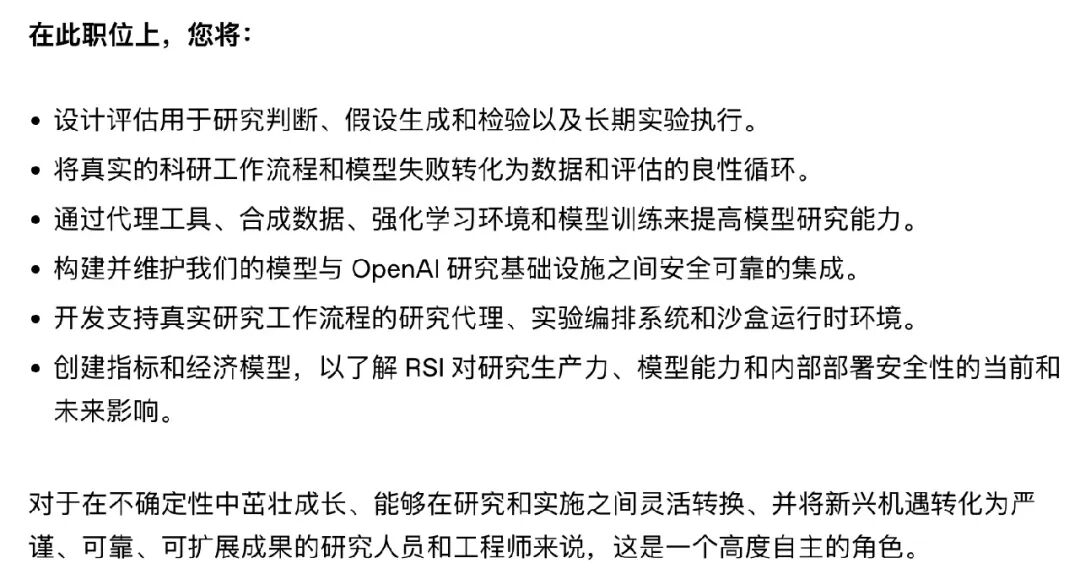
OpenAI's job recruitment information
This shows that OpenAI does not require the first step to be "GPT directly opens its own weights to modify itself". As long as AI can undertake more and more real model R&D activities, AI research capabilities may become a production resource that can be expanded through inference computing power.
Jakub Pachocki, Chief Scientist of OpenAI, stated in his recent article "An Alien Mind" that if AI continues to progress, the deep involvement of machine intelligence in its own R&D is the natural result of long-term technological progress, and he calls automated AI research a more radical "expanding intelligence through computing power". OpenAI also clearly stated that it is further directing research towards RSI.
However, Pachocki emphasized that the above judgment does not mean that the entire research community should now significantly accelerate deep learning research. On the contrary, it is necessary to "consciously choose how to move forward". He also said that no lab has yet achieved proper alignment and monitoring to ensure long-term maximum-speed scaling.
OpenAI also stated that it currently does not know how to safely achieve "aligned full recursive self-improvement". If the risks cannot be fully controlled, it will consider slowing down or stopping the development or deployment of related systems.
Therefore, OpenAI is currently scaling up AI researchers while studying how fast RSI should continue.
Compared with OpenAI's scaling of AI researchers, Anthropic is more inclined to scale an increasingly Agent-based virtual lab: how much coding still requires humans, how many experiments still require humans, how much research collaboration still requires humans, and finally whether the judgment of "what to research" will gradually be mastered by Claude.
Google is Optimizing "How to Find Answers"
In contrast, Google has recently shown another route on RSI that is more focused on "search and discovery mechanism": not only letting AI find better answers, but also starting to let it improve "the method of finding answers".
On September 2, when Google released the Gemini 3.8 series of models, it disclosed a previously rarely publicized detail of model R&D. Google said that in addition to sharing the same set of basic intelligence, the models also leverage long-running Agent loops to further accelerate R&D, and these loops are designed for "recursively evaluating and improving the underlying models".
This does not mean that Gemini 3.8 is already able to autonomously train the next generation of Gemini. Google has not yet disclosed which specific links in the model training, data, evaluation or post-training processes these Agent loops have participated in, and how much R&D work has been automated. However, this at least shows that Agents are no longer just used to write code or optimize peripheral infrastructure, but have begun to enter the iterative process of underlying models.
Less than two weeks later, this route took another step forward.
On September 14, a research team from Google, Google DeepMind, the University of Maryland and the University of Virginia published the paper "Dream-RSI: Recursive Self-Improvement through Evolving Worlds", trying to solve another problem in automated AI research: if AI can already continuously propose candidate solutions, can it further learn "how to explore more effectively"?
In the past, a large number of automatic discovery systems including AlphaEvolve have been able to let models generate candidate algorithms, then run, score and filter them through Evaluator, so that better candidate solutions enter the next round of search. But what Dream-RSI focuses on is not a specific answer, but the exploration policy that controls the entire discovery process.
In this framework, the Agent first conducts real exploration according to the current policy, generating a "Discovery Tree" that records different attempts, branches and results. These histories are reorganized into a reusable Replay Simulator. The system can then test a large number of different exploration policies in this historical simulator, such as which branch to continue next, when to open a new route, how many tasks should be parallelized, and when to stop the search.
Since the execution results of these branches have already been generated in previous real experiments, the system can compare different policies at low cost without re-invoking the underlying Agent, re-running the code and Evaluator. The filtered new policy is then put into real tasks to generate new exploration history; the new history is added to the simulator to continue to support the next round of policy improvement.
The whole process therefore forms: real exploration → accumulating history → constructing Replay Simulator → improving exploration policy → re-conducting real exploration → obtaining more history. The research team calls it the RSI loop closed on the meta-exploration layer.
It is worth noting that in the experiment, the Coding Agent, Evaluator and execution interface are all kept fixed, and what really changes is the exploration policy at the upper layer that determines "where the computing power should be invested". That is to say, the model itself does not necessarily need to become stronger immediately, and the same Agent can also obtain better discovery efficiency by improving research and exploration methods.
This also echoes Google's judgment on the bottleneck of AI scientific research this year. In July this year, several researchers from Google DeepMind proposed that as the cost of Agents generating hypotheses and candidate solutions drops rapidly, scientific research may face a new "verification bottleneck": ideas will become cheaper and cheaper, but confirming that an idea is truly valid is still expensive and slow. Especially in fields such as life sciences, the speed of real experiments will not increase synchronously with the model's generation capability.
Whether AlphaEvolve relies on an automatic Evaluator or Dream-RSI uses verified real execution results to construct a Replay Simulator, Google's route has an obvious feature: exploration can become more and more automated and even start self-improving, but verification is always the anchor of the entire loop.
In addition, in June this year, in the article "From AGI to ASI", Google DeepMind did not write RSI as the only path for AGI to reach superintelligence, but listed four possible paths: continuing to scale existing AGI, the emergence of new AI paradigms, RSI, and the emergence of ASI from large-scale multi-agent clusters. DeepMind also emphasized that each path may encounter different frictions and bottlenecks.
This means that in Google's framework, it is not necessary for a monolithic system of "Gemini trains the next generation of Gemini by itself" to emerge in the future. It is also possible that models, Agents, search algorithms, evaluators and tools together form a scientific research system with capabilities far exceeding that of a single model.
Recursive is More Radical: Make Research Itself "Recursive"
Compared with the three giants, Recursive, co-founded by Tian Yuandong, has taken "RSI" as the company's core goal from the very beginning.
The company first focuses on AI science itself, that is, "building AI that can optimize AI", and then extends this method to other scientific fields. Recursive judges that what is really important is not just letting AI complete more existing research tasks, but establishing an open mechanism that can continuously generate new discoveries and allow new discoveries to continue to drive subsequent innovation.
This has an obvious difference from the traditional "automated scientific research Agent". An ordinary scientific research Agent can accept a goal, then write code, run experiments, analyze results, and give answers; Recursive cares more about whether the knowledge obtained from this round of experiments can truly enter the next round of research and change the subsequent exploration methods.
It believes that the recursive idea will lead to a logical conclusion: the fastest path to superintelligence will be realized by AI that can recursively self-improve; and this process relies on open algorithms to continuously generate endless innovation. The company uses biological evolution and cultural evolution as analogies: every valuable discovery enters an ever-expanding "archive", and subsequent innovations continue to build on previous achievements instead of starting from scratch every time.
In June this year, Recursive first announced the early results of its automated AI research system. It has been able to complete the closed loop of "proposing ideas - implementing - running experiments - verifying results - selecting the next experiment based on results" around a clear goal, while running multiple long-term research threads in parallel, retaining the valid context of past experiments, merging promising research branches, and checking reward hacking and experimental variance before confirming performance improvement as real progress. Recursive defines this as the first step towards automated AI research, not that RSI has been completed.