Seeking Great Gains With Small Stakes: The Ambition of an AI4S Underwater Company
Written by Hu Xiangyun
Edited by Hai Ruojing
In May this year, 28-year-old Zaixi Zhang finished his postdoctoral research at Princeton University and returned to China. Multiple opportunities opened up for him at the same time: a faculty position at a US university, chief scientist at a top AI company, and an annual salary of tens of millions of yuan. In the end, he chose to join the Hong Kong University of Science and Technology as an assistant professor, and stepped into the narrow gate of entrepreneurship by founding the AI for Science company Scinetics.
Exclusive from Waves: Scinetics has recently completed a financing of nearly 50 million RMB. This round of financing is led by Inno Venture Capital, with Yijing Capital, Xiaomiao Langcheng, and Linge Venture Capital participating as follow-on investors.
This is one of the few crossroads in his life so far. From the University of Science and Technology of China's Youth Class, direct doctoral program, to joint training at Harvard Medical School, and then working as a postdoctoral researcher in Mengdi Wang's team at Princeton University, the young PI engaged in AI4S research is one of the most sought-after entrepreneur profiles in the current venture capital market.
But he also struggled a lot when making the decision to start a business.
Joining a large company means sufficient computing power, data and talent allocation; becoming a university PI and starting a business means you have to find people, funds and resources relatively independently, with uncertainties in both technology and business.
What finally made Zaixi Zhang make up his mind was "work autonomy". He wanted to lead his own research direction instead of being constrained by a large corporate organization, and he preferred the process of building a whole system from scratch.
Before starting his business, Zaixi Zhang and his team developed the scientific agent Stella. After Stella was launched last year, it served thousands of scientific research users, more than 70% of whom came from top universities and laboratories such as Stanford and Princeton. Compared with self-training foundational models, agents are faster to implement, easier to integrate into existing R&D processes, and can achieve commercialization more quickly.
However, this lightweight path still has limitations at present. Using large language models as the reasoning engine, when scientific agents encounter data such as protein structures and nucleic acid sequences, they first translate the problems into "natural language", and then hand over the text instructions to the model for execution. The fine 3D structure and modal relationships will be "lost" in several translation conversions, and even dozens of interactions of the agent cannot avoid errors.
During his doctoral period, Zaixi Zhang developed the molecular screening model MGSSL, the drug molecule generation model FLAG, etc., which reached SOTA in multiple segmented fields. But he judged that single-point capability is not enough, and the AI4S industry will move towards multi-modality collectively in the future. Therefore, the core of Scinetics is to build a multi-modal long-horizon reasoning foundational model.
He proposed the concept of "Science Token", hoping to convert scientific data such as small molecules, nucleic acids and protein structures into a unified representation unit of the model, without going through the translation of human language, so that the model can reason in the native scientific modality and complete scientific tasks.
In the short term, they will focus on life science which has the clearest commercialization path, and gradually expand to scientific fields such as materials and engineering in the future.
Talking about the future, Zaixi Zhang believes that AI4S will definitely usher in its GPT moment and Coding moment, and this is a market that may surpass Coding; he also believes that his small team has the strength to develop a "unified" scientific foundational model, and become a foundational model company in the AI4S sector that is comparable to DeepSeek and Anthropic.
In the early stage of the technological revolution, the technical paths have not converged, so entrepreneurs have the opportunity to "leverage small resources to gain big advantages". Recently, we talked with Zaixi Zhang about what kind of future he is betting on by starting his AI4S business at this moment?
Dialogue (edited):
AI4S, a Trillion-dollar Market Comparable to Coding
Waves: In 2019, when you were 21 years old, you chose AI for Science as your doctoral research direction, which seems very prescient in hindsight. How do you feel about the track turning from unpopular to hot?
Zaixi Zhang: I am really lucky that my career transformation just caught the industry trend.
When I was pursuing my doctorate, this was a non-consensus track. The industry's cognition back then was "Science+AI", where AI was an additional algorithm tool to improve business efficiency. Projects had to be deeply bound to specific drug pipelines, for example, focusing on peptide drugs, or only building vertical protein models.
Now AI4S is evolving towards the general direction, and the market generally believes that this track will usher in its own "Coding moment". Coding gives humans the ability to create things in the digital world; AI4S is transforming humans' underlying ability to explore science and discover new knowledge, and its market value can be comparable to or even surpass that of Coding.
From the iteration of AlphaFold from version 1 to 4, we can clearly see that AI capabilities are rapidly improving. The scientific problems to be studied have not changed dramatically, but new algorithms make the tasks that were difficult to model and predict in the past solvable. The inclusion of more scientific modalities further enhances the model's capabilities.
Waves: Science covers a very wide range of directions. What are the mainstream technical paths for venture capital in this track now? Is there a trend of convergence on technical routes?
Zaixi Zhang: Objectively speaking, there is a lot of noise in the AI4S track at this stage. AI4S practitioners are mainly making layouts based on their past backgrounds, and there is no consensus on technical routes yet, so it is difficult to judge which is better.
The first type is scientific agents, which mainly complete scientific tasks by calling external tools. Their advantages are fast implementation, rapid integration into existing R&D processes, and short commercial verification cycles, so many startups have emerged in this direction.
Large technology companies are also working on it, such as Anthropic's Claude Science and OpenAI's GPT-Rosalind. However, their main battlefield is still more general directions such as Coding, and the scientific direction is just a placeholder layout for tentative exploration.
The second type is virtual cells. Influenced by related work and papers from the Arc Institute, virtual cells have become extremely popular since last year. Theoretically, it simulates the changes of cells after being exposed to drugs and gene editing in the computer, which can eliminate batches of invalid candidates in advance, and compress R&D time and costs. The industry has high expectations for it, and it is developing relatively fast.
The third type is the AI4S foundational model direction we chose. This is a "bottom-up" route, focusing on underlying molecular interactions, and deriving upper-level phenomena such as diseases and gene regulatory networks from molecular mechanisms.
Waves: Last year you launched the scientific agent Stella, which is said to have received good feedback. Why didn't you choose this lighter route?
Zaixi Zhang: After Stella was launched last year, it served thousands of scientific research users, more than 70% of whom came from top universities and laboratories such as Stanford and Princeton. Professor Feng Zhang from MIT also used it.
But we found that the scientific agent paradigm has a fundamental problem:
It essentially translates scientific problems into natural language for the model to understand, and then translates them back into structural instructions for tools to execute. A lot of fine 3D structure information and subtle correlations between different modalities will be lost during the translation process.
This is the ceiling of the paradigm itself. You can certainly keep adding tools and processes to the agent framework, but as long as the underlying reasoning is still based on text, this bottleneck will always exist.
Waves: Can you give an example of a task that agents cannot accomplish?
Zaixi Zhang: For example, local protein structure optimization. To rotate a certain side chain by 5 degrees to a specific angle to form hydrogen bonds or other molecular interactions, it highly relies on fine reasoning and design in 3D space.
If you use an agent to do this, you need to let the large language model output text instructions, and then call a structure diffusion model such as RF diffusion to execute. But the structure model itself cannot well understand text information, the output of the tool has to be converted into strings and screenshots and then fed back to the large language model. The agent is confused about the result, it seems right but not quite, and can only keep iterating.
For this step, we tried many agents and interacted dozens of times repeatedly, wasting a lot of Tokens, but got a bunch of unusable results. The root cause is the lack of native scientific modality reasoning capability.
Big Dream of a Prodigy: Multi-modal Scientific Foundational Model
Waves: So you think it is necessary to develop AI4S foundational models? Can a foundational model solve the "cross-modal translation" problem?
Zaixi Zhang: Since translation will cause loss, we just skip the translation step, and let the model directly perform long-horizon reasoning (Chain of Science Tokens) for multi-modal scientific data in the native scientific modality space. This foundational model is also the core product of our company.
We have developed a discrete Tokenization scheme for various scientific modalities such as omics, protein structures, molecular chemical formulas, and nucleic acid sequences, converting all kinds of scientific information into unified Science Tokens and inputting them into the model, without relying on human natural language as an abstract transfer station, which is closer to the essence of science.
The model training is divided into three stages: pre-training, mid-training, and post-training. Pre-training establishes multi-modal life science representations, mid-training learns the cross-layer rules from sequences to structures, functions and cellular phenotypes, and post-training focuses on enhancing long-horizon reasoning capabilities.
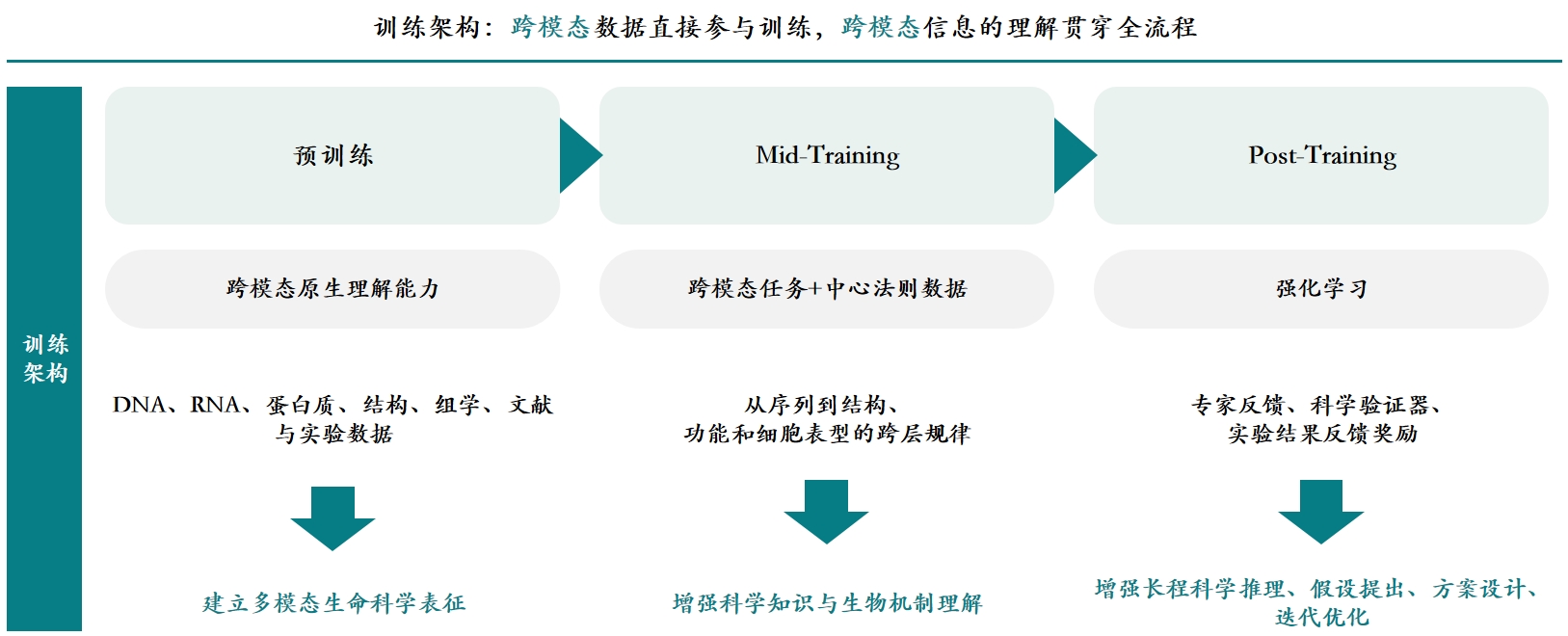
AI4S Foundational Model Training Framework (Source: Scinetics)
Waves: What is the difference between this kind of long-horizon reasoning and the previous small vertical models that solve single-point tasks?
Zaixi Zhang: For example, for enzyme design, we no longer get the result in one step, but reason step by step like a human scientist: first build the active center of the enzyme, which is the core region that determines the catalytic function; then build the protein scaffold to support the active center; finally supplement the side chains and fine-tune the details.
This long-chain reasoning capability is not possessed by traditional vertical models and tool-calling agents.
Waves: Converting all kinds of scientific information into a "unified" Science Token sounds very attractive, but the data structures of small molecules, nucleic acids, proteins and other substances are very different. Why can your team do this?
Zaixi Zhang: The first problem that Science Token needs to solve is to let the model understand different scientific modalities.
In the past, we have developed corresponding foundational models for small molecules, nucleic acids, proteins, complexes and cross-modal texts respectively. We have gone through the whole process from data collection, model construction to training. Therefore, the team knows how to encode each type of scientific data and how to align different modalities.
At the same time, when developing agents such as Stella and BioClaw, we have accumulated a large amount of long-chain reasoning data, and explored methods to enhance reasoning capabilities through post-training.
In addition, the dry-wet closed loop is also very important. In addition to the computing and algorithm modules, Stella is also connected to automated wet experiments. We have run through dry-wet closed loop cases in tasks such as target discovery, antibody optimization, and small nucleic acid design. Therefore, we also know how AI should connect to real scientific research tasks and automated experimental equipment.
The evolution of the model requires a large amount of high-quality data actively. The closed loop of dry and wet experiments can support us to continuously obtain training data and iterate continuously.
Waves: Judging from the current exploration results, what is the capability of this foundational model?
Zaixi Zhang: It has achieved good results in individual tasks such as protein structure prediction, protein function annotation, RNA secondary structure prediction, and DNA mutation prediction.
We are not very surprised by this result. After all, the scientific system itself is a complex multi-modal system. If all multi-modal information can be incorporated into the model and design search is carried out from a global perspective, it is naturally easier to get a better solution.
At present, we are exploring the next-generation model training methods, for example, trying AI for AI and recursive training paradigms to explore the inherent laws of science, expand more modalities, or increase the number of model parameters, so as to strengthen the long-horizon scientific reasoning capability. We expect to realize the ChatGPT moment of AI4S foundational models along this direction.
Taking Science Token as the Business Model
Waves: From the perspective of pricing and commercialization, will Science Token bring a new business model?
Zaixi Zhang: Yes. However, the pricing logic of Science Token is different from that of text Token. The pricing of text Token mainly refers to computing power and electricity cost, but Science Token not only considers these basic costs, but also measures the scientific value behind it. In some fields, such as small nucleic acids, data is very scarce, so the corresponding Token value is naturally higher, and the pricing should reflect the actual business value.
We hope to become a foundational model company in the AI4S sector that is comparable to DeepSeek and Anthropic, and explore a business model that uses Science Token as the billing unit.
Waves: For the billing based on Science Token, who are the ideal buyers and what scenarios are they specifically used in?
Zaixi Zhang: For example, pharmaceutical companies. When the model capability is strong enough, we don't need to put a lot of effort into BD to bind a single pipeline for delivery. We can take on all kinds of tasks for antibody pipelines, peptide pipelines, small nucleic acid pipelines, and so on.
At this time, the billing unit can be based on "how many Science Tokens are consumed to solve this drug design problem". Just like Coding, we don't price by the number of code lines or modules. Customers trust the model's capabilities, call the service directly, and pay according to the number of Tokens consumed. This can save a lot of BD case negotiation work.
Waves: If this model can be realized, will it also become a common commercialization path for AI4S foundational model enterprises?
Zaixi Zhang: Science Token is still a unique concept we proposed; as for the standards for measuring the quality of long-chain scientific reasoning data and its billing standards, there are no mature solutions in the whole industry. When we communicated with some large AI companies, they didn't think this through either. So it is still a very early business idea, which requires the joint promotion of the industry to reach a consensus.
Waves: From the perspective of the primary market, we can see that many investment institutions and funds are pouring into this track, but the current financing volume of this direction is far less than that of large models and embodied intelligence. Where do you think the differences lie?
Zaixi Zhang: There are two extreme mindsets in the market, both of which may lead to hesitation in investment decisions.
Some investors recognize the trillion-dollar AI4S market, believe in the equality of AI-enabled science, and hope that everyone can release their imagination to participate in scientific exploration. Their doubt is whether the current technical capability can make this happen. Others think the AI4S market is relatively small, with only university teachers, students and PIs as customers who have weak payment capacity.
In the past, the market had a clear understanding of vertical models, but investors have stricter evaluation criteria for the "unified" scientific foundational model. Because they think that the combination of Harness and small vertical models is enough to meet scientific research needs. From the user side, although many researchers are looking forward to a more intelligent foundational model, they are used to calling specialized tool models due to inertial thinking, which is also a contradiction.
Waves: What kind of investment institutions are more willing to bet on AI4S foundational models?
Zaixi Zhang: Some market-oriented funds that invest in technology, and some investors who have in-depth experience in the pharmaceutical field. They understand the "historical technical debt" in the existing R&D system, which is just like "shit mountain code": pharmaceutical companies have integrated hundreds of small models internally, and information transmission in each link has loss, leading to extremely high maintenance costs.
Therefore, from the logic of system engineering, they judge that AI