Seres' separation leaves car owners distraught, Xiaomi's orders surge by 635%: Should Huawei build cars on its own?
On September 15, a highly dramatic contrast unfolded in the automotive industry.
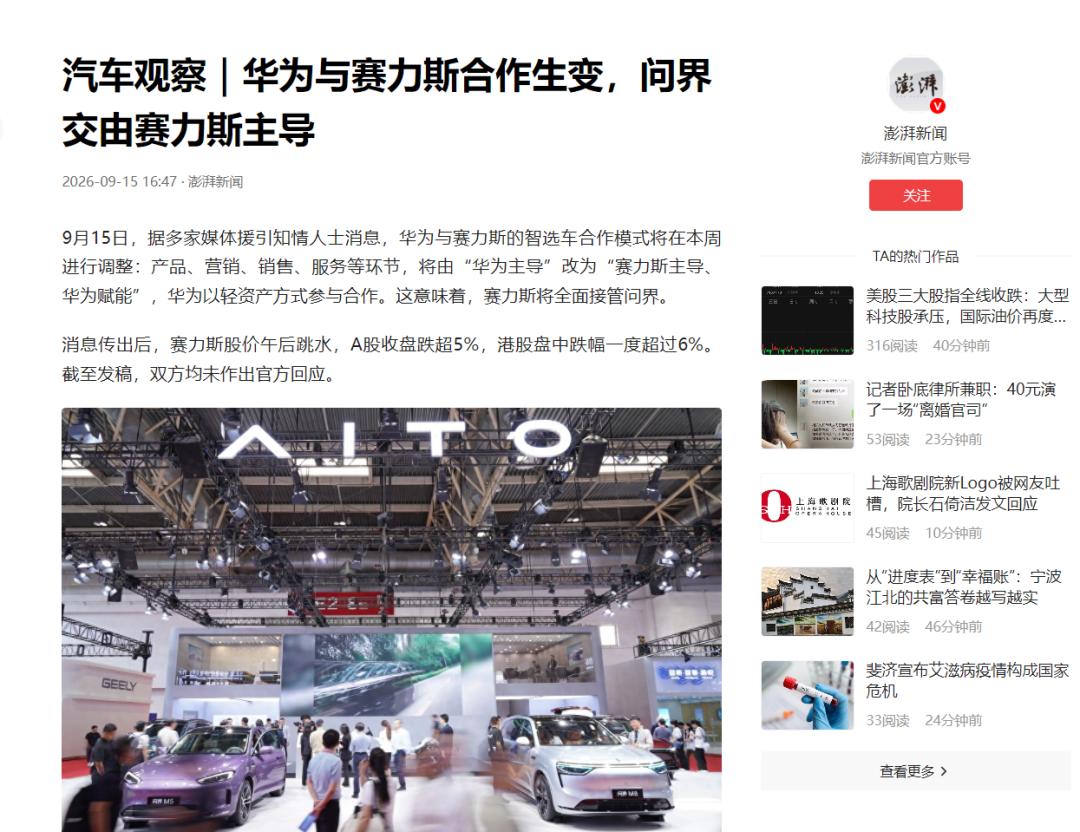
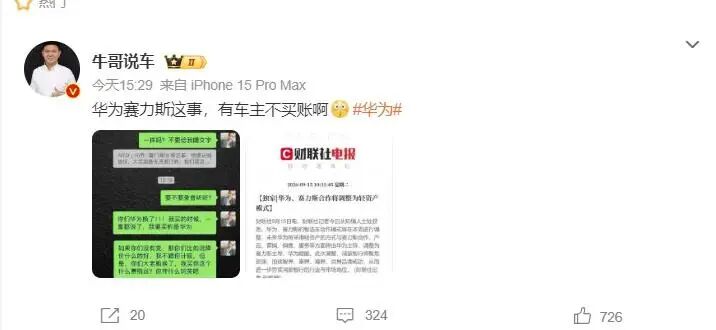
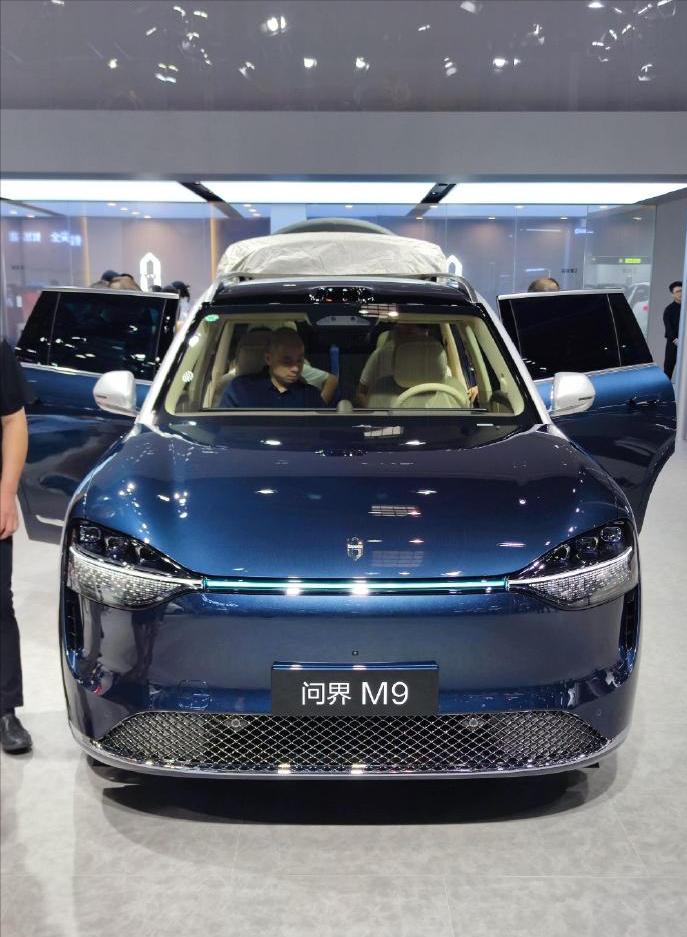
On one hand, Huawei and Seres officially announced the adjustment of their cooperation model, returning the control of product, marketing, channels and services to Seres, which saw its stock price drop by 5% that day. Coupled with the delayed delivery of AITO M9, car owners were extremely frustrated, the topic "Who should I trust when buying an AITO car" directly hit the top trending search, and it was rumored that some owners wanted to cancel their orders out of anger.
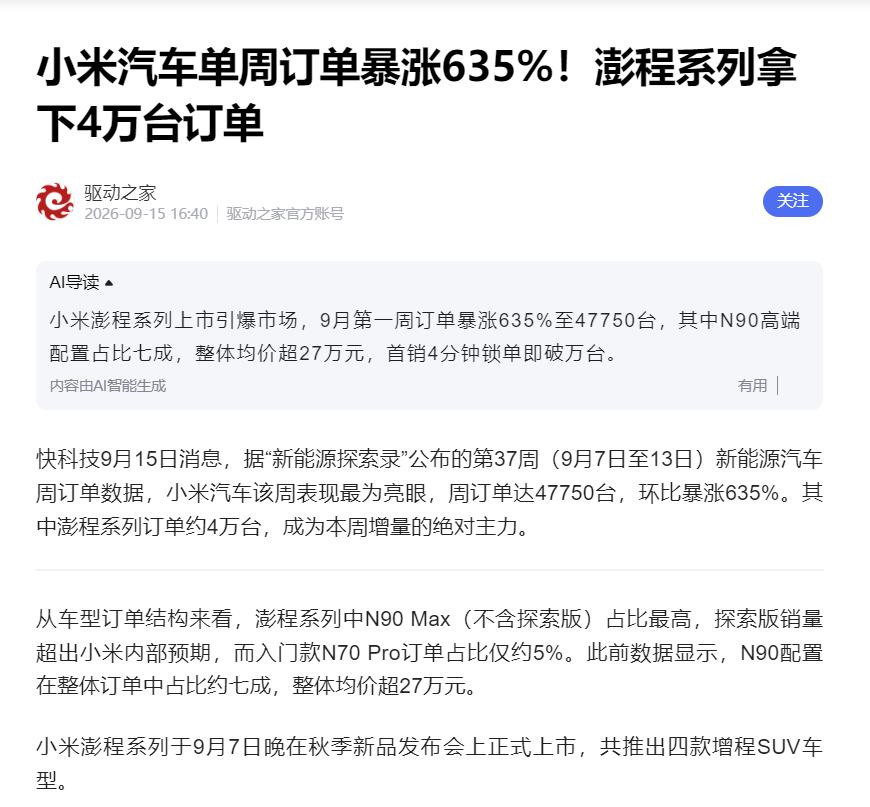
On the other hand, Xiaomi's new extended-range SUV Pengcheng was launched on September 7, with over 10,000 orders locked in 4 minutes. In the 37th week, the single-week orders reached 47750 units, surging by 635% month-on-month, among which Pengcheng contributed about 40,000 units. Lei Jun even went to Xuzhou in person to hand over the keys to the first batch of car owners.
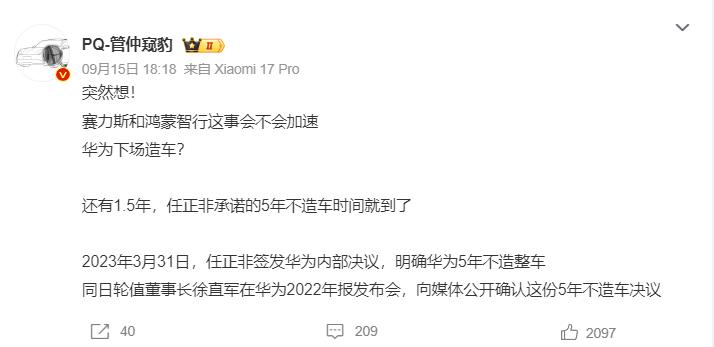
At this moment, the old topic of "Should Huawei make cars itself" was brought up again and became a trending search on Weibo. Some industry insiders said whether the incident between Seres and Harmony Intelligent Mobility would accelerate Huawei's entry into the car manufacturing business? There is only 1.5 years left before the 5-year no-car-manufacturing commitment made by Ren Zhengfei expires.
Many people think that Xiaomi, which manufactures cars on its own, is extremely successful, while Huawei, which helps others build cars, is in a complete mess. If Huawei had entered the car manufacturing business earlier, there would not have been all these disputes today.
But in fact, Ren Zhengfei once talked about Huawei's no-car-manufacturing policy, and the option of self-manufacturing cars basically does not exist. Now Huawei's board of directors has also come forward to reaffirm its commitment to not making cars. Behind Huawei's repeated emphasis on not manufacturing cars, it is not about the time limit, but about its business model.
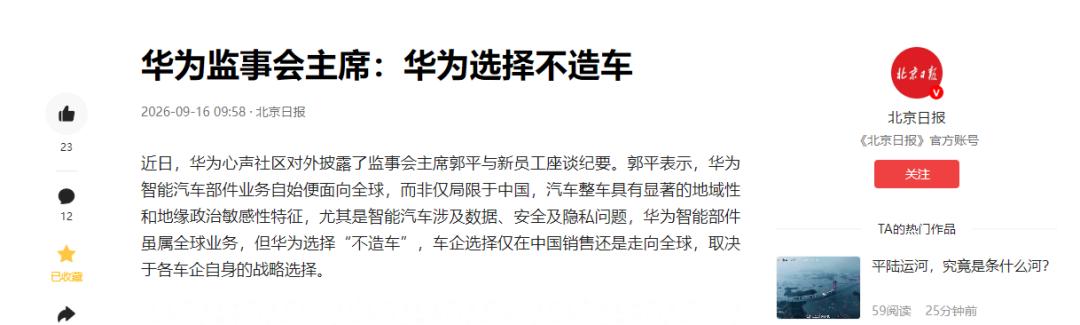
Here comes the question: Should Huawei enter the car manufacturing business in person?
To be fair, if Huawei really makes cars on its own, it does have its advantages.
Manufacturing cars on its own means full control over branding, products, channels, delivery and after-sales services, with highly unified rights and responsibilities, there will be no trust gap where "when there is a problem with the car, consumers do not know whether to turn to Huawei or Seres".
The root of the anxiety of "Who should I trust when buying an AITO car" this time is the blurred rights and responsibilities — users think they are buying a Huawei car, but the legal manufacturer has always been Seres.
If it manufactures cars on its own, all the profits belong to itself, no need to share with partners; the decision-making chain is short, the rhythm is controlled by itself, and there is no need to repeatedly game with cooperation partners.
Xiaomi is the most vivid example: self-research, self-production, self-sales, it takes full responsibility for the production capacity when orders surge, it has delivered 800,000 units in 29 months, and the brand mindshare belongs to itself 100%, which is clean and efficient.
Judging only from this perspective, Huawei really seems to enter the car manufacturing business. But business decisions cannot only see the benefits of gaining profits, but ignore the pain of facing risks.
There are three unavoidable barriers behind Huawei's no-car-manufacturing policy
The first is capital, the money-devouring attribute of heavy asset manufacturing industry.
Car manufacturing is heavy asset, long cycle and low gross profit. A high-end production line costs tens of billions, the R&D of a new car costs billions, and the payback period often starts from ten years. Apple burned a lot of money and finally terminated its car project, how many years have domestic new car manufacturers developed? They still have not achieved stable profitability so far.
According to the data from Cui Dongshu, the automotive industry sees revenue growth but no profit growth, with the net profit margin falling to 1%! While the net profit margin of upstream battery enterprises has risen to 9%.
Therefore, instead of doing heavy work, it is better to do empowerment, only hold the core technology and core business in hand, this business is actually more profitable than complete vehicle manufacturing.
What is Huawei's situation? It has just been sanctioned, its main businesses including chips, computing power, AI, cloud all require massive investment, these are the areas that determine its survival and development in the next ten years.
The goal of Huawei's automotive business is to become the NVIDIA and Bosch in the field of intelligent vehicles — as a shovel seller, there is no need to go down the mine to mine in person, and compete head-on with established players such as BYD and Geely that have been engaged in this industry for decades.
The second barrier is that once Huawei manufactures cars, it will become the enemy of the entire industry overnight.
Huawei is now following the route of "Bosch in the era of intelligent vehicles", selling its Qiankun intelligent driving system and HarmonyOS cockpit to dozens of car companies, and the number of cooperative models is expected to reach 80 to 90 in 2026. This is a huge "one-to-many" business: Huawei provides technology, and all parties achieve win-win results. The more partners it has, the deeper its moat is.
Huawei is now a key supplier and an enabler that provides selling points for car companies, precisely because it has officially announced that it will not manufacture cars. It is known that in 2026, Huawei's Intelligent Automotive Solution is expected to achieve a net profit of 20 billion yuan, which is just the beginning.
However, if it manufactures complete vehicles on its own, the nature of the business will change. Chery, BAIC, JAC, Changan will all turn from "customers" to "competitors" overnight. Who dares to hand over their core intelligent driving and cockpit business to an opponent that will compete for the market tomorrow?
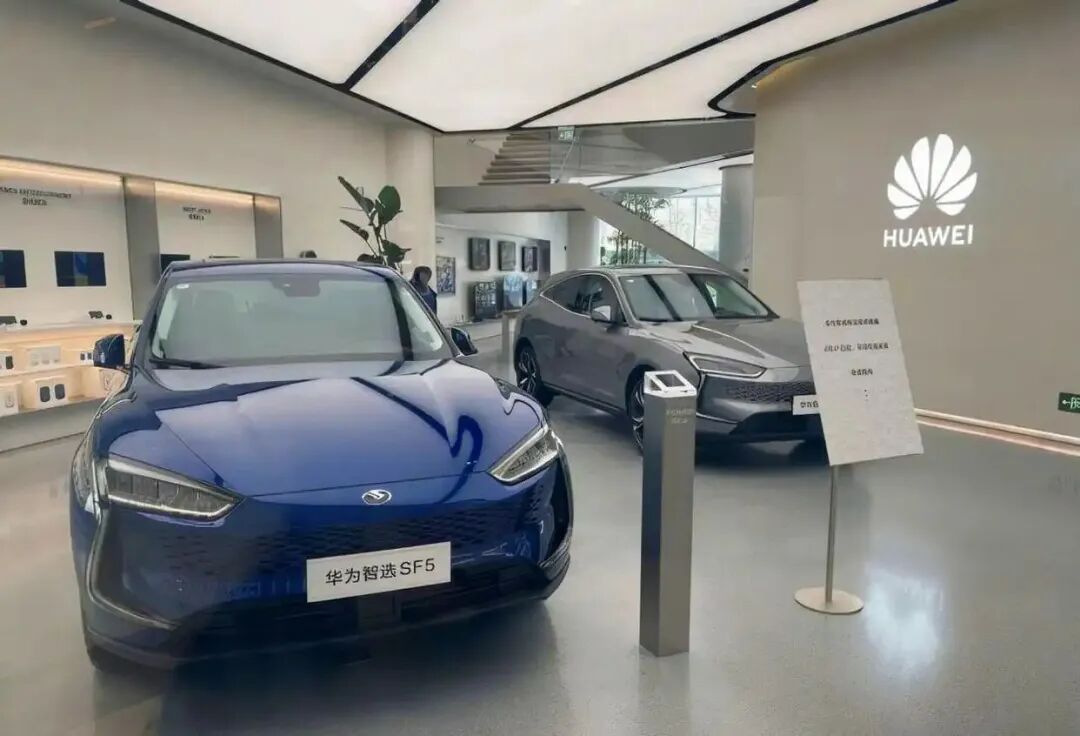
Therefore, entering the car manufacturing business will blow up its own customer pool, which covers almost most of China's automotive industry: BAIC, Changan, Chery, Dongfeng, SAIC, GAC, Seres and so on, and there are also many joint ventures in its cockpit business.
At that time, Huawei will win one brand, but lose its entire partner ecosystem, turning from "the supplier of the whole industry" to "the public enemy of the whole industry".
After understanding this point, you will know that returning the operating right of AITO to Seres this time, from another perspective, is to show other partners: I will not compete for your business, I only sell technology.
The third barrier is geopolitics. Complete vehicles have extremely strong data security and regional attributes, and Huawei's brand has long been under special "supervision" overseas. By selling auto parts, it can sell products to car companies all over the world and make profits quietly; by building a complete vehicle brand, the doors of many markets will be directly closed to it.
Xiaomi and Huawei take different paths
In the mobile phone sector, Xiaomi and Huawei have always been the two brands that the industry used to compare, but in the automotive sector, the paths they take are completely different.
After the growth of the mobile phone business hits the ceiling, Xiaomi must go all in on the automotive business as its second growth curve. For Lei Jun, car manufacturing is a do-or-die battle, he has no baggage and can bet all his reputation on it.
Huawei, however, has several cash cow businesses including chips, communications, computing power, cloud and terminals. For Huawei, the automotive business is an "empowerment track", not its "only lifeline".
One is the charge of entrepreneurs who have no way back, the other is the ecological layout of a platform company. Their optimal solutions are naturally different. It is actually prescribing the wrong medicine to ask Huawei to follow Xiaomi's development path.
In any case, this turmoil has indeed exposed the real problems of the Huawei Smart Selection model.
In the past few years, Huawei has been deeply involved in product definition, marketing and channels, and consumers have long defaulted to the idea that "AITO is a Huawei car", but there is a misalignment between brand mindshare and actual rights and responsibilities.
This misalignment is a bonus in a favorable environment, but once the model is adjusted or the delivery goes wrong, it will break out into a trust crisis intensively.
Therefore, the correct direction should not be "Huawei manufactures cars on its own", but to straighten out the blurred relationship: technology empowerment belongs to Huawei, and complete vehicle operation belongs to cooperative car companies, so that consumers can clearly understand the positioning of each party.
In the short term, the stock price drops, car owners are panicked, and Seres needs to make up for the lessons of brand building and service improvement; but in the long run, Huawei's Smart Selection model must go through this stage. As for delayed delivery and frequent configuration changes, these are basic operation skills, which have nothing to do with who manufactures the cars, and must be improved by the team itself.
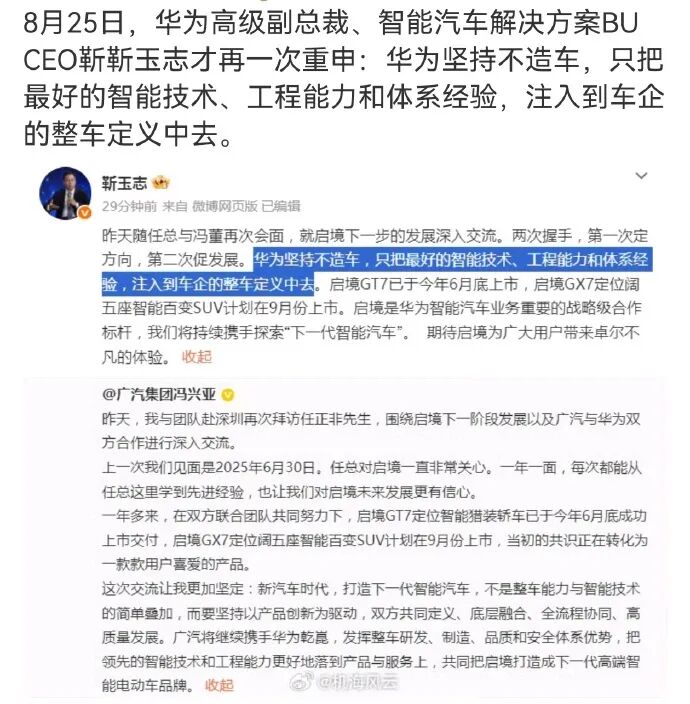
To sum up the analysis, the benefits of self-manufacturing cars are unified branding, exclusive profits, and the same success as Xiaomi; but the cost is very high: heavy asset capital consumption, becoming the enemy of the entire industry, and being restricted by geopolitical factors.
What Huawei wants to do is obviously not to become the next BYD or Xiaomi, but to become the "Bosch plus NVIDIA in the era of intelligent vehicles" that all car companies cannot avoid.
AITO is more like a test field. After the technology is verified and the model is demonstrated, Huawei returns the field to the farmers, and goes back to sell more advanced agricultural tools. This business is much larger than planting a piece of land by itself.
At the card table of intelligent vehicles, Huawei chooses the position of the dealer. And the dealer usually stays at the card table much longer than the players who play the game themselves.
This article is from the WeChat Official Account "Hotspot Microcomment" (ID: redianweiping), the author is Wang Xinxi, and 36Kr publishes it with authorization.