Hotels are starting to compete fiercely on "single-room renovation", with no bottom line for prices?
This article is from the WeChat official account "Space Secrets Investigator", author: Wang Xiaoxiong, published with authorization from 36Kr.
Renovation starting from 3000 yuan and completed in 13 days. Recently, Bona and Yibai Hotel Group under Yue Group have successively launched their competitive "killer moves". Nowadays, mid-tier hotel groups are collectively stepping into this market that was once defined by top-tier groups, with increasingly complete brand matrices and increasingly solid supply and design capabilities.
Behind the booming market, sharp questions also arise: Will the money saved in the thousand-yuan renovation turn into rework costs in the future? Where is the red line between the extremely low cost and the guest experience? What is the payback period for high-cost stock renovation? Among the various price ranges, it is increasingly difficult for property owners to calculate the cost clearly...
Entering the "Thousand-Yuan Era", single-room renovation has become more "involutional"
Recently, hotel groups are talking about "single-room renovation" more and more frequently.
In September, Yue Group launched a series of property owner interviews to reveal the renovation cost to the market through real cases. In the first episode, Yue Group talked with the investor of a Bona Hotel in Ili, mentioning that the single-room renovation cost of this store is about 26,000 yuan, and the renovation cycle is about 40 days; after the renovation, the occupancy rate of rooms per night increased by 15%-20%.
It is not difficult to see that whether it is new construction or existing hotel renovation, the core consideration of property owners always focuses on the balance between input and return - how much to invest per room, how long the construction and renovation cycle is, and what the operating data is, are the key basis for decision-making.
So when we look at more market cases, we will find that the "sense of tension" about cost has become one of the consensuses of hotel groups.
Also in September, Yibai Hotel Group completed the layout of 2000 stores across the country, and released the latest announcement of single-room renovation cost, which is basically less than 80,000 yuan per room. The single-room investment of the mid-range new project of Tuke Urban under the group has been reduced to 79,800 yuan (including public areas), and the light renovation single-room investment of 100 Inn has even been reduced to 10,000 yuan.
Beman Hotel under Dossen also released the latest price for conventional renovation, which is about 30,000-50,000 yuan per room. This price is applicable to properties that realize renewal by reusing existing facilities, partial renovation, and replacing some facilities, and some of its optimized renovation cases are around 29,000 yuan per room.
Earlier, when Space Secrets Investigator explored Yizhi Hotel under Meihao, it also focused on showing the cases of existing stock renovation. Among them, the light renovation cost per room of the Xi'an Datang Never Sleeps City project was compressed to 6,000 yuan per room, and some people joked that it is "cheaper than buying furniture when moving".
If Hanting under Huazhu opened the "30,000-yuan era" of hotel single-room renovation, now the light renovation of single rooms of some hotel groups has moved towards the "thousand-yuan era".
This "sense of tension" at the cost level does not come out of nowhere. According to Stock Era: Reconstruction of Hotel Property Asset Value Empowerment released by an authoritative hotel consulting group, nearly 732,000 hotel rooms will enter the 15-year renovation cycle node in the next three years.
If we quantify the concept of 732,000 rooms by the number of urban hotel rooms, it is equivalent to renovating all the existing hotel rooms in Beijing and there is still surplus; the absolute growth in number also indicates that this is not a dispensable market, but a cake that is being fiercely contested by all groups.
Returning from the macro status quo to the industry perspective, we can't help but ask: Why can Beman, Yizhi and other hotels generally compress the single-room renovation cost to between 40,000 and 60,000 yuan? From which aspects do brands generally reduce costs? Why do they all publicize extremely low costs and extremely high cost performance?
And what the market is most concerned about is, how can hotel groups maintain quality when the single-room renovation cost falls below the thousand-yuan threshold?
From 100,000 yuan down to 3000 yuan, there are "tricks" in hotel stock renovation
It is certainly good to help investors reduce costs, increase efficiency and save funds. But today's existing hotel renovation is still in a "black box", and the industry has never established a universal set of technical language and evaluation standards.
To put it bluntly, different parties have different statements about what to renovate, how much to spend, and how long it takes to get the payback, and countless investors bear the cost of this information gap with real money.
/ Single-room renovation is still in the "black box era"
Some investors revealed to Space Secrets Investigator that the cost of standardized renovation for joining a mid-range or mid-to-high-end hotel is usually 80,000 to 100,000 yuan per room, which is a ten-million-level investment calculated based on 100 rooms (including public areas); for most hotel owners who want to join a chain hotel from an independent hotel, this is not a small sum.
At the same time, the average industry investment return cycle has been extended to 5.4 years. After investing this sum of money, it is still an unknown whether they can earn it back.
So for many investors, renovation has become like a gamble.
Some investors' hotels are located in the core area of the city, near subway stations, business districts and government affairs areas, but their choice of hotel brands and control over the renovation degree fail to meet market expectations, wasting the location dividend in vain.
Some investors encountered "cosmetic renovation": only hanging a new sign, painting a few walls, and replacing a set of bedding, but the core pain points of the original hotel such as spatial pattern, sound insulation, lighting, and bathroom have not been truly solved. In the end, they only have the name of a chain on OTA platforms, but the guest experience has not been improved.
Some owners are attracted by the extremely low single-room renovation cost, thinking that they can join a large chain brand at low cost, but ignore the renovation requirements of public areas, and finally have to invest more funds to meet the acceptance standards of the brand party.
Various difficulties of investors are forcing this "black box" to open. What they want is no longer just "renovation + brand replacement", but repositioning, function reconstruction, and operation model reconstruction, which upgrades the requirements for the depth, accuracy and system of renovation.
Therefore, Space Secrets Investigator believes that it is necessary for the hotel industry to make single-room renovation more transparent and clearer.
/ Multi-brand and multi-gradient, to create differentiated renovation solutions
Take Rezen, a domestic mid-tier private hotel group as an example. Its brands involving existing stock renovation mainly include Rezen Cloudwide, Rezen Kaiman, Gray Whale Hotel, Rezen Langyu and so on. The price range formed by the single-room cost of these brands is quite wide, covering almost all ranges from economy to mid-to-high end.
The lowest price is Gray Whale Hotel. This brand, which focuses on mid-to-high-end intelligence and light renovation routes, has a stock renovation cost as low as 10,000 yuan per room. It adopts the light renovation model of "small investment, large return", and digitally renovates old hotels by combining elements such as intelligence, movies and e-sports, with few parts to be modified, so the cost is naturally low.
The mid-range price is occupied by Rezen Cloudfi and Rezen Cloudfi International. The former is positioned as a mid-range business hotel, while the latter targets the mid-to-high-end business market, with the maximum stock renovation cost reaching 30,000 yuan per room and 60,000 yuan per room respectively.
It is worth noting that Rezen Cloudfi adopts the strategy of "thousand stores with thousand faces", which deliberately controls the investment in public areas and unnecessary configurations during renovation, which also explains why its lower price limit can be compressed to the thousand-yuan level in some cases.
Turning our attention to Elong Hotel Technology, which is also in the mid-tier position, it is well known in the industry for its complete stock renovation matrix.
For existing hotel renovation, Elong has launched three major stock renewal expert brands: Meilihao Hotel, Yizhi Hotel and Yixuan Hotel, and Elong Anyun Hotel also provides stock renovation solutions.
Among them, the main promoted Meilihao Hotel is positioned as a mid-to-high-end stock renewal brand, targeting mid-to-high-end existing hotels, high-star hotels and resort projects, with the renewal slogan "Old Place, New Story".
Its price system is divided into three grades according to the renovation depth: light renovation is about 15,000-20,000 yuan per room, medium renovation is about 20,000-40,000 yuan per room, and heavy renovation reaches about 50,000 yuan per room.
The mid-range market is undertaken by Elong Anyun Hotel. It targets mid-range independent existing hotels, and provides three levels of renovation solutions: "Smart Achievement", "Smart Beauty" and "Smart Win", with the single-room cost ranging from 3000 yuan to 30,000 yuan.
/ Seize segmentation, pursue speed, and create refined stock renovation solutions
If we look further down the market, in the segmented track of small-room-volume existing stock renovation, the brands under Shangmei have attracted close attention once launched.
The core brands under Shangmei Digital Intelligence for existing hotel renovation are mainly Thank You and Junyi. Different brands have different single-room costs according to the renovation degree and property conditions.
Take Junyi as an example. This light-standard hotel brand is suitable for existing old hotel renovation and light decoration renovation, especially for old and small properties with about 60 rooms; its selling points are short renovation cycle and extremely low cost, with the single-room cost of about 20,000-30,000 yuan, focusing on minimal renovation and extremely fast opening.
For property owners whose properties are in good condition and only want to change the sign and facade, this is almost one of the lowest "entry tickets" in the current market.
The core brands under Yue Group for existing hotel rebranding and light renovation are mainly Bona Hotel and Bona S Hotel. The huge cost gap between the two brands can be regarded as a sample in the industry.
Bona Hotel is positioned as mid-range, focusing on light renovation and modular upgrading, with an extremely short renovation cycle, the fastest even only 13 days.
Its single-room cost is surprisingly low, about 3000 yuan per room, but this price corresponds to minimal renovation. Due to different renovation contents or urban differences in some stores, the actual single-room cost is about 26,000-30,000 yuan per room.
As part of the Bona system, Bona S Hotel, which is positioned as mid-to-high end, follows a completely different logic. It targets high-quality non-standard hotels in cities, carries out systematic renovation from partial space functions, linen colors to service awareness, and controls the single-room cost within 100,000 yuan.
Finally, let's look at Dossen Group. Its mid-range stock renovation brand Beman Hotel has a very interesting strategy, which turns renovation into a precise package similar to "medical aesthetic" style, and property owners can choose according to their needs just like ordering dishes.
Specifically, the entry-level light renovation package is priced at 10,000 yuan per room, which mainly covers basic items such as brand sign, door lock, intelligent equipment, and lobby soft decoration; the fast return medium renovation package does not exceed 30,000 yuan per room, adding public area and guest room lamp replacement, partial hardware and soft decoration upgrade on the basis of light renovation; the replica-level medium renovation package is within 50,000 yuan per room, which is a comprehensive renovation, even replacing toilets, bed back panels, wooden floors, and sanitary wares.
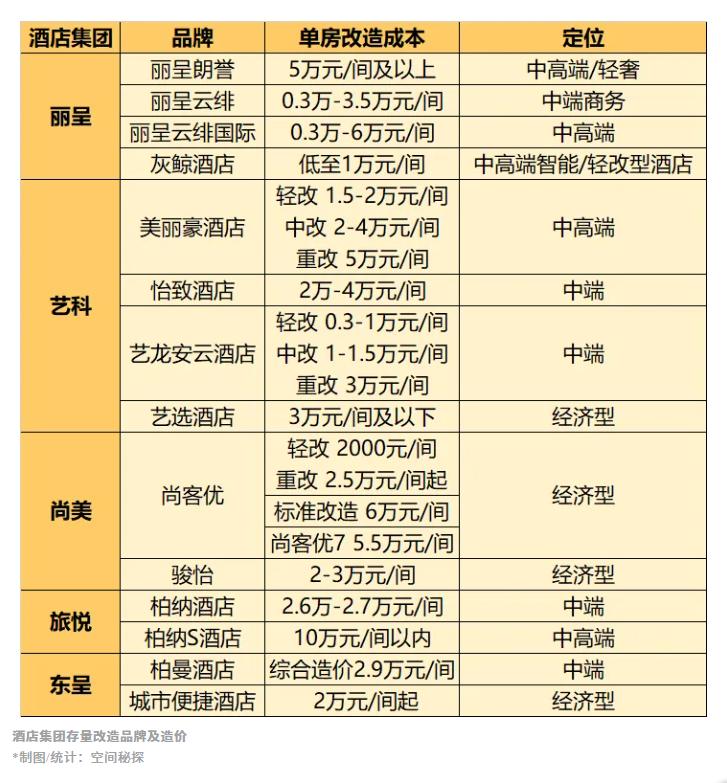
After sorting out all cases, it is not difficult to find that existing stock renovation is no longer a one-size-fits-all business.
From the extremely simple rebranding of 3000 yuan to the systematic renewal of nearly 100,000 yuan, the renovation solutions of different groups, different brands and different grades actually correspond to completely different property conditions and investment return expectations.
For property owners, the real task is not to find the "cheapest" solution, but to figure out their own property foundation, target customer group and cash flow status, and then choose the right solution. After all, every penny invested in renovation will eventually be recovered through room rate and occupancy rate.
There are 3 mainstream renovation grades, and mid-tier hotel groups have become new "catfish" in the market
In the previous part, we sorted out the stock renovation price systems of major hotel groups, but the numbers on paper are only references. For a real store, what effect each budget can achieve and what bottom lines cannot be touched no matter how much money is spent, are the things that property owners care most about.
So when we break down the renovation targets, standards and cases written in the stock renovation tender documents of major hotel groups, the current existing stock renovation brands on the market are mainly divided into three grades.
/ Grade 20,000 yuan and below:
Partial renewal, large-scale reuse of existing facilities, the rigid demand of economy hotels
The core positioning of this grade is no large-scale demolition and reconstruction, no modification to the structure and water and electricity. It is most suitable for those existing economy hotels with intact foundation but outdated decoration.
There are indeed many old hotels that have been operating for many years with stable customer sources, and their score decline only comes from visual problems such as yellowed walls and worn furniture, without any hardware defects.
The core logic of the 20,000-yuan grade is to retain the original high-quality hard decoration, and only replace the old parts that affect the appearance and score.
The content that can be implemented at this price is mainly concentrated in four sections: for the wall, if the original wall is intact, wall panels or wall cloth can be directly pasted to cover old stains and scratches; there is no need to break the original floor tiles, SPC flooring can be paved on the original floor tiles, with extremely short construction period and almost no construction waste; for soft decoration and furniture, optimization is the main method, pasting color changing film on old furniture, replacing broken accessories, and then replacing curtains, lamps and decorative paintings, the appearance will be completely renewed immediately; for the bathroom, surface renovation is carried out, replacing all sanitary wares, hardware shower heads and faucets, so that the bathroom looks almost newly renovated without breaking tiles.
What kind of stores are suitable for this grade? Properties with intact structure, no hidden dangers in water and electricity, no water leakage in the bathroom, only outdated decoration and old appearance, the goal is to upgrade at low cost, stabilize the occupancy rate, improve the platform score, and do not pursue high-end premium.
But what this price cannot achieve is also clear: wall demolition and room pattern adjustment are not included in the construction scope, the overall replacement and rectification of all water and electricity pipelines in the whole house are not within the service scope, and the sound insulation reinforcement of guest rooms and the installation of full set of intelligent guest control systems are not included.
/ Grade 30,000-60,000 yuan:
Moderate renovation, the mainstream choice for economy hotels to upgrade to mid-range
The budget doubles, coming to the second grade with a single-room cost of about 40,000 yuan.
The positioning of this grade is to break through the surface renewal, solve hardware shortcomings in a targeted manner, and achieve a balance between appearance, experience and practicality.
A hotel industry practitioner told Space Secrets Investigator that the 40,000-yuan single-room budget is the golden range for existing hotel renovation at present, and the vast majority of hotels that want to upgrade and raise room rates should spend their renovation costs in this range.
Why is it the golden range? Because it is exactly at the intersection of two key goals: the investment will not be so high that the payback period is dragged too long