HYROX Apologizes: How Did the "Most Beloved Event Among the Middle Class" Come to This Point?
Text by He Zhexin
Edited by Qiao Qian
Imagine that you have stuck to gym training every day for four or five months, spent nearly a thousand yuan on event tickets, plus class fees, equipment, transportation and accommodation. The total cost has already approached five figures. Today, you are standing at the HYROX Beijing Station venue, with only one goal in mind: to refresh your personal best record.
You finished the first kilometer at the target pace, the ski erg did not malfunction, and you even overtook two other runners when you moved into the straight section of the third kilometer after pushing the sled. Right at that moment, you noticed that dirty fluid was dripping down the calf of the runner ahead. She had lost control of her bodily functions, but showed no intention of stopping.
No one at the scene called for her to stop. Theoretically you had a choice, because the rulebook clearly states that a participant can withdraw voluntarily if they believe they cannot continue, but the price would be that nearly half a year of hard work goes down the drain.
You suddenly realize that this sport, known as the "new favorite of the middle class", neither simply rewards the strong, nor is it as full of passion and thrill as imagined. Beneath the polished filter, it is more like a commercial event that rushed to expand globally and cash in quickly before its core rules were even fully perfected.
The Capital-Led Narrative
Two days after the incident, on September 14, HYROX co-founder Moritz Fürste published an apology statement: "I need to respond directly to everyone regarding the recent incident that took place in China. I apologize to all those who were directly or indirectly affected, and to all those who feel we did not handle this incident properly."
In just one day, HYROX's attitude made a 180-degree turnaround. Previously, HYROX had released an official statement on overseas social media platforms, voicing full support for the involved participant. As for the party at the center of the incident, she deleted the controversial post that read "A win is a win" after the race, but as of now, she has still not issued a public apology to other participants for contaminating the track.
The shift in HYROX's official stance looks more like a response forced by public opinion pressure.
After the incident broke out, on-site videos and photos spread rapidly across Chinese and international social media platforms, dragging the event organizer into a credibility crisis. Some participants from the Beijing Station pointed out that in HYROX's newly released competition rules, "participants spitting" will be strictly penalized with a 2-minute time penalty, but the referee did not require the involved participant who caused large-scale, severe public health contamination to withdraw from the race.
The reason why this public relations crisis escalated into a public opinion storm in just a few days, fundamentally, is that HYROX has become extraordinarily popular right now.
How popular is HYROX? A set of data speaks for itself. The total number of people who complete marathons worldwide each year is approximately between 1.1 million and 1.3 million. In the 2024 to 2025 season, around 550,000 people finished HYROX races; in the 2025 to 2026 season, this figure further rose to 1.5 million.
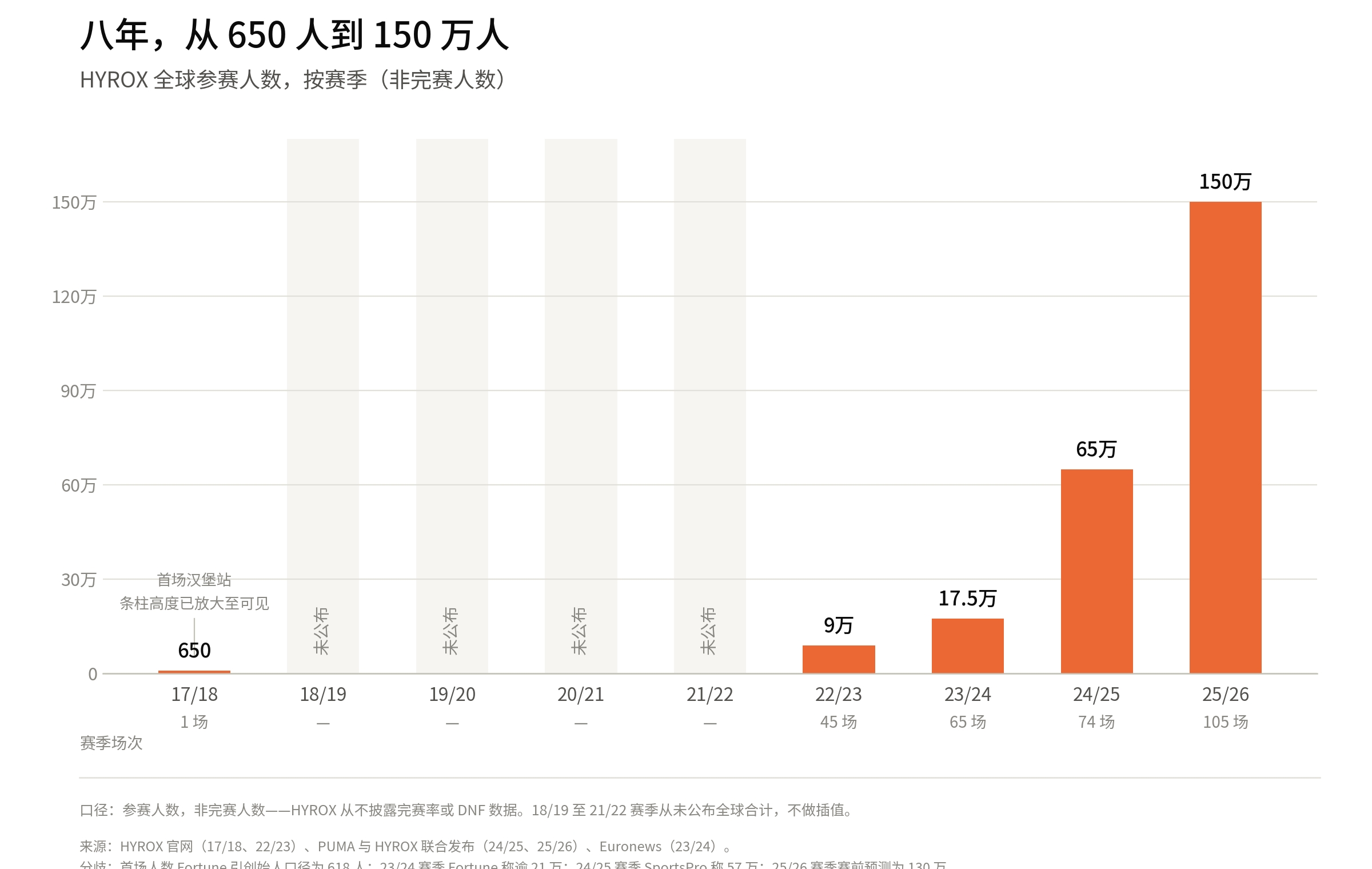
Data source: Publicly available materials
This means that judging from the number of participants alone, HYROX's level of public popularity has been close to that of marathons. The core audience and peripheral consumer groups covered by marathons are enough to support a market worth tens of billions of yuan. It is only natural that HYROX's organizer would be tempted by such prospects.
A brief review of HYROX's development history shows that this is a commercial event that was carefully designed from its very first day, with its sights precisely set on the middle-class demographic.
Of the three founders, one is an athlete and the other two come from the marketing field. What they tried to solve was not "creating a new sport", but a consumer phenomenon: "52% of people say fitness is their sport, but what exactly is that sport?"
Thus, the three designed the competition format of "8 1-kilometer runs, alternating with 8 functional challenge stations". The entire competition is held indoors, only total completion time is counted, and all results are uniformly included in the global ranking system.
In 2017, the first HYROX event was held at the Hamburg Exhibition Center in Germany, with only 650 participants. The founder once revealed that their goal at the time was: "to create a high-spec, grand event that looks like it costs 2 million euros with a budget of 200,000 euros", so as to attract urban middle-class consumers who are used to high-quality lifestyles.
After entering the Asian market, HYROX did not get off to a smooth start at first, because its brand image was too elitist. Therefore, the organizer began to weaken the competitive attribute of the individual category, and expand the mixed doubles, four-person relay and corporate categories, packaging the event as a new team building method and a social tool for the middle class.
This strategy delivered remarkable results. In 2024, only 1,700 people participated in the first HYROX Beijing race; in May of the following year, the two Shanghai Station events had more than 10,000 total participants, and became a trending topic on social media platforms, with related content on Douyin recording over 10 billion views.
After precisely attracting the middle-class group with high income, high consumption willingness and strong emphasis on healthy lifestyles, brand sponsorships came pouring in.
In addition to PUMA, which has been the title cooperation partner since the brand's inception, logos of various sports brands, cosmetics, nutritional supplements, wearable devices and even car brands are spread all over the venue and on the chests of participants in domestic HYROX events. Some good-looking participants have their bare upper bodies covered with brand logos, and are even jokingly referred to as "walking billboards".
In the 2025 fiscal year, HYROX's revenue was approximately 135 million to 140 million euros. With the rapid expansion of the global market, especially the Asian market, CNBC predicts that its expected 2026 revenue will double to 270 million US dollars.
Shortly before this incident took place, HYROX's founders repurchased 51% of the shares, and together with the newly joined investor L Catterton, promoted the event to further expand its scale, raise its public profile and boost its commercialization level.
However, the pace of this capital-fueled carnival has ultimately moved far too fast.
Who Gets to Call a Stop?
In the early stage of the incident, HYROX's global headquarters tried to explain the on-site misstep as an "unforeseen emergency". They argued in their statement that the competition scheme for elite participants and the mass participant scheme "got mixed up", leading to ambiguity in the application and understanding of the rules, so the on-site referee failed to intervene in time.
If you break down HYROX's revenue structure, you can see through the reason why they "dared not call for a stop": this event relies heavily on participant registration fees and ticket revenue. Any decision that disrupts the normal operation of the event, reduces the participation experience, or even leads to participant withdrawals, may directly undermine the stable operation of its commercial model.
We can compare HYROX with city marathons.
Take the New York Marathon as an example. Its largest source of revenue is commercial sponsorships and public donations, amounting to approximately 50.52 million US dollars; mass participant registration fees come next, at around 49.16 million US dollars. The two are almost evenly matched. This means that nearly half of the New York Marathon's operating costs are borne by third parties - corporate sponsors, charities and donors.
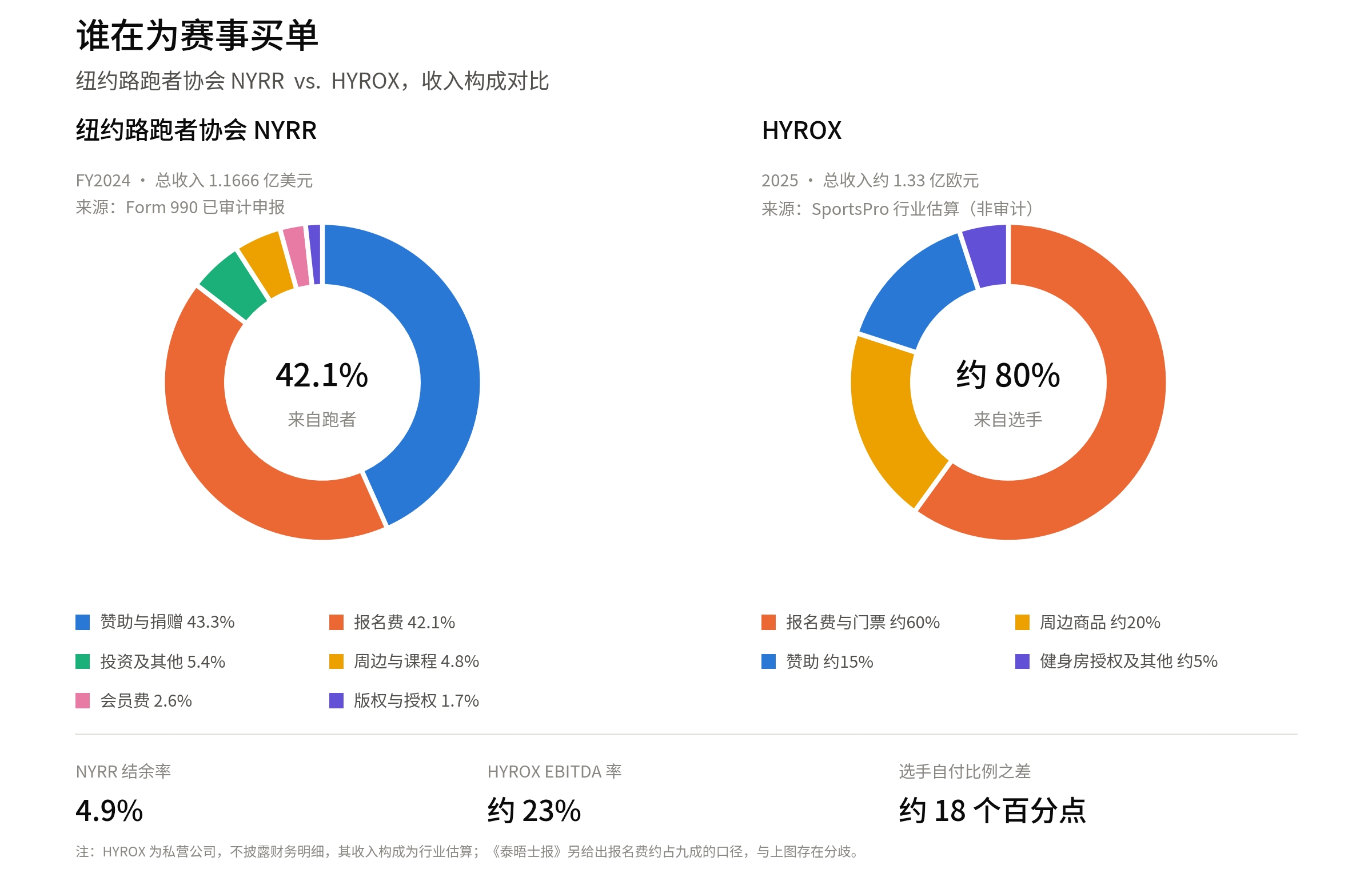
Comparison of revenue sources between the New York Marathon and HYROX
According to the breakdown from sports business media SportsPro, mass participant registration fees and ticket revenue directly account for 55% to 65% of HYROX's total revenue, sponsorship revenue accounts for around 15%, and the rest comes from peripheral licensing and merchandise sales. The data given by The Times is even more extreme: registration fees make up as high as 90% of total revenue.
Australian financial institution SBO Financial estimates that HYROX's gross profit margin for global events is as high as 80%, and the organizer does not even need to spend much on marketing - because middle-class participants who are eager to build a self-disciplined personal brand will voluntarily become the event's "free promoters" on social media.
HYROX's founders also revealed that a single event can break even as long as around 1,500 participants sign up.
In addition, NYRR, the organizer of the New York Marathon, is a non-profit organization (as are most top marathon event organizers around the world), and most of its surplus funds are legally required to be invested in community public welfare projects. HYROX generated approximately 133 million euros in revenue in the 2025 fiscal year, with corresponding EBITDA (earnings before interest, taxes, depreciation and amortization) of around 30 million euros, representing a profit margin of 23%.
There is no doubt that calling a stop in a non-profit city marathon and stopping a private for-profit event carry completely different economic costs.
After this incident took place, another speculation circulated on Chinese social media platforms: the involved participant's status as a global brand ambassador for PUMA made the event organizer overly cautious, and they did not dare to require her to withdraw from the race.
Although this speculation has no direct evidence to support it, and neither HYROX nor PUMA has responded to it, the fact that this rumor spread across the entire internet in just a few hours and almost no one considered it absurd precisely shows that the public's assumption that "ordinary participants have to make way for commercial privileges" has become one of HYROX's biggest credibility crises.
Unresolved Aftermath
Multiple industry insiders interviewed by 36Kr pointed out that the "vagueness" in HYROX's equipment functional requirements may become a limiting factor for its further commercialization: "Apart from certain requirements for footwear, HYROX participants can handle the race course with any quick-drying sportswear."
PUMA, the brand most deeply tied to HYROX, has also indirectly confirmed this point through its financial performance.
PUMA CEO Arthur Hoeld once referred to HYROX as a "lighthouse-level" partnership during an earnings call, but he also admitted that the Training business segment currently only accounts for a single-digit percentage of the group's total revenue. Up to now, PUMA has not disclosed any specific sales data directly generated by HYROX. This means that for both parties, this partnership currently delivers more brand strategic value than direct financial returns.
This high level of substitutability in hardware equipment has also made other sports giants cautious about entering this field.
Adidas, Nike and even On Running have all launched shoe models suitable for hybrid functional training, emphasizing stronger grip and forefoot flexibility, but whether they are restricted by the exclusive title clause or not, none of them have deeply tied their product naming to HYROX, and instead describe the products as "comprehensive training" or "hybrid training" footwear.
For L Catterton, the top-tier consumer investment fund under LVMH that announced the acquisition of a majority stake in HYROX for 600 million euros (approximately 4.7 billion yuan) just three days before the incident, the challenges may have only just begun.
As a consumer investment fund under LVMH, L Catterton's core investment logic is to find consumer assets that can define middle-class lifestyles. Its heavy bet on HYROX is not only based on the commercial potential of the event itself, but also on the brand label of "high-end, self-disciplined, new middle-class social way" that it has built. When the symbol of this sport slips from "middle class, healthy, fashionable" to "dirty, out of control, lacking basic respect", its appeal to high-net-worth individuals and high-end cross-border sponsors will naturally disappear.
The speed of HYROX's global expansion and commercial monetization has clearly outpaced the development of its event safety, referee training and crisis management systems. This kind of "sequela of rapid growth" is not unprecedented in the hybrid fitness space. CrossFit, which shares almost the same growth logic as HYROX, once paid a price of human life for its lagging governance capacity.
On August 8, 2024, participant Lazar Đukić unfortunately drowned during the open water swimming event on the opening day of the CrossFit Games. After the incident, CrossFit hired an independent third-party investigation team to interview spectators, participants and staff, collect complete video footage, and compare the safety standards with other professional water sports events. Three months later, the official announced 6 institutional adjustments including the establishment of a full-time safety management position and an independent safety committee.
CrossFit is also a for-profit commercial company that generates revenue through event content, gym licensing and participation fees. But it proved one point: being a commercial entity does not mean an enterprise can be exempted from basic governance responsibilities.
In comparison, HYROX has clearly had better luck this time. No one was injured or lost their life, and the price seems to be nothing more than a public opinion storm and a large number of mocking internet memes.
Commercialization itself is not a sin. The fact that a sport can get hundreds of thousands of people to voluntarily "pay to do physical labor" is a demonstration of strong commercial capability. But when a race cannot be stopped, sooner or later it will reach a moment where it has to come to a halt.