A full carriage of passengers bought the wrong tickets. Should all these high-speed railway stations be renamed?
The "misleading" high-speed railway station names have once again sparked public attention.
According to media reports, a tourist who claimed to be visiting Luzhou, Sichuan Province, left a message on the local online government inquiry platform recently, saying that he took a high-speed train from another city to Luzhou that day. When he searched for "Luzhou" on 12306, he saw "Luzhou East" and assumed it was the station in the urban area. Only after arriving did he find that the station is located in Yunjin Town, Lu County, more than 30 kilometers away from the urban area: almost all passengers on the train were in the same situation, some hurrying home, some on business trips, all were troubled badly by this.
The tourist suggested renaming Luzhou East Station to "Lu County Yunjin Station" or "Lu County East Station", and meanwhile marking the actual location next to the station name on 12306 in the short term, "so that no more people will fall into the pit." In response, the Luzhou Municipal Transportation Bureau replied that the renaming of high-speed railway stations needs to be approved by China State Railway Group Co., Ltd. At present, relevant suggestions have been forwarded to the railway department, and the work progress will be continuously tracked in the follow-up.
Looking across the country, high-speed railway stations that are far away from the urban area and easy to confuse people with their names, just like Luzhou East Station, are not unique cases.
Behind this, it is far more than a simple problem of misleading station names, which further reflects the underlying logic of regional game and urban expansion.
01
In fact, when it comes to the distance between high-speed railway stations and urban areas, the 30-kilometer distance from Luzhou East Station to the urban area of Luzhou is not among the longest in China.
For example, the well-known Xiaogan North Station is actually located in Dawu County, nearly 100 kilometers away from the urban area of Xiaogan. Many passengers tease that it is more convenient to go to Wuhan from Xiaogan North Station than to the urban area of Xiaogan.
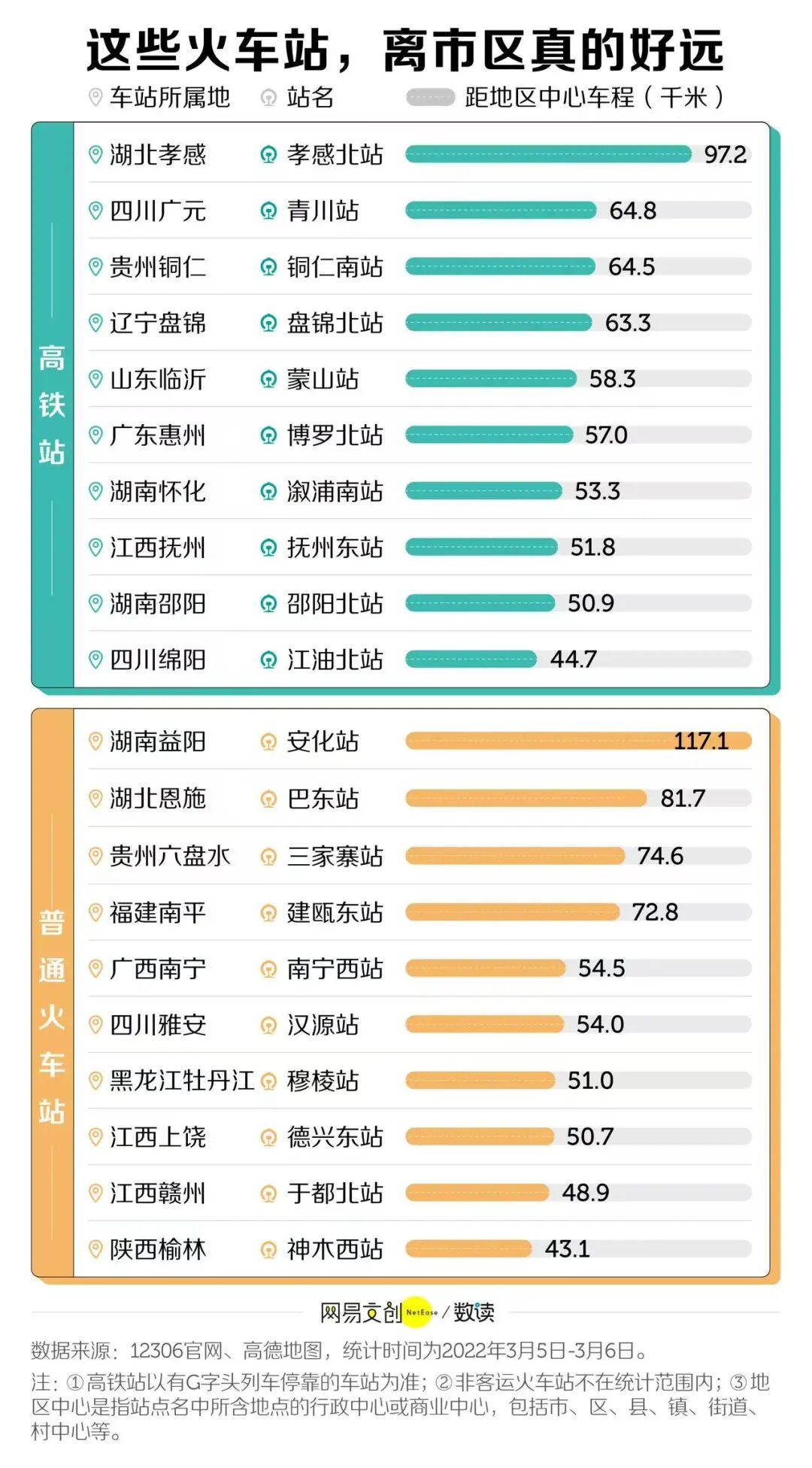
In addition, stations such as Qingchuan Station, Tongren South Station, Panjin North Station are all more than 60 kilometers away from the urban area.
Of course, the public's complaints about this problem are not only because the stations are far away, but also because of the confusion caused by the naming. Because many high-speed railway stations are clearly located in counties or even towns, but are named after the prefecture-level city, which easily makes out-of-town passengers misjudge the location.
That is to say, site selection is one aspect, and naming is another problem.
Let's look at site selection first. Overall, there are several reasons why high-speed railway stations are often far away from urban areas.
First of all, from a technical point of view, there are objective constraints at the engineering level. Due to the high speed of high-speed trains, the lines need a larger turning radius. Therefore, considering factors such as cost, the lines will naturally bypass dense built-up areas. Of course, this reason cannot explain those extreme cases where the stations are dozens of kilometers away from the urban area.
In addition, geographical factors cannot be ignored. For example, Qingchuan Station is far away from the county seat of Qingchuan and is located in a valley. One important reason is that it is restricted by the complex local terrain, which also gives birth to the unique "separation of station and line" design across the country.
The deeper and more common reason is related to the special functions endowed to high-speed railway stations. Many people may have noticed that the wave of high-speed railway construction in the past more than ten years coincided exactly with the expansion of domestic cities.
It can be said that high-speed railway stations are never just transportation hubs, but also engines driving urban expansion. As early years, some media statistics showed that more than 70 cities across the country have planned to build high-speed railway new towns.
The rapid advancement of subway construction actually follows the same logic. The reason why Luzhou East Station, which has attracted public attention this time, is located in Yunjin Town, Lu County, is actually closely related to the locally planned Luzhou East New Town.
Public reports show that Luzhou East Station of Chongqing-Kunming High-speed Railway is the starting project of the core area of the high-speed railway new town, laying a foundation for the development of land plots in the future, kicking off the construction of Luzhou East New Town. At present, the station has been in operation for nearly two years. And "promoting the construction of Luzhou East New Town in an orderly manner" has also been included in the Sichuan Provincial Territorial Space Plan (2021-2035).
02
Since these high-speed railway stations are located in county areas, why not name them directly after the towns or counties where they are located?
Behind this is the competition for resources and the game of discourse power between cities. For example, the so-called "Four Famous North Stations" teased by netizens: Xiaogan North, Yangquan North, Panjin North and Shaoyang North, are all located in counties, far away from the urban area, but all named after the prefecture-level cities where they are located. They also have one thing in common, that is, without exception, they are the first high-speed railway stations of their respective prefecture-level cities.
Understanding this point, the naming logic behind it is not so difficult to understand.
First, prefecture-level cities will not easily give up the high-speed railway business card. For many cities, the first high-speed railway is a landmark achievement of entering the high-speed railway era, and it is difficult to give this honor to the counties under their jurisdiction. Of course, there are exceptions. Some strong counties and county-level cities, such as Kunshan, Yiwu, Guanghan, etc., have high popularity on their own, so they do not have to worry that their "naming right" will be taken away by the prefecture-level city.
Second, the determination of high-speed railway lines and stations is the result of local governments striving for support from higher authorities. At the stage of station application, prefecture-level cities are usually required to coordinate resources to connect with superior departments, strive for lines to pass through and set up stations, so the station naming will naturally give priority to the identity of the prefecture-level city. The hot "high-speed railway station competition" across the country in previous years is a very realistic footnote to this point.
Third, although the station is located in a county, the station name is based on the prefecture-level city, which also means that the construction standards and supporting scale of the high-speed railway station are more likely to be planned according to the positioning of the prefecture-level city.
Fourth, for the county where the station is located, accepting the naming of the prefecture-level city is sometimes a two-way "compromise". You know, with the name of the prefecture-level city, higher exposure can be obtained in external investment attraction and urban publicity, which is equivalent to getting a larger business card for county development.
Therefore, these seemingly incredible station names are actually realistic products under the pattern of urban competition and regional development in a specific period.
03
So, can this situation be changed?
It should be said that it is quite difficult to systematically modify such station names. After all, the renaming of high-speed railway stations affects the whole situation. For example, ticket systems, line signs, map navigation, various transportation supporting facilities and other related contents all need to be updated synchronously. In addition, many high-speed railway stations have actually been in operation for more than ten years, and their names have long been widely accepted by the public.
Of course, there are also successful precedents of renaming. For example, since April 1, 2022, the former Badong Station in Hubei Province was renamed Yesanguan Station, and Badong North Station was renamed Badong Station. The former Badong Station before renaming was located in Yesanguan Town, 90 kilometers away from the county seat of Badong, which misled many passengers.
Therefore, before systematic renaming is realized, it is feasible and necessary to add corresponding geographical location information reminders on the 12306 ticket purchase page as netizens suggested.
It should be noted that a high-speed railway station that is easy to confuse people in terms of name and location will not only bring inconvenience to passengers, but also directly affect the first impression of out-of-town tourists. This is also part of the city's image.
To a large extent, this "extensive" naming and site selection actually carries a common development ambition of domestic cities in a certain period: pursuing larger urban scale, greater reputation, and broader space for development imagination.
Nowadays, this ambitious state is obviously fading away. Many high-speed railway new towns that were highly expected in those years have lost their popularity, and even some high-speed railway stations themselves have been left unused. From this perspective, these high-speed railway stations far away from the urban area are also a mark of the times left in the process of China's urban expansion.
This article is from the WeChat official account "Western City Story", the author is Western Jun, and 36Kr is published with authorization.