The coffee robot that can serve a cup of coffee in 58 seconds and perform latte art has sold 6 million cups across 70 countries worldwide.
By | Feng Yaling, Yang Yuexin
Editor | A Zhi
Order taking, extraction, latte art, and cup serving are completed in one go by the robotic arm. In less than 1 minute, a cup of coffee with custom latte art pattern is handed out through the glass window. At the 2026 World Robot Conference in Beijing in August, this COFE+ "coffee shop" robotic system from Hippo Robot, which is about 2 meters high and 1.5 meters wide, has attracted the attention of many exhibition visitors.
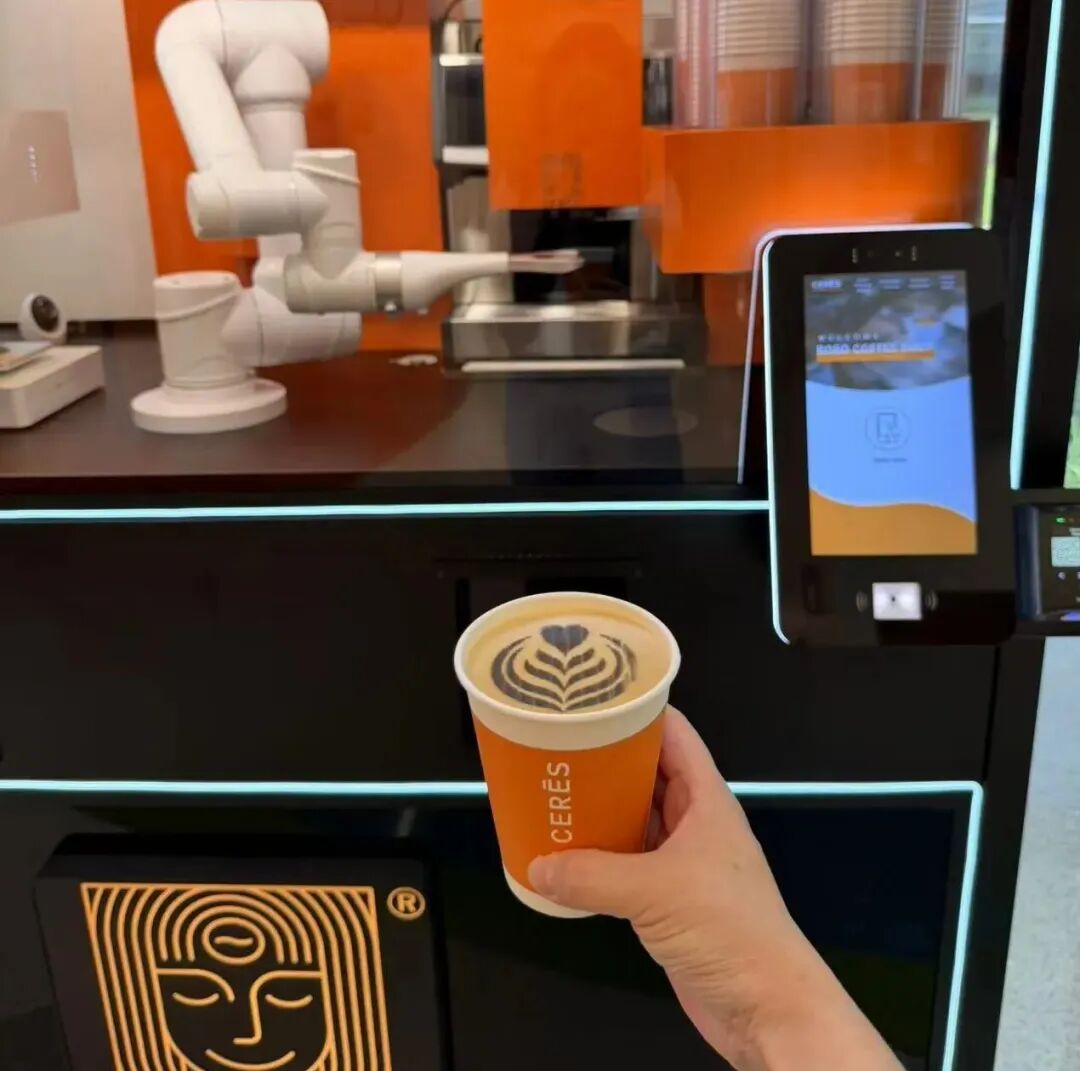
3D printed coffee made by COFE+ North American (Texas) customer at a children's hospital location
Founded in 2018, Hippo Robot is one of the earliest enterprises in China to enter the coffee robot track. Different from the path of most enterprises in the industry that "look for scenarios with existing technologies", Hippo Robot started to reverse deduce technology R&D from scenario demands in 2017, and has iterated its products 8 times in 8 years.
In traditional coffee shops, rent, labor and decoration amortization together account for 60% to 70% of the total cost, and are facing upward pressure. In contrast, the "mobile coffee shop" of Hippo Robot only has an investment cost of about 70% of that of traditional coffee shops on the premise of ensuring coffee taste and latte art effect.
At present, the products have been deployed in nearly 4000 locations around the world, including Harvard University, Massachusetts General Hospital, National University of Singapore, Denver Airport, Kuala Lumpur Airport, Google Headquarters, as well as the Davos Forum, the Two Sessions of China and other conference venues, with a total output of 6 million drinks.
1. Self-developed robot components, customizable latte art patterns
When Hippo Robot decided to make coffee robots in 2018, it was not based on technical judgment, but on industrial economics judgment: "It is not that we are looking for coffee scenarios for robots, but that the coffee industry itself needs a more automated way." Han Feizi, co-founder of Hippo Robot, said, "We do not simply chase technical hotspots, but aim to create new productivity that can work stably for a long time."
He did the math: in the cost structure of coffee shops such as Starbucks and Luckin, rent, labor and depreciation of decoration amortization account for 60%-70% of the total cost, and are still rising continuously. At the same time, baristas who can do stable latte art generally have high training costs but high turnover rates.
As one of the most industrialized and standardized drinks in the world, coffee has high consumption frequency, mature processes and quantifiable taste. The tools for processes such as bean grinding, extraction and milk frothing have achieved a certain degree of industrialization, and itself has the industrial foundation to be replaced by robots.
In the first half of 2019, the first prototype of Hippo Robot was deployed in an office building in Changning District, Shanghai, but many problems arose after it was put into use: consumers did not know how to use it, could not tell which cup was theirs, and did not know how long they had to wait after placing an order.
In addition to the insufficient user experience on the market side, there is no ready-made supply chain available on the production side. In the past, the capping action of takeaway coffee was done manually by baristas, and there was no demand for automatic capping machines on the market; how to accurately control the proportion of the robot's syrup machine and ice machine also needed to be solved.
So Hippo Robot had to design the modules by itself and find factories for production. "Self-developing components is very painful, but once it is done, it becomes our moat." Han Feizi said, "We have applied for more than 120 patents for inventions and other types, formed more than 1200 technical know-hows and more than 2800 sets of process parameters."
After the supply chain problem was solved, Hippo Robot began to focus on product iteration and continuously improve user experience. By the sixth generation of products, it has been able to support latte art and custom printing of any pattern.
Han Feizi introduced: "The success of latte art does not depend on the accuracy of motion control, but on fluid mechanics. Specifically, robot latte art is modeled through fluid mechanics to calculate the flow, diffusion and stacking rules of milk foam on the surface of espresso, and convert latte art into a set of measurable and calculable physical variables. After consumers upload any picture or text, the algorithm can reversely deduce the corresponding milk flow control parameters in real time, and the robotic arm can generate custom patterns on the coffee surface."
The newly launched 7th generation coffee robot further optimizes the bean grinding and extraction parameters, and upgrades the taste on the basis of pursuing output stability. In the human-machine competition of the Hongqiao Robot Coffee Competition in May 2026, the 7th generation product was judged by professional referees, and its score in the taste dimension was no less than that of human coffee masters.
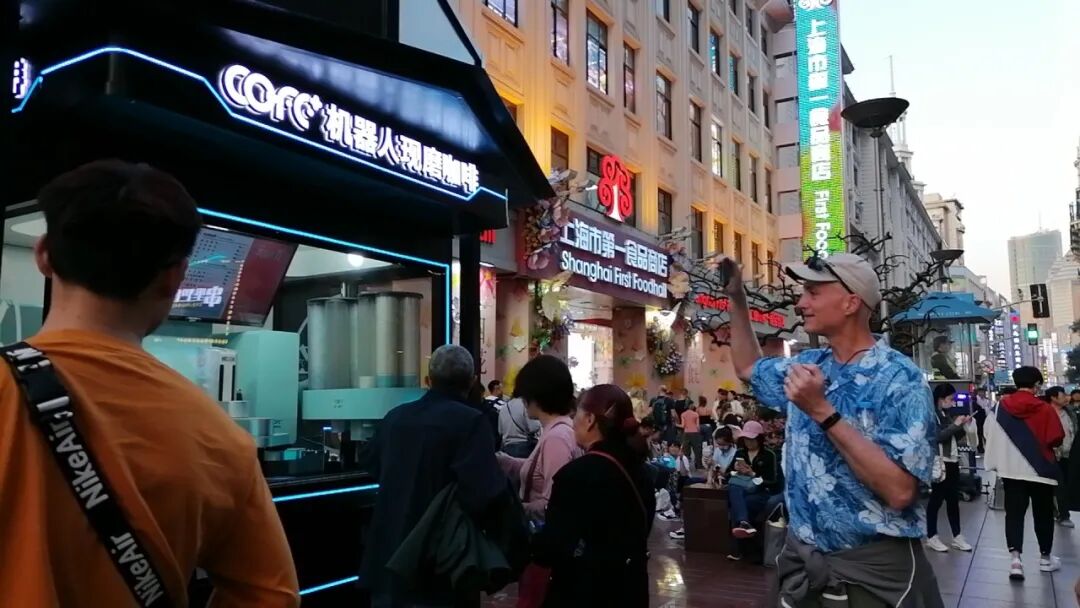
Hippo Robot "coffee shop" location at Nanjing Road Pedestrian Street, the Bund, Shanghai
2. Provide multiple sales modes, with investment cost 70% of that of chain coffee shops
At present, Hippo Robot has deployed more than 4000 locations around the world, of which only 40 are directly-operated stores for product testing and collecting user feedback, and other locations are operated locally by B-end partners. "We are not selling coffee robot equipment, but outputting an overall solution of light robot stores that can make stable profits." Han Feizi said.
Hippo Robot has 5 modes of cooperation with B-end customers, which can be flexibly matched according to customer needs:
Under the agency mode, customers use the brand of Hippo Robot, and the equipment is mainly placed in scenarios such as airports and tourist attractions.
Under the procurement mode, customers purchase the equipment and place it in their own properties.
The customization mode is for big brands and Fortune 500 companies, where customers can use their own brands and adjust the appearance of the robot products.
The leasing mode is for entities that cannot engage in cross-industry operations, such as financial institutions, government agencies, and public institutions.
The joint operation mode is for important scenarios such as landmark buildings, and Hippo Robot is responsible for investing in the equipment.
Hippo Robot also integrates the upstream supply chain of raw materials such as coffee beans, dairy products and syrup, adjusts the taste according to different markets and continuously develops new products. In terms of output taste and richness of categories, Hippo Robot benchmarks chain coffee brands such as Luckin. "The essence of a robot coffee shop is still coffee service, and taste is king." Han Feizi said.
In terms of terminal pricing, Hippo Robot dynamically adjusts the price according to the price of a single cup of coffee at the location, while keeping the store opening cost at 70% of that of chain brand stores.
3. Completing infrastructure in emerging markets, focusing on compliance in European and American markets
As early as 2021, Hippo Robot started its overseas expansion, and the first intention order came from the Dubai Expo organizer's procurement plan for 50 coffee robots.
At that time, during the epidemic period, Chinese and foreign personnel needed to be quarantined for 28 days when traveling, the customs clearance process of equipment was cumbersome, and the on-site debugging overseas was very difficult. Although appearing at the Dubai Expo might lead to losses, Han Feizi decided to overcome all difficulties: "This is a rare opportunity to verify the adaptability of our products in real scenarios in other countries, such as different climates, voltages, payment systems and consumption habits."
Taking this opportunity, Hippo Robot set up a dedicated overseas team. In the following three years, it launched small batches of products in different countries to test product stability and collect first-line operation data.
The issues to be verified listed by Han Feizi include: In humid countries like Brazil, what if the circuits and materials get damp? In the dry and static-prone environment of the Middle East, will the precision sensors be interfered with? In the environment of small shops, small doors and narrow passages in Japan, can the equipment with wheels move in and out freely? Will the different local water quality hardness and mineral content affect the final taste of coffee?
After the products achieved stable operation in different environments, all national certifications were obtained one after another, and the remote after-sales system was established, Han Feizi judged that the company already had the conditions for large-scale expansion of overseas markets.
Emerging markets such as Southeast Asia and the Middle East are the first regions that Hippo Robot entered.
Coffee consumption in these regions is in a growth period with many opportunities, but the infrastructure conditions are relatively "backward". For example, some Middle Eastern countries still use cash as the main payment method, and the mobile payment platforms in various Southeast Asian countries are independent of each other, which means that when the equipment enters different countries, it needs to connect to many different payment systems.
Secondly, the communication networks in many regions are still at the 2G-4G stage, with unstable network and low speed. Some networks do not support IoT device connection, which directly limits the normal operation of robot equipment that relies on remote operation and maintenance and data transmission. To this end, Hippo Robot specially recruited relevant talents, and developed a micro-communication system with AI intelligent allocation to realize "one device works all over the world".
In mature markets such as Europe, America, Japan and South Korea, Hippo Robot faces another kind of difficulty. Although consumers in these markets have good acceptance of unmanned equipment, they also have higher requirements for coffee quality, and the compliance standards are stricter.
Taking food contact materials as an example, parts that are in direct contact with coffee, milk and water, such as extraction heads, milk tubes, water tanks and cup holders, must meet the standards of US FDA, EU EC1935/2004 and Japan Food Sanitation Law respectively, and pass the migration test to ensure that no harmful substances enter the drinks.
In terms of equipment cleaning, the milk line system needs to have a standardized high-temperature disinfection process and traceable cleaning records, and the unmanned equipment must also have automatic cleaning and expiration reminder mechanisms; in places such as international airports and hospitals where food hygiene and fire protection are strictly controlled by national ministries, higher functions such as poison prevention, epidemic prevention and fire protection are also required.
In order to meet these strict requirements, Hippo Robot puts compliance capabilities in the product design stage, instead of supplementing the certifications after entering the market. Coffee products are benchmarked against the regulatory requirements of professional-grade coffee shops, and the whole chain of operation, consumables and cleaning is traceable, ensuring that the production data of each cup of coffee can be traced to the specific material batch and equipment operation parameters.
As of August 2026, COFE+ of Hippo Robot has covered 70 countries and regions around the world, and has landed in more than 200 international cities.
Han Feizi concluded that the local adaptation of overseas markets is divided into two levels: the software and content layer, such as language interface, menu formula, payment method, brand color, latte art pattern and drink category, which does not affect the equipment structure and is relatively easy to achieve.
The interface and compliance layer such as voltage, plugs, local certifications, water circuits, water quality and consumables needs to be converted to adapt to local standards, while the core components such as motion control, fluid algorithm and body mechanism ontology behind it remain globally unified. "If you customize at the bottom of the structure, the enterprise will definitely be chaotic in the later stage, and huge hidden dangers will be buried in the after-sales system." Han Feizi explained.
In his definition, Hippo Robot is not a robot company, but a new consumer company. "Hippo Robot targets the new economy, new formats and new models, and uses robot technology to restructure the cost structure and consumption experience of the traditional coffee business."
In the future, Hippo Robot will iterate towards the direction of fewer components, more covered categories, stronger consumption experience and higher intelligence, and its overseas business will further deepen local and refined operation. "We hope to reinvent the coffee shop and push coffee consumption into the era of light stores." he said.