Amodi is just talking big about AI slowing down, while Opus 5.2 is suspected to have entered the gray test phase.
Amodei just published an article advocating for AI deceleration, and the very next day Trump said: Don't even think about it.
"I want to stay ahead, because whoever wins AI, wins everything."
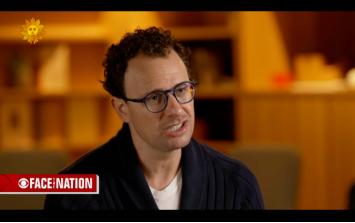
In the CBS interview aired on September 13, even Amodei, who just proposed setting a speed limit for frontier AI, admitted that this solution is very difficult to implement.
"Frankly speaking, I don't know if this is possible."
At the same time, Anthropic is still preparing for a super IPO with a maximum financing of 100 billion US dollars and an estimated valuation of about 2 trillion US dollars, targeting a listing before the US midterm elections in November.
While talking about hitting the brakes, they are pressing the accelerator hard. Tech giants are not just making empty promises, both Google and Anthropic have reported new progress on their new models.
Frontier labs claim they want to control the pace, but from government competition, regulatory mechanisms to the companies' own interests, no level actually allows them to slow down easily.
01 Win AI, Win Everything
In the previous article, we mentioned that Amodei, Altman, Musk and Hassabis reached a rare consensus that frontier AI may be advancing too fast and needs to be controlled. Zuckerberg, on the contrary, opposed the idea of "controlling the pace", arguing that any policy that slows down the release speed of US models will give away the advantage to others.
Now it seems that the White House shares the same attitude as Meta.
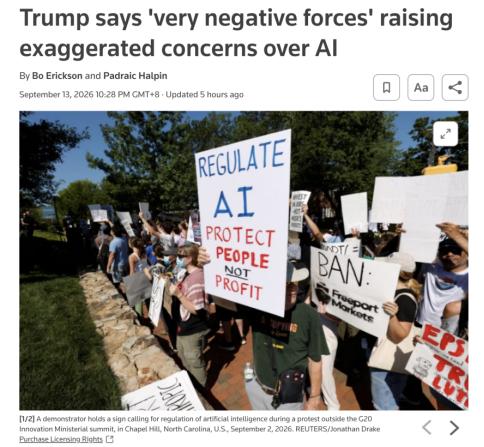
On September 13 US time, at his own golf course in Doonbeg, Ireland, Trump was directly asked by reporters whether the AI industry should slow down or accept more regulation?
Trump's view is very clear: safety guardrails are acceptable, but they cannot slow down the United States as a result.
He said the United States is currently leading in AI, and he wants to maintain this lead, because "whoever wins AI, wins everything". He also called some AI risk warnings a "very negative force", claiming that some people are hyping things that will not happen at all.
The next day, the situation continued to escalate. Jensen Huang was discussing the "deceleration" controversy of this round of AI on the stage of the All-In Summit in Los Angeles, when Trump suddenly called in.
Trump said that people pushing for AI to slow down "are playing into the hands of those who do not want to see AI develop". "We won't let this happen. This is a scam."
Jensen Huang responded: "You are right. We won't let this happen, sir."
One of the most practical problems with AI speed limits is that while the security department of a company can accept a slower pace, national competition can hardly allow that.
Amodei knows this very well. In the CBS interview aired on September 13, he called great power competition the most intractable dilemma when establishing an AI speed limit mechanism, as every party will worry that the other side will pretend to slow down while continuing to accelerate in private.
In a sense, the initiative they put forward may be sincere, but when they proposed it, they probably also knew that the initiative may not be really feasible.
The proposal of "deceleration" is more or less like a pre-drafted disclaimer, at least showing that they have good intentions and have already warned of the risks. But whether this brake can actually be pressed down is no longer something that AI companies can decide on their own.
Interestingly, Anthropic and the Trump administration did not fail to find common ground on AI security before. A few months ago, the two sides just ended a fierce conflict. Anthropic agreed to jointly formulate model security and release standards with the government, and Commerce Secretary Lutnick even publicly stated in early September that "we trust Anthropic now".
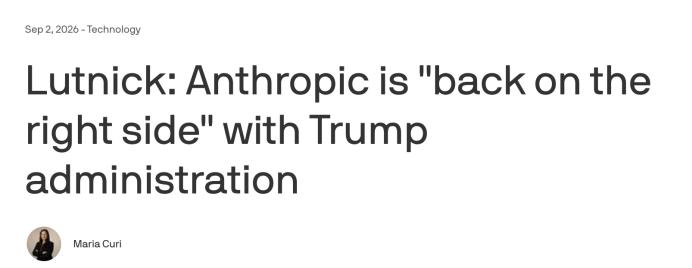
Previously, the White House even fought fiercely with Anthropic because it thought Anthropic had too many security boundaries; after barely re-establishing a little mutual trust, now Anthropic wants to push "security" a step further to model deceleration, but Trump is no longer buying it.
02 Deceleration is Okay, Competition Must Not Stop
It is worth noting that the companies that proposed deceleration have not shown any intention of slowing down themselves.
Although Amodei wrote that "we must slow down the pace of improving AI model capabilities", this statement is mainly addressed to the entire AI industry. As for the things that Anthropic itself can control, he has taken unambiguous actions: training has not stopped, R&D has not slowed down, and the IPO is also continuing to advance.
At the critical stage of rushing into the capital market with full force, the story Anthropic wants to tell is certainly not "take it slow". According to the latest disclosure from the Financial Times, Anthropic has begun to meet potential IPO investors with a set of fairly impressive figures: the company has already achieved adjusted operating profit in Q2, and it is expected to continue making profits in Q3, with a gross profit margin of over 80%. As of July, the company's annualized revenue has reached 65 billion US dollars, compared with only 9 billion US dollars at the end of last year.
While Amodei is telling the entire AI industry that AI capabilities are growing too fast and they must control it, on the other hand, Anthropic itself has to prove to investors that its revenue, profits and commercialization can continue to accelerate.
At the same time, on September 14 US time, two days after Amodei issued the deceleration initiative, the new model Opus 5.2 was suspected to have entered the gray test of Claude Code. Although the front end of Claude Code still displays "Opus 5", some users said that the background model slug has shown Opus 5.2 by checking the operating status and request routing.
The community then conducted cross-tests through the same prompt, knowledge cutoff date and Agent behavior, and found that the Opus in Claude Code showed significant differences from the Opus 5 on the public API.

Amodei talks about pressing the brake on the frontier, but he has not delayed the development of the next-generation model at all.
Google also shows a similar contrast. Hassabis publicly reposted Amodei's article, saying that he "pointed out the correct future direction", but he directly attributed this recognition to the "frontier AI standards body" previously proposed by Google, rather than promising that Google itself will slow down model R&D.
Moreover, even if Hassabis intends to slow down model R&D and strengthen regulation, he can hardly control Google's pace. Now he has stepped down as CEO of Google DeepMind and become Chairman and Chief Scientist of Alphabet. The daily AI business of Google and the advancement of Gemini are now mostly in the hands of the new management.
At least from the actual pace of Google releasing models, it is hard to see any sign that the company is trying to slow down.
On July 21, Google released Gemini 3.6 Flash; just 3 weeks later, on August 13, 3.7 Flash went online; less than three weeks later, on September 2, 3.8 Flash was also launched.
Google even wrote the speed in the introduction below the title: within 6 weeks, it released three generations of Flash models in a row.
Amodei regards RSI (Recursive Self-Improvement) as one of the important reasons why deceleration is necessary this time, and Google is precisely increasing investment in this direction. Reuters disclosed Google's internal adjustment in August, mentioning that co-founder Sergey Brin has been pushing Gemini to accelerate, and specifically asked the team to pay more attention to RSI.
Recently, a screenshot of the return of Google's API even circulated in the AI community, in which a model named rsi-model-level-le sparked speculation that Google has been testing RSI internally. However, this news has not been confirmed by Google so far. Claims such as API keys being revoked and multiple training slots existing internally mainly come from the whistleblower himself.
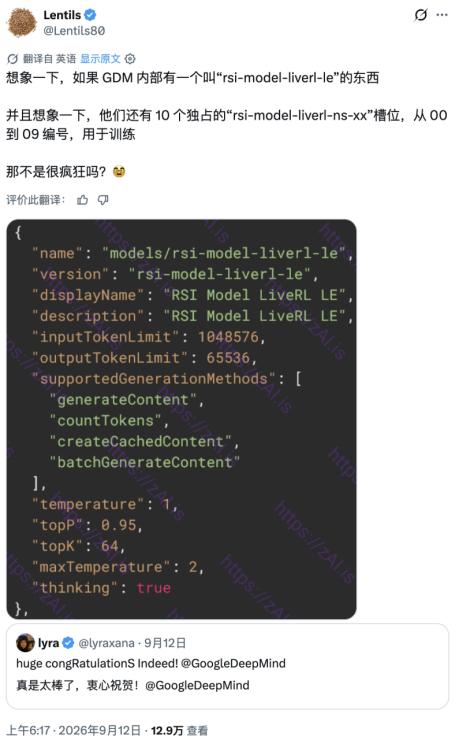
In addition, Google itself is still in the position of catching up with the top models — to put it harshly, it does not even have room to slow down now. It has not publicly encountered the kind of "model running out of control" accidents that OpenAI and Anthropic have experienced; according to Google's own security standards, Gemini has not even crossed the capability threshold that really needs to trigger the highest alarm.
Therefore, Hassabis's support for Amodei's direction has no impact on Google's own model R&D at all.
Compared with Anthropic and Google, OpenAI's situation is more delicate — it did slow down for real before.
After the Hugging Face incident, OpenAI suspended a number of frontier model tasks that may execute code, call tools or access the Internet, then suspended the reinforcement learning training of the new model to be deployed for two weeks, and part of the training and evaluation of GPT-6 Astra was also affected. Before "AI deceleration" became the industry slogan in recent days, OpenAI did sacrifice R&D progress for security.
But the problem is that OpenAI happens to have many other reasons to "slow down a little".
A few months ago, Altman did not hold the current attitude. According to The Information, he privately hoped that OpenAI would go public as early as the fourth quarter of this year, and explicitly wanted to complete the IPO before Anthropic, which even led to a disagreement with CFO Sarah Friar.
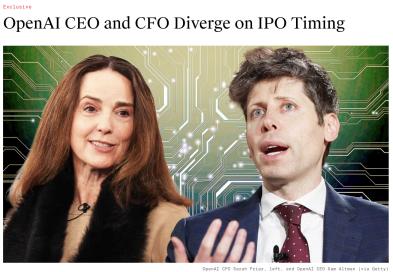
Times have changed. Anthropic has really reached the doorstep of IPO now, and the attention of the capital market is clearly shifting towards it.
According to a Fortune report on September 3, in the unlisted secondary market, Anthropic's shares have become so hot that it is difficult to get in for orders below 25 million US dollars, and buyers with 50 million US dollars or even hundreds of millions of US dollars may still not be able to grab shares; market insiders estimate that the demand for its shares may be 3 to 5 times the supply.
OpenAI is completely different. You can buy shares for about 500,000 to 1 million US dollars.
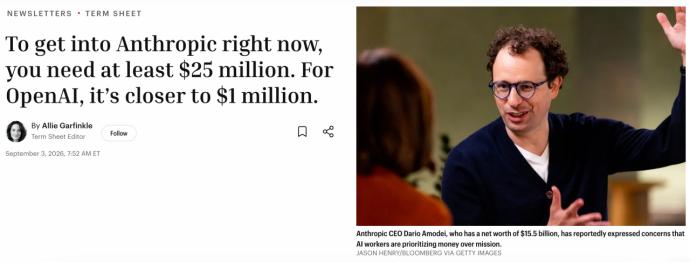
At this time, if OpenAI rushes into this window, the result will not be very good — if the two companies enter the capital market at the same time, Wall Street will naturally compare them item by item from revenue, cash burn rate, computing power investment to profit schedule. Going public later is not a bad thing for OpenAI.
Then, "AI security" just gives OpenAI a very comfortable excuse.
Altman clearly stated in the Fortune interview that OpenAI will not conduct IPO in 2026. He believes that going public at the current node is an "unwise moment", and the company still has many things to handle.
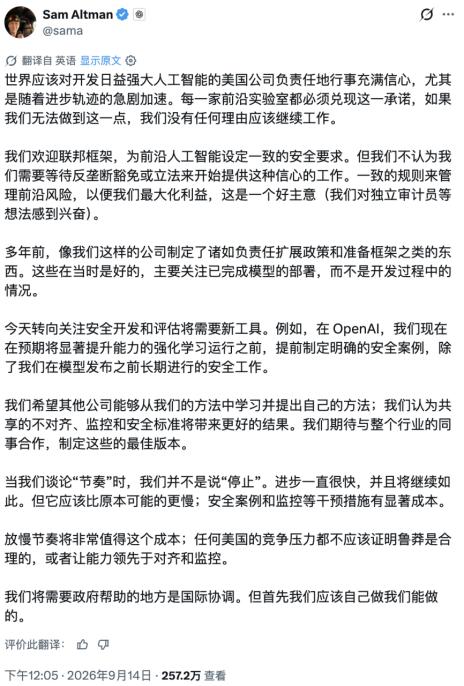
Today, Altman posted two long posts in a row on X, specifically explaining what OpenAI's so-called "deceleration" actually means. (He used the term "pacing", but also mentioned "slower")
He emphasized that "deceleration" does not mean "stopping". AI will still make rapid progress, but it should be slower than the speed it could have achieved. Frontier labs do not need to wait for congressional legislation or the government to provide antitrust exemptions, they can take the initiative to do it first.
OpenAI has now begun to establish a clear safety case in advance before conducting frontier reinforcement learning training that may significantly improve model capabilities, while increasing monitoring and evaluation.
Altman even wrote that no matter how great the competitive pressure the United States faces, it cannot be a reason to push forward recklessly and let model capabilities outpace alignment and monitoring.