Uncovering the restructuring of FAW and GAC: It is far more than using 20 billion yuan to merge the northern and southern Toyota joint ventures.
"The biggest annual news in China's automotive industry is here."
Wei Jinqiao made this conclusion to us in the meeting room — the trading suspension announcement released by GAC Group on September 14 finally brought the news of the integration and restructuring between FAW and GAC to the public.
In fact, we had heard rumors about this as early as last year, but we could not disclose the information to the public at that time.
You may think the statement in GAC's announcement is very implicit: the company is planning to purchase part of the equity of "a certain complete vehicle joint venture" held by FAW Co., Ltd. by issuing shares.
But behind all the silence, the undercurrent is roaring deafeningly.
Three days ago, the National Development and Reform Commission just mentioned that it supports large enterprise groups to promote mergers and reorganizations in a market-oriented and legalized manner, so as to avoid homogeneous competition in product design and technology R&D.
According to market estimates, GAC may acquire approximately 25% of the equity of FAW Toyota, with a consideration of about 20 billion yuan. FAW will thus become the second largest shareholder of GAC.
The core of this matter cannot be simplified as "merging North and South Toyota with 20 billion yuan". The merger of North and South Toyota is only the tip of the iceberg above the water. Beneath the surface lies a deeper rearrangement of resources.
FAW has long-established brand heritage, a complete R&D and manufacturing system, and an irreplicable historical status. GAC has stronger market-oriented capabilities, is located in the region with the densest new energy vehicle industry in South China, and has accumulated rich experience in vehicle electrification and three-electric technology.
Toyota's operating rights in China will be more delegated to GAC, while profits and technologies will be opened up to FAW. The 20 billion-yuan consideration is only a payment method, not the end goal itself.
The real underlying logic of this transaction is to let FAW's resources and GAC's market-oriented capabilities give full play to their respective advantages, and set a benchmark for "improving efficiency and eliminating involution through resource integration".
Aiming to be the top seller in the domestic market?
According to the currently circulating market estimates, GAC may acquire approximately 25% of the equity of FAW Toyota held by FAW Co., Ltd. by issuing shares, with a consideration of about 20 billion yuan.
If calculated based on the issue price of around 4.7 yuan per share of GAC's A-shares before the trading suspension, approximately 4.255 billion additional shares need to be issued. After the transaction is completed, FAW will hold approximately 29.44% of GAC's shares, close to 30%, becoming the second largest shareholder second only to Guangzhou Automobile Industry Group. The shareholding ratio of Guangzhou Automobile Industry Group may drop from about 54.02% to about 38.1%, but it is still likely to maintain the controlling position in the absence of concert party arrangements.
All these figures are market estimates or assumptions, not officially disclosed data. FAW's nearly 30% shareholding does not mean that it will automatically get a seat on the board of directors, and the final result depends on the provisions of the restructuring agreement and the election results of the shareholders' meeting. All details shall be subject to the major asset restructuring plan, audit and evaluation results, and regulatory review documents issued by GAC Group.
At present, the equity structure of FAW Toyota is that FAW Co., Ltd. holds 50%, Toyota Motor Corporation holds 45.7706%, and Toyota China holds 4.2294%.
According to the information we obtained, after GAC takes a stake, it will integrate with GAC Toyota to establish a unified sales company. It is expected that Toyota will hold 50% of the shares, FAW will hold 25%, and GAC will hold 25%. In addition, the internal conflict between sister models that has troubled dealers on both sides for a long time will also be eliminated, the channels will be completely opened up, and all models can be sold and maintained at all stores.
This model has received strong support from Toyota.
Why restructure FAW and GAC? Why restructure in this way? The answer lies in "one addition and one subtraction".
The addition refers to the expansion of scale.
In accordance with global conventions, an equity ratio of around 30% is sufficient to merge the sales volumes of FAW and GAC, similar to the Renault-Nissan-Mitsubishi alliance in the past.
Looking at the combined sales volume of the two groups in the past 17 years, the outline of the combined scale is very clear.
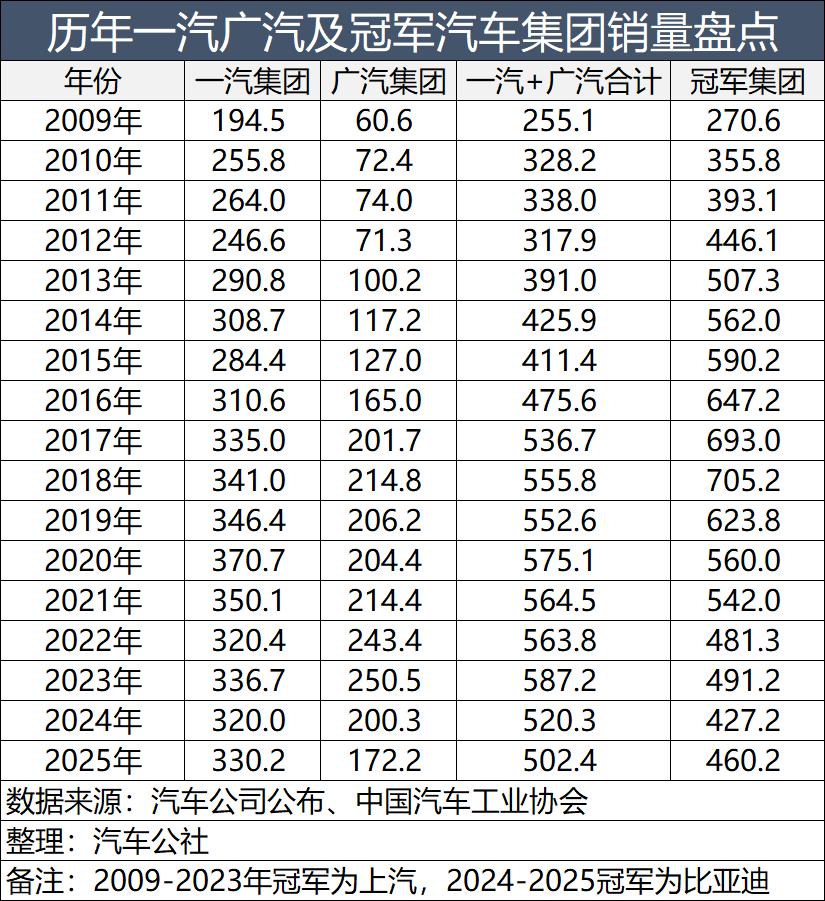
In 2009, FAW sold 1.945 million vehicles and GAC sold 606,000 vehicles, totaling 2.551 million vehicles, while the champion of that year sold 2.706 million vehicles. In 2013, the total sales volume of the two reached 3.91 million, while the champion sold 5.073 million, and the gap widened. In 2016, the total sales volume reached 4.756 million, while the champion sold 6.472 million. By 2020, the total sales volume reached 5.751 million, surpassing the 5.6 million sales volume of the champion for the first time. In 2023, the total sales volume reached 5.872 million, while the champion sold 4.912 million. In 2024, the total sales volume reached 5.203 million, while the champion sold 4.272 million. In 2025, the total sales volume reached 5.024 million, while the champion sold 4.602 million.
It can be seen that if FAW and GAC merge, their annual sales volume in recent years will be between 5 million and 5.8 million units, which gives them the potential to compete for the top spot in the domestic market, standing at the same level as BYD's expected sales target in 2026.
The subtraction refers to the elimination of internal friction.
Feedback from dealers is more direct: "The current price war of Toyota in China is mainly caused by the internal competition between FAW Toyota and GAC Toyota, such as the Granvia and the Sienna. If North and South Toyota are merged and the price war is weakened, the profit per vehicle is estimated to reach the level of 10,000 yuan."
This "10,000 yuan per vehicle" is crucial for both the sales channels and automobile companies.
Numbers themselves do not generate competitiveness. The resource density brought by scale generates competitiveness. At present, FAW and GAC each maintain multiple R&D platforms and multiple brand systems, consuming each other in the same price range. After the merger, if the unified platform and centralized procurement can be realized in the back-end, the R&D cost and procurement cost amortized per vehicle can be significantly reduced under the same sales base.
The reason why BYD's vertical integration is so formidable is not that it sold 4.6 million vehicles, but that the scale of 4.6 million vehicles is fully utilized by batteries, electric drives, chips and vehicle platforms, generating scale effects at every link.
If the merger of FAW and GAC only adds the two sales figures together without touching the repeated construction in the back-end, the 5 million vehicles will only be a nice-looking number. But if the commercial vehicle chassis of FAW, the high-end positioning of Hongqi, the electrification platform of GAC and the hybrid system of Toyota can be well coordinated, the gold content of this scale will be completely different.
The title of "the top domestic automaker" does not lie in the sales sheet, but in the resource sheet. The complementarity between FAW and GAC determines the deeper significance of the restructuring.
FAW gets access to technology, GAC gets brand empowerment
In a transaction, what is most easily seen are the equity and numbers.
FAW gets GAC's shares, and GAC gets FAW Toyota's equity. But these are only the buoys on the water. Beneath the buoys, two things are being transferred: technology and brand.
Let's talk about technology first.
GAC's accumulation in electrification is deeper than the outside world imagines. Aion's Magazine Battery has been installed in more than 1.3 million vehicles cumulatively, with a total driving mileage of more than 110 billion kilometers, and no spontaneous combustion accident has been reported. The Magazine Battery 2.0 will not catch fire even after the entire pack is shot in the test, reaching the new national standard for battery safety five years in advance. This is not a laboratory concept, but real data that has been verified by millions of vehicles on the road.
In terms of battery production capacity, Hymoment Battery has a planned total capacity of more than 60GWh, with 18GWh of production lines already completed, and the capacity will be increased to 36GWh-58GWh by 2027. Hymoment is also the only enterprise in China's lithium battery industry that has passed the national intelligent manufacturing capability maturity level 4 certification for all sub-domains and all clauses.
Going a step further, the sample A cell of the all-solid-state battery developed by Greater Bay Technology has been offline, with a single-cell energy density of 260 to 500 Wh/kg, 2 to 3C stable fast charging, no open flame and no large amount of smoke in the acupuncture test. The punctured cell can still light up the LED sign. The goal is to achieve GWh-level mass production and vehicle installation applications in 2026.
GAC has all these technologies, but it lacks a scenario to apply them to create greater value.
On FAW's side, the Bestune brand is in urgent need of technical support. In 2025, the annual sales volume of Bestune exceeded 200,000 units, with a new energy penetration rate of more than 85%, which seems to be a good momentum. But in the first half of 2026, the domestic retail sales of Bestune was only 39,000 units, down about 35% year-on-year.
If GAC's technology can be injected into Bestune, the situation will be completely different. The safety data of the Magazine Battery is ready, the production capacity of Hymoment is ready, and the solid-state battery roadmap of Greater Bay Technology is also ready. Bestune does not need to build a battery system from scratch, and can directly access the supply chain and technical platform that GAC has already verified, so the improvement of product strength is visible.
The three major platforms released by FAW at the 2026 Science and Technology Conference — Tiangong pure electric, Honghu hybrid, and Jiuzhang intelligent — have already had a framework, but the too high-end and cutting-edge technologies are more suitable for the high-end brand Hongqi, and the cost may not be suitable for the mass-market brand Bestune.
Then let's talk about the brand.
GAC has been working on high-end brands for a long time. The Hyper brand is positioned as "elite mobility", and launched two models A800 and S600 in the first half of the year. The combined sales volume of Aion and Hyper in the first half of the year reached 181,600 units, a year-on-year increase of 67.08%. The figure is good, but the awareness of the Hyper brand in the high-end market has never really taken root. When consumers mention Chinese brands priced above 300,000 yuan, the first ones that come to mind are still Hongqi, NIO and Li Auto, not Hyper.
Hongqi is different. In the first half of 2026, Hongqi sold 137,800 units, which is not much different from the combined sales of Aion + Hyper. The position of Hongqi in the hearts of Chinese consumers has been accumulated for decades, which is not determined by the sales performance of several car models. Among domestic luxury brands, Hongqi's brand awareness and emotional recognition have no alternative up to now.
If GAC can be regarded as a unified whole with FAW, the high-end attributes of Hongqi will naturally empower GAC — "This group has Hongqi under its banner, so its grade should be pretty good."
But this matter cannot be simply regarded as a complementary relationship of "FAW lacks technology and GAC lacks brand". At a deeper level, it is the redistribution of roles between the two enterprises in the electrification era. FAW's strengths lie in the system, manufacturing, and historically accumulated brand assets, while its weaknesses lie in the rapid iteration of market-oriented products. GAC's strengths lie in the density of the South China supply chain, the implementation speed of three-electric technology, and the understanding of the C-end market, while its weaknesses lie in the ceiling of brand upgrading.
GAC exports technology to FAW, and FAW opens up brand resources to GAC. This is not a relationship where one party helps the other, but the two enterprises maximize what they are best at, and let the other party make up for what they are worst at. The efficiency of resource integration is reflected here.
As for the specific implementation methods — whether it is technology licensing, joint development, or the establishment of a joint technology company, these are the matters to be discussed in the restructuring agreement. Once the direction is set, the rest are arrangements at the execution level.
Integrate resources to eliminate involution
Even if you see the complementarity of technology and brand, you still can't see the full significance of the FAW-GAC restructuring — the operating rights are delegated to people who understand the market better, the technology and profits are handed over to people with more resources, and at the same time, the underlying logic of "improving efficiency and eliminating involution through resource integration" will take "FAW + GAC" as an important attempt and demonstration benchmark.
In the history of the automotive industry, there was a previous attempt at the integration of state-owned enterprises.
In 2020, Seres issued approximately 327 million shares to Dongfeng Motor Group at a fixed price of 11.76 yuan per share, to acquire the remaining 50% equity of Dongfeng Xiaokang.
After the transaction was completed, Dongfeng Xiaokang became a wholly-owned subsidiary of Seres, and Dongfeng Group became the second largest shareholder of Seres with a shareholding ratio of about 25.83%. The operating rights of the Dongfeng Fengguang brand were fully incorporated into the Seres system, and Dongfeng no longer intervened in daily operations, but shared profits as a strategic shareholder, while maintaining channels for technical exchanges and supply chain collaboration.
The logic is very clear: whoever understands the operation better gets the operating right; whoever provides resources gets the connection at the profit end and technology end. The property right and operating right are separated, and each party takes what they need.
But Dongfeng and Seres, one is a central SOE and the other is a private enterprise, have relatively short decision-making chains and relatively clear interest structures. The situation between FAW and GAC is much more complicated.
FAW is a central SOE directly under the SASAC, and GAC is a provincial state-owned enterprise under the jurisdiction of Guangdong Province. Each of them has a huge asset system, personnel structure and local interests behind it. The transfer of FAW Toyota's equity from FAW to GAC involves not only a financial account, but also the ownership of the existing management team of FAW Toyota, the repositioning of the profit contribution of the joint venture sector within FAW Group, and the coordination of the automotive industry layout between Jilin Province and Guangdong Province. None of these items is trivial.
But precisely because of this, if this transaction is completed, its demonstration significance will be far greater than the Dongfeng-Seres case. It proves not that "state-owned enterprises can integrate with private enterprises", but that "two large state-owned enterprises can also complete resource reallocation under the framework of separation of operating rights and ownership".
What this reconfiguration really aims to break is involution. The most typical example here is exactly Toyota itself.
