The "table-flipping" embodied intelligence kicks off a chaotic crisis public relations melee.
"More than 50 embodied intelligence companies are queuing for IPO on the Hong Kong Stock Exchange," according to a media report.
Last week, two posts on the personal social feed of the founder of Mech-Mind, as well as two statements from Galaxy Universal, pushed the embodied intelligence industry from the honeymoon period of "collective boosting" into a chaotic war of "undermining each other and overturning the table".
An embodied intelligence company that had just gone public for 8 days saw its stock price fall below the issue price. Instead of calming down investors, its founder publicly attacked peers on his personal social feed.
In fact, this is a carefully planned public relations war.

Today's article is a bit long, with more than 8,000 words. Hope it brings you insights, especially when the industry is in a special stage: most company leaders have little knowledge of public relations, while the industry receives extremely high public attention.
The author tries to discuss 5 questions:
1. Why did Mech-Mind "fire the first shot" after its stock price fell below the issue price?
2. Why did Galaxy Universal become the "perfect target"?
3. Is Galaxy Universal's crisis response up to standard?
4. Why is it said that the embodied intelligence industry has entered the era of "chaotic public relations war"?
5. How should the "narrative" strategy of embodied intelligence enterprises be adjusted?
We will elaborate on them one by one.
1. Why did Mech-Mind "fire the first shot" after its stock price broke the issue price?
From September 9 to 10, Shao Tianlan, founder of Mech-Mind, posted consecutively on his personal social feed, accusing some "event-driven" embodied intelligence enterprises of creating false revenue through data collection centers and related-party transactions, and directly named Galaxy Universal in the comment section.
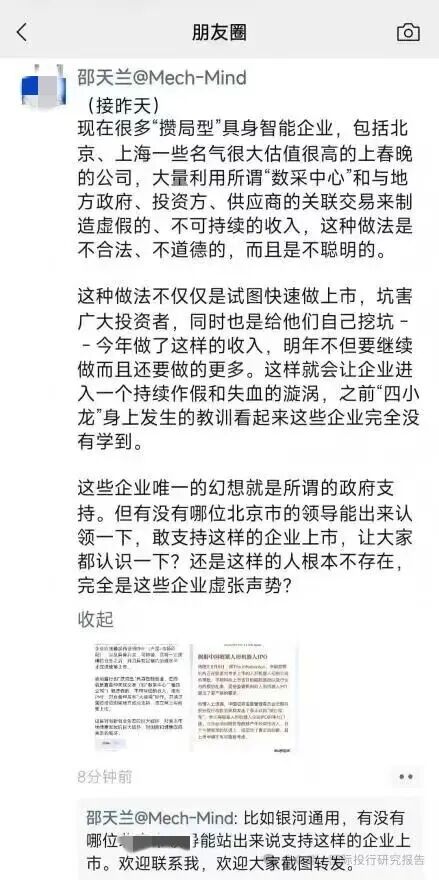
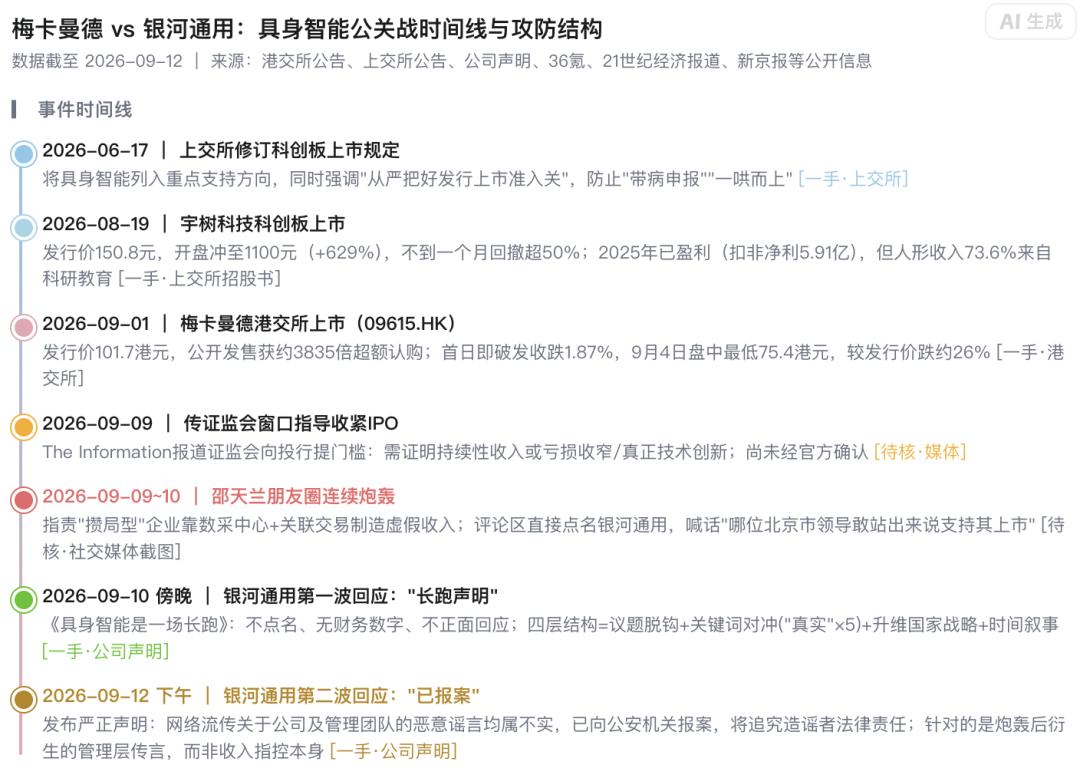
Galaxy Universal responded twice, first releasing a "long-distance running statement", and then announcing two days later that "it has filed a report with the public security organ". (This part will be commented later)
Many people's first reaction was: Is Shao Tianlan out of his mind? His company's stock price has fallen so sharply, instead of trying to save the situation, he chose to offend his peers.
On the contrary, the price breaking below issue price is exactly one of the reasons why he launched the attack.
Mech-Mind was listed on the Hong Kong Stock Exchange on September 1, with an issue price of HK$101.7. The public offering part recorded an oversubscription of about 3,835 times, refreshing the subscription record for Hong Kong stock robot IPOs in that year. However, its stock price broke the issue price on the first trading day, closing down 1.87%. It continued to fall in the following days, hitting a low of HK$75.4 in intraday trading on September 4, with a maximum retracement of about 26% from the issue price.
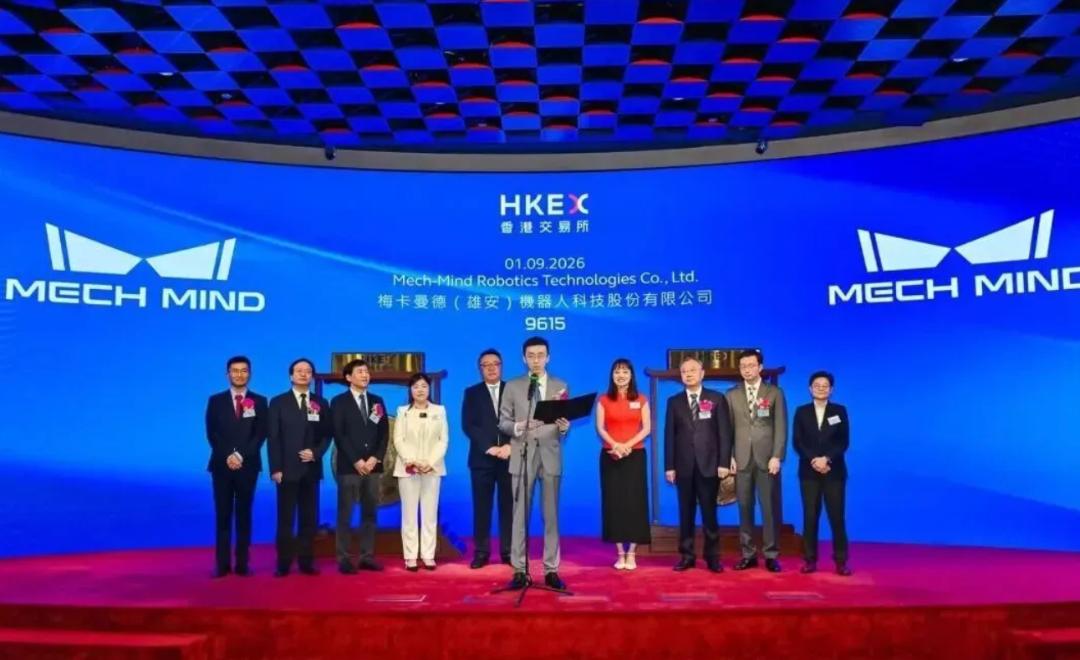
What does the combination of 3,835 times oversubscription and 26% price retracement mean? It means that the "embodied intelligence premium" given by the primary market has not been realized in the secondary market. Investors who subscribed for the new shares rushed in, found that the financial statements did not match the market story, and voted with their feet.
At this moment, Shao Tianlan needed a narrative to explain: It is not that my company is not worth this price, but that the valuation system of the entire industry has been polluted by "event organizers". Bad money drives out good money, and companies that earn real revenue are dragged down instead.
To put it bluntly, this is an operation to externalize the pressure on his own stock price. My stock fell not because I am not capable, but because some people in the industry are falsifying data, which has destroyed the credibility of the entire sector.
The second reason is rather coincidental, which is the precise alignment with the regulatory window.
On the same day Shao Tianlan launched the attack (September 9), U.S. tech media The Information reported that regulators had issued window guidance to some investment banks, raising the IPO review threshold for humanoid robot startups, requiring enterprises to prove their ability to generate sustainable revenue. Although this news has not been officially confirmed, as early as June 17, when the Shanghai Stock Exchange revised the Sci-Tech Innovation Board listing rules, it clearly stated that it would "strictly control the listing access threshold" to prevent "defective applications" and "blind rush to market".
Taking the initiative to expose industry problems at this time is equivalent to submitting a "statement of loyalty" to the regulator: I am clean, and I support strict investigation.
The third and most critical reason is the shift of valuation paradigm.
Unitree went public on the Sci-Tech Innovation Board on August 19, with its opening price once hitting 1,100 yuan, but in less than a month, its stock price retraced more than 50% from the high point. Mech-Mind itself broke the issue price on the first day of listing. The secondary market has cast its vote with real money: listing does not mean value recognition, and the premium brought by story-telling is shrinking.
At this node, Shao Tianlan's public denunciation actually reclassified all companies in this track according to "revenue": one category is "revenue that can be audited transparently", and the other category is "revenue piled up by event-driven arrangements", and he classified his company into the first category.
The cost of two posts on the personal social feed is almost zero. What about the potential benefits? It enhances the scarcity of the "verifiable financial statement" camp, shows support to regulators, and attributes the reason for the price drop to the whole industry.
This "public relations war" is extremely cost-effective.
2. Why did Galaxy Universal become the "perfect target"?
This is the most overlooked but most worthy of study part of the whole incident.
The model of "government-led event arrangement + data recycling" is no secret in the embodied intelligence industry. UBtech's Walker S series won data collection orders worth more than 750 million yuan, Agibot has established at least 30 joint ventures with local state-owned assets, and there are even cases where joint ventures make reverse purchases.
If we talk about "event-driven arrangement", Agibot's "characteristics" may be more "typical" than Galaxy Universal.
So why was Galaxy Universal targeted?
The answer is hidden in the original text of Shao Tianlan's social feed post. He wrote: "Some well-known, high-valuation humanoid robot companies in Beijing and Shanghai that appeared in the Spring Festival Gala."
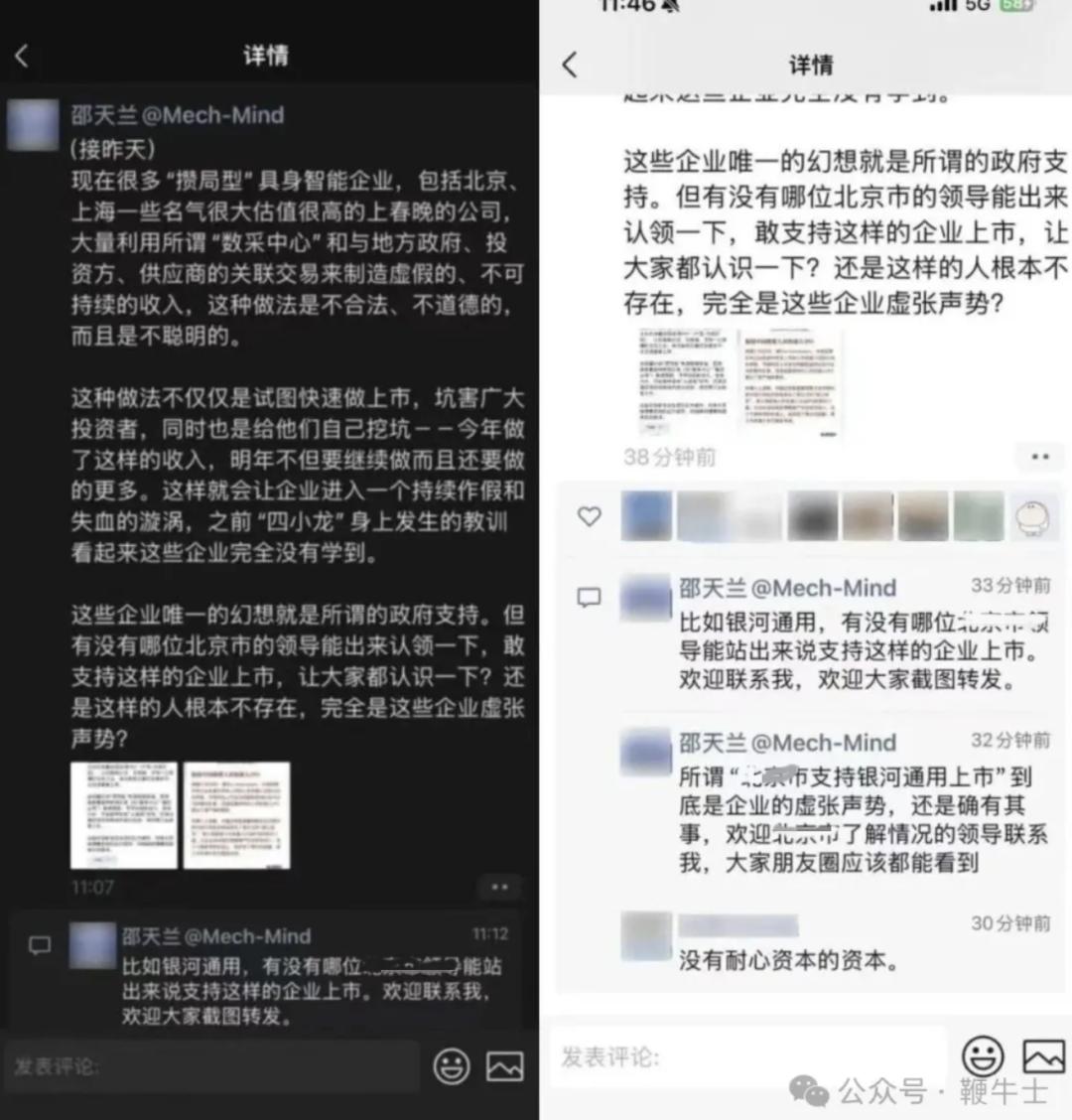
Note these four qualifiers: location (Beijing/Shanghai), high popularity, high valuation, and appearance in the Spring Festival Gala. They are not random descriptions, but precise screening criteria.
The first layer is "appearing in the Spring Festival Gala". Four robot companies appeared on the stage of the 2026 Spring Festival Gala: Unitree, Galaxy Universal, Magic Atom, and Songyan Dynamics. These are the four companies with the highest public popularity.
The second layer is "Beijing and Shanghai". Among the four Gala companies, Unitree is located in Hangzhou and Magic Atom in Suzhou, which are excluded by the location restriction. The remaining two companies in Beijing are Songyan Dynamics and Galaxy Universal.
Why is Unitree excluded? Although 73.6% of its humanoid robot revenue comes from scientific research and education, it is one of the few profitable companies, with a non-recurring net profit of 591 million yuan in 2025. If he attacks Unitree, the other party can directly refute: "I made 600 million yuan, you lost 1 billion yuan, who is arranging events to falsify revenue?" That would be a suicidal attack.
The third layer is "high popularity and high valuation". Among the two remaining Beijing companies, Songyan Dynamics has a valuation of nearly 10 billion yuan, while Galaxy Universal has a valuation of more than 200 billion yuan, with a total of about 70 billion yuan raised through six rounds of financing. Its investors include the National AI Industry Investment Fund, CATL, Meituan, Bosch, Sinopec Capital, and CITIC. In terms of the level of "popularity" and "valuation", Songyan Dynamics cannot compare with Galaxy Universal.
In addition, Songyan Dynamics focuses on consumer-grade products, which is not a typical model of "data collection center + local state-owned assets related-party transaction". Galaxy Universal has a heavier state-owned asset background, with deep ties to CATL (leading a 1.1 billion yuan investment and participating in production line operation). Its structure of "investor is also major customer" is exactly the typical target of related-party transaction doubts.
The fourth layer: Galaxy Universal may be a customer of Mech-Mind, while Agibot is not (instead, it is a customer of Mech-Mind's competitor).
According to a source cited by 21st Century Business Herald, Galaxy Universal is one of Mech-Mind's customers. Mech-Mind is in the upstream, providing standardized "eye-brain-hand" components (3D camera + large model + dexterous hand); Galaxy Universal is in the downstream, purchasing parts and assembling complete machines. If this is true, it means three things:
1. Mech-Mind has first-hand knowledge of Galaxy Universal's purchase volume and payment rhythm. As a supplier, it knows better than any external observer whether Galaxy Universal's orders are sustainable. If Galaxy Universal's revenue is piled up by event-driven arrangements, Mech-Mind itself is the "purchased" link, and it knows it clearly.
2. Attacking a customer is equivalent to actively drawing a clear line. Mech-Mind is telling the market: "One of my customers generates revenue through event-driven arrangements, and I distance myself from it." This can in turn prove the authenticity of Mech-Mind's remaining revenue (50.3% from overseas, 86% from old customers) — this is a strategy of "abandoning the pawn to protect the king", sacrificing one potentially problematic customer to prove the overall revenue quality.
3. Since Agibot is not a customer of Mech-Mind, the latter does not have first-hand information about it.
The fifth layer: no public audited financial statements, and opaque revenue structure.
Listed companies (Unitree, UBtech) have three common "anti-attack moats": audited financial statements, public revenue structure, and sufficient legal resources. To accuse them of "false revenue" requires overturning the audit opinion, which has an extremely high threshold.
As for Galaxy Universal, although 36Kr and other media reported that it may have submitted a confidential listing application to the Hong Kong Stock Exchange, the company has always denied its listing plan, and has not made public its prospectus. It has no public audited financial statements, and its revenue structure is always a black box. At this stage, any public defense about the quality of revenue may become a note in the prospectus and the trigger of inquiry letters — "if you speak, you may violate the rules; if you don't speak, you will be questioned".
This forms a perfect "unfalsifiable" accusation. Shao Tianlan says your revenue is falsified, you cannot refute with an audit report (because you don't have one), and you cannot disclose specific data (because you are in the quiet period), so you can only respond with vague rhetoric.
Attacking a listed company is "playing with open cards" — the opponent's cards are all on the table, and you need solid evidence. Attacking a to-be-listed company is "playing with hidden cards" — the opponent's cards are under the table, and you only need to raise questions.
So you can see, from more than ten companies involved in data collection centers and related-party transactions, Shao Tianlan used four public qualifiers: "appeared in Spring Festival Gala + located in Beijing/Shanghai + high popularity + high valuation", plus two hidden conditions: "is our customer" and "no public audited financial statements", to accurately screen out the only "perfect target" with typical event-driven characteristics, highest valuation, highest popularity, weakest counterattack ability, our first-hand information, and unfalsifiable accusation.
In fact, Agibot also has a high probability of being selected, and attacking your own customer is a bit damaging to personal reputation.
3. Is Galaxy Universal's crisis response up to standard?
Galaxy Universal's response was divided into two waves. Let's look at the first wave first.
In the evening of September 10, less than 24 hours after the denunciation was spread, Galaxy Universal released a statement on its official WeChat account titled "Embodied Intelligence is a Long-distance Race, We Only Race Against Time". The full text is less than 1,000 words, does not mention the name "Mech-Mind", and does not list any financial figures.
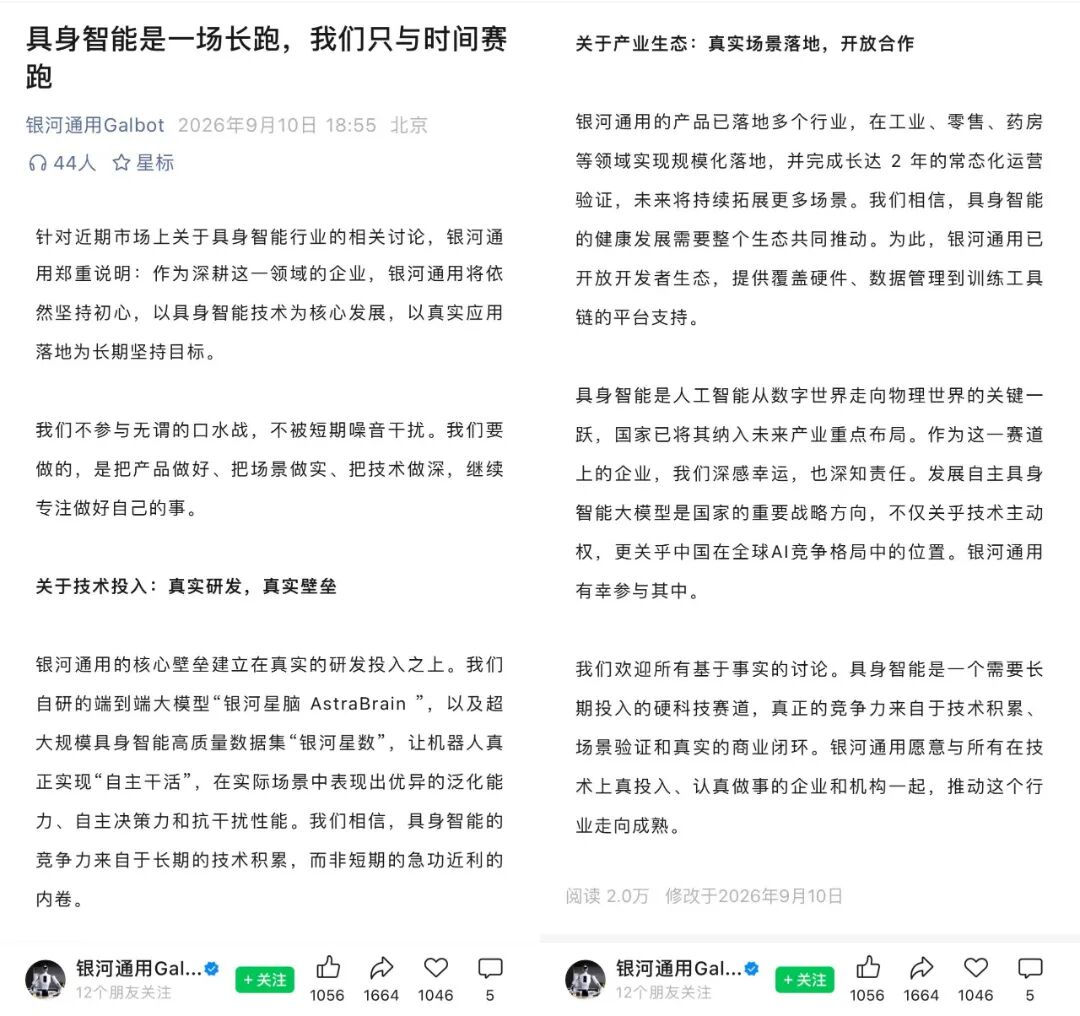
This statement is actually well written, containing 4 layers of structure:
The first layer is issue decoupling. "We do not engage in unnecessary verbal battles, and will not be disturbed by short-term noise." — it does not respond to specific accusations, and does not even mention the name of the other party. This is a standard crisis public relations action: once you refute point by point, you are equivalent to recognizing the issue framework set by the other party.
The second layer is keyword hedging. The core keyword of Shao Tianlan's accusation is "false revenue", and the word "real" appears at least five times in Galaxy Universal's response — "real R&D, real technical barriers, real scenario implementation, real business closed loop". The accusation says you are fake, the response repeatedly says I am real, but does not provide any verifiable evidence.
The third layer is dimensionality upgrading defense. "Developing independent embodied intelligence large models is an important strategic direction of the country, which is not only related to technical initiative, but also related to China's position in the global AI competition pattern." — questioning me is questioning the entire industry? This statement has extremely strong defensiveness, but the logical leap is also obvious: the national strategy supports the industrial direction, and never endorses the revenue quality of any single