The wave of bankruptcies of gold chain stores has arrived.
Gold is a relatively standardized product, which means that whoever can appear in front of consumers more frequently and conveniently will capture the market. Therefore, China's jewelry industry has long been deeply fond of the franchise model. But this logic has completely failed in the era of high gold prices.
Three Different Ways of "Collapse", All in the Same Industry Winter
The more valuable gold is, the harder it is for gold sellers to make a living.
On the evening of September 10, a risk warning announcement from Northeast Securities confirmed the news that Qianye Jewelry had encountered a major crisis. The announcement stated that the company and other relevant personnel of Qianye Jewelry were unable to contact Lin Mingjie and Gao Xiaosong, the actual controllers of Qianye Jewelry, for unknown reasons.
Qianye Jewelry is a Beijing-based brand listed on the New Third Board, which started with design and once had Hollywood star Anne Hathaway as its brand spokesperson. Northeast Securities is its sponsoring broker. Some time ago, people posted articles online one after another claiming that Qianye Jewelry had defaulted on their salaries.

At present, the products in the official flagship stores of Qianye Jewelry on platforms such as Tmall, JD.com and Douyin have been basically removed from shelves. Some offline stores are still open, but many have already been vacated and closed. According to the introduction on its official Xiaohongshu account, Qianye has more than 500 stores in over 40 cities across China.
The financial report of Qianye shows that in the first half of 2026, the company's revenue was 213 million yuan, down 26.07% year on year; as of the end of June, the total liabilities reached 290 million yuan.
The biggest problem lies in the depletion of sales under high gold prices and gold consumption tax.
Qianye's inventory is as high as 1.535 billion yuan, accounting for 96.56% of its total assets, almost all of which is tied up in gold and jewelry inventory. The liquid cash on the books has been nearly exhausted. The monetary funds are only 933,700 yuan, down 74.58% from the end of 2025. The inventory turnover rate is only 0.23 times, and the turnover days exceed 1500 days.
Previously, Qianye has been gradually reducing costs. With the implementation of the new gold tax policy, Qianye shrank the live streaming channels with high costs. As a result, online revenue shrank significantly, from nearly 70% of the total revenue at one point to 9% in the first half of this year.
This is not the first collapsed gold chain brand.
On September 8, Cuihua Jewelry, a long-standing player in the A-share gold sector, received a prior notice of termination of listing from the Shenzhen Stock Exchange for failing to disclose its annual report within the specified time limit.
As of August 31 before the trading suspension, this "China Time-honored Brand" which originated in Shenyang and was founded during the reign of Emperor Guangxu, had its closing market value below 500 million yuan for 18 consecutive trading days, locking in the mandatory delisting due to trading rules in advance.
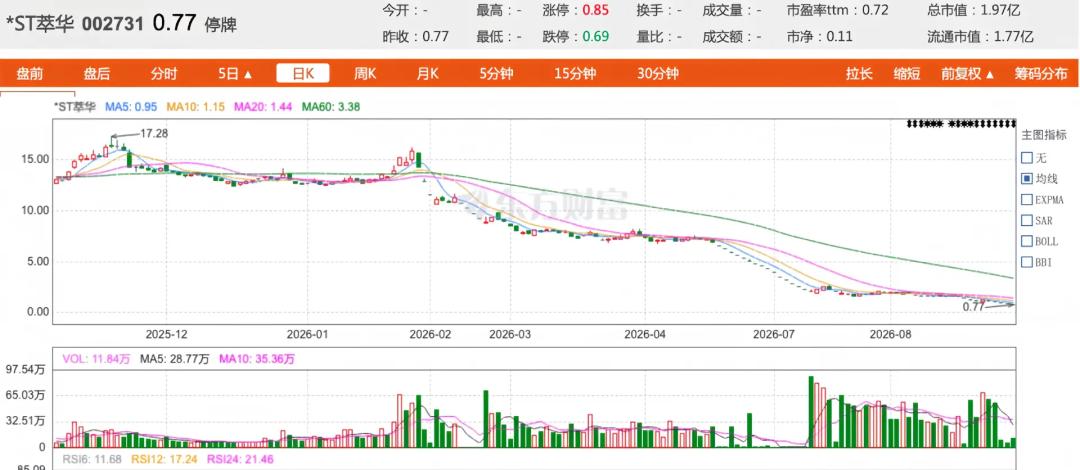
The share price of Cuihua Jewelry plummeted, Source: Eastmoney.com
The direct trigger for Cuihua's delisting was the delayed release of its annual report, but it was filed for investigation by the China Securities Regulatory Commission in February on suspicion of illegal information disclosure.
Cuihua's main business is the wholesale of gold ornaments, with a gross profit margin of only about 13% all year round. In recent years, its inventory has gradually accumulated. The company's book inventory is as high as 3.723 billion yuan.
However, according to the latest audit, "there is a significant difference between the actual inventory quantity and the closing quantity in the financial statements". In other words, a large amount of gold in the warehouse has disappeared, which can be called the "Zhangzidao incident" in the gold industry.
The starting point of this collapse was actually the cross-border M&A of lithium salts that bought at a high point in 2023. At that time, the lithium price had fallen from its peak. This cross-border move not only failed to save the company, but also dragged down the cash flow of its main business, and eventually dragged this old brand into the delisting vortex.
Even Hangmin Jewelry, which has a complete industrial chain, recently closed its online stores, citing "the company's strategic adjustment and optimization of online business".
Hangmin Jewelry is more of an active choice to shrink. In the first half of the year, the sales volume of gold ornaments was 19.779 tons, down 27.40% year on year; the main business revenue of gold business was 1.854 billion yuan, down 46.09% year on year.
The half-year report attributed this to the fact that the gold ornament business was affected by the dual impacts of sharp fluctuations in gold prices and tax policy adjustments, and the company actively adjusted its product structure amid weak terminal demand.
Hangmin closed its inefficient e-commerce stores and turned to products with high processing fees and high added value, making the gold business no longer the largest source of revenue.
There are three different ways of collapse with different postures, but they all share the same macro background: gold prices fluctuate at a high level, jewelry consumption plummets, while the consumption of gold bars and gold coins soars against the trend.
In January, the international gold price broke through $5500 per ounce, hitting a record high, and the listed price of domestic brand gold ornaments once stood at 1700 yuan per gram.
Data from the China Gold Association shows that in the first half of the year, the domestic gold consumption was 511.412 tons, up 1.23% year on year; among which, the consumption of gold ornaments decreased by 33.88% year on year, and the consumption of gold bars and gold coins increased by 28.42% year on year.
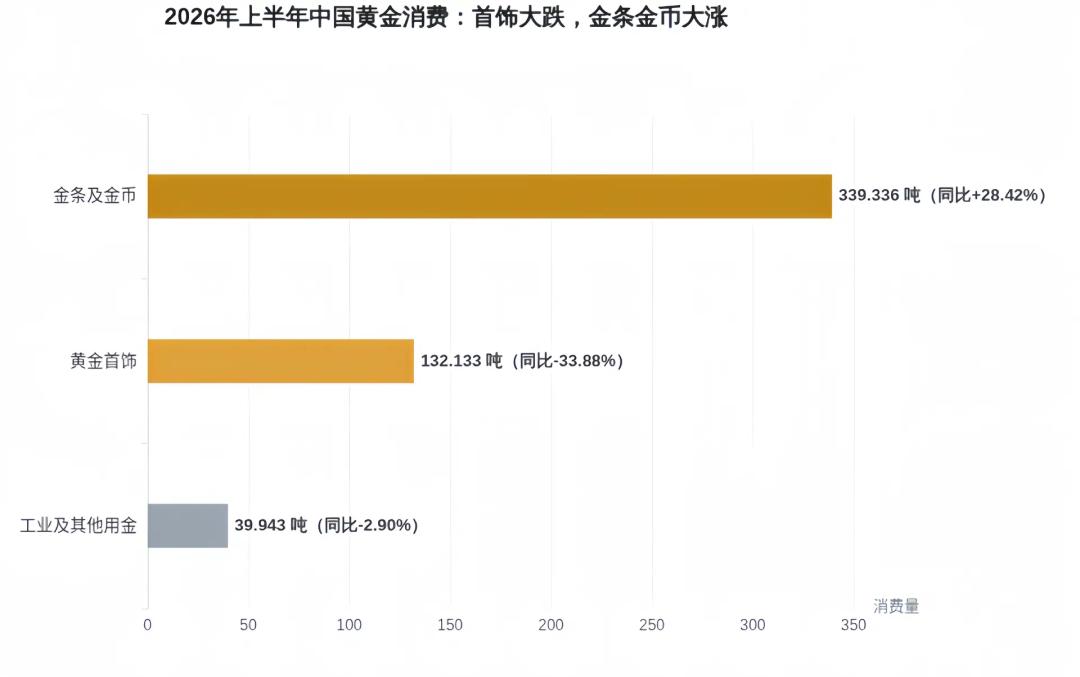
Data source: China Gold Association
Gold is still very popular, but people no longer buy gold ornaments, and turn to gold bars and gold coins with stronger investment attributes and higher value preservation.
Gold stores have always had no trouble with their performance when gold prices are stable and rising moderately. But the bull market has unexpectedly brought about a devastating blow.
Many New Stores Failed to Survive to Maturity
In the first half of this year, the performance of listed gold and jewelry companies was under pressure across almost the entire industry.
Among them, traditional leading brands are under the greatest pressure. Both the revenue and net profit of Chow Tai Seng fell by more than 20%; the revenue and net profit of Lao Feng Xiang both fell by more than 40% year on year.
In the first half of the year, the revenue of Chow Tai Seng's franchise channels plummeted from about 2.4 billion yuan in the same period of the previous year to 707 million yuan, a year-on-year plunge of 70.84%, and the proportion of franchise channel revenue dropped from 52.76% to 19.42%.
Ancient-style gold still seems to be performing well. In the first half of the year, Lao Pu Gold's revenue was 19.808 billion yuan, up 60.30% year on year, and its attributable net profit was 4.267 billion yuan, up 88.20% year on year. But as we analyzed in previous articles, if we look at the data of the first and second quarters, the growth of Lao Pu Gold mainly came from the first three months when the gold price soared, and the quarter-on-quarter decline in the second quarter was very obvious.
The reasons for the sharp drop in the performance of traditional brands are, on the one hand, the overall cold of gold jewelry consumption, and on the other hand, the rapid change of terminal channels.
Financial data shows that among the 9 companies including Chow Tai Fook, Lao Feng Xiang, Chow Tai Seng, Yuyuan Inc., ZLF, China Gold, Luk Fook Holdings, Mengjinyuan and CHJ, only CHJ increased the number of stores against the trend, and the total number of stores of the other 8 companies dropped from 33,828 at the end of June last year to 29,047 at the end of June this year.
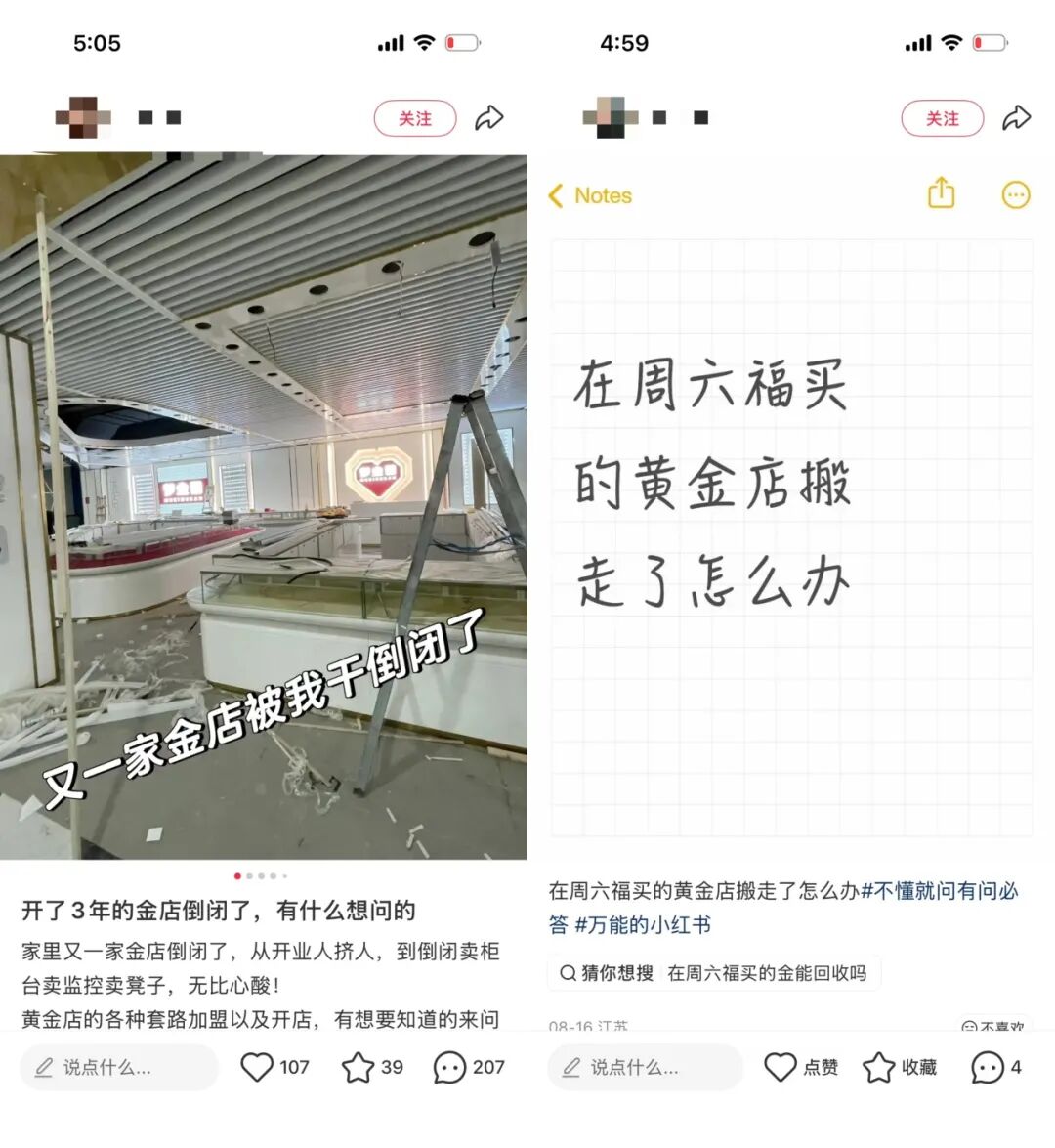
In other words, within one year, the number of stores of listed gold and jewelry enterprises decreased by 4,781 on a net basis.
According to statistics from other media, in the first half of 2026, the number of franchise stores decreased by more than 2,600 on a net basis.
The statistical calibers of these two data are different, but in fact, this round of store closures is also dominated by franchise stores. Among the 473 stores that Chow Tai Seng reduced on a net basis in the first half of the year, 454 came from the franchise system; Lao Feng Xiang closed a total of 342 low-efficiency franchise stores in third- and fourth-tier cities in the first half of the year, accounting for about 63% of the total number of closed franchise stores.
At present, the channel structure of listed gold and jewelry companies is dominated by franchise stores, and the proportion of franchise stores of brands such as Mengjinyuan, China Gold and ZLF is above 90%.
As for the reasons for store closures, some official announcements gloss over it, saying "In the first half of 2026, the company adjusted its business outlets according to the regional market situation". There are also companies like Chow Tai Seng that directly stated that "the main factor is the sharp fluctuation of gold prices, the willingness of downstream franchise customers to restock continues to be low, and they generally adopt the strategy of destocking; secondly, the company actively closes inefficient franchise stores to improve the overall quality of channels."
On the whole, franchise stores and brands are in a cooperative relationship. When the market is good and profitable, they open stores rapidly, and of course they will close stores rapidly when they can't make money.
Song Jiangzhen, director of the Market Research Center of Guangdong Southern Gold Market Research Institute, said in an interview with the media: "Many small franchisees do not have hedging tools and dare not restock in large quantities at high prices, so they generally choose the conservative strategy of 'destocking and purchasing less'. In contrast, the capital and inventory of self-operated stores are covered by listed companies, which have large-scale capital and supply chain hedging means, can allocate inventory across cycles and bear phased losses, so more franchisees are the ones that collapse."
Since leading brands began to expand their channels in 2019, the total number of stores of the above 9 companies has increased from more than 20,000 (several of them were not listed at that time, and the data was estimated based on public reports) to nearly 30,000 now. From the industry-wide expansion in 2022 and 2023 to the brake on expansion in 2024, the market has actually gone through a roller coaster ride.
Many new stores in this process did not go through the cultivation period. Previously, there was a saying in the industry that the average cultivation period for new gold jewelry stores was about 6 years to reach 90% of the level of mature stores.
The Gold Bull Market "Kills" the Franchise Model
China's jewelry industry has long been deeply fond of the franchise model.
The proportion of franchise stores of leading gold jewelry brands generally reaches more than 90%. Chow Tai Fook, with a franchise rate of more than 70%, seems like an outlier among its peers.
Why? Why not follow the global high-end luxury jewelry companies to restrain store opening, and then attract customers from the whole city and even surrounding provinces?
This is closely related to the characteristics of the industry: the growth rate of the whole industry is equivalent to the growth rate of China's GDP. The high-end luxury jewelry market is almost monopolized by European and American brands; in terms of consumption volume, under the influence of Chinese traditional customs, gold ornaments dominate jewelry consumption. Data from IBIS World shows that the sales proportion of gold ornaments reaches 60%.
Gold is the real battlefield for Chinese and Hong Kong-funded jewelry companies.
Gold is a relatively standardized product, which means that whoever can appear in front of consumers more frequently and conveniently will capture the market.
After the epidemic, this logic of franchise expansion was further amplified.
Chow Tai Fook, the "latecomer" in franchise rate, clearly stated in 2022: "We believe that third-tier and lower-tier cities and towns have huge store opening potential". In the 2022 fiscal year (as of March 31, 2022), it opened more than 1,300 stores on a net basis.
Brand owners sink rapidly with very low capital investment by relying on provincial agents and franchisees, and franchisees obtain customer flow with the help of brand endorsement.
At that stage when the gold price had not soared and consumer confidence was still recovering, brands and franchisees had the same goal — opening stores means growth. This model seemed to be a win-win situation.
But this logic has completely failed in the era of high gold prices.
The gram-weighted jewelry of the chain franchise is "squeezed from both sides".
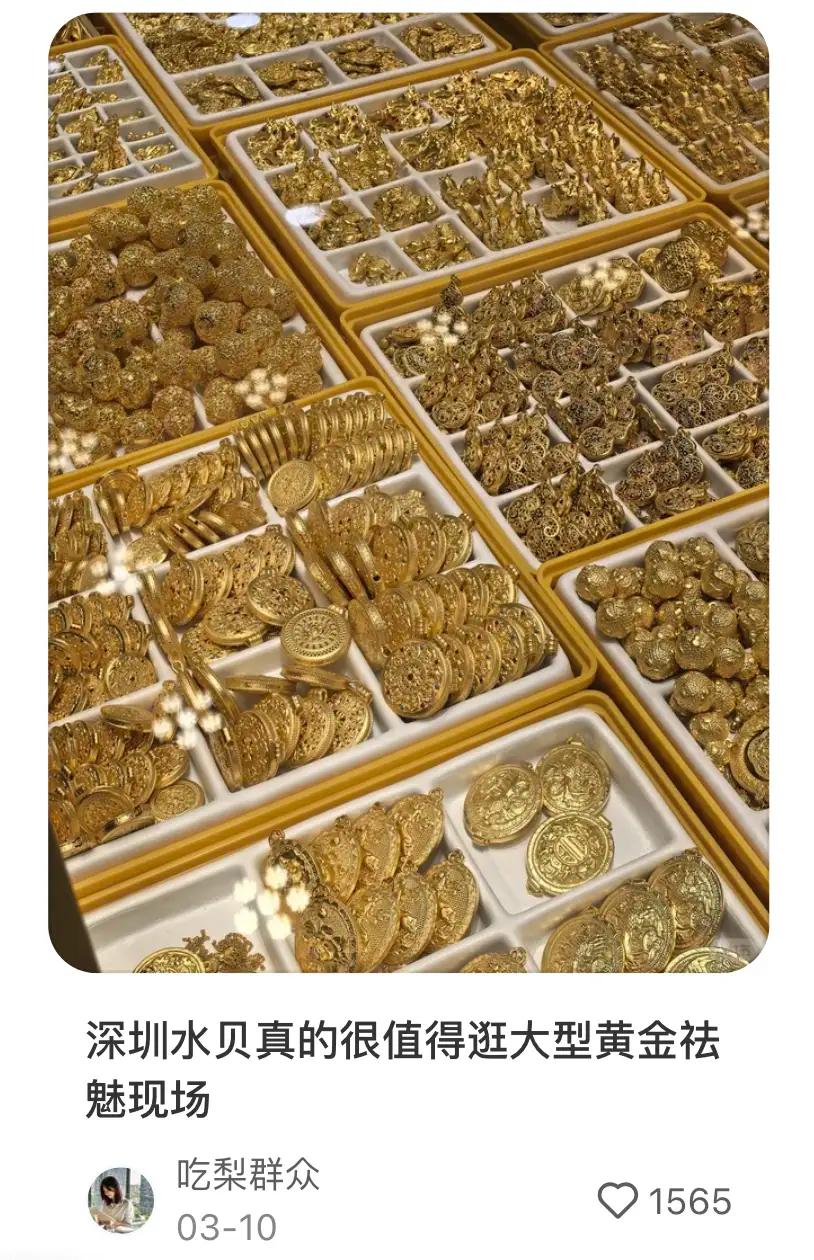
Price-sensitive consumers turn to Shuibei, bypass traditional franchised gold jewelry brands, and directly break the brand premium; consumers pursuing design sense turn to Lao Pu Gold. The latter's "fixed price" model ensures the surge of revenue and net profit, and its gross profit margin remains above 60% for a long time. However, the gross profit margin of traditional brands such as Chow Tai Seng is only in the range of 15%-25%.
The high gold price directly raises the purchase threshold, and users can only reduce their purchases. The gram weight of "three golds"