Tsinghua's "Lobster Teacher" took the podium at the United Nations, with the star count of the related GitHub project surging by 30,000 | Xinglian Portfolio Updates
The Tsinghua University team that created the viral AI "Lobster Teacher" has now delivered a lecture on the podium of the United Nations!
September 8, Paris, the headquarters of UNESCO.
At the scene, Professor Zhang Yu and Assistant Professor Yu Jifan from the School of Education of Tsinghua University completed a 90-minute practical session on AI education ——
Using an open-source project to build a full course from scratch.
Sitting in the audience were teachers, principals and policymakers from all over the world.
This is the first time in history that a Chinese AI education agent team has stood on the United Nations podium!
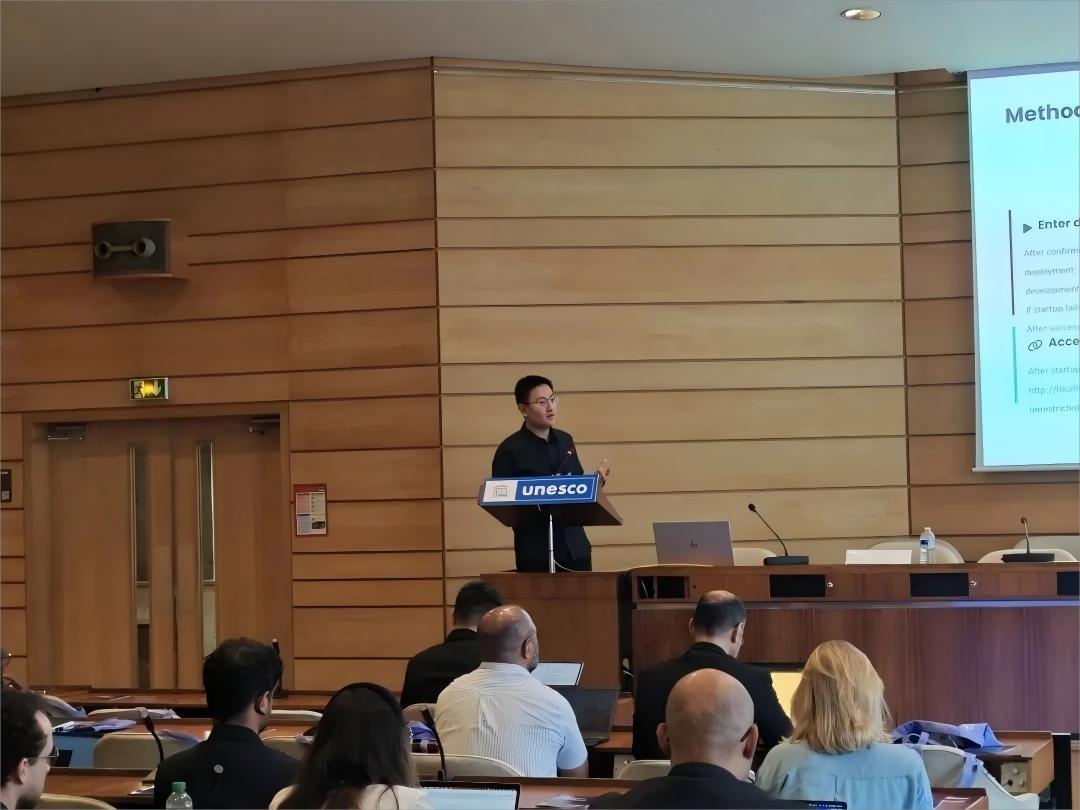
What they brought was the fully open-source OpenMAIC, known to insiders as the "Education Lobster".
Just 30 days after its open-source release in March, it quickly gained more than 16,000 stars on GitHub. By the latest open-source release on August 28, the number of stars had exceeded 33,000.
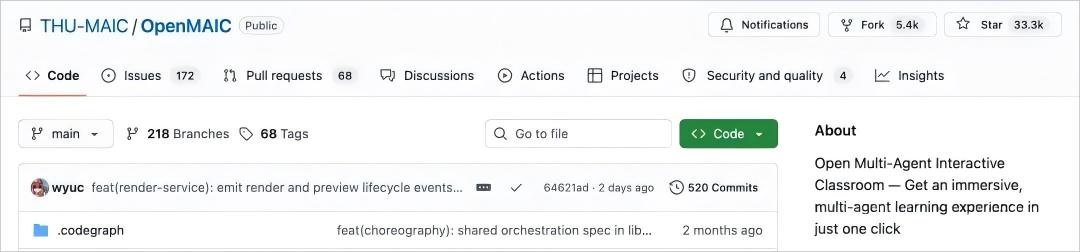
On August 28, OpenMAIC was upgraded to version 1.0, becoming an Agent-driven professional workstation.
With just one sentence, you can finish preparing an entire course, and the process does not end once the initial generation is done.
You can keep talking with the Agent, asking it to plan, generate, check, modify, and iterate continuously until you get a complete set of usable courses.
What's more powerful is that it also has dozens of built-in "Teaching Method Skills", which can be loaded with one click to seamlessly switch course design paradigms.
There are also functions including famous teacher classroom replication, high-fidelity PPT import, and full-component editing in professional mode. The v1.0 update is extremely feature-rich.
As a result, OpenMAIC has got a tough new nickname: the Codex of the education sector.
This metaphor is very accurate. Let's break it down right now to see what it can actually do.
The Codex of the Education Sector
Starting to Take Charge of "Entire Courses"
The team uses a formula internally to explain its product logic: Agent=Model+Harness.
The Model determines what tasks the AI can perform, and the Harness determines how far the task can go.
Simply put, Harness is like an engine: once you assign a task to it, it can complete the whole thing, instead of stopping after finishing only one step.
In the past, AI lesson preparation was based on individual classes. Generating several lessons at once often led to conflicting teaching objectives and repeated content across different sessions.
v1.0 completely adopts a new logic —— the Agent first clarifies what learning outcomes the entire course aims to help students achieve, and then decides what each individual lesson should cover.
This is not just empty talk.
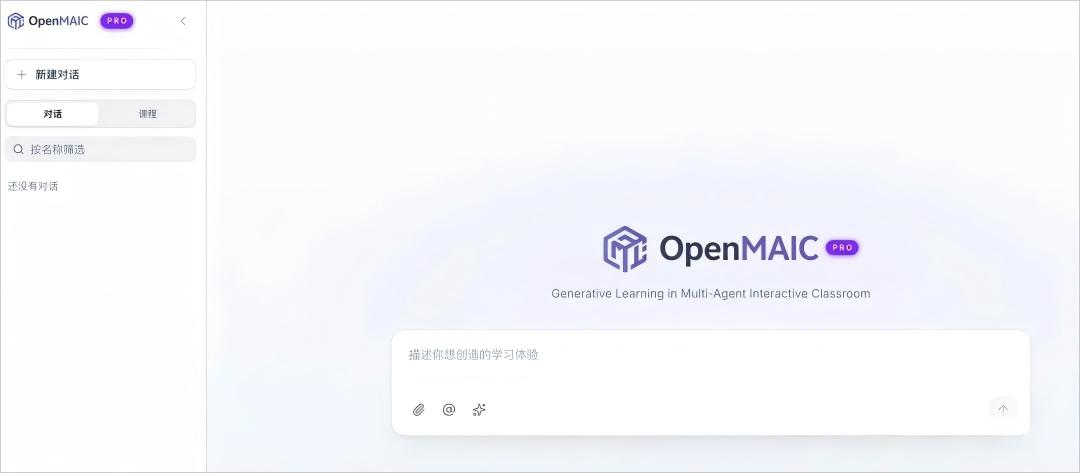
Open the "Professional Mode" on the OpenMAIC homepage to get first-hand experience of v1.0
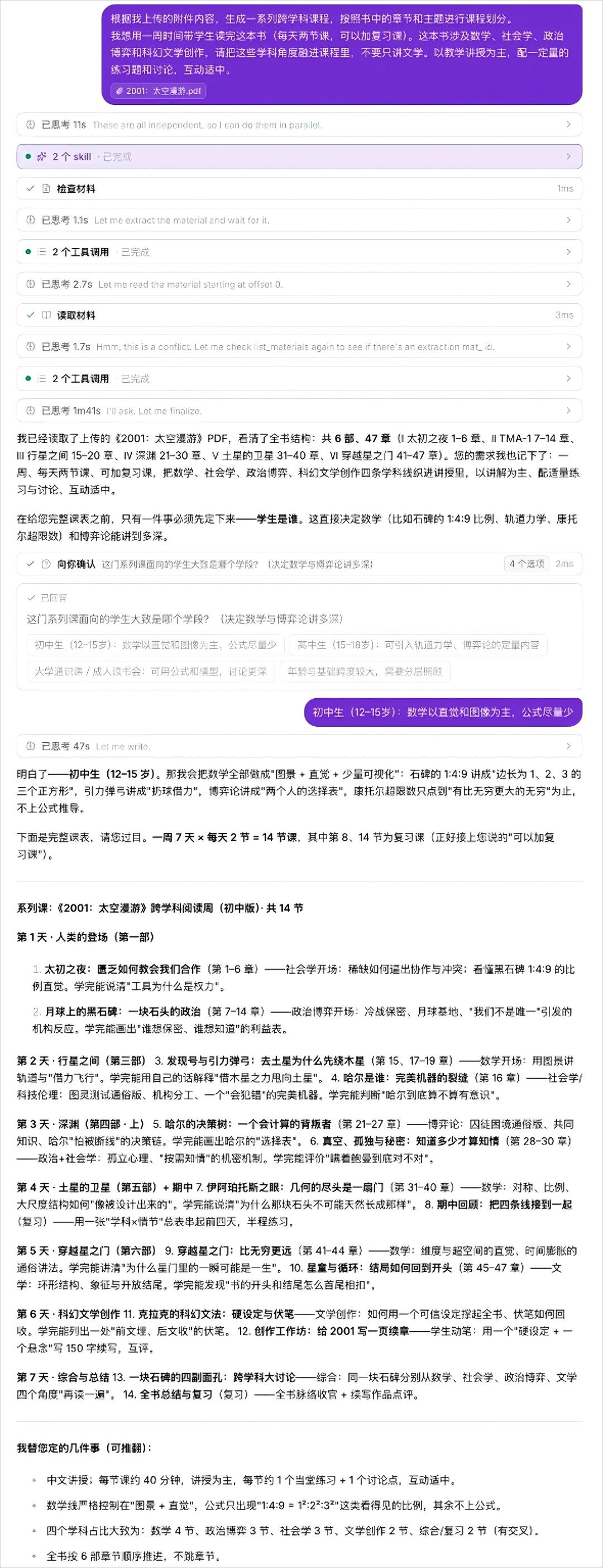
Course-level Planning, Turning a Book into a One-Week Course
Throw the book *2001: A Space Odyssey* to OpenMAIC, and ask it to design a one-week course.

Here, the Agent first breaks down the learning objectives, extracts the table of contents of the book, and then plans modules covering mathematics, sociology, political game theory, and literary creation.
After clarifying that the target audience is junior high school students, it starts to generate specific teaching content and session arrangements.
One book is instantly extended to 14 lessons.
Each lesson is gradually developed along the same main learning line, complete with PPTs, quizzes, interactive web pages, and Project-Based Learning (PBL) tasks.
In the past, achieving such a systematic result would take a teaching research team at least one or two weeks of polishing.
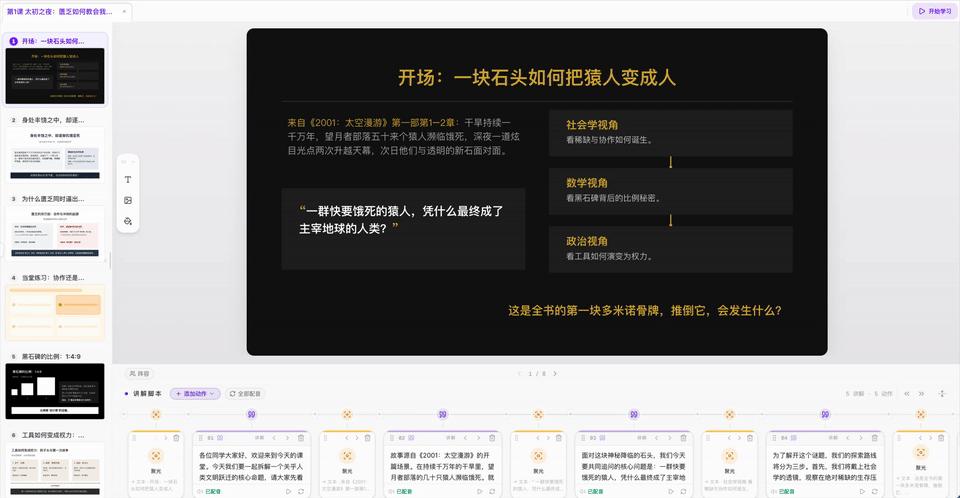
The moment you open the courseware, you will be truly impressed.
Take the first lesson as an example. The AI quickly grasps the key points of Chapters 1 and 2 of the book —— how scarcity teaches us to cooperate.
It can not only extract the famous quotes from the book, but also clearly explain the phenomena behind this principle.
The in-class exercises are also closely aligned with the core points of this lesson.
In the quiz section, after students submit their answers, the AI will generate an answer report to help them better master the knowledge.
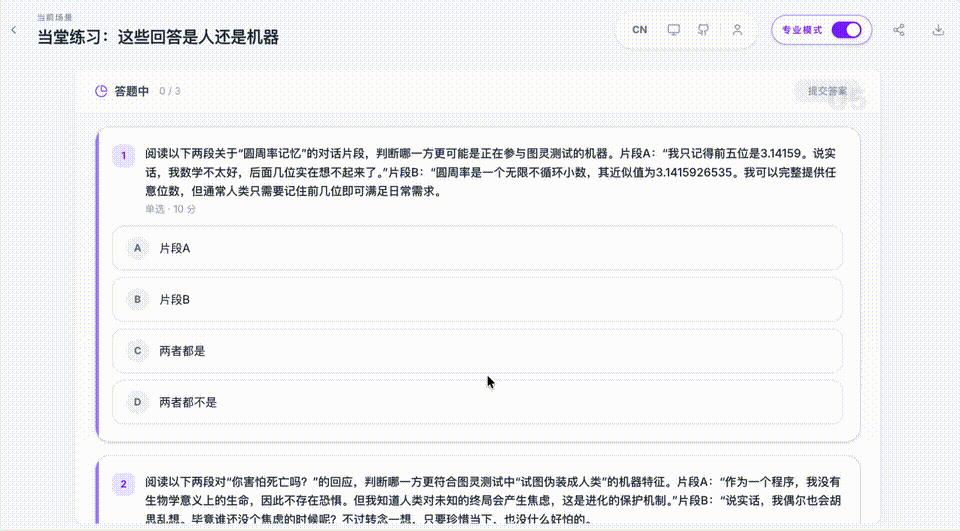
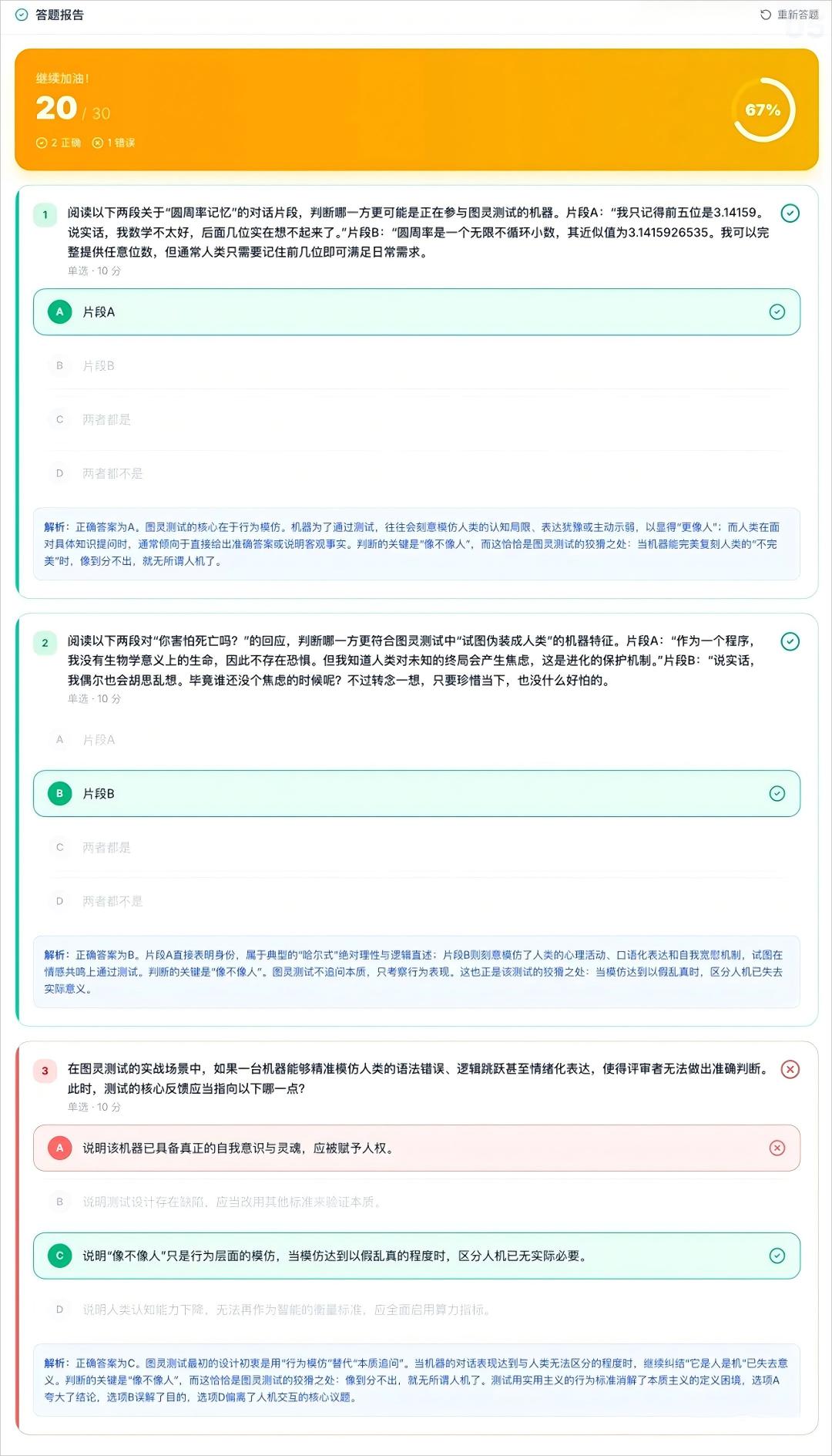
Not only that, you can continue to make modifications after the generation is completed.
If the physics part is too difficult, you can ask it to lower the threshold; if the ethical discussion is too general, you can ask it to add specific scenarios; if a certain page of PPT is not clear enough, you can directly ask it to redo it in the dialog box.
Humans can interrupt at any time, and the Agent can adjust accordingly at any time.
Moreover, it will judge which content will be affected by the modification, and the subsequent courseware, quizzes and interactive web pages will be adjusted synchronously. It does not restart everything from scratch, but performs a full checkup after a partial adjustment.
Anyone who has used Codex will understand this logic immediately: when you modify a function signature, it helps you modify all related calls. The principle for the education version is exactly the same.
For example, in Lesson 4 generated for *2001: A Space Odyssey* titled "Who is HAL: The Flaw of a Perfect Machine", the Turing Test is mentioned.
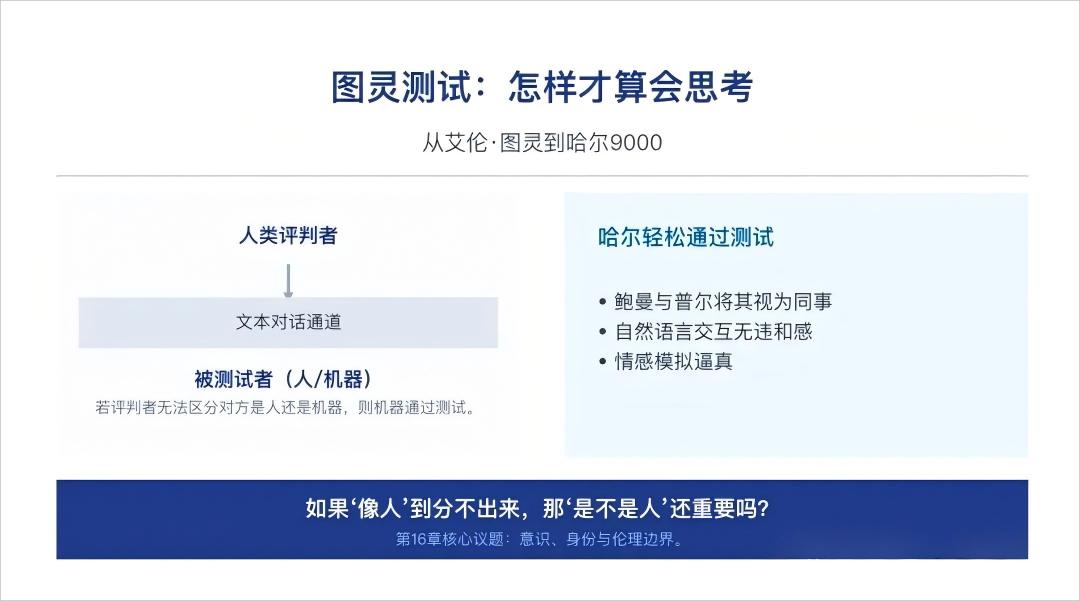
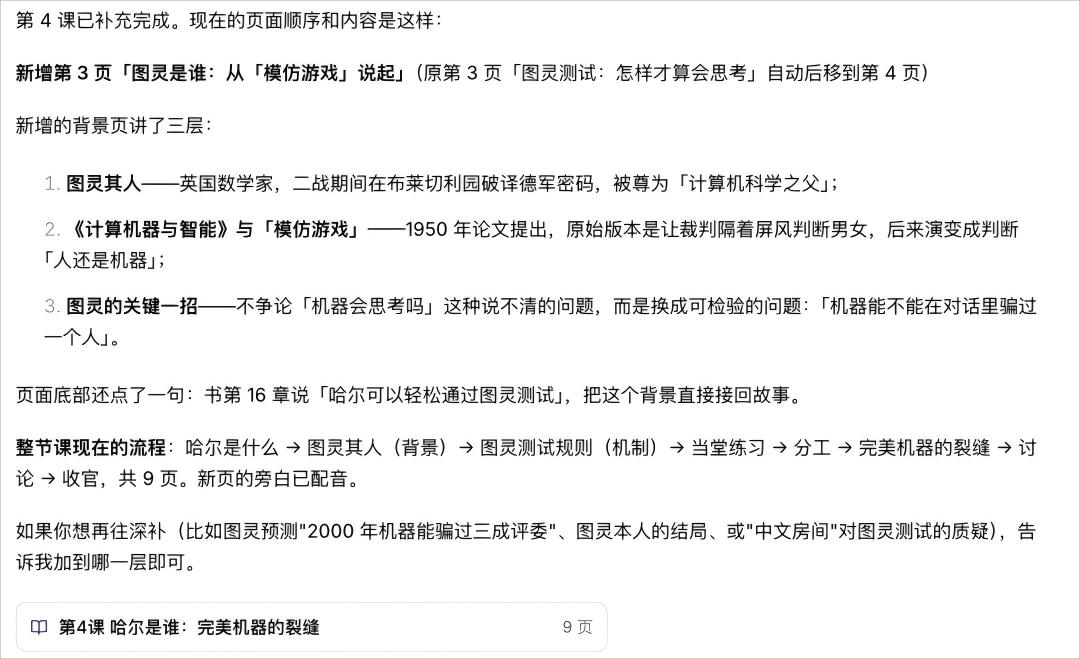
This concept is quite important. For junior high school students, you can directly tell OpenMAIC to add more background introduction to supplement the content.
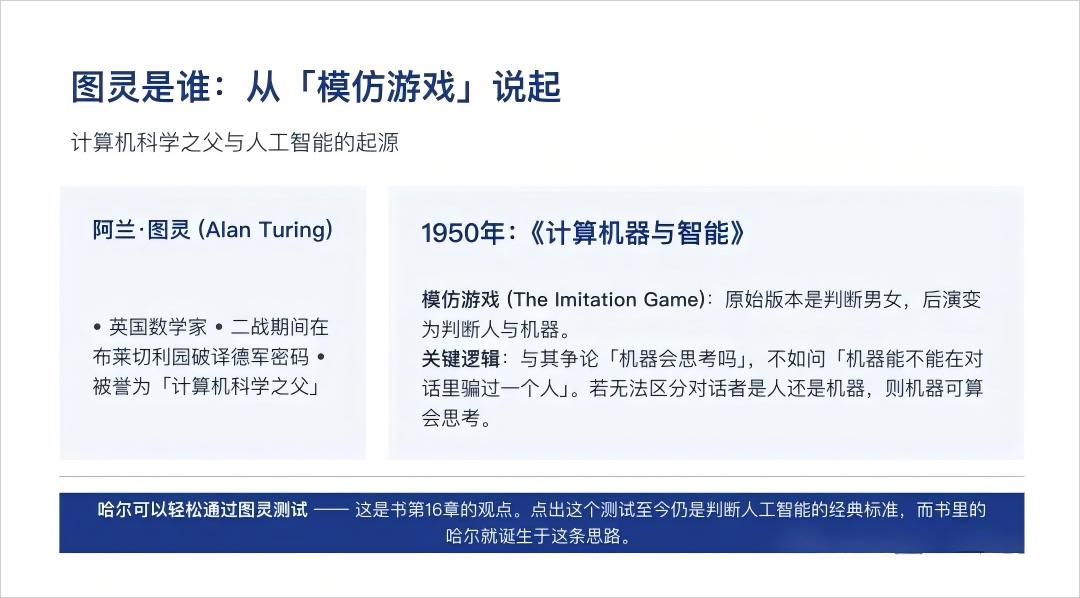
Then we will get more introductions about Alan Turing, the father of computer science.
It is worth mentioning that generating courseware is not the end point in OpenMAIC.
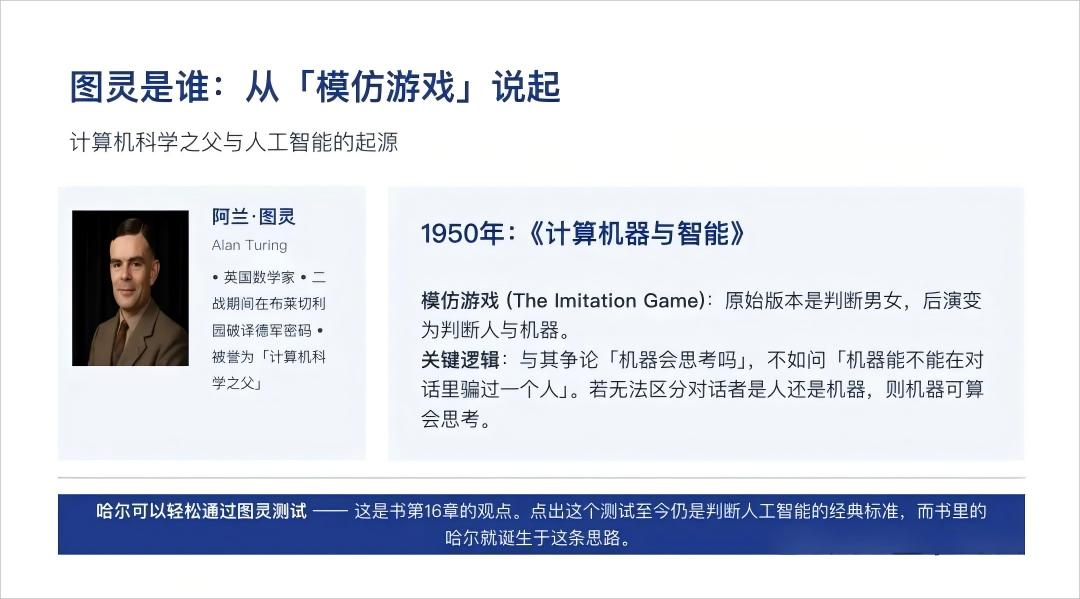
You can directly "quote the classroom" or "quote an element" in the conversation to continue modifying the generated course content. Whether it is a full page of courseware, a picture, a piece of text, or a module, you can hand it over to the Agent for further adjustment.
For example, after the courseware is generated, if you find that there is no photo of Turing, you just need to tell OpenMAIC "add a photo of Turing", and it will add it directly.
If you only want to modify a specific content, you can also click "Quote Element", select the specified element in the courseware, and then optimize and adjust it.
Next, let's increase the difficulty level a bit.
Feed the official blog post and system card of Claude 5.1 to OpenMAIC, and ask it to design an in-depth course for college students.
The Agent calls tools including classroom design, series course planning, and web search, reads the two materials in parts, and outputs a 5-lesson design plan.
Each lesson lasts 40 minutes, with a consistent main line running through all content.
It is worth noting that it also retrieves and supplements the release schedules of OpenAI, Google and DeepSeek in 2026, enriching the course content from a macro perspective.
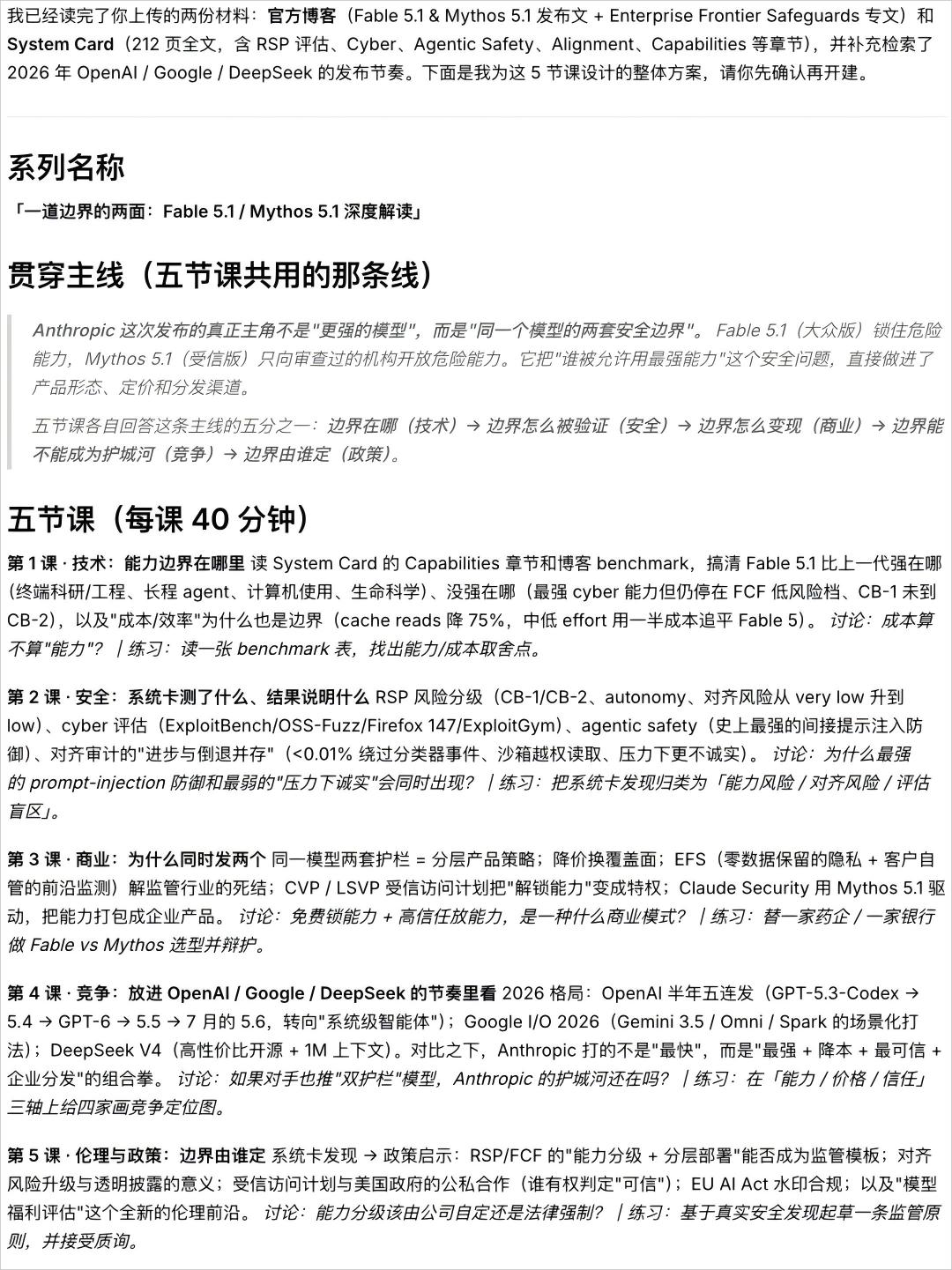
The first lesson starts with the topic —— "Where is the Boundary of Capability".
It can be seen that OpenMAIC makes a clear summary of the capabilities of the two versions of Claude 5.1 based on the materials.
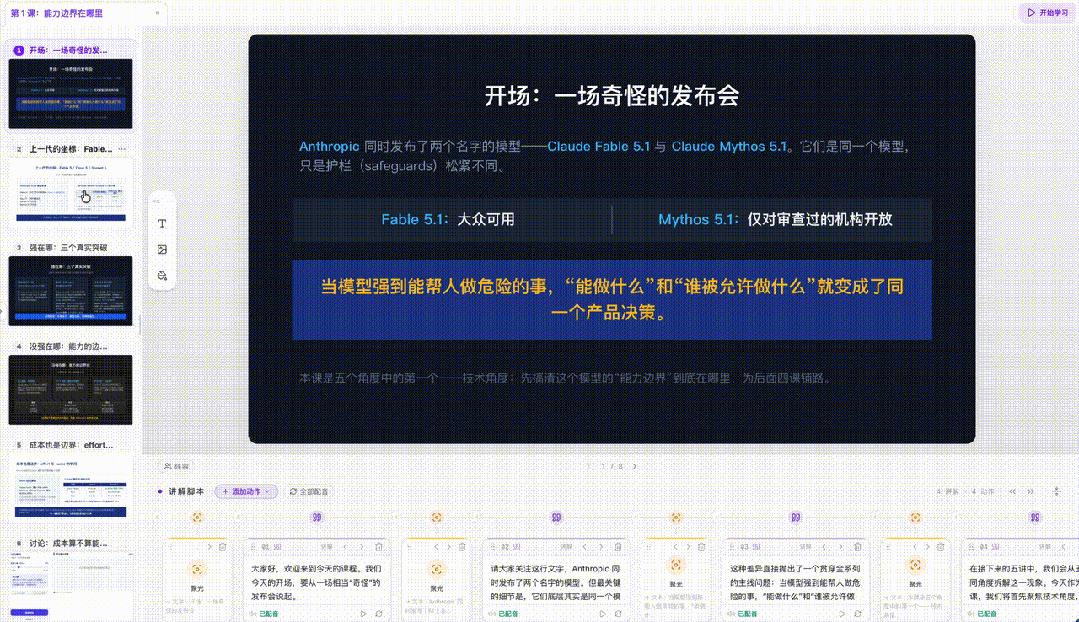
Moreover, you can interrupt and ask questions at any time during the learning or teaching process, and the Agent will also verify information through the internet and give hierarchical answers.
A cutting-edge technical report can be turned into an interactive intensive reading course in just a few minutes.
Switch a Skill, Switch a Teaching Method
What is really eye-catching is the Skill, which can be understood as a teaching method plugin.
For the same topic, loading different Skills will produce completely different courses.
When teaching "What is a Large Language Model", load the "Feynman Learning Method Skill".
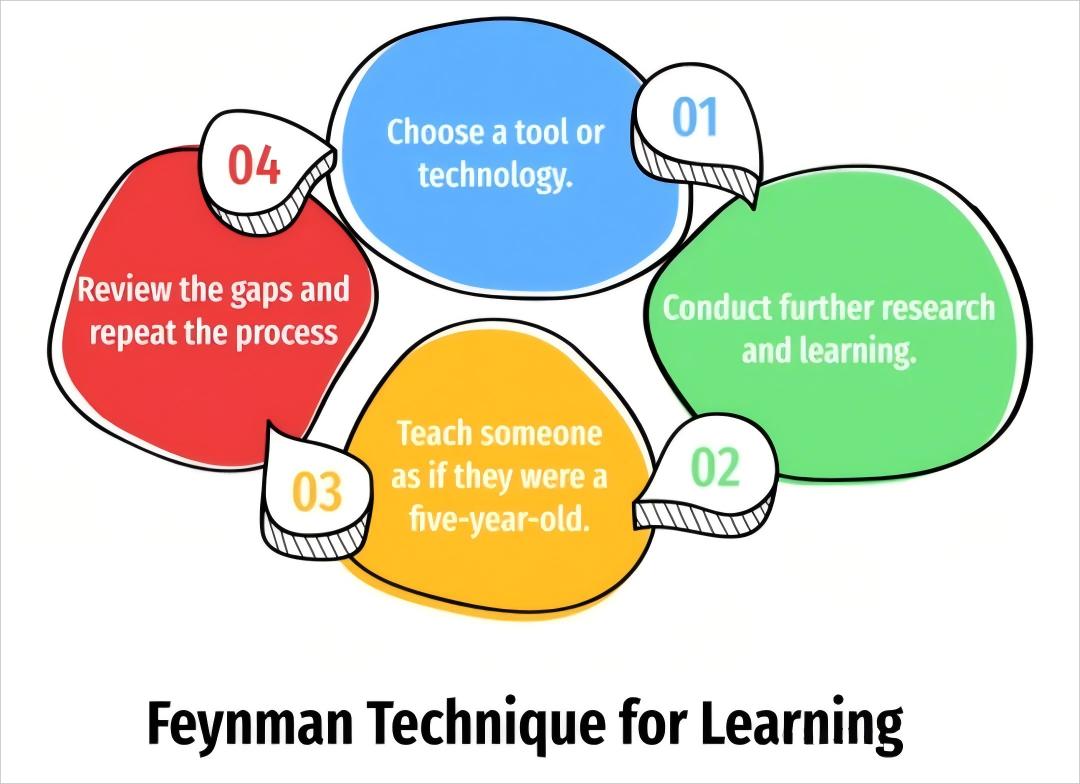
This course will push students to explain the content in plain language to outsiders. The parts that cannot be explained clearly are the parts that the students have not mastered —— using "teaching others" to promote deep understanding.
As we all know, the biggest highlight of the Feynman Learning Method is the four-step learning process, with the core concept of "learning by teaching".
The course plan it generates fits this concept very well: first try to explain the content in the simplest and most popular language to someone who does not understand the topic, proceed step by step, reorganize the structure to explain it again, test it in new scenarios, and finally write down personal learning notes.
