Hard Krypton On-site Coverage at IFA — AI Hardware No Longer Only Answers Questions
If consumer electronics shows in the past two years saw all products rushing to prove they are "AI-enabled", a notable shift is taking place at IFA 2026: AI is no longer just an add-on function stuffed into TVs, refrigerators and computers, but has started to become the underlying logic for hardware operation.
From September 4 to 8, IFA 2026 was held in Berlin, Germany. According to official data, this edition of the exhibition gathered more than 1,900 brands, with robotics, artificial intelligence, smart home and even flying vehicles as key highlights on display.
What deserves more attention than the number of new products, however, is that the competition for AI hardware has entered a new phase with fundamentally changed priorities.
In the past, manufacturers competed to connect to larger models and generate more fluent text; today, the industry is starting to answer more specific questions: Can AI run independently on local devices? Can it perceive the physical world and execute tasks? Can it help users save time, reduce costs, and even enhance human physical capabilities in real-world scenarios?
From agentic PCs on the desk to exoskeletons worn on the body, AI is stepping out of the chat box and into the real world.
AI Goes Local: PCs Are Evolving From Tools to "Agents"
In this wave of AI development, personal computers once found themselves in an awkward position.
On one hand, PC manufacturers have been rolling out AI PCs intensively, with the AI computing power of processors continuously increasing; on the other hand, when users actually use large models, most of the computing still takes place on the cloud. PCs are more like entry points connecting to AI services, rather than independent devices that host AI locally.
Yet the cloud is not the optimal solution for all scenarios. For ordinary consumers, uploading data to the cloud may only raise privacy concerns; for industries including government affairs, healthcare, finance, and scientific research, whether data can leave local devices is often a clear compliance red line. In addition, when an agent needs to run for a long time, frequently call models to complete tasks and process internal enterprise data which consumes more tokens, the latency and cost of cloud inference will be further amplified.
Therefore, a clear direction at this year's IFA is to keep more AI tasks on local devices and complete them through end-side models with larger parameters and higher intelligence. GMK made its global debut of the desktop AI supercomputing workstation EVO-X5 Pro at the exhibition, equipped with the AMD Ryzen AI Max+ PRO 495 processor. It is the world's first agentic PC that can fully run 300B parameter-level large language models (LLM) offline, and is defined as an Agentic PC for the agent era.
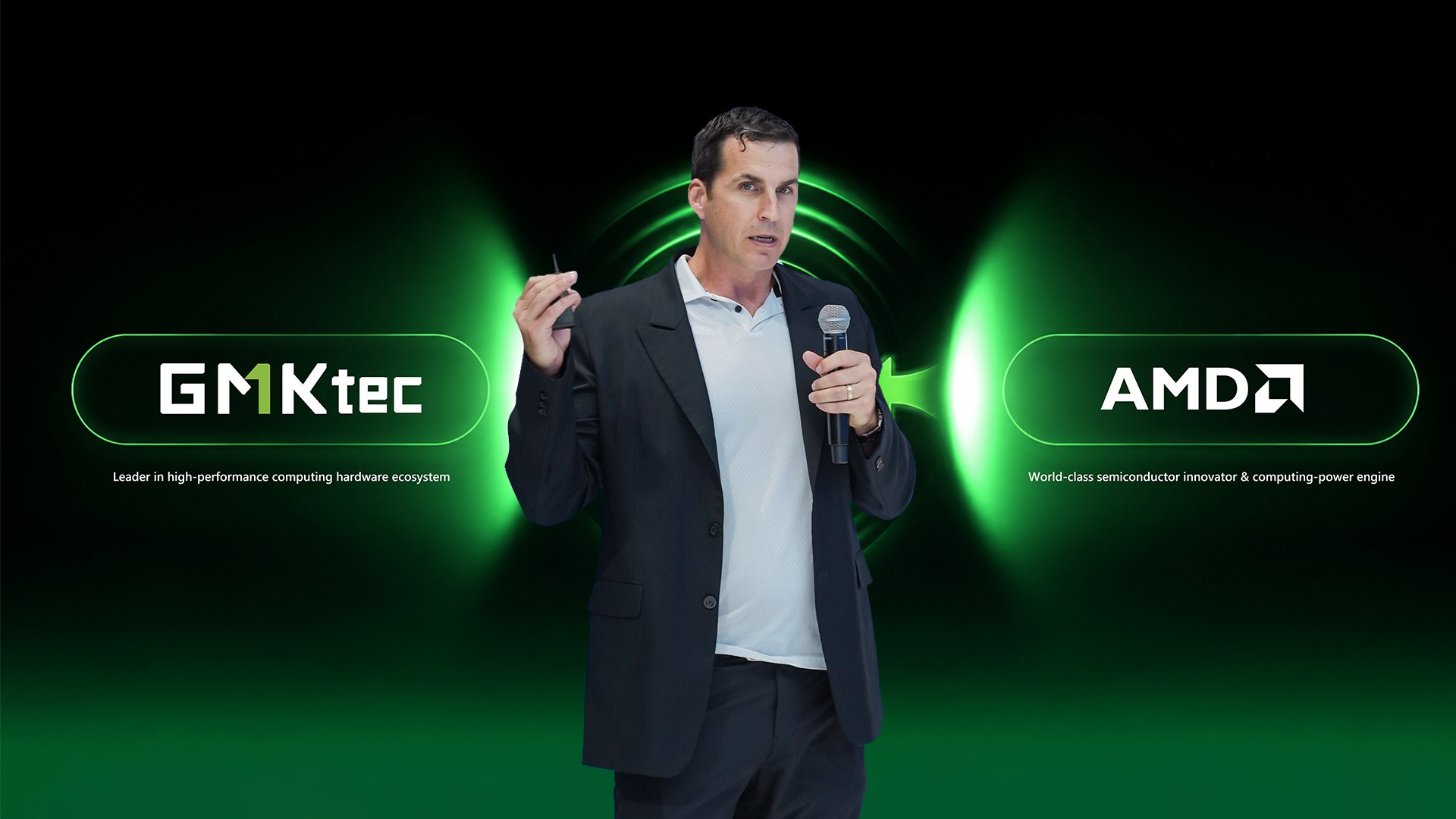
Equipped with the AMD Ryzen AI Max+ PRO 495 processor, this product adopts a collaborative architecture of CPU, GPU and NPU, and is configured with 192GB of unified shared memory, supporting a maximum allocation of 160GB as dedicated video memory. According to GMK, the EVO-X5 Pro can run 300B parameter-level large language models completely offline, and is mainly oriented to scenarios such as government affairs, biomedicine, financial investment, classified scientific research and enterprise commercial use. It also supports multi-device interconnection to form a distributed computing cluster, and integrates out-of-band remote management and an independent security chip to meet enterprises' requirements for continuous operation and data security.
What is truly noteworthy is not just the number "300B", but the change in the role of PCs: it is no longer only responsible for calling AI, but starts to host models, data and agent tasks locally. If AI PCs solve the problem of "whether a computer can run AI", Agentic PCs try to answer the question of "whether a computer can continuously complete tasks on behalf of humans".
Of course, local large models still face challenges such as power consumption, heat dissipation, software ecology and actual deployment costs. The scale of parameters does not equal real user experience. But as the running location of models shifts from the cloud back to the desktop, a new round of competition centered on data, computing power and agent entry points has begun.
AI Integrates With the Human Body: Robots Do Not Necessarily Look Like Humans
Another path for AI to enter the physical world is robotics.
This year's IFA lists robotics as one of its core future topics. Exhibited products include humanoid robots that can dance, perform tai chi and complete difficult movements, as well as smart devices for home use, rescue and assisted living. The IFA official summarizes this trend as Physical AI: AI no longer only processes information, but perceives the environment, responds to changes and completes real-world tasks.
Nevertheless, embodied intelligence does not only have one solution of "building a complete humanoid". Compared with humanoid robots that pursue general capabilities, exoskeletons have taken a path closer to humans: they do not replace humans, but identify human movement intentions and then amplify human physical capabilities.
In the embodied intelligence track, most of the spotlight falls on humanoid robots that attempt to replace humans, but some enterprises have chosen another path: letting intelligent technology collaborate with the human body to enhance human mobility.
Yuanshan Intelligent Mobility is one of such enterprises. Centered on services for people's whole life cycle, the company has built an EAI full-scenario smart ecology, and has currently launched exoskeleton robots, quadruped robots and a cloud technology platform, trying to apply intelligent technology to scenarios such as mobility assistance, companionship, safety and health management.
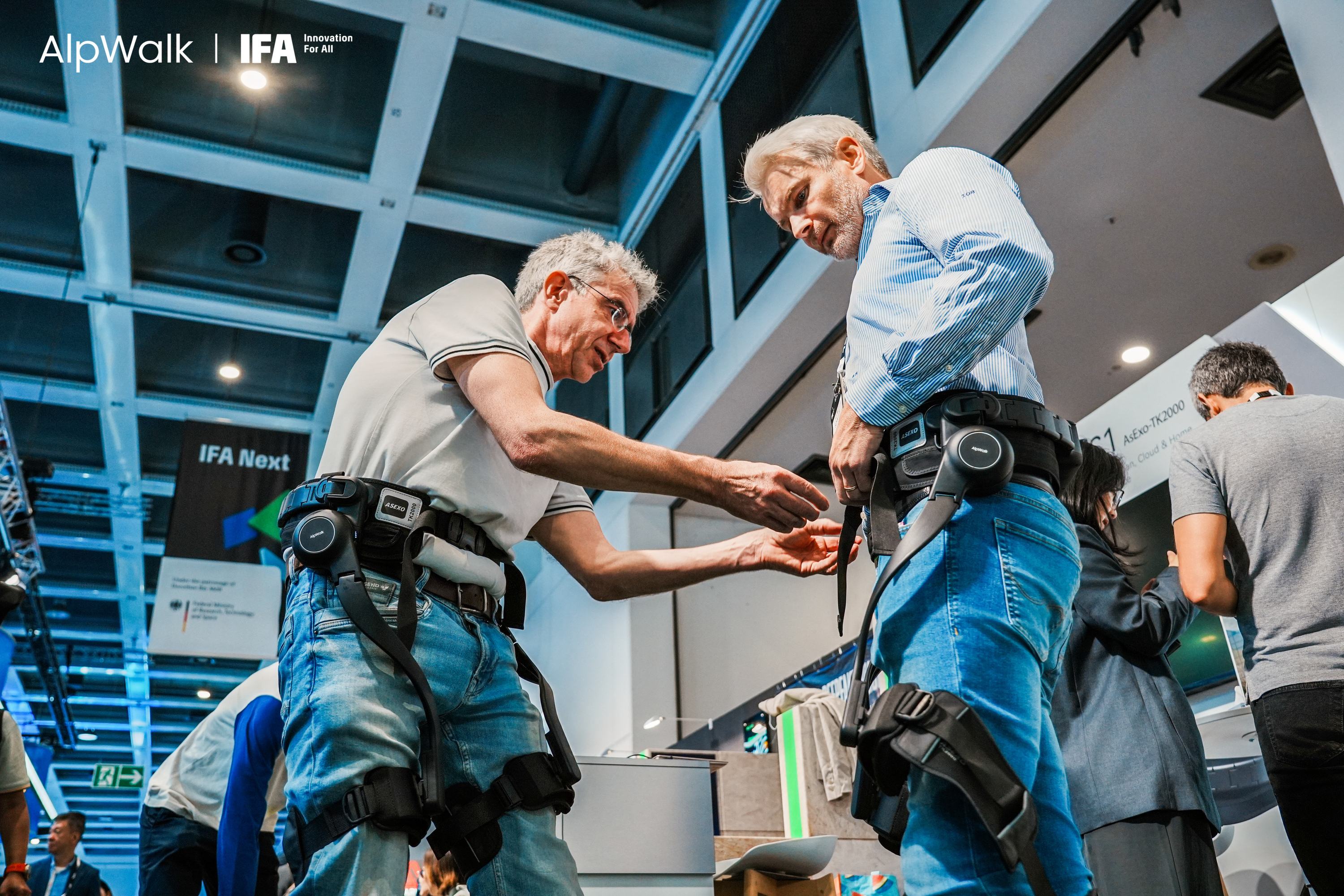
At this IFA, Yuanshan Intelligent Mobility brought the "Taishan S1" hip mobility assistance exoskeleton and the "Banshan M1" light-duty carrying exoskeleton, among which the Taishan S1 made its overseas debut. It is understood that different from some products on the current market that pursue single parameters such as weight, battery life or power assistance intensity, the Taishan S1 is mainly designed for active elderly people, and is specially tuned based on gait data of more than 10,000 elderly people, with more focus on safety and comfort in daily use. The product is equipped with fall prevention airbag accessories, multi-layer mechanical locking structure and remote footprint sharing functions. At present, Yuanshan Intelligent Mobility has entered hundreds of experience points in more than 50 cities across China, serving more than 10,000 elderly users in total, and advancing commercialization through paths including cultural tourism leasing, elderly care communities and C-end sales.
The exoskeleton is not a new concept, but in the past it was mostly applied in professional fields such as rehabilitation medicine and industrial handling. Now, with the continuous maturity of sensors, motors, algorithms and batteries, exoskeletons are evolving from medical devices or industrial equipment to consumer-grade products that ordinary users can buy, rent and use continuously.
This also means that the value of robots lies not only in imitating humans. Compared with completing a backflip on the stage, whether a machine can stably and safely help the elderly walk one more kilometer may be closer to the real starting point of embodied intelligence commercialization.
Chinese AI Hardware Goes Global: Entering the "Scenario Competition" Era
From GMK to Yuanshan Intelligent Mobility, the two companies have chosen completely different product forms: one puts larger models into desktop devices, the other integrates algorithms and motors into wearable devices for the human body. But they both point to the same trend — AI hardware is shifting from demonstrating capabilities to solving practical tasks.
This also means that the way Chinese technology enterprises compete at European exhibitions is changing.
In the past, the most prominent advantage of Chinese enterprises going global was supply chain efficiency: they could make products faster, with higher configurations and lower prices. Today, these capabilities are still important, but no longer sufficient to build long-term competitive barriers. Especially when AI becomes the standard configuration of all products, simply integrating large models and adding voice interaction can be easily replicated by competitors.
The real differentiation in the next stage will come from the understanding of application scenarios.
A local AI workstation cannot only prove how large a model it can run, but also answer questions such as which industries are willing to deploy it, how to ensure data security, and whether it can be integrated into existing workflows; a mobility assistance exoskeleton cannot only let people experience the freshness of "being pushed to walk" on the exhibition booth, but also answer questions such as whether the elderly dare to use it, whether it is comfortable to wear for a long time, how to protect users in case of accidents, and who is willing to pay for it.
This may also be the signal released by IFA 2026: when AI starts to move from the cloud to the desktop, from the screen to the human body, the end point of competition for hardware companies is no longer to launch a new product with AI, but to find a real scenario that is specific enough, high-frequency enough, and sufficient to support a closed business loop.
In the first half of the AI hardware race, all players rushed to prove that machines can understand humans.
In the second half, what will truly determine the outcome is whether machines can start to do things for humans, or even help humans do more.