Talent war! The top provincial capital has kicked off.
01
Guangzhou's Surge Against the Trend
Despite the nationwide population decline, the Pearl River Delta, with Guangzhou and Shenzhen as its core, still functions as the national population suction pump.
Last year, Guangdong Province still took the top spot in both total population increment and net population inflow across the country. Most critically, from the ranking of urban population increment: First, Guangdong occupies the top three positions. Shenzhen ranks first in population increment, Dongguan second, and Guangzhou third. Second, among the top 10 cities by population increment, 6 are located in Guangdong.
In the past two years, affected by the automotive industry, Guangzhou's economic growth has slowed down, but its population competitiveness has always remained strong, which can be described as a surge against the trend. In 2024, Guangzhou recorded a population increment of 151,000, ranking third nationwide, and its 2025 population increment ranked second across the country.
Judging from the population flow in the past few years, the gold content of coastal areas is still rising, and the national population continues to gather in the southeast coastal region. In contrast, the Pearl River Delta, supported by Shenzhen and Guangzhou, and supplemented by Dongguan and Foshan, almost outperforms the Yangtze River Delta anchored by Shanghai, Hangzhou, Nanjing, Suzhou and Hefei in terms of population competitiveness. The Yangtze River Delta and the Pearl River Delta are roughly on a par with each other in terms of economy, industry, technology and finance.
Why is there such a big gap in population competitiveness? Last year, Hangzhou, the city with the largest population increment in the Yangtze River Delta, even lagged behind Zhongshan and Huizhou. The fundamental reason lies in the cost of living. The biggest difference between the Yangtze River Delta and the Pearl River Delta is that: The former pursues order, aesthetics and long-termism; the latter emphasizes efficiency, speed and practical returns. The former is more refined, while the latter is more inclusive.
The regularity of Nanjing, the exquisiteness of Suzhou, the tranquility of Wuxi, coupled with the lakeside charm of Hangzhou and the international style of Shanghai, together constitute the most "orderly" pole in China's urbanization process.
As for the Pearl River Delta, even in Guangzhou and Shenzhen, which have first-class urban interfaces, there are a large number of urban villages interspersed in their central urban areas.
Indeed, urban villages have become the fundamental reason why the Pearl River Delta is far more competitive in attracting population than the Yangtze River Delta under the current general environment.
02
Guangzhou Steps Up Talent Recruitment
Despite its leading population competitiveness across the country and the mention of controlling population size in its 15th Five-Year Plan, Guangzhou is still not satisfied and has further intensified its efforts to attract talents.
The expression related to population in Guangzhou's 15th Five-Year Plan is as follows: Reasonably regulate and control the population size and density, guide the orderly evacuation of population in central urban areas, enhance the population carrying capacity of peripheral urban areas, and promote the coordinated optimization of urban space and population distribution.
The gist of this passage is that Guangzhou will control the population size, especially in the central urban areas, while expanding the population scale of its peripheral districts. One third of Guangzhou's total population is concentrated in the four core districts (Tianhe, Haizhu, Liwan, Yuexiu), whose total area only accounts for 3.8% of Guangzhou's entire territory. The population density in the core districts is excessively high, so Guangzhou has been diverting the population of core districts in the past five years, with remarkable effects.
In the past five years, among the four core districts of Guangzhou, three have witnessed a population decline, and only Tianhe recorded a slight increase. The total population of the four core districts reached 6.1273 million at the end of 2025, a decrease of 210,400 compared with five years ago. Meanwhile, among the sub-peripheral districts of Baiyun, Huangpu, Panyu and Huadu, the population of Panyu and Huadu has increased sharply. In the past five years, Panyu ranked first in population increment among all districts in Guangzhou, with an increase of 213,900 people, and Huadu increased by 124,300 people. The population of the peripheral districts of Nansha, Conghua and Zengcheng is also growing continuously.
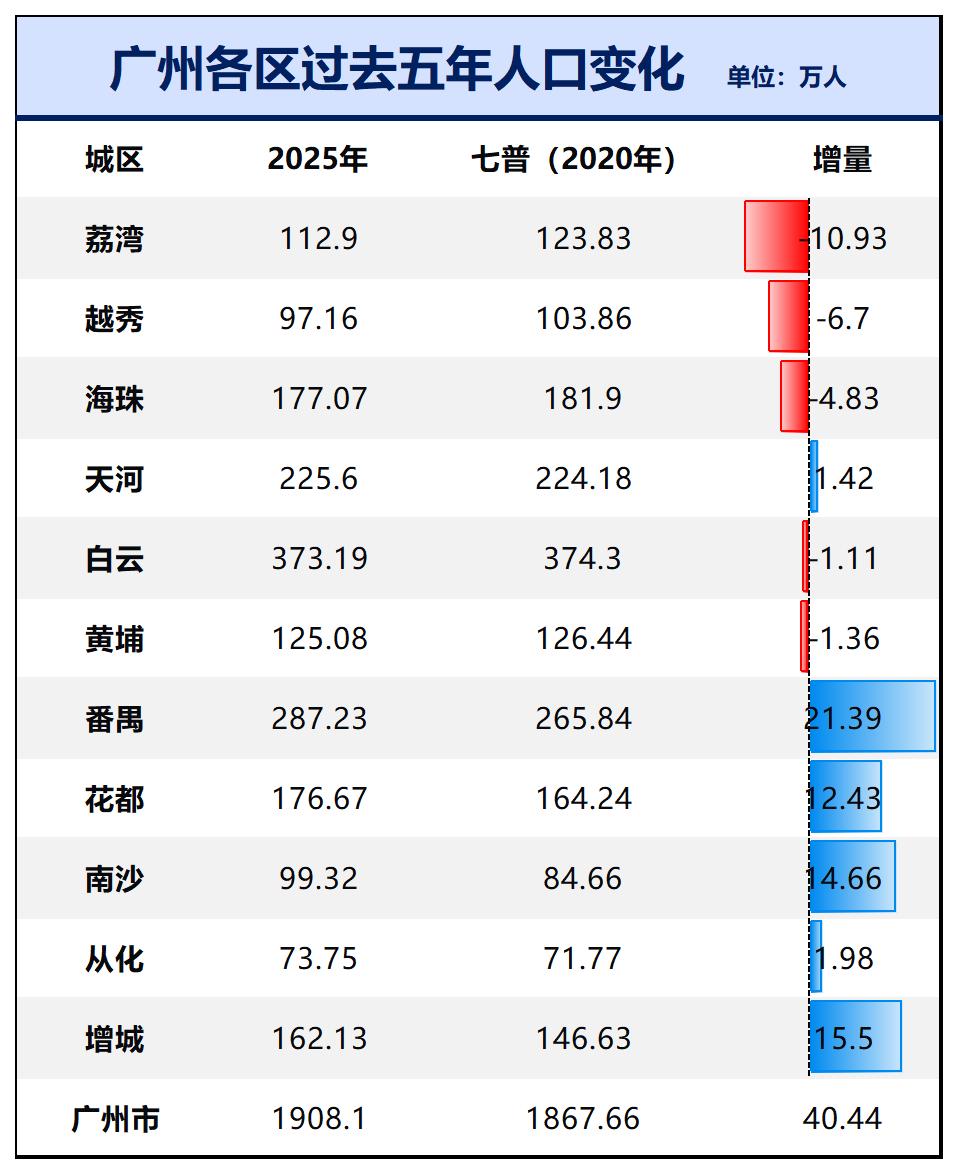
Illustration by City Finance; Data source: Guangzhou Municipal Bureau of Statistics
Guangzhou's population increased by 404,400 in 2025 compared with the data of the Seventh National Population Census, equivalent to the total population of a medium-sized county.
With such strong competitiveness, why does Guangzhou still spare no effort to attract people? It needs to be emphasized that this time Guangzhou is mainly targeting high-end talents. This time, it has directly traveled to Jiangsu, Zhejiang and Shanghai to recruit talents from universities and colleges with full sincerity.
For example, in terms of the number of job positions, according to the disclosure of Guangzhou Daily: From September 16 to 20, the "Million Talents Gather in Southern Guangdong" 2026 N-city Linkage Autumn Recruitment Event (Shanghai, Jiangsu, Zhejiang Region), co-hosted by the CPC Guangdong Provincial Committee, the People's Government of Guangdong Province and the Ministry of Education, and undertaken by the CPC Guangzhou Municipal Committee and the People's Government of Guangzhou, will enter 17 higher education institutions in Shanghai, Nanjing and Hangzhou, and hold 17 high-standard, high-quality campus job fairs within 5 days. As of September 5, Guangzhou has organized more than 2,700 employer visits, bringing over 130,000 job positions in total. Among them, more than 1,700 employers will participate in on-site recruitment, providing over 100,000 job positions.
This time, Guangzhou has offered 130,000 positions to recruit college talents from Jiangsu, Zhejiang and Shanghai, which are jointly provided by central state-owned enterprises, local state-owned enterprises and private enterprises in Guangzhou.
The recruitment will cover three central cities of Shanghai, Nanjing and Hangzhou, including 10 Shanghai universities such as Shanghai Jiao Tong University, Fudan University, Tongji University, East China Normal University and Shanghai International Studies University, 6 Nanjing universities such as Nanjing University, Nanjing University of Science and Technology, Southeast University and China Pharmaceutical University, as well as Zhejiang University in Hangzhou.
In terms of the most core remuneration package, the positions are very attractive: 97,000 positions with an annual salary of 80,000 to 300,000 RMB; 13,000 positions with an annual salary of 300,000 to 500,000 RMB; over 9,000 positions with an annual salary of 500,000 to 1,000,000 RMB; over 600 positions with an annual salary of more than 1,000,000 RMB; 13,000 positions with negotiable salary or other arrangements.
03
Why Does Guangzhou Still Need to Recruit Talents Aggressively
As repeatedly emphasized above, Guangzhou already has strong population competitiveness and sound population increment performance, so why is it still striving to attract more people?
There are two major driving forces behind this:
First, to cope with the population catching-up of Shenzhen. Guangzhou has strong population competitiveness, but Shenzhen's population competitiveness is even more outstanding. From 2010 to 2020, the population of Shenzhen increased by 7.136 million, ranking first nationwide. Guangzhou's population increased by 5.977 million in the same period, ranking second nationwide. The population increment of Shenzhen is 1.159 million higher than that of Guangzhou.
With the help of this population increment, the population gap between Shenzhen and Guangzhou has been narrowed from 2.3376 million in 2010 to 1.1065 million in 2020. In the past five years, Shenzhen has continued to catch up. The population gap between Shenzhen and Guangzhou was narrowed to less than 1 million in 2024, and further to 852,500 last year.
According to the current population increment trend of the two cities, Shenzhen is very likely to replace Guangzhou as the most populous city in Guangdong Province in as fast as five years, or at most ten years. Therefore, although Guangzhou's population competitiveness is at the forefront of the country, facing the strong population competitiveness of Shenzhen, it still has to continue to make efforts to attract talents.
Second, industrial upgrading urgently requires the support of talents. In the past two years, Guangzhou was greatly affected by its pillar automotive industry, and its industrial decline led to a significant slowdown in economic growth. Fortunately, Guangzhou has staged a strong comeback this year, with impressive performance in growth rate and increment.
In the first quarter, Guangzhou achieved an actual growth rate of 6%, 1 percentage point higher than the national average, leading among the top 10 GDP cities. In the first half of the year, Guangzhou's GDP growth rate reached 5.8%, 1.1 percentage points higher than the national average, tying for first place with Shenzhen among the top 10 cities.
The return of growth is backed by the resumption of growth of Guangzhou's three traditional major industries: Automobile manufacturing grew by 9.1%, electronic product manufacturing grew by 11.2%, and petrochemical manufacturing grew by 5.2%.
At the same time, the three driving forces of consumption, investment and export are all making efforts: In the first half of the year, the total retail sales of consumer goods in Guangzhou reached 577.478 billion RMB, a year-on-year increase of 2.9%. In the first half of the year, the fixed asset investment in Guangzhou increased by 6.1% year-on-year. In the first half of the year, the total import and export volume of Guangzhou reached 637.19 billion RMB, a year-on-year increase of 5.5%, of which exports reached 416.83 billion RMB, up 5.2%.
However, Guangzhou has no immediate worries but still faces long-term challenges. The recovery of the automotive, electronics and petrochemical industries has helped Guangzhou regain a firm foothold. But what determines the next round of urban competition is not traditional industries, but hard core technologies.
Competition among cities across China has entered the stage of competing for future industries. Beijing is betting on artificial intelligence, Shenzhen on robotics, Hangzhou on large models, and Shanghai on integrated circuits.
Guangzhou is also accelerating its transition to new tracks. In its newly released 15th Five-Year Plan, Guangzhou has placed all future industries including artificial intelligence, biomedicine and health, intelligent connected new energy vehicles, low-altitude economy, commercial aerospace, embodied intelligent robots, and new energy storage in core positions.
Artificial intelligence in particular is a key priority. Guangzhou has proposed to build a national pilot zone for AI innovative application, construct the Pazhou AI and Digital Economy Pilot Zone, and accelerate the formation of a complete industrial chain covering computing power, algorithms and applications.
Robotics is also a key direction. Relying on industrial platforms such as Huangpu and Nansha, Guangzhou is laying out embodied intelligent robots and high-end equipment manufacturing, hoping to transform the industrial foundation accumulated from automobile manufacturing into new advantages for intelligent manufacturing.
New tracks including low-altitude economy, commercial aerospace and biomanufacturing are also being advanced simultaneously. All these industries share one common feature: they do not compete for land or factory buildings, but for talents. The value brought by an algorithm engineer, a scientific research team or an entrepreneurial project far exceeds that of a production line in the era of traditional manufacturing.
This is also the reason why Guangzhou directly holds job fairs in Shanghai, Nanjing and Hangzhou. What it is competing for is not the number of graduates, but the industrial competitiveness for the next decade.
In the final analysis, population determines the scale of a city, and talents determine the upper limit of a city. In the past, Guangzhou became a major destination for population inflow across the country with its openness and inclusiveness. In the future, if Guangzhou wants to maintain its leading position as a first-tier city, it is no longer enough to only retain ordinary residents. It must also attract more high-end talents to settle in Guangzhou.
This article is from the WeChat official account "City Finance", written by City Finance, and published with authorization from 36Kr.