Property Market in Beijing and Shanghai After New Policies: Transactions Remain Active
In August 2026, property market policies in Beijing and Shanghai were successively optimized. On August 7, Beijing further lowered the home purchase threshold for non-local households and increased the support for provident fund loans; on August 20, on the basis of continuing the policies introduced in February, Shanghai further unlocked the home purchase demand outside the outer ring road and smoothed the housing replacement chain by lowering the down payment ratio for second homes outside the outer ring road and introducing replacement subsidies. The policies of both cities are focused on further releasing reasonable housing demand and improving market expectations.
Judging from market feedback, after the implementation of the new policies, the transactions of new and second-hand homes in Beijing and Shanghai have maintained a certain level of activity, the number of visitors to some new property projects has increased, and the consultation enthusiasm of first-time homebuyers and upgrading homebuyers has risen. In August, the transaction volume of second-hand commercial residential properties in Beijing reached 14,000 units, a year-on-year increase of 3.9%; the transaction scale of second-hand commercial properties in Shanghai remained at a high level, up 16.3% year on year; in terms of new homes, the transaction area of newly built commercial residential properties in August was basically the same as the same period of last year, while that in Shanghai increased by 16.0% year on year.
However, from the current performance, the property markets in Beijing and Shanghai are more of a recovery featured by active transaction and marginal improvement of the supply-demand relationship. On the one hand, the transaction volume of second-hand homes in Beijing and Shanghai in the first eight months both hit a new high in the past five years, and the market already had a solid transaction foundation; on the other hand, the newly added and existing listed second-hand home properties decreased, the supply of new homes slowed down, and the inventory and destocking cycle declined to some extent, easing the pressure on market supply and demand compared with the earlier period. However, prices are still in the adjustment channel, the inventory scale of new homes remains at a relatively high level, and the sustainability of market recovery remains to be observed.
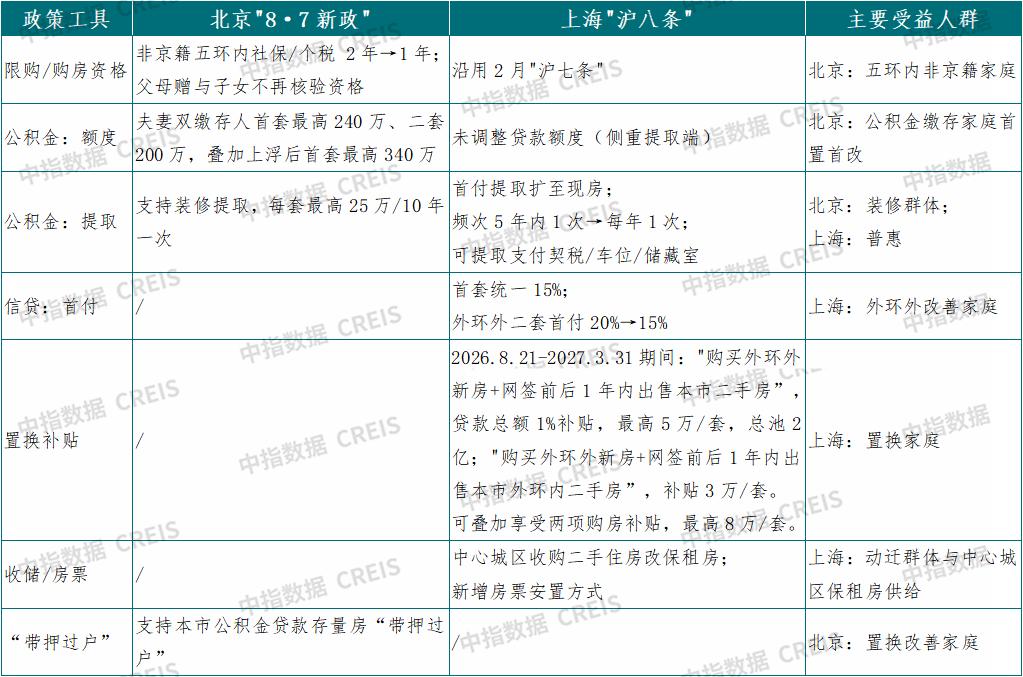
The overall market remained stable after the new policies in Beijing and Shanghai, with weekly transaction volume rising month on month in August
After the implementation of the new policies in Beijing and Shanghai, the number of visitors to some new property projects increased, and the consultation enthusiasm of both first-time homebuyers and upgrading homebuyers improved; the viewings and consultations of second-hand homes are also more active than in the earlier period.
According to the online signing data of second-hand homes, data from the China Index Academy shows that in August, the transaction volume of second-hand commercial residential properties in Beijing reached 14,000 units, a year-on-year increase of 3.9%; the transaction volume of second-hand commercial properties in Shanghai reached 23,000 units, up 16.3% year on year. From the perspective of weekly data, in the three weeks after the implementation of the new policy in Beijing (August 10 to August 30), the weekly transaction volume continued to grow month on month, and 3,300 units were traded in the first week of September, a year-on-year increase of 26.1%; in the week after the implementation of the new policy in Shanghai (August 24 to August 30), the weekly transaction volume still increased by 18.5% year on year on a high base, and 5,293 units were traded in the first week of September (August 31 to September 6), up 19.9% year on year.
Figure: Weekly transaction trend of new homes in Beijing and Shanghai from 2024 to 2026
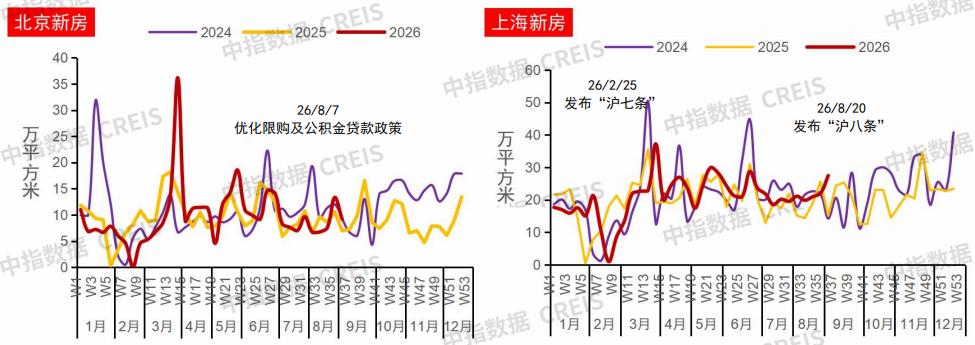
According to the online signing data of new homes, data from the China Index Academy shows that in August, the transaction area of newly built commercial residential properties in Beijing was 378,000 square meters, which was basically flat year on year; the transaction area of newly built commercial residential properties in Shanghai was 914,000 square meters, up 16.0% year on year. From the weekly data, in the last three weeks of August (August 10 to August 30), the transaction area of newly built commercial residential properties in Beijing continued to grow month on month, and 92,000 square meters were traded in the first week of September, a year-on-year increase of 31.2%; in the last week after the implementation of the new policy in Shanghai in August, the transaction area increased by 5.1% month on month, and 275,000 square meters were traded in the first week of September (August 31 to September 6), up 81.1% year on year.
The transaction volume of second-hand homes in Beijing and Shanghai in the first eight months both hit a new high in the past five years, and the supply-demand relationship in the market improved
Although the policy effect has initially appeared on the transaction side, whether it can continue depends crucially on whether the price-volume performance and the fundamental supply-demand situation in Beijing and Shanghai can support the sustained recovery.
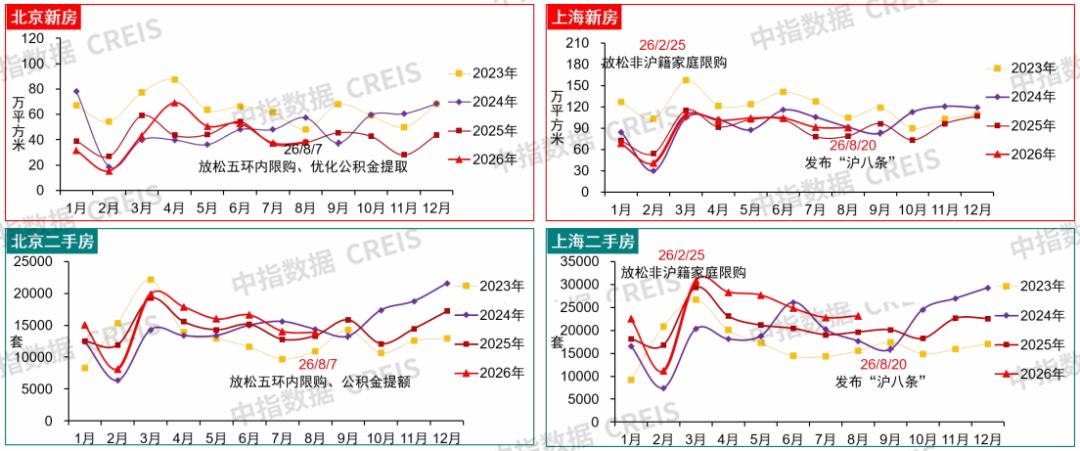
Judging from the transactions from January to August 2026, the cumulative transaction volume of second-hand commercial residential properties in Beijing reached 121,000 units, a year-on-year increase of 5.9%, and that in Shanghai reached 191,000 units, up 14.0% year on year. The transaction volume of second-hand homes in both cities hit a new high in the past five years. In August, 14,000 and 23,000 units of second-hand commercial residential properties were traded in Beijing and Shanghai respectively, still up 3.9% and 16.3% year on year on a high base. The transaction scale of second-hand homes in Beijing and Shanghai has achieved year-on-year growth for six consecutive months, and the market activity is expected to continue.
In terms of new homes, from January to August, the cumulative transaction area of newly built commercial residential properties in Beijing reached 3.378 million square meters, down 1.2% year on year, and the transaction area in August was 378,000 square meters, which was basically the same as the same period of last year; the cumulative transaction area of newly built commercial residential properties in Shanghai reached 7.113 million square meters, up 2.4% year on year, and the transaction area in August was 914,000 square meters, up 16.0% year on year.
Figure: Monthly transaction trend of new homes and second-hand homes in Beijing and Shanghai from 2023 to 2026
From the perspective of supply and demand, the market also shows certain signs of improvement.
According to data from the China Index Academy, since the fourth quarter of last year, the stock of listed second-hand homes of leading intermediaries in Beijing and Shanghai has decreased with fluctuations. At the end of August, the year-on-year decrease reached 14.8% and 25.3% respectively, 20% and 31% lower than the high point of last year, and the supply pressure of second-hand homes has been marginally alleviated.
The newly listed second-hand homes in Beijing and Shanghai remained stable on the whole. Since the second quarter, the number of newly listed units has shown a gradual downward trend. While the transaction volume expanded and the existing listed properties continued to be digested, the number of newly listed properties did not rise significantly, and the supply-demand relationship is gradually improving.
Affected by the slowdown of new supply, the inventory of new homes in Beijing has declined simultaneously. From January to August 2026, the newly launched area of newly built commercial residential properties in Beijing decreased by 31% year on year, and that in Shanghai decreased by 5% year on year. As of the end of August, the available for sale area of commercial residential properties in Beijing was 7.55 million square meters, down 20% year on year, and that in Shanghai increased slightly by 1% year on year. The destocking cycle has also shrunk simultaneously, dropping from 22.7 months at the high point in March this year to 18.2 months in August. The destocking pressure of new homes has been alleviated compared with the earlier period, but the current inventory scale of new homes is still at a high level, and the subsequent recovery still depends on the continuous expansion of transaction volume.
In terms of prices, according to the 100-city Price Index of the China Real Estate Index System, from January to August 2026, the price of second-hand residential properties in Beijing dropped by 4.58% cumulatively. Since the beginning of this year, the average listed price of second-hand homes has been declining, but the decline has narrowed significantly; the cumulative decline of second-hand residential properties in Shanghai was 1.22%, with a month-on-month increase for five consecutive months starting from March, and a slight drop of 0.03% in August. Driven by the launch of some high-quality projects, the cumulative prices of newly built residential properties in Beijing and Shanghai increased by 0.81% and 3.99% respectively from January to August, and Shanghai has maintained an upward trend since March.
Trend Outlook
Overall, after the implementation of the new policies in Beijing and Shanghai in August, the transaction of second-hand homes remained active, and the supply-demand relationship in the market improved marginally. However, prices are still in the adjustment channel, the inventory scale of new homes is still at a relatively high level, and whether the market can achieve sustained improvement still needs to observe the subsequent transaction performance and the transmission of demand to the new home market.
In the short term, the support of the new policies in Beijing and Shanghai on the demand side will continue to be released gradually. The lowered home purchase threshold for non-local residents in Beijing and increased provident fund support is expected to continue to drive the demand of first-time homebuyers and first-time upgrading homebuyers; policies such as the reduction of the down payment ratio for second homes outside the outer ring road in Shanghai and the introduction of replacement subsidies are conducive to further smoothing the replacement chain of upgrading families. With the continuous release of policy effects, it is expected that the transaction of new and second-hand homes in Beijing and Shanghai will maintain a certain level of activity during the "Golden September and Silver October" period, but the market recovery will still show obvious differentiation, and the degree of demand improvement transmitted to the new home side remains the key.
At the same time, the reform of the commercial housing sales system was further implemented on August 28, raising the pre-sale threshold, promoting the gradual popularization of existing home sales, and further improving the pre-sale conditions and capital supervision. In the short term, the policies have relatively limited direct impact on the properties on sale in Beijing and Shanghai (the original pre-sale conditions and mortgage disbursement nodes are still implemented); at the same time, the reduction of phased new supply is conducive to the destocking of current high-quality projects.
In the medium and long term, with the gradual advancement of existing home sales, coupled with the increasingly prudent investment and development decisions of real estate enterprises, the supply scale of the new home market may decline, which will have a certain impact on the sales scale of new homes. On the whole, the property markets in Beijing and Shanghai will continue the trend of differentiated recovery. In the short term, the focus is on whether the demand-side policies can continue to promote the improvement of transactions, and in the medium and long term, it is necessary to pay attention to the supply changes brought about by the sales system reform and its impact on the market scale and the development model of real estate enterprises.
This article is from the WeChat Official Account "China Index Academy", written by China Index Research Institute, and authorized for release by 36Kr.