The European version of OpenAI raises 23.5 billion in financing, with its valuation surging 80% within one year.
European AI has just secured another huge funding round.
French AI company Mistral announced the completion of its €3 billion Series D financing, equivalent to about 23.4 billion yuan, with a post-money valuation exceeding €21 billion, roughly 163.6 billion yuan.
It is led by Samsung Electronics, co-led by the Scaleup Europe Fund managed by EQT and existing shareholder PSG Equity, with new investors including Advent, funds and accounts managed by BlackRock, and the Grand Duchy of Luxembourg. Mistral stated that this is the largest single round of equity financing ever completed by a European technology company.
What is even more remarkable is the speed.
Mistral was only founded in April 2023, and it has been just three years to date. Its last financing round was in September 2025, led by ASML with €1.7 billion, when the post-money valuation reached €11.7 billion. In just one year, the company's valuation has risen from €11.7 billion to over €21 billion, representing an increase of nearly 80%.
If you only look at the financing figures, this is already astonishing. But what truly makes Mistral worth paying attention to is why it can still attract continuous investments from two global semiconductor giants even when facing intense pressure from OpenAI, Anthropic and Google.
01
Three Researchers Starting a Business
Secured €100 Million in One Month
Mistral's story has a very "AI era" starting point.
The company has three founders: Arthur Mensch, Guillaume Lample and Timothée Lacroix.
Mensch previously worked at Google DeepMind, while Lample and Lacroix came from Meta AI. The three of them met in France's elite university system in their early years, and later joined US tech giants respectively to conduct AI research.
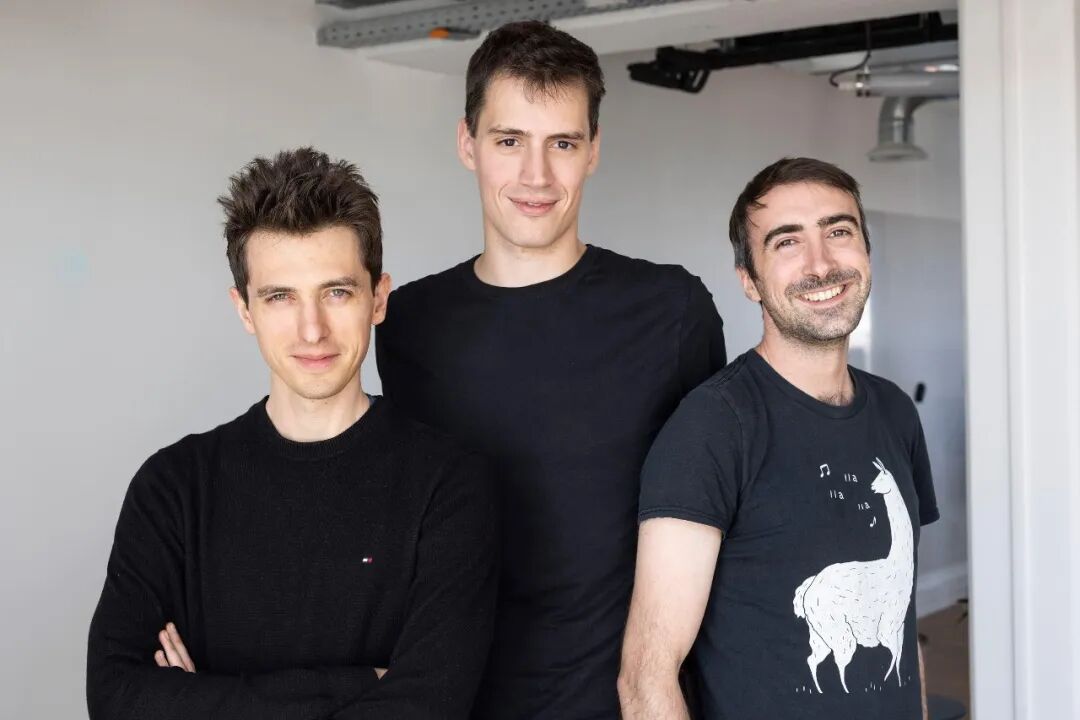
Three co-founders of Mistral
Among them, Mensch participated in DeepMind's famous Chinchilla research. One of the core issues discussed in this work is how large models can balance parameter scale, training data and computing power efficiency. In other words, even before starting his own business, he was researching the most costly problem in today's large model industry: how to use more reasonable computing power to train models better.
In 2023, right after ChatGPT ignited the global AI entrepreneurship boom, the three of them left their big tech employers and returned to Paris to start their own business.
Then a very remarkable scene took place.
Only about one month after the company was founded, with no official product launch and not enough employees recruited, it completed a €105 million seed round financing at a valuation of about €240 million. This set a new record for seed financing of European AI startups at that time, according to the Financial Times.
Capital was not betting on revenue or customers, but on the three researchers.
Six months later, Mistral completed hundreds of millions of euros in financing, and its valuation quickly rushed to about €2 billion. It continued to raise funds in 2024, and in 2025 ASML invested about €1.3 billion to lead the Series C round, obtaining approximately 11% of the shares.
Over the past three years, Mistral has grown from "a group of European researchers wanting to challenge OpenAI" to a company with a valuation of over €21 billion.
This is probably one of the most extreme business models in the AI era: the founding team is valued at hundreds of millions of dollars first, and products and revenue are supplemented later.
02
No Longer Raising Funds Based on Stories
If Mistral only had the "European version of OpenAI" story, Samsung would hardly bet billions of euros on it.
What truly supports its valuation is the accelerating commercialization progress.
Mistral's latest disclosure shows that its business has now covered 20 countries, providing AI services for more than 125 large global enterprises, including customers such as Airbus, ASML and HSBC.
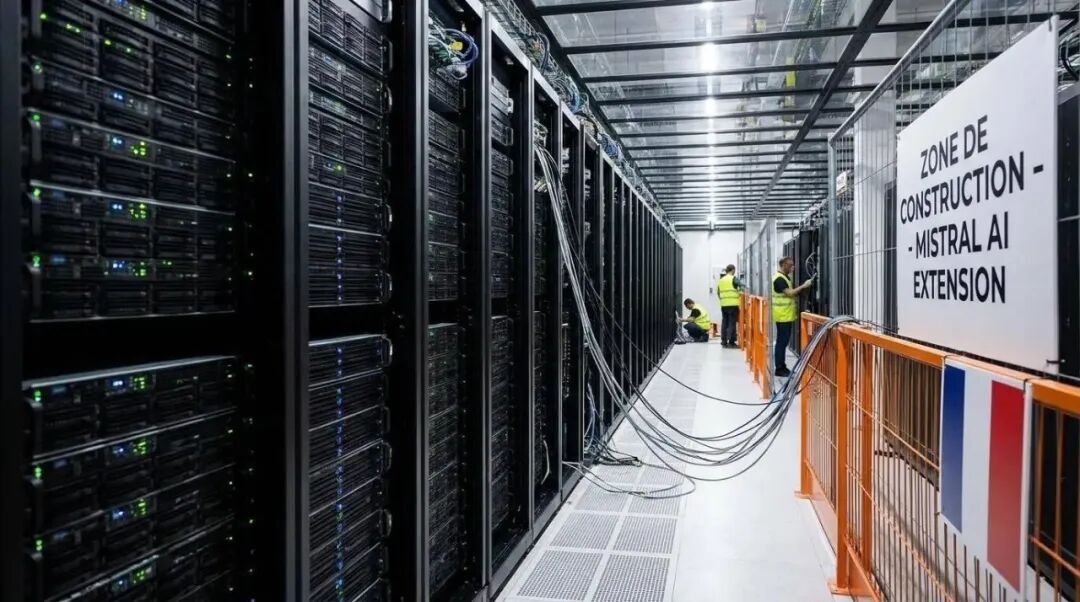
Mistral is continuously expanding its AI infrastructure
These customers are not here just to experience chatbots.
Airbus partners with Mistral to apply AI in highly sensitive scenarios such as aircraft design, engineering, operation, national defense and aerospace; ASML hopes to apply Mistral's AI capabilities to semiconductor equipment and complex engineering; financial institutions like HSBC attach more importance to data privacy and on-premises deployment capabilities.
This is exactly one of the biggest commercial differences between Mistral and ChatGPT.
OpenAI is more like a global consumer-grade super application, while Mistral is increasingly becoming an enterprise AI infrastructure company.
It sells not only model APIs, but also private enterprise deployment, customized models, AI infrastructure and computing power services.
This path has already started to generate revenue.
According to Reuters, Mistral expects its annualized recurring revenue to reach 1 billion US dollars by the end of 2026; the Wall Street Journal reported that the company has crossed the $1 billion ARR threshold. There are differences in statistical calibers, but it at least shows that its business scale has entered the "billion-dollar level" discussion scope.
For a company that has been established for three years, this speed is already very impressive.
But the problems are equally obvious.
A valuation of €21 billion corresponds to an annualized revenue of about 1 billion US dollars, which is still a very high multiple. Investors are obviously not buying into how much money Mistral makes today, but betting that it will become the entry point for European AI infrastructure in the future.
Therefore, this €3 billion financing is not a "reward", but more like an admission ticket for the next stage of competition.
03
Why Chip Giants Are Scrambling to Invest
There is a very noteworthy detail in Mistral's two consecutive financing rounds. The lead investor in 2025 was ASML, and the lead investor in 2026 is Samsung. One masters the world's most advanced lithography equipment, and the other is one of the world's largest memory chip and semiconductor enterprises.
In two consecutive rounds, the lead investors all come from the semiconductor industry. This is no coincidence.
The large model industry is increasingly becoming a "computing power guzzler". The more powerful the model is, the more GPUs, memory, networks and data centers it requires; the wider the enterprise deployment, the further the reasoning demand will drive chip consumption.
Therefore, when chip companies invest in AI model companies, in a sense, they are investing in their own downstream demand.
After ASML invested about €1.3 billion in the previous round, it became an important shareholder of Mistral, and the two sides clearly proposed to jointly explore the application of AI in advanced semiconductor equipment and engineering.
Samsung's bet this time also follows industrial logic.
The demand for HBM, high-end memory, servers and data centers from AI training and reasoning continues to grow. If Mistral eventually becomes the main AI supplier for large European enterprises and governments, it will definitely require a huge amount of chips and computing power infrastructure behind it.
More directly, Mistral itself has begun to develop into a "computing power company". The company announced this year that it will build up to 1GW level AI computing power capacity in Europe by 2030, and continue to expand local reasoning and infrastructure in Europe. Therefore, Samsung is not just investing in a "large model team". It is betting that a new major AI computing power customer may emerge in Europe in the future.
This is also why AI investment is increasingly like an industrial alliance today: model companies need chips, chip companies need model manufacturing demand, and data centers need both to fill the servers together.
The money goes around and finally turns into computing power.
04
Europe Does Not Want to Be Strangled by Others in Core Technology
If we only compare models, Mistral is actually not in an easy situation. It is facing competition from OpenAI, Anthropic, Google, and a growing number of open source models from China.
The funding gap is particularly obvious. The UK's Financial Times pointed out that Mistral's €3 billion financing round is already a European record, but it is still very small compared with the financing scale of US AI companies. Anthropic's financing scale this year alone far exceeds it, according to the Financial Times.
Therefore, Mistral's real moat is not that "its model is necessarily better than OpenAI's". What it sells can be summed up in four words: independent and controllable.
Mistral has long emphasized open weights, allowing enterprises to deploy models on their own, keep data in their own servers, and freely choose computing power suppliers.
For ordinary consumers, this may not be that important.
But for banks, military industry, government, aerospace and aviation companies, it is extremely important.
A company may allow its employees to use ChatGPT to write emails, but it may not dare to send all aircraft design blueprints, bank customer data and national defense data to the servers of an American cloud company.
Mistral has seized this market gap.
It tells European customers: you can use my model, the server can be placed in Europe, the data can stay under your control, and even the model itself can be deployed by yourself. This is why the so-called "sovereign AI" is becoming a profitable business. In the past, Europe's advocacy of technological sovereignty was more like a political slogan.
Now, it has begun to turn into procurement budgets.
After the €3 billion financing, what Mistral needs to prove is its profitability.
Achieving a valuation of €21 billion in three years, Mistral has completed something that European technology companies have rarely achieved in the past: it has carved out a European foothold in a track dominated by American tech giants.
But the larger the financing, the more realistic the exam questions become.
The €3 billion will eventually be largely spent on model training, data centers, chips and international expansion. The problem in the large model industry has never been "whether there is revenue", but whether revenue growth can outpace computing power costs.
Therefore, when evaluating Mistral in the future, we should not only look at how much the next-generation model's benchmark performance has improved, but also focus on three figures: number of customers, ARR, and computing power cost. Can 125 large enterprise customers grow to 500? Can the billion-dollar level annualized revenue continue to double? How much computing power does it take to burn to earn 1 euro of revenue?
These three questions determine whether Mistral will eventually become a real European AI giant, or a model company with a high valuation that requires long-term capital infusion.
Samsung and ASML have already placed their bets on behalf of Europe.
The next step is for Mistral to prove a more difficult thing: Europe can not only build an AI company worth 20 billion euros, but also build an AI company that makes truly huge profits.
This article is from the WeChat official account "Pencil News" (ID: pencilnews), written by Xi Wen, edited by Zou Wei, and authorized for release by 36Kr.