Reflection on China GT Racing Accident: Improper Budget Control May Be the Root Cause of the Tragedy
The controversy surrounding the accident at the China GT Shanghai event has grown increasingly intense.
On September 5, during the opening race of the GT3 class at the fourth stop of the China GT Chinese Supercar Championship in Shanghai, the No. 91 car of the FIST Auto team was involved in a collision incident and caught fire. Thanks to Hattog, the driver of the No. 79 car from the Phantom Global Racing team, who made the decisive call to abandon his race, the trapped driver Milroy was rescued in time.
Milroy posted on social media to confirm his safety after the race, and thanked Hattog for "saving his life". Singer Wang Yibo, who competed in the same class, liked Hattog's life-saving act that disregarded his own personal safety on social media platforms.
However, the event organizer's management has faced intense public criticism. The FIST Auto team condemned the organizer for "serious dereliction of duty in on-site emergency response and safety rescue support, with obvious loopholes in the rescue response that nearly led to a tragedy", and announced its withdrawal from China GT with immediate effect.
Later, the FIST Auto team issued another statement, condemning the official statement released by the organizer as "extremely unprofessional in response, lacking a sense of responsibility, and failing to face up to a series of problems exposed in this incident". After Yang Baijie, a driver from the 610 Racing team, disclosed more details related to the accident on social media, he also announced his withdrawal from China GT. The No. 33 car of 610 Racing was one of the vehicles involved in the accident that caused the No. 91 car to catch fire. Actor Daniel Wu, who participated in another class of the event, posted a video criticizing the organizer for improper response.
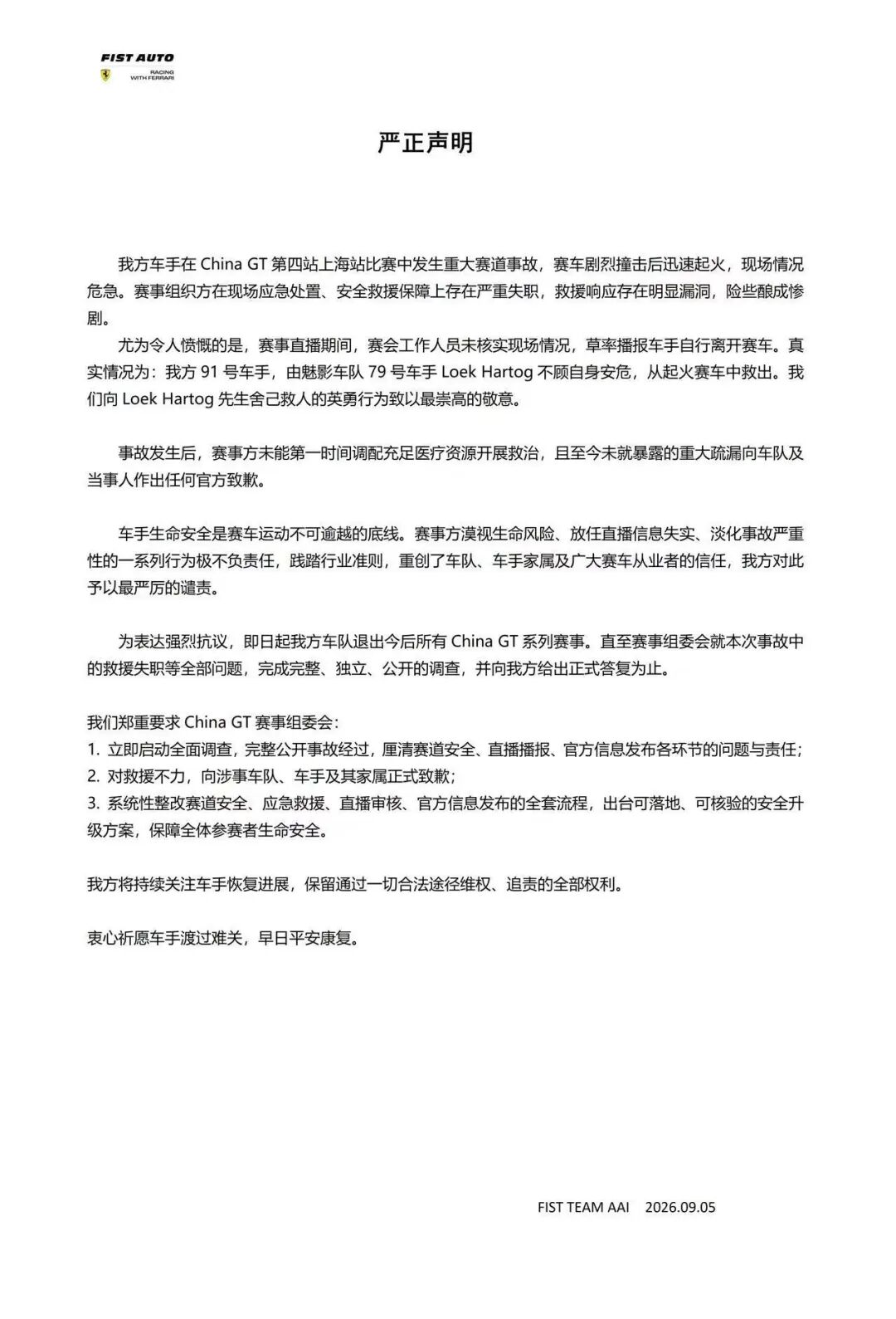
FIST Auto Team Statement
Motor racing, a sport that uses high-speed cars as competition tools, can be described as "naturally coexisting with accidents". Therefore, in its hundreds of years of development, motorsport has always promoted both hardware configuration upgrades and software process optimization to improve safety guarantees on the track. The core of the public outcry over this China GT Shanghai event is not the severity of the accident itself, but the flawed post-accident handling process that is truly distressing.
01
Insufficient accident handling capabilities of the first arriving staff
After the accident, the on-board footage of the rescue driver Hattog quickly spread online. Netizens could see the whole process from Hattog stopping his car mid-race to rescuing Milroy. There were two very jarring scenes in the video.
Phantom Global Racing, Hattog's team, released the footage of the rescue process
Scene 1: Hattog could not get close to the driver's seat effectively due to the fierce fire. He saw that some staff members had already arrived at the scene with fire extinguishers, so he ran to the staff, took the fire extinguisher, and ran back to the crashed car. Compared with Hattog's full sprint, the staff member who handed over the fire extinguisher walked in small quick steps. Although he was running, he showed no sense of urgency for rescue. After handing over the fire extinguisher, the staff member turned around and left with the same small steps, seemingly staying by the side of the track to observe the progress of the accident. No further footage from the No.79 car's recording shows whether the staff member continued to participate in the rescue work.
Scene 2: After Hattog got the fire extinguisher, a second staff member arrived with another fire extinguisher. He also walked over in small quick steps, then stopped in front of the No.79 car, and tried to pull the safety pin of the fire extinguisher. Obviously, he did not figure out how to handle the pin at first, and after fumbling with it for about 20 seconds, a third staff member came over with a fire extinguisher, and he stopped fiddling with the pin.
These two scenes are shocking, revealing how sloppy the event's safety guarantee process is. Every second counts in saving lives, but the rescuers moved at a leisurely pace. Of the first two staff members who arrived at the scene, one seemed to leave the rescue site, and the other did not master the basic operation of fire-fighting equipment. It is no wonder that netizens all lamented that if Hattog had not stepped in to help, Milroy would have been in great danger.
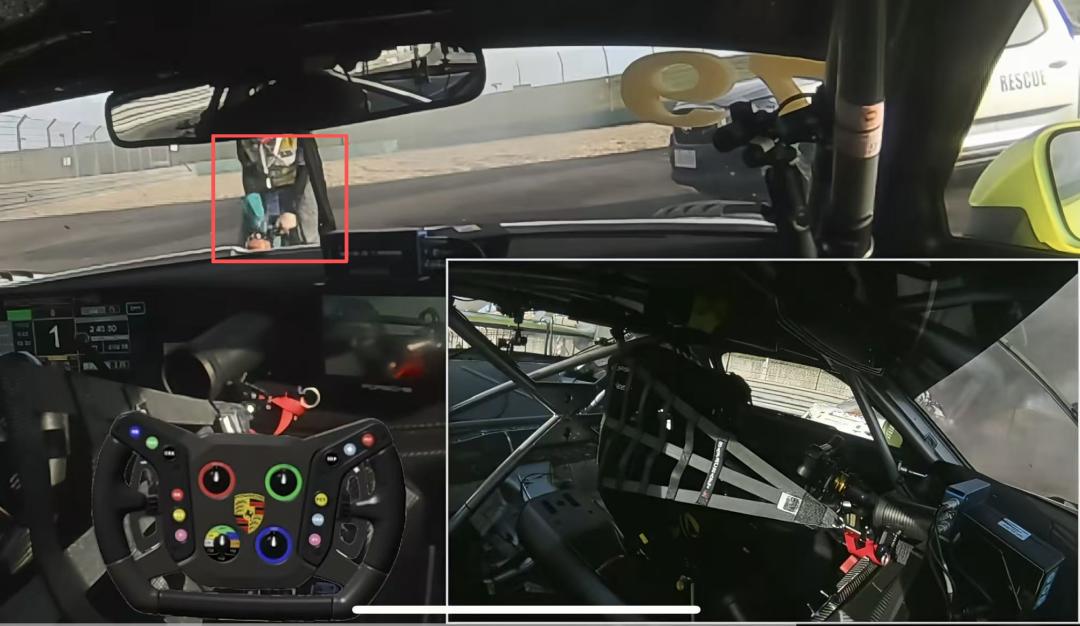
The staff member who failed to figure out how to use the fire extinguisher. Source: footage captured from the No.79 car's on-board camera
Judging from the video, the staff members in both scenes did not seem to be in the prime of life, so it is inevitable that their movements are not as fast as racing drivers. On the other hand, the two staff members were wearing reflective vests, and seemed to be more responsible for track order rather than formal members of the rescue team, which may also be the reason why one of them could not operate the fire extinguisher smoothly. Therefore, in the public controversy, there are relatively few voices directly accusing the two staff members. What people are more concerned about is the severity of the process loophole: the first arriving staff members are not competent for rescue work, while the real rescue team arrives far too late.
So is the rescue car really late? Before there is an official authoritative review report, the author tries to calculate the total time elapsed from the accident to the arrival of the rescue vehicle. When the accident scene was shown on the event live stream and the No.91 car caught fire, there were 41 minutes and 56 seconds left in the race (hereinafter the time format is presented with colons, that is, 41:56). When the live stream showed the red flag was waved, there were 41:39 left in the race. At this moment, the live footage showed the No.18 car preparing to pass Turn 16 of the Shanghai International Circuit (the final turn). At this point, Hattog was 6.449 seconds behind the No.18 car.
Looking at Hattog's on-board video, when he entered Turn 14 where the accident occurred, 1 minute and 45 seconds had elapsed in this lap, and the expected lap time was 2 minutes and 2 seconds, meaning it would take about 17 seconds to reach the finish line. Turn 16 is roughly located at the midpoint between Turn 14 and the finish line. Roughly estimated, Hattog would take about 7.5 seconds to drive to Turn 16 under normal driving conditions.
Combined with the fact that the No.18 car was at Turn 16 and about 6.449 seconds ahead of Hattog when the red flag was waved, it is roughly judged that the red flag was waved almost at the same time when Hattog entered Turn 14 (with a potential error of one or two seconds). According to statistics from the No.79 car's video, the duration from entering Turn 14 to the arrival of the rescue vehicle is about 53 seconds. Based on this, the key data is roughly inferred: The rescue vehicle arrived at the accident scene 53 seconds after the red flag appeared, and 70 seconds after the No.91 car caught fire.
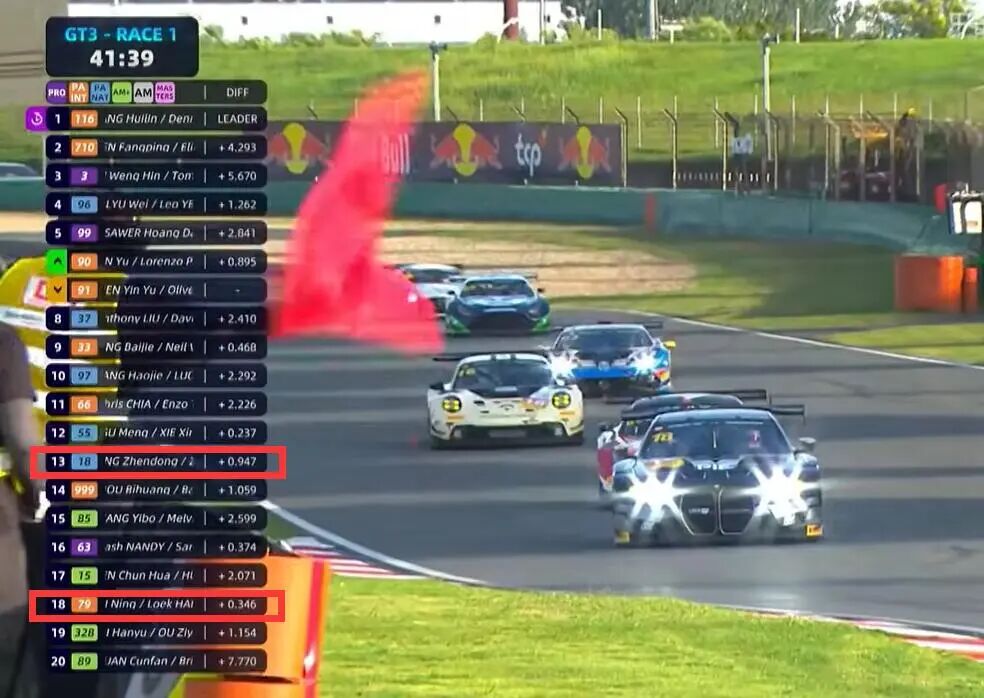
When the red flag was waved, Hattog's car was more than 6 seconds behind the No.18 car. Source: footage captured from the event live stream
According to the FIA's standard of an accident response time within two minutes for circuit races, the arrival time of the rescue vehicle at the China GT Shanghai event actually meets the requirements. However, when compared with the leading indicators in the industry, 70 seconds is far from satisfactory. At the 2020 F1 Bahrain Grand Prix, Grosjean also encountered a crash and fire accident, and the medical vehicle arrived in only 11 seconds. In 2020, Ryan Stanton, then Safety and Medical Director of NASCAR, said, "For a circuit, a 30-second response time is already very tight, and usually vehicles or personnel should arrive at the scene within 5 to 10 seconds."
In Milroy's case, he was trapped in the car while the vehicle was burning, making the situation even more critical. The minimum requirement for a racing suit to withstand burning is 12 seconds, and suits made of thicker materials can last more than 20 seconds. More than 30 seconds of exposure undoubtedly puts the driver in extreme danger.
Therefore, overall, the 70-second arrival time of the rescue vehicle at the China GT Shanghai event is indeed lagging in the scenario of a raging fire and a trapped driver. This lag is significantly amplified by Hattog's decisive stop to rescue, and the first arriving staff members' apparent helplessness.
02
The organizer's attitude after the accident was also widely criticized
If the organizer's performance in immediate rescue can be described as "unsatisfactory but not necessarily below the industry baseline", the organizer's response in other areas is really hard to convince people.
The FIST Auto team mentioned in its statement: "What is particularly outrageous is that during the live broadcast of the event, the officials did not verify the scene situation, and hastily announced that the driver had left the car on his own." The false broadcast of the accident situation, under the most benevolent interpretation, means that the internal communication chain of the organizer is imperfect; under a more critical interpretation, it is suspected of covering up the truth. No matter how you interpret it, most people agree with the FIST Auto team's criticism.
Chen Junshan, spokesperson of the FIST Auto team, further criticized the organizer's response in an interview with automotive media DCar. Chen Junshan gave an example: "After the driver was rescued, no event staff or medical personnel were seen at the scene for five minutes." Driver Yang Baijie also further revealed inside information on overseas social platforms, including the most outrageous claim that "the ambulance driver was sleeping and could not be woken up for 15 minutes", and that when the organizer asked the involved drivers for information, "their first reaction was to smile", "tried to shift the blame to the drivers", and "asked the drivers to help take responsibility when facing the public". In addition, Yang Baijie also directly accused some staff members of "dropping their fire extinguishers and fleeing" out of fear.
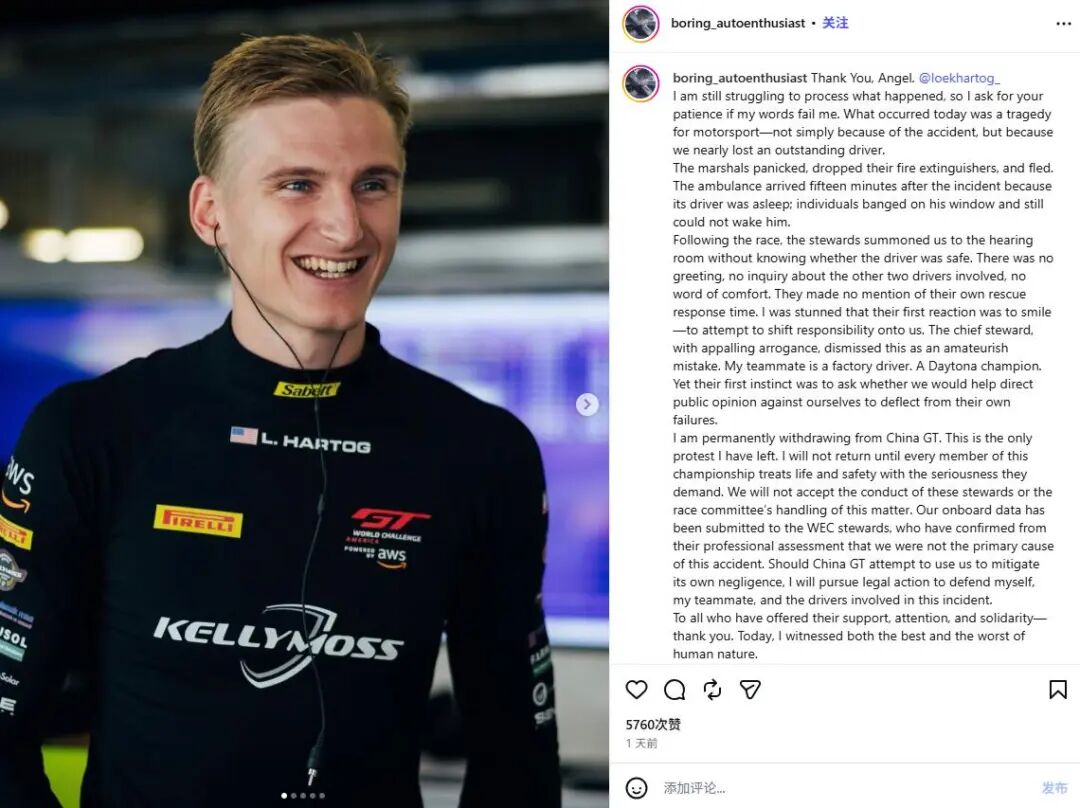
Yang Baijie exposed the inside story of the accident handling. Source: Yang Baijie's social media
Yang Baijie's revelations are one-sided statements. Without the support of testimonies from other involved parties and objective materials, it is not appropriate to directly use his claims to criticize the organizer. In particular, the claim that "the ambulance arrived 15 minutes later" has been proven to be exaggerated. As seen in the live broadcast, the ambulance had already arrived when there were 35:34 left in the race, about 6 minutes after the No.91 car caught fire in the live footage. However, for the organizer, Yang Baijie's criticism is highly inflammatory, and some details also fit the public's intuitive judgment on the responsibility of the accident (unprofessional staff, imperfect communication mechanisms). The criticism has fully fermented, bringing greater public opinion response pressure to the organizer.
Another point that drew criticism was the official statement issued by the organizer after the accident. On the afternoon of September 6, the organizer responded to public opinions on the accident through its official Weibo account. The wording that the event configuration "conforms to the national-level event configuration and needs to be improved in detailed management" was fiercely denounced by netizens, who considered it a despicable act of shifting responsibility. After that, the organizer did not supplement any new information, and public calls for a reasonable explanation grew louder. Including Daniel Wu pointing out that the organizer did not respond to the details "within 36 hours", which was really "not decent".
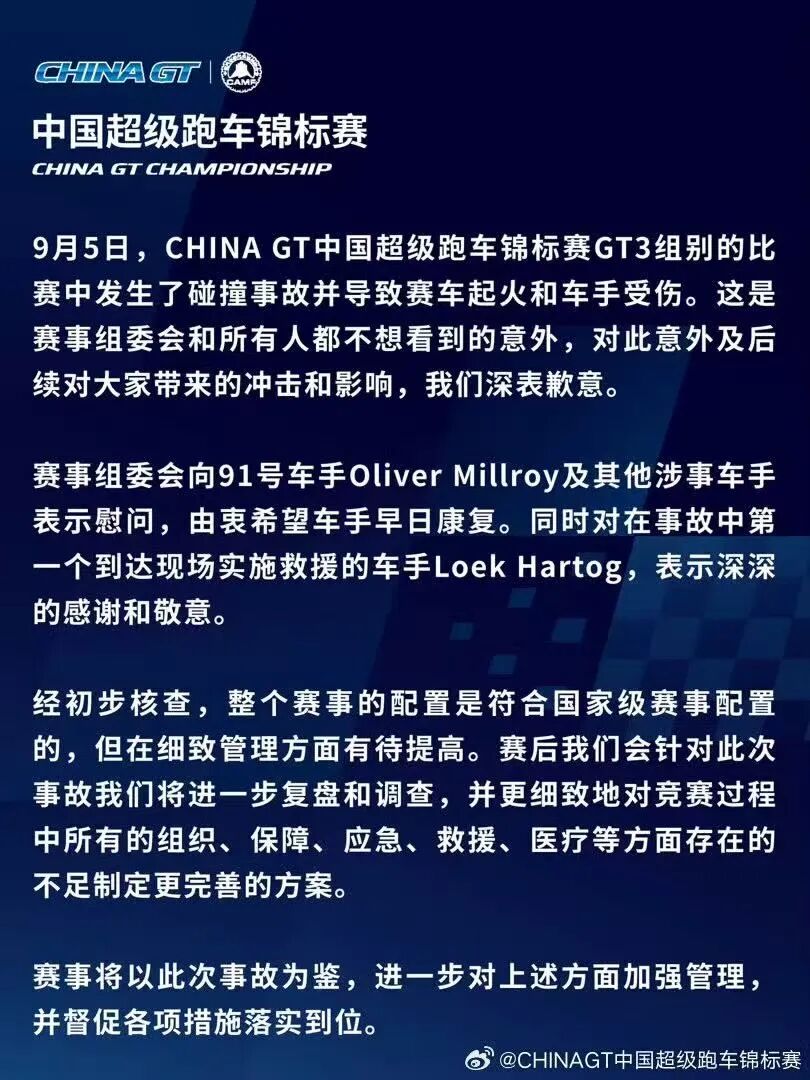
The organizer's response statement
So far, the general controversial and critical points of the China GT Shanghai accident have been basically reviewed. Next, instead of being preconceived by public opinions, we should examine the lessons brought by the accident in the context of the current operation of domestic sports events.
03
The response statement did not cover the content of most public concern
From the occurrence of the accident on September 5 to the deadline of this article on September 8, the organizer actually had to deal with two things at the same time: first, explain why the accident response was ineffective; second, calm the erupting public sentiment.
First, about public sentiment. At present, the only public response to public opinion from the organizer is the statement issued on September 6. Combined with the author's practical experience in participating in event operations, this statement is actually "very standard".
The so-called "standard" means that the wording of the statement is in line with the general principles of current public opinion response plans for domestic large-scale sports events. Large domestic sports events will have public opinion management plans, which specify the principles, processes, personnel structure, etc. of public opinion management, and may even pre-set targeted wording for some hypothetical scenarios. When public opinion problems actually occur, in practice, the pre-set wording is often directly extracted as needed, slightly modified for targeted response, and then released through designated channels.
The formulation of these pre-set wordings usually hides a premise: first emphasize the legitimacy or rationality of the organizer's execution process, and then explain how to deal with the current problems encountered. The highly questioned wording of "conforming to national-level event configuration" from the China GT organizer is very likely a product of similar principles. Under intense public scrutiny, the organizer will not be "stubborn" and directly deny public doubts, but will try to first establish a foothold that they have "fulfilled their due responsibilities".
In addition, the expression of apology at the beginning of the statement, and the second part that offers condolences to the injured driver and praises the rescue driver, are all carefully designed response sequences. The apology focuses on first expressing that the organizer does not deny responsibility, and the subsequent condolences and praise emphasize the "humanistic spirit", striving to establish a positive energy theme of "kindness and beauty in humanity" in an unfortunate event before discussing other issues.
Theoretically, such a public opinion response idea is reasonable in specific scenarios or even general scenarios. When we talk about "public opinion response", it sounds like a major event, where the organizer is facing massive public condemnation. In fact, most public opinion response work is to respond to a small number of negative comments in a targeted manner. When these comments do not form a large scale, after the organizer responds with a gesture of "understanding the demands" and "being neither humble nor overbearing", the corresponding public opinion response process is completed smoothly.
However, the public doubts faced by China GT this time are about a fresh human life that could have been lost due to the organizer's lack of professionalism. The public's demand is for the organizer to "reveal its own shortcomings", admit its lack of professionalism and explain how to deal with these unprofessional problems in the future. China GT's response obviously did not