Huawei and Xiaomi released their foldable smartphones on the same day: the Huawei Mate XT 2 Ultimate Design starts at 19,999 yuan, with the highest-spec variant priced at 24,999 yuan; the Xiaomi 18 Fold is priced starting from 10,999 yuan, and its top-tier model costs up to 14,999 yuan.
Huawei and Xiaomi held new product launch events on the same day (the 7th), releasing their new foldable smartphones one after another.
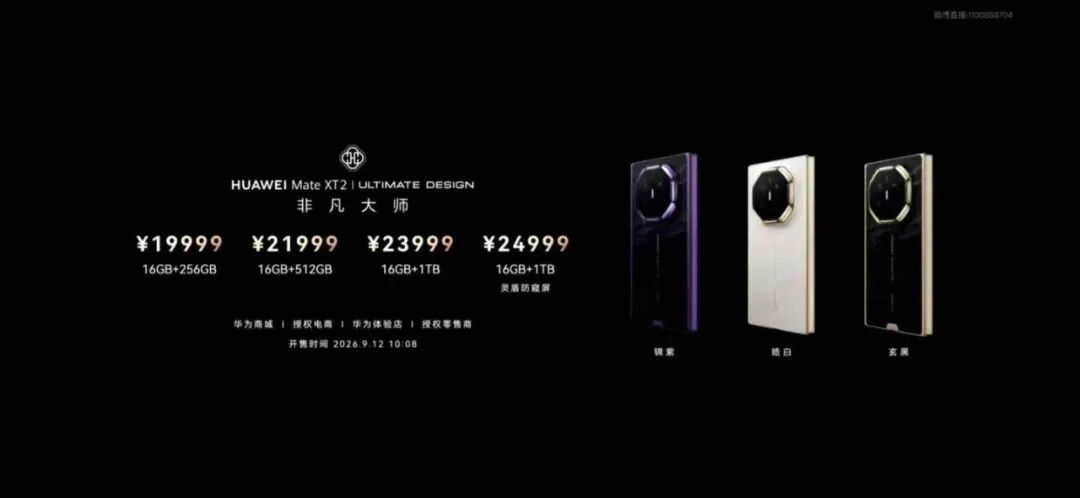
Specifically, Huawei launched its tri-fold Mate XT 2 Ultimate Master on the afternoon of the 7th, with the 16GB+256GB, 16GB+512GB, 16GB+1TB, and 16GB+1TB (Smart Shield Privacy Screen Edition) versions priced at 19999 yuan, 21999 yuan, 23999 yuan, and 24999 yuan respectively.
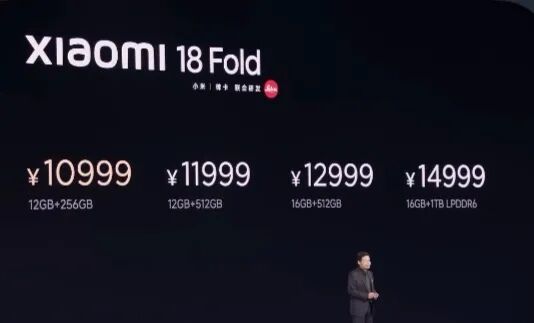
That same evening, Xiaomi released its mid-fold 18 Fold, with the 12GB+256GB, 12GB+512GB, 16GB+512GB, and 16GB+1TB versions priced at 10999 yuan, 11999 yuan, 12999 yuan, and 14999 yuan respectively.
Fierce Head-to-Head Competition at September Smartphone Launch Events
According to public information, the six major mobile phone brands Huawei, Xiaomi, Apple, Honor, vivo and OPPO have all scheduled their second-half flagship new product launches in September, which is different from previous years.
In the past, the fall new product season usually started in September, and each brand could roughly occupy an exclusive 2-3 week market window, with the latest launch events even extending to November. But this year, within just three weeks, more than ten flagship models from six major brands have been unveiled one after another, leaving almost no breathing room for the market.
Per public information, in addition to Huawei and Xiaomi going head-to-head on the 7th, Apple will bring its first foldable iPhone Ultra to the stage on the 9th local time; in mid-to-late September, the bar-style flagship new devices from vivo, Huawei, OPPO, Honor and Xiaomi are expected to be launched in turn.
Why has the pace of new product launches in the second half of the year accelerated significantly?
Ivan Lam, senior analyst at global market research institution Counterpoint Research, told China News Network that overall, the number of product models and projects launched by mobile phone manufacturers this year has decreased, so high-end products can get more sufficient resource support; on the other hand, hardware-level innovation this year is relatively limited, new flagship phones face lower difficulty in introducing new technologies and new hardware, and the overall progress of projects is smoother.
Hou Lin, chief analyst at global technology market research and consulting firm Omdia, told China News Network that against the backdrop of product price increases this year, the old logic of cutting prices for promotion several months after new product launches no longer holds, so all shipment pressure falls on new products, which is the main reason for the accelerated pace of new product releases.
Before new products are even unveiled, consumers have already felt the price rise of older models.
On September 1, multiple domestic mobile phone brands including Huawei, Xiaomi and Honor adjusted their prices in a concentrated manner, covering products across all price ranges from the thousand-yuan tier to high-end flagships. Among them, prices for all versions of the Huawei Mate 80 rose by 800 to 1000 yuan; prices for all versions of the Xiaomi 17 increased by 300 to 500 yuan; prices for all versions of the Honor Magic8 went up by 300 to 500 yuan.
Are older models getting price hikes first to pave the way for new product pricing?
"There is definitely cost pressure, and laying a price foundation for new products is also a reason," Hou Lin pointed out. This round of price adjustment is a consideration of multiple factors. He predicts that from 2026 to 2028, manufacturers will carry out price adjustments more frequently.
Ivan Lam analyzed that the cost pressure brought by memory price hikes is well known, and the cost of other key components has also risen to varying degrees, putting pressure on the previous value chain. In fact, many new products this year have been priced according to the new value chain, and the price increase of existing products is more of a last resort under cost pressure.
Foldable Phones Become the Core Fulcrum for Upward Shift of Price Bands
Under the pressure of price increases, it is difficult for brands to get users to pay willingly without sufficiently convincing "hard selling points".
It is worth noting that in this September flagship melee, the first products to debut are not the traditional bar-style "king of phones", but foldable products.
At Huawei's launch event on the afternoon of the 7th, it was introduced that the brand-new spread-wing tri-fold HUAWEI Mate XT 2 Ultimate Master adopts a left-right opening and unfolding method, which is more in line with users' usage intuition. The device is equipped with the brand-new HarmonyOS 7, and its panoramic multi-window capability supports three parallel full-screen windows, multi-level window size adjustment, independent volume adjustment and other distinctive experiences.
At Xiaomi's evening launch event, Lei Jun, Chairman and CEO of Xiaomi, introduced that the 18 Fold has a 5.38-inch outer screen and a 7.58-inch inner screen (when unfolded), adopting the standard 1:√2 paper aspect ratio. Users can easily reach the top of the screen with their thumb when holding the device with one hand. "It is a Dolby Cinema in your pocket, a game console in your pocket, and even an e-book reader in your pocket."
According to reports from multiple tech websites, the upcoming iPhone Ultra adopts a book-style horizontal fold with an inner screen of about 7.8 inches, and its viewing experience after unfolding is close to that of the iPad mini. The device has not been officially sold yet, and market research firm IDC predicts that the average selling price of this phone will be 2550 US dollars, with the top-tier configuration possibly reaching 3000 US dollars.
Ivan Lam pointed out that both Chinese manufacturers, Samsung and Apple have regarded foldable smartphones as a key strategic fulcrum to drive the overall upward shift of the high-end price band.
Apart from the foldable form factor, chips are another core focus of competition among brands.
The A20 Pro in the iPhone 18 Pro series will be the first to adopt TSMC's 2nm (N2) process; the Xiaomi 18 Fold will be the first to be equipped with the Xuanjie O3 chip and support the new generation LPDDR6 memory; the Huawei Mate XT 2 Ultimate Master will debut with the Kirin 9050 Pro chip. At the same time, the 6th generation Snapdragon 8 Elite Edition is expected to be widely applied in new phones from vivo, OPPO, Honor, OnePlus and iQOO.
"To cope with rising prices, brands must definitely launch new features to create high-priced products, instead of raising prices simply due to rising costs, so they will all build highlights to attract consumers," Hou Lin mentioned. Technically, the R&D difficulty of chips and AI is higher than that of wide-fold products that only change the screen aspect ratio, but from the perspective of consumer perception, the change in screen size is the most noticeable.
Can these technological narratives really make consumers pay willingly for the price increases?
Hou Lin believes that price increases are reasonable only when technological breakthroughs are transformed into strong perceived value. If it is only a numerical upgrade such as a 0.1nm improvement in chip process that consumers cannot clearly perceive, it will be difficult for consumers to think the price increase is worthwhile.
Ivan Lam said that the target consumer group of September's new products is concentrated on high-price-segment users who are replacing their phones, and the overall coverage is still limited. However, the Chinese market is still in the process of continuous high-end development and consumption upgrading, and more and more consumers will consider upgrading to higher price segments when replacing their phones.
"In the Chinese market where the trend of rational consumption is obvious, consumers are still willing to pay higher prices for better products, but the premise is that the products themselves can make them feel 'worth it'," Ivan Lam added. This also means that consumers' requirements will be more stringent: in addition to higher requirements for product durability and usability, they will also have higher expectations for the extra value that products can bring.
The views in this article are for reference only and do not constitute investment advice. Investment involves risks, and caution is advised when entering the market.
This article is from the WeChat Official Account "China News Network" (ID: jwview), written by Xie Jingwen, and republished by 36Kr with authorization.