The split governance plan for Audi China has been basically finalized, and only the AUDI brand will be retained for SAIC Audi.
The four-ring brand and AUDI brand deployed by Audi in the Chinese market are both being strengthened and differentiated. Caijing has exclusively learned recently that Audi's plan to reallocate brand resources in the Chinese market has been basically finalized. Going forward, SAIC Audi will only operate the AUDI brand, and the four-ring brand will be fully transferred to FAW Audi. It should be noted that the AUDI brand is an intelligent connected electric vehicle series created by Audi exclusively for the Chinese market without the four-ring logo, while the four-ring brand covers Audi's globally unified fuel and electric product lines.
At present, SAIC Audi operates two pure electric models E5 and E7X under the AUDI brand, as well as three fuel models A5L Sportback, A7L, Q6 and one pure electric model Q5 e-tron under the four-ring brand. As the long-term operator of the four-ring brand, FAW Audi owns all other domestic and imported models of the four-ring brand, and is responsible for selling two pure electric models A6L e-tron and Q6L e-tron developed by Audi FAW New Energy based on Audi's PPE platform.
On the market side, SAIC Audi has begun to cut prices and promote sales of four-ring brand models, with an obvious intention of clearing inventory. On the production side, the output of some four-ring brand models has declined since the beginning of this year. Data for July shows that the output of all models returned to zero, and SAIC Audi's stance of separating from the four-ring brand has gradually become clear.
From this perspective, the Audi Innovative Technology Center (AITC), newly established on September 3, has taken on new significance. This new company is built exclusively for the AUDI brand and is a joint venture between Audi AG and SAIC Motor. This means that SAIC Audi has taken a key step in building an independent and complete R&D, production and marketing system relying on the AUDI brand. Although the details remain to be negotiated, the "two Audis" represented by AUDI and the four-ring brand are not far from being divided between the north and the south.
The demarcation plan is basically finalized, with detailed rules to be negotiated
The essence of this plan is to draw a clear boundary for Audi's two brand systems in China. The rights and responsibilities for the design, production and sales of four-ring Audi models are entirely under FAW Audi. SAIC Audi will no longer operate products with the four-ring logo, and only retain the AUDI brand business. In principle, FAW Audi will take over the existing user rights and after-sales services of SAIC Audi's four-ring brand models, and coordinate the rights and interests of dealers.
However, there is still a certain distance before the plan is implemented. According to insiders of the enterprise who revealed to Caijing, at this stage, the joint venture business departments of both sides are still refining the implementation details, including the division of production and sales rights and responsibilities, and clarifying the production and sales ownership system of different models. At the same time, key details such as how FAW Audi will take over the existing user rights and after-sales services of SAIC Audi's four-ring brand models, as well as the connection of dealer rights and interests, are being sorted out. Since the detailed terms have not been fully finalized, the official cooperation contract has not yet been signed, there is no clear timeline for the overall implementation, and relevant work is still being continuously promoted and negotiated.
At present, there are multiple substantial entities under Audi in China, including Audi China, FAW Audi, Audi FAW New Energy, SAIC Audi and the Audi-SAIC cooperation project, each undertaking different functions. In addition to Audi China, which oversees Audi's business in China, FAW Audi is responsible for the production and sales of domestic four-ring brand models as well as import business, and is the largest and longest-established party. Audi FAW New Energy undertakes the production of PPE platform pure electric models. SAIC Audi not only manages the business of some four-ring brand models, but also oversees the production and sales of AUDI brand models, while the Audi-SAIC cooperation project is in charge of R&D and brand strategy for AUDI brand models.
The five entities correspond to a complex coordination mechanism and corresponding costs. This is not only the result of Audi's expansion in China in the past few years, but also the reason why rights and responsibilities need to be re-divided at present. There were previous rumors that Audi hoped to realize the merger of FAW Audi and SAIC Audi, but Gernot Döllner, CEO of Audi Group, stated in a media communication in March this year that Audi will continue to adhere to the existing dual-partner strategy, and emphasized that the current cooperation model with the two Chinese partners FAW and SAIC is "very beneficial" to the brand development. Gernot Döllner said that Audi's two major partners in China have formed a clear division of labor, and the core task of the current cooperation with SAIC Motor is to promote the development of the AUDI brand.
However, a merger means overturning the existing complex interest pattern, which is too radical in practical operation. Audi finally chose a more practical path, that is, to maintain the brand governance under the dual-partner framework. Judging from the subsequent development of events, the merger option is too radical, and Audi does hope to maintain the dual-partner strategy, provided that the cooperation model with the two major Chinese partners is adjusted. According to the information currently available to Caijing, the implementation difficulties of the plan are concentrated in two links: production and sales ownership, and after-sales service takeover.
Audi Innovation Center serves as a one-on-one R&D entity
Involving multi-party games, the details of the separation of the four-ring brand and the AUDI brand are yet to be finalized, but Audi and SAIC Motor have obviously reached some consensus, focusing on the independence and strengthening of the AUDI brand.
Equity information shows that AITC is actually owned by three parties, with a structure of 49% held by SAIC Motor, 41% by Audi AG, and 10% by Volkswagen China. SAIC is the largest single shareholder, but the German side holds a higher overall shareholding ratio. According to public data, the center has a registered capital of 694 million RMB, and its legal representative is Matthias Pfister. Some industry insiders pointed out that this equity structure is similar to the shareholder composition of Audi FAW New Energy, in which Audi, FAW Group and Volkswagen China hold 55%, 40% and 5% respectively. The difference is that SAIC, as a single shareholder, has a greater weight, which reflects SAIC's more advantageous position in the technical structure of the AUDI brand.
Source: Enterprise
In terms of personnel, Audi appointed Matthias Pfister as general manager, and SAIC appointed Shan Yunwei as deputy general manager, jointly leading a team of about 300 people. In addition, Fred Schulze concurrently serves as the chairman of the AITC board of directors, reflecting the guiding role of the AUDI brand side in AITC. Fred Schulze reports directly to Gernot Döllner within the Audi system, which means that AITC is an institution independent of the existing Audi China R&D center and directly connected to Audi's headquarters in Germany.
The business scope of AITC includes vehicle and driving control performance, AI (artificial intelligence) intelligent cockpit and next-generation advanced driver assistance system, and it lays out the fields of software-defined vehicles and AI-defined vehicles. This company has full vehicle development and end-to-end capabilities. SAIC Audi's AUDI brand has thus obtained a complete system from product definition to full vehicle development, with a clear intention of advancing R&D. Caijing noticed that in Audi Group's 2025 annual report, the senior management of the group gave a positive evaluation of the performance of the AUDI brand, and said that its R&D cycle has been shortened by 30%.
The aforementioned enterprise insider believes that the core structural shortboard faced by current joint-venture luxury brands is first of all the slow pace of product iteration. Compared with the rapid iteration of local new energy brands, the joint venture system is constrained by the overseas R&D system and strict verification standards, and the product update cycle is relatively lagging behind. The German R&D system has rigorous and conservative standards, adhering to the full-cycle extreme environment test procedures such as two winters and two summers, and the entire verification system takes a fixed time that cannot be compressed.
Taking FAW Audi as an example, public reports show that each of its new cars needs to be verified at four extreme test sites: Changchun Nong'an Proving Ground, Heihe, Hainan and Turpan before being put into production, and go through two complete winters and two complete summers of test experience. This also leads to the products that are iteratively launched now still matching the user needs of three to five years ago, making it difficult to quickly keep up with the current market consumption changes and technology upgrading rhythm.
"Two winters and two summers" refers to the requirement that the vehicle needs to complete two rounds of winter and two rounds of summer extreme environment tests before mass production, covering conditions such as extreme cold, high temperature and high humidity. This process is part of the engineering standards of German luxury brands and the source of their reliability. However, in China's new energy vehicle market, the facelift cycle of some models has been compressed to less than one year, and the iteration of intelligent functions is calculated on a monthly basis. When the verification cycle cannot be compressed, the starting point of product definition must be moved forward, which is also one of the backgrounds for the birth of AITC.
However, there is also a view in the industry that whether AITC can truly break through the complex software approval process within the Volkswagen Group and realize rapid iteration synchronized with China's localized needs remains to be seen.
At the same time, multiple systems and R&D verification investments, superimposed on the characteristics of the supply chain structure, make the overall cost control pressure of the brand greater than that of independent new energy brands, and the pressure is obvious in the current competitive environment. The one-on-one service of AITC and the AUDI brand, with single-line management, also helps to streamline the system and reduce costs.
It is reported that the AUDI brand will jointly develop four new models based on Audi's ADP 2.0 intelligent digital platform, and the first model is planned to be launched in 2028, with a significantly accelerated R&D rhythm. For the AUDI brand, which only has two existing models on sale, this is a rapid expansion of the product lineup.
It can be seen that no matter when the four-ring brand is separated out, the strengthening of the AUDI brand has been the consensus of all relevant parties and an established fact. Industry insiders pointed out that in the top-level design, the AUDI brand will have more independent and complete systematic capabilities, and gradually have the ability to operate independently without the support of the four-ring brand.
SAIC Audi cuts prices to clear inventory, showing a stance of separation
Compared with the slow advancement of shareholders in top-level design, SAIC Audi has taken much more aggressive actions on the front line of production and sales.
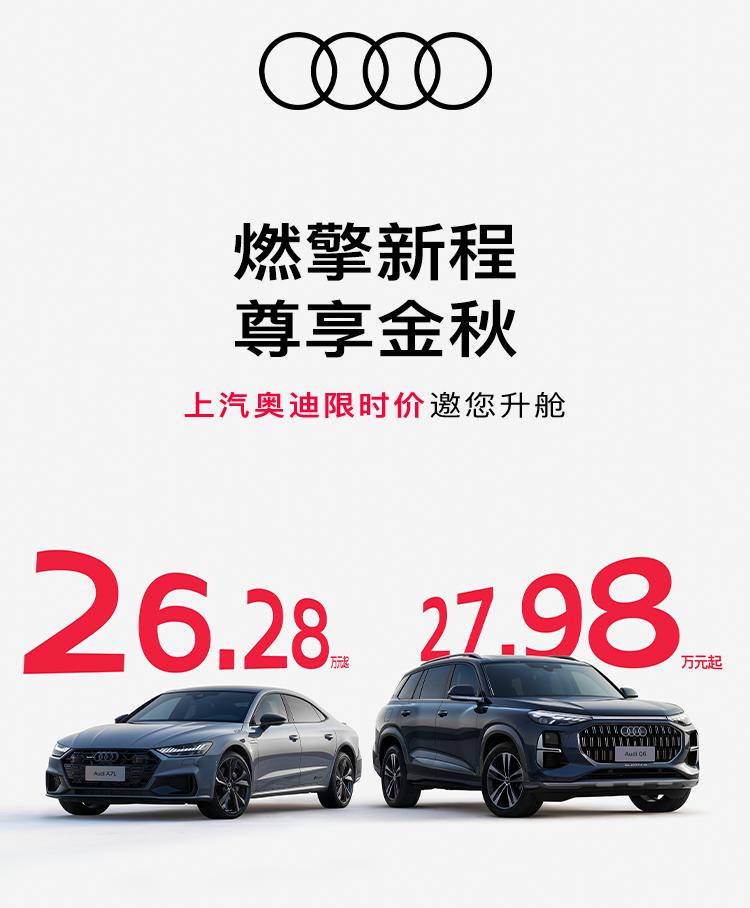
On September 3, the same day the Audi Innovation Center was established, SAIC Audi launched a limited-time preferential activity for two high-end models, the A7L and Q6. The mid-size sedan Audi A7L with a guide price of 418,700 RMB has a preferential price of 262,800 RMB, and the mid-size SUV Audi Q6 with a guide price of 467,600 RMB has been reduced to 279,800 RMB. The preferential prices of both products are equivalent to about 60% of the guide price.
Source: Enterprise
What is more noteworthy is the dynamics of SAIC Audi on the production side. According to third-party data, as of July this year, SAIC Audi seems to have fully stopped the production of all four-ring brand models under its banner. Among them, the pure electric SUV Audi Q5 e-tron based on the previous-generation MEB platform has not been produced this year. The cumulative output of the A7L, which launched large-scale promotions this time, from March to July is less than 50 units, and the annual output of Q6 is only about 3,000 units. Even the A5L Sportback, the best-selling model of SAIC Audi's four-ring brand, produced more than 1,800 units in June before returning to zero in July.
On the one hand, there are discounts and promotions, and on the other hand, there is a full suspension of production. It is obvious that SAIC Audi's four-ring brand models are being sold at reduced prices to clear inventory. SAIC Audi told Caijing that all products are still in production, but did not disclose specific production figures. However, Caijing learned from SAIC Audi dealers that some stores have already started to clear inventory sales of four-ring brand models, and frontline staff in stores also prefer to sell AUDI brand models. Combined with the output of the four models returning to zero in the same month, SAIC Audi has shown an active stance of separating from the four-ring logo in the practical operation of production and sales.
Behind this stance, firm determination is required for support. On the one hand, the four models of the four-ring brand are still the sales support of the entire SAIC Audi. From January to July this year, more than 12,500 units were sold cumulatively, accounting for about half of SAIC Audi's total sales, of which the A5L alone accounts for 30%. If all of them are separated out, SAIC Audi will face relatively high sales pressure.
On the other hand, Audi is also aware of the impact of frequent price cuts and promotions on brands and users. "If car sales are increasingly dependent on how much discount dealers can offer, this is not a sustainable development approach," Johannes Roscheck, President of Audi China, said in an interview with the media on September 3. Johannes Roscheck also pointed out that a significant price change of a newly sold car in a short period of time will also directly affect the residual value of the user's vehicle, and further intensify the market's price pressure.
If Johannes Roscheck's statement can represent the consensus of Audi's brand operation strategy in China, then SAIC Audi's price cut promotion this time has a greater intention of clarifying brand assets than boosting short-term sales.
The four-ring brand returns to the north, and the challenges of takeover exceed sales itself
Even the simple transfer and takeover of brands and products is not an easy task for FAW Audi and SAIC Audi.
As mentioned earlier, four-ring brand models account for half of SAIC Audi's sales. After the transfer, only two models of the AUDI brand will be on sale. According to the plan, the first product of AITC will be launched in 2028. Before that, the AUDI brand may have new car launches, but with the high-profile release of AITC in advance, it is difficult to determine to what extent consumers are willing to pay for transitional products.
However, judging from the market performance of AUDI E5 and E7X, it is feared that the two models are difficult to support the status that a luxury brand should have. According to third-party data, in 2025, the cumulative sales of AUDI E5 were about 7,600 units. Entering 2026, the sales of E5 further declined, with about 230 units sold in January and about 400 units in February. In March this year, it rose to about 2,200 units with the help of price cut promotions, but then fell back quickly, with only about 450 units sold in April. By July 2026, the sales of E5 dropped to only 165 units. In the first seven months of 2026, the cumulative sales of E5 were about 4,110 units.
E7X was officially launched at the end of May 2026. Third-party data shows that it sold 3,770 units in June, and dropped to less than 2,000 units in July. Together with previous shipments, by the end of July this year, the cumulative sales of E7X exceeded 8,500 units. The total sales of the entire AUDI brand in the first seven months of this year were more than 12,600 units.
The challenges faced by FAW Audi are by no means as simple as adding more on-sale models and after-sales services. On the one hand, A5L and A7L each have corresponding platform models in FAW Audi's product lineup, with similar technical platforms and price ranges. If FAW Audi wants to continue production and sales, it