Sudden drastic changes have taken place in the primary market, and the fundraising threshold has been raised.
The primary market is undergoing drastic changes!
Recently, the China Securities Regulatory Commission (CSRC) has publicly solicited opinions on the "Regulations on the Supervision and Administration of Private Investment Fund Raising (Draft for Comment)", with the deadline for feedback being October 4.
The release of this news has sparked heated discussions in the financial circle.
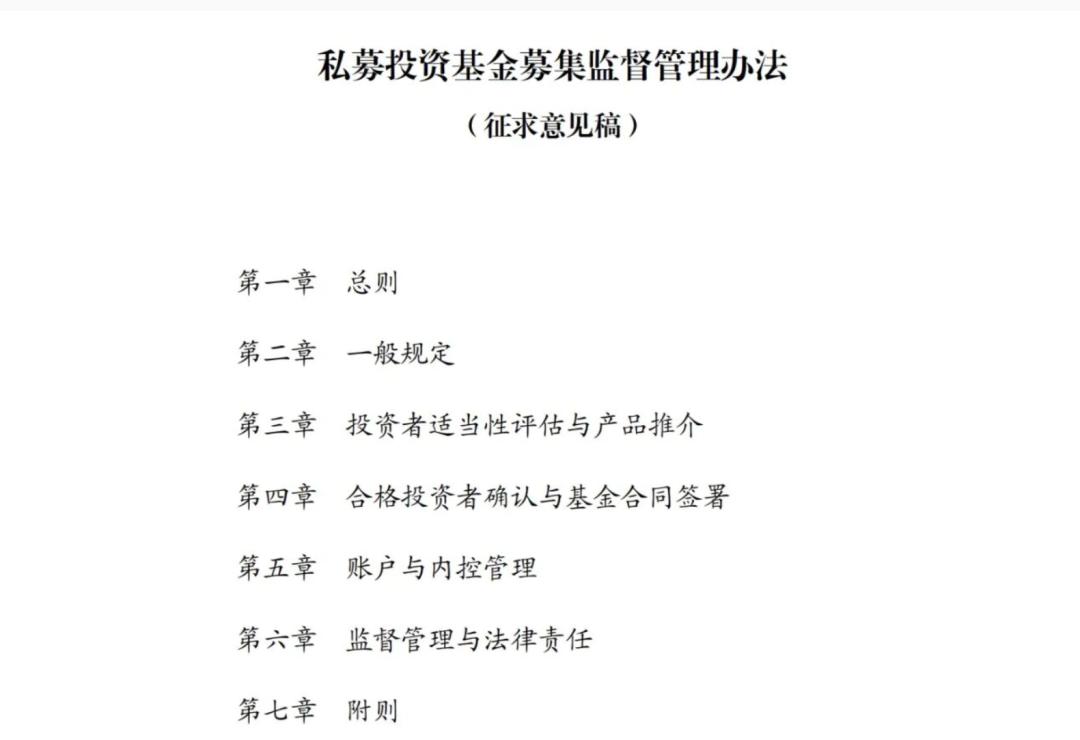
The document has only 7 chapters and 45 articles, but it regulates the most critical step of private equity fundraising.
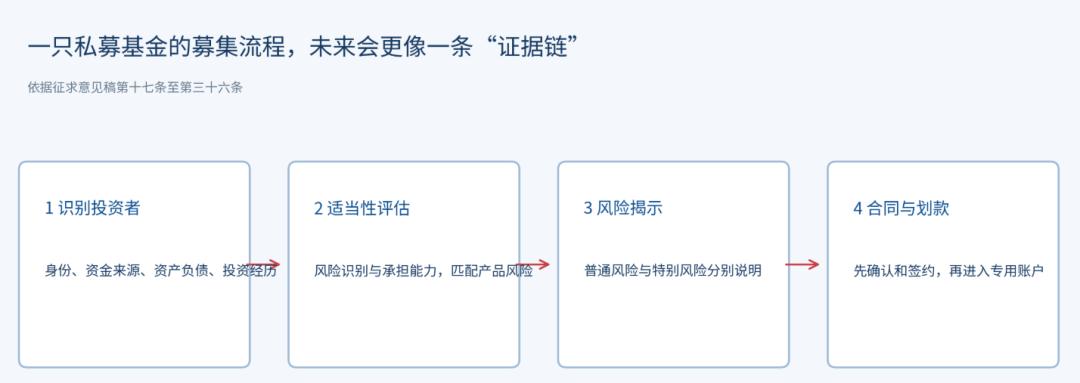
Before funds flow from investors to the fund, all details including who can contact investors, how to judge whether investors are qualified, to what extent risks should be disclosed, which account the funds are transferred to, and who is responsible in case of problems, must be fully recorded.
The CSRC regards this as an important step to improve the administrative rule system for private equity funds.
To put it bluntly, after the implementation of the new regulation, private equity fundraising can no longer prove compliance only by "signed documents and completed procedures", but the entire process must be traceable, verifiable and accountable.
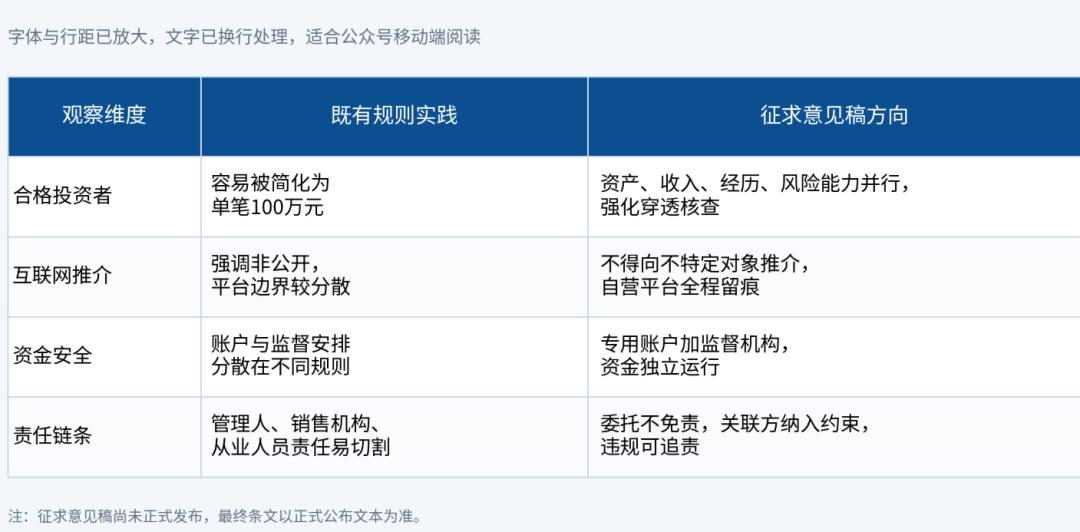
The industry has reached a point where the entry threshold must be strictly guarded
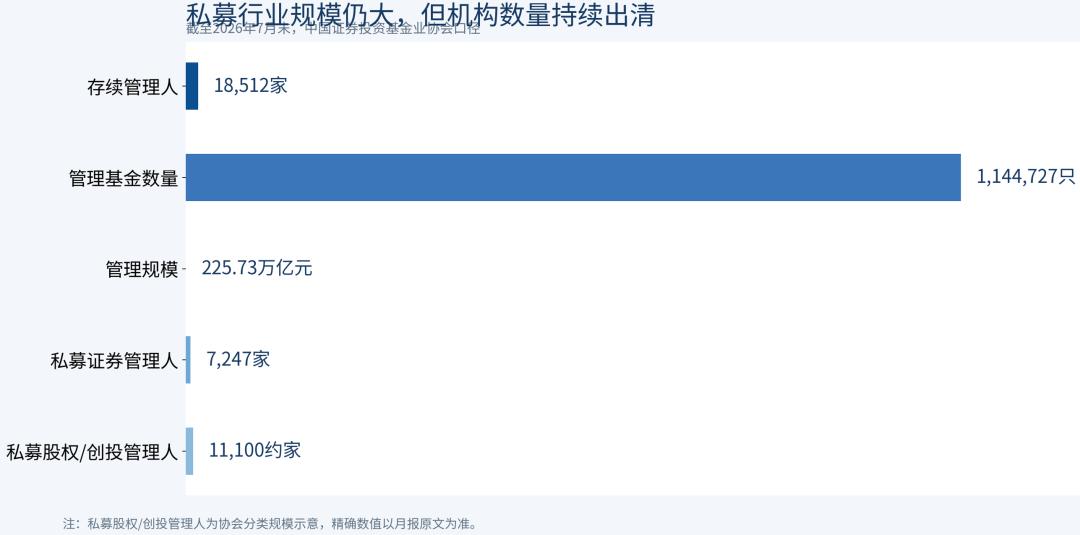
Private equity funds already hold a considerable share in China's capital market. Data from the Asset Management Association of China shows that by the end of July 2026, there were 18,512 surviving private equity fund managers, managing 1,144,727 funds with a total management scale of 225.73 trillion yuan.
Among them, there are 7,247 private securities investment fund managers, and about 11,100 private equity and venture capital fund managers.
Despite the huge figures, the industry is not in an easy situation. Since 2026, the number of surviving managers has continued to decline, and the private equity industry has entered a stage of simultaneous differentiation and clearance.
The market is not short of products. What is truly scarce is verifiable investment capabilities, stable fundraising channels, and compliance systems that can withstand scrutiny.
In reality, troubles in the fundraising link are not uncommon.
Some people describe "minimum investment of 1 million yuan" as the full condition for qualified investors, some present historical performance as future returns, and some package single underlying assets, related party transactions or leverage structures too lightly. In addition, some fundraising work is handed over to third parties without corresponding qualifications.
Their common problem is that the documents seem complete, but investors may not truly understand the risks, and managers may not have completed the appropriateness judgment properly.
What this draft for comment aims to fill is exactly the gap between formal compliance and substantive due diligence.
Five core clauses that determine how fundraising will be carried out in the future
1. Qualified investors are no longer defined simply as "those who have 1 million yuan"
The draft for comment puts forward combined conditions for individual qualified investors:
Having more than two years of relevant investment experience, or serving as senior management of specific financial institutions;
The total financial assets of the family are not less than 5 million yuan, or the net financial assets of the family are not less than 3 million yuan, or the average annual personal income in the past three years is not less than 500,000 yuan;
The investment amount in a single fund is not less than 1 million yuan, and the first paid-in amount is also not less than 1 million yuan; at the same time, the investor must have corresponding risk identification capability and risk bearing capacity.
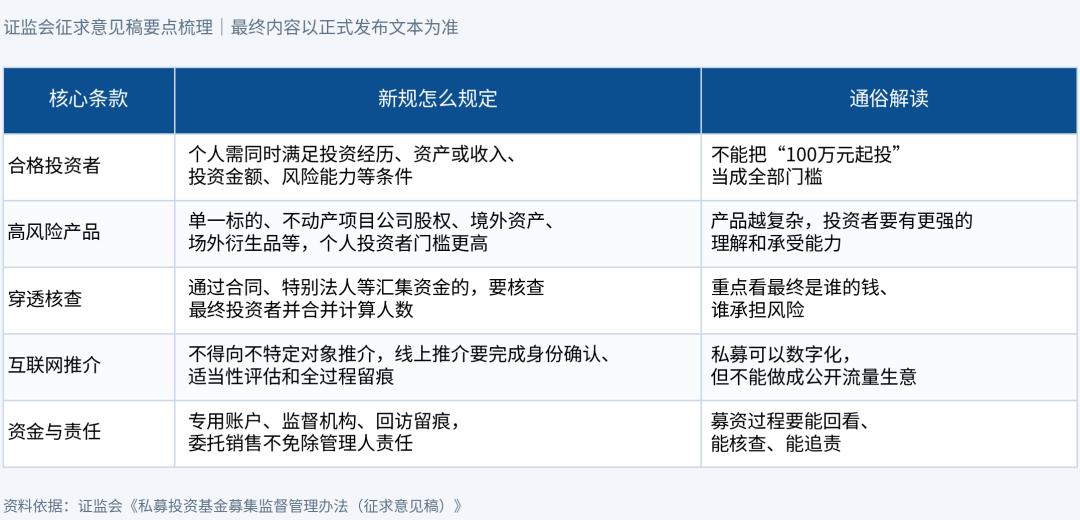
This clause is correcting a very common misinterpretation. 1 million yuan is only the condition for the investment amount, and cannot replace the requirements for assets, income, investment experience and risk capacity.
In the future, it will be difficult to convince the regulators only by providing a transfer voucher to prove that an investor is qualified.
For funds that mainly invest in equity of real estate project companies, single underlying assets, overseas assets, over-the-counter derivatives and other assets with high complexity or low liquidity, the draft for comment sets higher requirements, including more than four years of relevant investment experience, family financial assets of no less than 10 million yuan, family net financial assets of no less than 6 million yuan, etc.
The logic behind it is not complicated: the more complex the product is and the harder it is to exit, the stronger the understanding and bearing capacity investors need to have.
2. Penetrating verification is specified in greater detail
If multiple investors pool funds through contracts, special legal persons and other forms to invest in private equity funds, managers and sales institutions need to conduct penetrating verification of whether the final investors are qualified, and calculate the number of investors on a consolidated basis.
Evasion behaviors such as share splitting, income right splitting, and setting up multiple funds for a single underlying asset are also clearly included in the prohibited scope.
This will directly affect some "channel-based" fundraising arrangements. In the past, regulators only checked how many layers the contract had, but in the future, they will further trace who the capital actually belongs to and who bears the risks. The regulatory sight will continue to extend from the surface of the contract to the final investors and the source of funds.
3. The internet can be used to provide services, but private equity fundraising cannot be turned into public advertising
The draft for comment allows managers to publicly introduce their brands, development strategies, investment strategies, personnel information and fundraising channels, but they are not allowed to publicly publicize the specific information of private equity fund products.
Private equity funds shall not be promoted to unspecified objects through internet platforms.
If the self-operated internet platform promotes private equity funds to investors who have completed specific object confirmation and appropriateness assessment, it must complete identity verification, qualified investor commitment, risk questionnaire and adaptation assessment, and keep traces of the entire process.
Online operation is not a problem, but blurred boundaries are. Private equity can use the internet to improve efficiency, but cannot turn "non-public fundraising" into a traffic business that everyone can see and click to purchase.
4. Capital safety is upgraded from principle requirements to account mechanism
Managers and sales institutions shall open special accounts for fundraising settlement, and all processes including fund pooling, share transfer, income distribution, redemption payment and liquidation distribution shall be carried out through the special accounts.
The accounts shall also be supervised by fundraising settlement capital supervision institutions such as commercial banks or securities companies that have obtained the fund sales business qualification.
Capital safety cannot be guaranteed only by the phrase "earmarking funds for specified use". Independent accounts, third-party supervision, reconciliation and transfer records are the things that can clarify the facts when disputes arise.
5. Entrusted sales does not mean outsourced responsibilities
If a manager entrusts a sales institution to raise funds, the responsibilities assumed by the manager in accordance with the law will not be exempted as a result. The manager shall also carry out access review and continuous management of the entrusted institution, and replace it in time and report to the local regulatory agency if any violation is found.
Managers, sales institutions and practitioners shall not promise capital preservation and fixed returns, shall not conduct false publicity, misleading sales and interest transmission, and shall not raise funds in disguised forms through institutions or individuals without sales qualifications.
The draft for comment also proposes that the performance of fundraisers should not be evaluated only by sales results, and investor complaints and misleading sales should also be included in the assessment. This change is very targeted. Many risks do not arise because the system is not written, but because the internal incentive mechanism only rewards "bringing in the money", and no one seriously checks "whether this sum of money is suitable to be brought in".
It is not starting from scratch, but to implement responsibilities to the fundraising site
In 2016, the Asset Management Association of China has released the "Measures for the Administration of Private Investment Fund Raising Behaviors", which has made self-regulatory arrangements for specific object confirmation, risk disclosure, cooling-off period and return visit confirmation.
The changes this time do not mean completely overturning the past rules, but further integrating the requirements scattered in laws, administrative regulations and self-regulatory rules into special administrative rules at the CSRC level, and supplementing the requirements for account supervision, penetrating verification, internet trace retention, related party constraints and accountability.
It does not change the basic logic that private equity funds are raised from qualified investors in a non-public manner, nor does it guarantee returns for investors.
It only rearranges the order: first confirm whether you are suitable to enter this market, then confirm whether you truly understand the risks, and finally confirm whether the funds have been transferred to the correct account as agreed.
Who will have an easier time and who will face greater difficulties
Large managers need to carry out system upgrades first. Investor portrait, risk rating, online trace retention, sales institution management, related party transaction isolation and document preservation must all be incorporated into daily processes.
The cost will rise, but compliance will also become a new trust threshold.
The pressure on small and medium-sized managers will be more direct. In the past, they raised funds through acquaintance referrals, external channels, temporary materials and personal sales capabilities, but in the future, it will be difficult to maintain the business only by "relationships" and "sales pitches". Institutions without stable investment research capabilities, compliance personnel and trace retention systems will face higher operating costs, and fundraising will become more and more difficult.
Sales institutions can no longer simply treat private equity as a value-added sales product for high-net-worth clients. Risk questionnaires, product ratings, special risk disclosure and return visit records will all become important materials to judge whether the sales institution has fulfilled its due diligence obligations in the future.
For investors, the change is not only that the threshold is slightly higher, but that they must seriously answer several questions before investing: whether the money belongs to them, whether they can afford the loss, how long it will take to exit the product, whether they have seen clearly the risks of related party transactions and single underlying assets, and whether they understand that historical performance does not represent future returns.
Science and technology innovation and equity investment may feel that fundraising is slower, requires more documents and has stricter screening in the short term. But patient capital that is truly willing to invest in early-stage, small-scale and technology-focused projects inherently needs a stable institutional environment.
By keeping unsuitable funds out, managers are more likely to make judgments based on long-term value, instead of being led by short-term redemption pressure and frequent fundraising demands.
What really needs to be competed for is no longer the speed of fundraising
The attitude of this new regulation is very clear. The regulators do not oppose private equity to take risks, but they cannot sell risks to people who cannot afford them; they do not oppose managers to charge reasonable fees, but they cannot create illusions through vague publicity and complex structures; they do not oppose industry competition, but competition cannot be achieved by bypassing thresholds, hiding risks and evading responsibilities.
Private equity funds, in the final analysis, turn professional capabilities into fiduciary responsibilities. What managers get is not a sum of ordinary capital, but the authorization from investors on their judgment.
The greater the authorization, the heavier the obligation of explanation.
In the past, the market used to ask "how much money have you raised", but in the future, three questions should be asked more: where does the money come from, whether investors truly understand the risks, and whether managers have the ability to turn their commitments into long-term results.
The draft for comment is not the final rule after all. The standards for qualified investors, the boundary of internet platforms, the responsibilities of sales institutions and the implementation caliber may all be adjusted later. The implementation of the new regulation cannot be completed only by adding more forms and audio-video recording.
The real effect depends on whether risks can be identified earlier, whether investors are less misled, and whether the industry shifts from competing for fundraising speed to competing for investment capabilities.
The author personally judges that the private equity industry will further differentiate.
Head institutions will get more institutional capital with their brands, performance and system capabilities; small and medium-sized institutions with real long-term investment capabilities still have opportunities; institutions that only survive by channels, packaging and sales pitches will find it more and more difficult to operate.
The industry scale may not shrink immediately, but the market will reprice the "value content" of each institution.
This is not the end point of private equity funds, but more like a watershed for the industry to shift from pursuing expansion speed to professional operation.
Only when the entry of the fundraising end is strictly guarded, can the investment end be qualified to talk about long-termism.
This article is from the WeChat official account "Investment Banking Circle", written by Senior Sister of Investment Banking, authorized for release by 36Kr.