Country Garden 2026 Interim Report: No Conclusion Can Be Issued
On August 26, Country Garden disclosed its performance for the first half of 2026. During the reporting period, the company recorded a revenue of 44.081 billion yuan, a year-on-year decrease of 39.3%; the net loss attributable to shareholders of the company amounted to 15.616 billion yuan, narrowing from 19.078 billion yuan in the same period of last year.
Compared with the figures themselves, the most noteworthy part of the entire document is Country Garden's definition of its own status — "In the second half of 2026, the Group will enter the most critical stage of transitioning from 'ensuring home delivery' to normal operation".
On the other hand, revenue is still declining, the main business is still loss-making, and cash size remains limited. Meanwhile, the auditor is 'unable to express a conclusion' on the company's going concern basis.

Source: Performance Report
Country Garden is indeed moving forward from the deepest point of the crisis, but for now, there are signs of blood stanching, while blood generation remains to be verified.
01
Looking at the profit alone, Country Garden's performance in the first half of this year seems to have improved.
In the first half of 2026, the company recorded a net loss of 16.442 billion yuan, narrowing by 16.3% year-on-year; the net loss attributable to shareholders was 15.616 billion yuan, narrowing by 18.2% year-on-year. However, the revenue side still contracted significantly, dropping from 72.570 billion yuan in the same period of last year to 44.081 billion yuan.
Among them, the revenue from real estate development business was 42.356 billion yuan, a year-on-year decrease of 39.5%, accounting for 96.1% of the company's total revenue; the external revenue from technology construction business dropped from 1.466 billion yuan to 474 million yuan, a year-on-year decrease of 67.7%.
What is more noteworthy is the gross profit. The term "gross profit" only appears once in the entire document, and "gross loss" has been used as the default term to refer to gross profit.
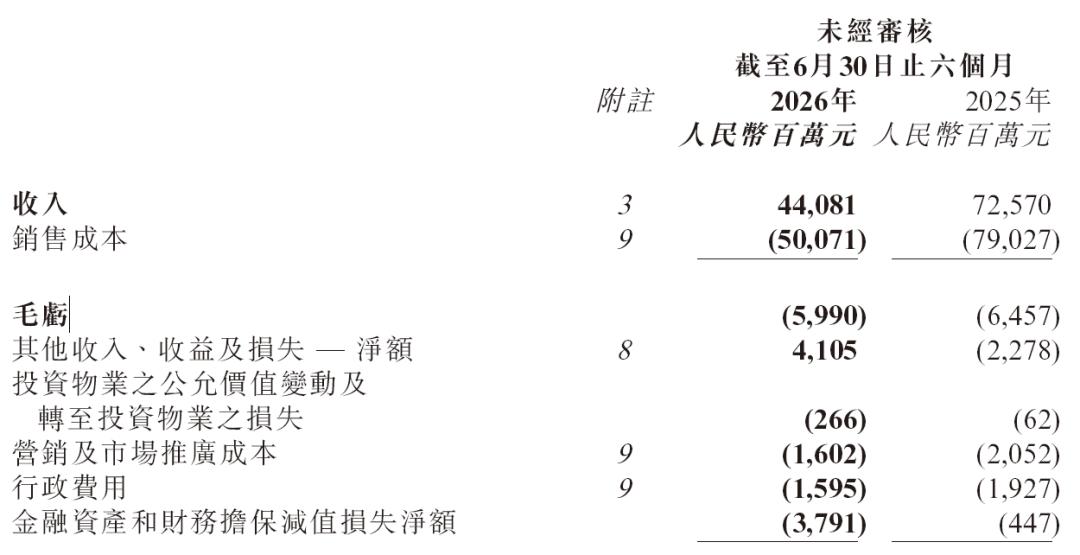
Source: Performance Report
During the reporting period, Country Garden recorded a gross loss of 5.99 billion yuan. The company explained that this was mainly due to a provision of 6.173 billion yuan for impairment of properties under construction and completed properties held for sale. Excluding this part of impairment, the actual gross profit of the company in the first half of the year was 183 million yuan.
Country Garden is gradually stanching the bleeding from the huge operating losses in the past, but its main business has not yet formed sufficient profitability.
If we apply the same question to the 2025 annual financial report, what result will we get?
In 2025, Country Garden achieved a net profit of 1.624 billion yuan, and the net profit attributable to shareholders was 3.261 billion yuan, turning from huge losses in 2024 to profit. However, the profit structure in 2025 does not mean that the core real estate business has re-entered a growth cycle. In that year, Country Garden recorded 82.137 billion yuan of "other income, gains and losses — net", one of the important sources of which was debt restructuring gains; at the same time, the company made an impairment provision of about 44.507 billion yuan for properties under construction and completed properties held for sale.
Therefore, the "profit" in 2025 more reflects the repair of the balance sheet by factors such as debt restructuring and asset disposal, rather than the traditional operating profit growth. In the first half of 2026, as the scale of debt restructuring gains declined, Country Garden's operating status was once again brought to the forefront.
The large figures are not actually important. What really matters is whether the company can get rid of the model of gaining phased respite through balance sheet adjustment in the future, and re-establish stable operating cash flow.
02
What Country Garden is doing is not ineffective.
As of June 30, 2026, the company's total borrowings were about 142.661 billion yuan, a decrease of about 5.3 billion yuan from 147.959 billion yuan at the end of 2025; in April 2026, the company repurchased onshore corporate bonds with a principal of about 3.75 billion yuan with about 454 million yuan in cash, and confirmed debt restructuring gains of 1.621 billion yuan.
Earlier, the offshore debt restructuring plan involving about 17.7 billion US dollars officially took effect on December 30, 2025, and the restructuring plan for 9 onshore corporate bonds involving about 137.7 billion yuan has also been approved.
Debt restructuring has bought time for Country Garden. But the problem is that this time window is still accompanied by considerable cash pressure.
As of the end of June, the company's cash and cash equivalents amounted to only 5.737 billion yuan, and restricted cash was 10.938 billion yuan, totaling 16.675 billion yuan; at the same time, the total borrowings were 142.661 billion yuan, of which 101.546 billion yuan was classified as current liabilities. About 82.4 billion yuan of the company's borrowings have defaulted or cross-defaulted.
Therefore, the decline in debt scale does not mean that the risk has disappeared. For Country Garden today, what really matters is whether sales, payment collection and asset disposal can continuously provide cash to make this rearranged balance sheet operate effectively.
Independent auditor Zhonghui Anda Certified Public Accountants did not express a conclusion on Country Garden's interim financial information for the first half of 2026. The reason is far more than just the loss — the company's ability to continue as a going concern depends on a number of conditions that have not yet been fully determined: whether real estate sales can be realized as forecast and payments can be collected in time; whether the remaining debts can be further extended or restructured; whether solutions for payables can be reached with suppliers; and whether favorable results can be obtained in relevant litigations.
The auditor explicitly stated that it was unable to obtain sufficient and appropriate review evidence to draw a conclusion on the appropriateness of the above key assumptions.
This also forms the most distinct contradiction of Country Garden at present: the company is describing to the market the next stage of "normal operation", but whether it can truly reach that stage still depends on the fulfillment of a series of future conditions such as sales, payment collection, debt negotiation and litigation.
03
Country Garden is obviously looking for new answers beyond debt.
The company is continuing to promote the "one body, two wings" strategy, taking real estate development as the core, technology construction and entrusted construction and management as the two wings, and regarding product capability, service capability and cost capability as the new core competitiveness.
In terms of entrusted construction and management, Phoenix Zhituo has undertaken more than 200 projects in total, with a total entrusted management area of nearly 20 million square meters; the cumulative delivery of Bothen smart construction robots has exceeded 5,200 units, with the application area exceeding 40 million square meters.
But at least from the perspective of short-term performance, the "two wings" cannot replace real estate development yet. In the first half of 2026, the revenue of technology construction not only did not grow, but also decreased by 67.7% year-on-year. This means that technology construction and entrusted construction and management are more like long-term capabilities that Country Garden is trying to build, rather than a "lifeline" to solve the cash flow problem at the moment.
Whether Country Garden can truly complete the so-called "second entrepreneurship" will eventually return to the real estate sector itself — how much of the remaining assets can be sold, how much payment can be collected, how much profit can be generated, and whether it can gradually get rid of the past development model of high leverage and high turnover.
Debt restructuring only bought Country Garden a period of time. Now, this period is starting to enter the fulfillment stage. What really determines Country Garden's next journey is no longer just whether it can survive, but whether it can regenerate its own blood.
At the policy level, a noteworthy variable has emerged recently.
On August 28, five departments including the Ministry of Housing and Urban-Rural Development, the People's Bank of China, the State Administration of Financial Regulation, and the China Securities Regulatory Commission jointly released new real estate policies. Among them, the "Opinions on Supporting the Construction of a New Real Estate Development Model through the Capital Market" issued by the CSRC clearly proposes to "meet the reasonable financing needs of real estate enterprises of all forms of ownership without discrimination", and promote the transformation of real estate enterprise financing from "relying on entity credit" to "based on project conditions". The supporting document "Measures for the Administration of Commercial Housing Development Loans (Trial)" also emphasizes that there shall be no discrimination against projects of real estate enterprises of all forms of ownership, and the group risk of real estate enterprises and the risk of a single project shall be reasonably distinguished.
This means that the financing logic is shifting from "looking at the parent company's credit" to "looking at the project itself". For private real estate enterprises like Country Garden that still have a large number of existing projects but whose group-level credit has been damaged, if the project itself has the ability of self-sustainable cash flow, it will theoretically obtain a more equitable financing environment than in the past.
For Country Garden, this may be a window of marginal improvement.
This article is from the WeChat Official Account "Future Habitat", written by Zhang Guohao, authorized for release by 36Kr.