Post-90s serial AR entrepreneur manufactures optical chips with semiconductor technology, completes over 100 million yuan Series B financing | 36Kr Exclusive
Source / Enterprise
This article is about 2100 words, with an estimated reading time of 4 minutes
Author | OU Xue
Editor | YUAN Silai
Hard Krypton learned that Avalon Holdings (Beijing) Co., Ltd. (hereinafter referred to as "Avalon") recently announced the completion of a Series B financing of over 100 million RMB. This round is led by existing shareholder Plum Ventures, with participation from Deyang State-owned Capital and Ningbo State-owned Capital. The funds will be mainly used for R&D breakthroughs of large field-of-view optical waveguide chips, capacity expansion of the mass production base in Deyang, Sichuan, and the industrial implementation of optical communication device business.
Founded in 2017 and headquartered in Beijing, Avalon is a national high-tech enterprise and a "specialized, refined, differential and innovative" enterprise, focusing on metasurface optical waveguide chips, AR smart glasses complete machines and industry solutions, and has built a full-process closed loop from chip design and master manufacturing to mass production processing.
Avalon's path to enter the AR track is different from most startups. Its founder Xu Peipei, a PhD from Peking University, was once in charge of the Honor product line business at Huawei. In 2015, he judged that the new generation of mobile computing terminals would most likely evolve in the AR direction, so he decided to start a business.
In the first few years, Avalon mainly produced AR complete machines for the to B and to G markets, and achieved the highest domestic shipment volume in the police field. However, the complete machine business made the team realize a deep-seated problem: the supply chain could not provide optical waveguide display solutions that meet the requirements.
"We have in-depth cooperation with many partners around the world, and we could not find any usable products, so we decided to develop it on our own," Xu Peipei told Hard Krypton. In 2020, Avalon launched optical R&D and chose a technical route completely different from peers at home and abroad: metasurface optical waveguide combined with the new silicon carbide material. The core idea of this route is to manufacture optical chips with semiconductor technology.
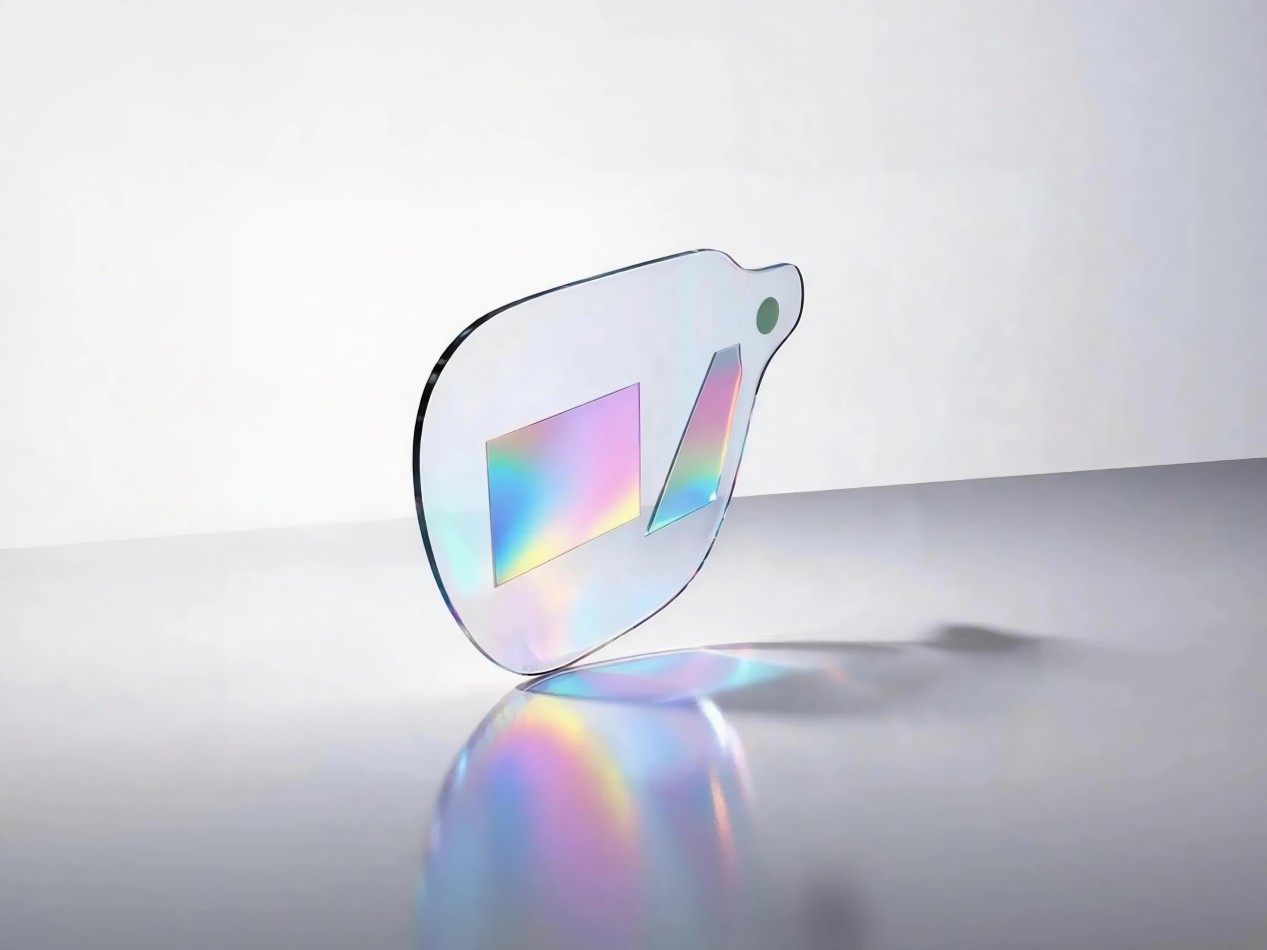
At present, the mainstream optical waveguide solution in the industry is SRG (Surface Relief Grating), but it has problems such as low light efficiency, severe chromatic dispersion and rainbow patterns. Avalon's MGW metasurface solution can precisely regulate the phase and amplitude of light waves through subwavelength structures, achieving generational leadership in multiple core indicators.
According to Xu Peipei, the optical efficiency of Avalon's industry-first MGW metasurface optical waveguide can reach more than three times that of SRG, the field of view can reach more than 50°, a single layer of material can achieve a field of view of more than 70°, and it fundamentally improves the problems of chromatic dispersion and rainbow patterns. In terms of cost, it is expected to be about 60% lower than the industry average after mass production.
The production line is another barrier. The manufacturing process of optical waveguides is basically the same as that of chip production, with a construction period of about 2 to 2.5 years. Insufficient production capacity has become the norm in the industry. At present, Avalon has formed a dual-base layout of the R&D pilot base in Shunyi, Beijing and the mass production base in Deyang, Sichuan. The entry of Deyang State-owned Capital in this round will further consolidate the production capacity foundation and industrial chain collaboration.
In 2023, the company purchased an electron beam lithography machine from the Netherlands, which is equipment owned by very few startups in China and can keep the R&D iteration speed at the "daily level". The 8-inch silicon carbide AR grating waveguide production line under construction by the company is expected to reach an annual capacity of one million pieces after it is put into operation in 2027.
In addition, Xu Peipei revealed that Avalon is about to release a new generation of large field-of-view optical waveguide products. Through innovative optical micro-nano structure design, this product takes into account the light and thin form and mass production cost, and can solve the core pain points of "large field of view, light weight and low cost" of consumer-grade AR glasses.
However, an easy-to-ask question is: since Avalon makes both chips and complete machines, will it compete with downstream customers? Xu Peipei explained that the company's complete machine business is concentrated in to B/to G segmented markets such as police and industry, and does not involve consumer-grade AR glasses. Its S-series AR glasses and XR cloud platform have been deployed on a large scale in electric power, industry, energy and other fields, serving hundreds of industry customers including State Grid. This part of the market requires special certifications (such as special equipment certification of the Ministry of Public Security), which consumer brands usually do not enter, while optical waveguide chips are sold openly to all complete machine manufacturers.
It is revealed that Avalon's revenue in 2025 is about 70 million yuan, which is expected to double to about 150 million yuan in 2026, and the target is to reach 500 million yuan in 2028.
The following is an edited excerpt of the conversation between Hard Krypton and company founder Xu Peipei:
Hard Krypton: When do you think the inflection point for the real volume growth of the AR industry will come?
Xu Peipei: The sales volume of many AR products has been very high this year, reaching several million or even tens of millions of units. I think the inflection point will definitely come in 2027. In terms of product form, the weight of glasses has been reduced to the 30-gram level, which is no different from myopia glasses, and the wearing experience is acceptable to the public. At the application level, there was indeed a lack of killer applications before, but AI is developing rapidly, and we judge that there will be such applications soon. By the end of this year or the beginning of next year, leading companies will release new products, and almost all Fortune 500 consumer electronics companies are making layouts in this field.
Hard Krypton: Few enterprises in the industry choose the metasurface optical waveguide technical route. Why did you dare to choose this route at the beginning?
Xu Peipei: In fact, we didn't deliberately choose an unpopular route, we were forced to do so. We have been making complete machines for five years before 2020, and we have basically tried all the optical waveguide solutions that can be cooperated on the market. No matter at home or abroad, no one can really meet our requirements for display effect and mass production feasibility. The traditional SRG solution has too low light efficiency, severe chromatic dispersion, low yield and high cost. Later, we changed our mind: can we use semiconductor manufacturing methods to make optical chips? The essence of metasurface is to regulate light with subwavelength structures, which naturally matches the semiconductor process. Coupled with the new material of silicon carbide, which has high refractive index and good light transmittance, a single layer can achieve full-color display without stacking multiple layers like traditional solutions. No one took this route at the beginning, and we encountered many difficulties, but after we got through it, the parameter indicators are a full generation ahead of our peers, and these investments are worthwhile.
Hard Krypton: Since Avalon makes both chips and complete machines, will it have a competitive relationship with downstream complete machine customers?
Xu Peipei: Many people have asked this question, but in fact there is little conflict. Our own complete machines are only made for the segmented to B and to G markets, such as police and industry, and we do not make consumer-grade AR glasses. These segmented markets require special equipment certifications, which consumer brands usually do not enter, and they are all focused on to C scenarios, so the customer groups basically do not overlap. Our waveguide chips are completely open and sold to all AR complete machine manufacturers around the world. Consumer terminal manufacturers will not enter the police market. Chips are used to build core barriers, and complete machines are used for scenario verification and cash flow, and the two sides do not interfere with each other.
Investor Views:
Plum Ventures: "Since the last round of investment, Avalon has exceeded our expectations in the process maturity, mass production yield and customer implementation of optical waveguide chips. We continue to increase our position because we are optimistic about the long-term certainty of metasurface optics in the AR display and optical communication markets, and we also recognize the team's execution ability to turn 'hard technology' into 'hard production capacity'."
Deyang State-owned Capital: "Avalon's Deyang mass production base is an important part of the local optoelectronic industry layout. This investment is not only financial support, but also industrial collaboration. We look forward to taking capital as a link to promote more optoelectronic chip production lines to take root in Deyang."