What do the first group of users think of Tesla Cybercab during its first week of passenger-carrying operation?
Tesla's Cybercab has already hit the road to pick up passengers.
On September 4 local time in the United States, the first batch of Cybercabs joined the Austin Robotaxi fleet and began offering paid services in limited local areas. At this stage, passengers hail rides through the Robotaxi App, and cannot specify the Cybercab model, with specific vehicles dispatched uniformly by the system.
The addition of Cybercab to the fleet also takes place amid the continuous expansion of Tesla's Robotaxi network.
Over the past year, Tesla has gradually expanded its service scope in Texas and Florida. This year, it has successively entered Miami, Orlando and Tampa, with unsupervised operation launched from the very beginning in some cities. The latest registration records show that Tesla currently has 420 self-driving vehicles registered in Texas, of which 375 are Model Y units and 45 are Cybercab units.
The Cybercab hitting the road is only the first step. What needs to be focused on next is the passenger experience, the scale that Tesla's Robotaxi network has reached, and whether this model can further evolve from operating with dozens of vehicles to large-scale commercial deployment.
01 Cybercab Undergoing Passenger Testing
The interior structure of Cybercab is extremely simple: two seats, one large screen, no steering wheel, accelerator or brake pedals. The butterfly doors open automatically. After passengers sit in, the vehicle adjusts the seats and air conditioning according to personal settings, and can also continue playing the music or video that was being played on the mobile phone before the ride.

Tesla Cybercab. Source: X
Most feedback from users who have already ridden Cybercab focuses on two aspects: the vehicle runs relatively smoothly, and the interior space and riding experience are very different from those of ordinary cars; at the same time, some details related to hailing rides, finding vehicles and in-car operations still need to be adjusted.
Sawyer Merritt, a Tesla owner and content creator, has spent a total of about 5 hours riding Cybercab, with the longest single trip lasting around 40 minutes. He said he did not encounter obvious jitters, hesitant maneuvers or abnormal actions during the rides. After several experiences, he believes the overall driving performance of the vehicle is very smooth.
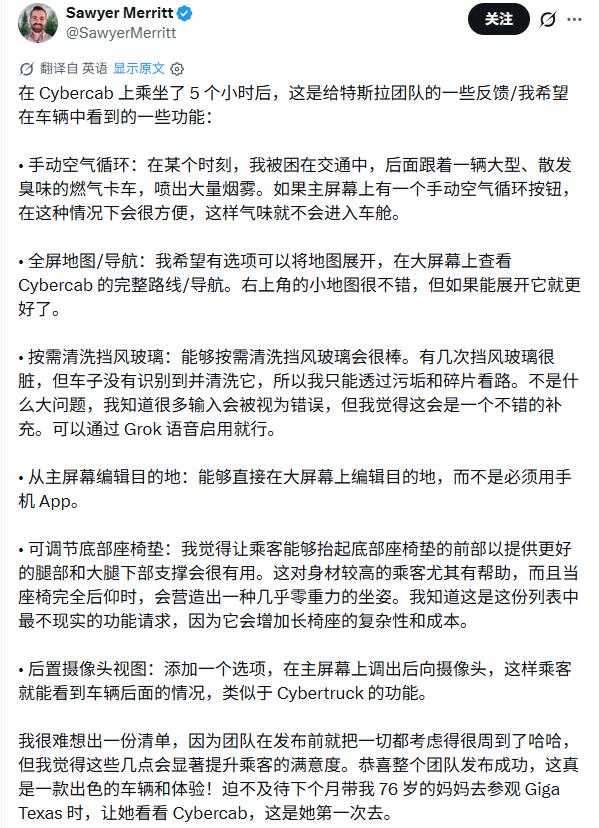
His suggestions mainly focus on in-car functions, such as adding a full-screen map, allowing direct modification of destinations on the screen, displaying the rear camera feed, and providing manual air circulation and windshield wiper functions.
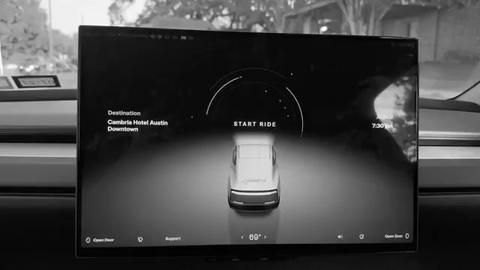
Merritt's ride experience video. Source: X
Devin Olsen has ridden Cybercab more than 30 times. He raised several issues: when multiple Cybercabs are parked together, he hopes the vehicles can be more easily identifiable through lights or other methods; he hopes the system supports multiple drop-off points, the map can provide a satellite view, and passengers are allowed to adjust the drop-off location directly inside the vehicle.
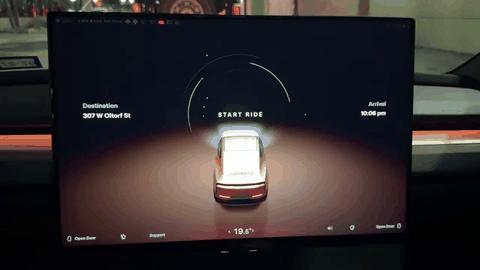
Olsen's published ride video. Source: X
All this feedback has one thing in common. Traveling from the start point to the end point has already become a basic function, and passengers are starting to pay attention to the tasks that used to be completed by human drivers during the entire ride.
The experience of visually impaired passenger Gary Moss further illustrates this point. He lost his eyesight 5 years ago. Before that, he drove 50,000 to 65,000 kilometers every year. After losing the ability to drive, he needed family members to accompany him most of the time when going to coffee shops, attending events or handling daily affairs.
When he rode Cybercab, the automatic door opening function and spacious cockpit left a deep impression on him. He described the interior as feeling like "his own living room", where he could sit and listen to music or chat with his son, while the vehicle completes the rest of the journey on its own.
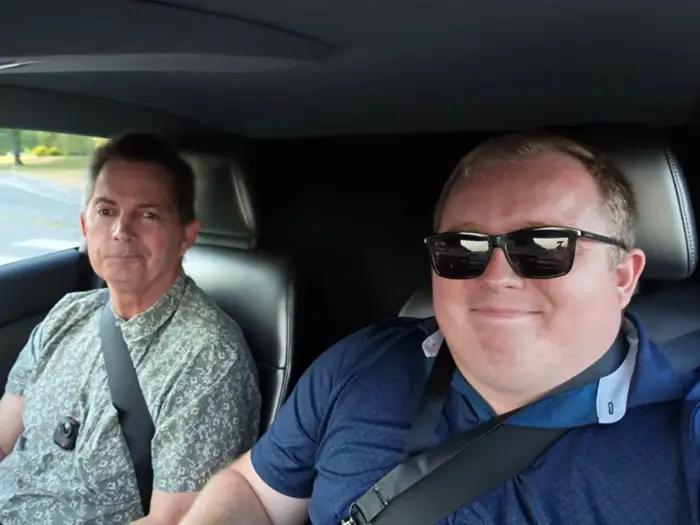
Moss (left) riding Cybercab with his son. Source: BI
But for Moss, the guidance for finding the vehicle and after getting off is even more important. For example, when several Cybercabs are parked together, there is no obvious audio prompt to help him find his vehicle. Grok can answer questions about current location, remaining mileage and travel time, but it cannot completely replace the mobile phone to complete destination setup.
Moss hopes that after the vehicle arrives at the stop, it can announce the parking position via voice, and tell passengers how far it is from the parking spot to the destination on foot.
As Robotaxi is truly open to ordinary passengers, experience standards are also changing. In the past, the evaluation of a self-driving car usually focused on whether it can complete the driving task. Now passengers will continue to ask whether it is convenient to hail a ride, whether the vehicle is easy to find, whether the destination can be modified at any time, and whether passengers can get sufficient assistance after getting off.
Cybercab has already begun to face this level of testing.
02 The "Economic Calculation" of Cybercab
From the very beginning of its design, Cybercab has made trade-offs around the operating cost of Robotaxi services.
The vehicle is equipped with a 48kWh battery and 4680 cells, with a drag coefficient lower than 0.20, and the electric drive system is further reduced in size and weight. A "boxless" production scheme is adopted in the manufacturing process, with which Tesla hopes to shorten the production line length by about 50%. The car body also uses reaction injection molded plastics to further eliminate the traditional metal body manufacturing and painting processes.
Elon Musk previously set the target for Cybercab to keep the selling price below $30,000, with an operating cost of about 20 cents per mile; after including taxes and other expenses, the overall cost is about 30 to 40 cents per mile.
But for Robotaxi, whether the cost can really be reduced depends on another indicator: vehicle utilization rate.
A direct manifestation of vehicle utilization is how many consecutive travel tasks a single vehicle can undertake in one day. Luis Ovalle, a user from Spain, gave an example to describe the possible future usage scenarios of Cybercab: in the morning, Cybercab sends him to the office, then drives back home on its own; after a while, it sends his wife to the airport, then picks up his daughter from the university, and finally returns to the office to pick him up.
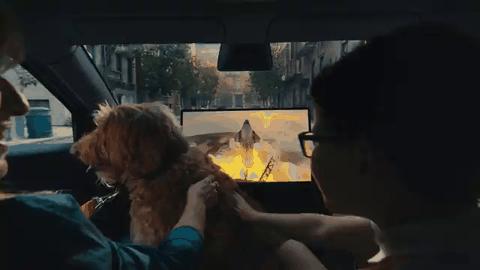
Ovalle's envisioned Cybercab usage scenario. Source: X
He believes that one vehicle can continuously undertake different travel tasks for the whole family, and people in the car can work or handle other affairs during the ride.
This usage pattern is also part of the fleet model envisioned by Musk. Car owners use their cars for personal use on a daily basis, and when they are away for several days, they can add their vehicles to the fleet via the App; when they need to use the car, they can recall the vehicle from the fleet. Tesla operates part of the vehicles itself, and also allows end users to put their own cars into the fleet.
This model requires a high vehicle utilization rate. Ordinary private cars are parked for most of the day, but after accessing the Robotaxi network, they can continue to take orders during the time when the car owner does not need the vehicle. The more vehicles there are, the higher the requirements for dispatching, maintenance, charging and operation systems will be.
03 Launched in Seven Cities, Still on the Eve of Large-scale Deployment
Before Cybercab entered Austin, Tesla's Robotaxi service had already covered seven markets: Austin, Dallas, Houston, Miami, Orlando, Tampa and the San Francisco Bay Area. Cybercab currently only provides ride services in Austin, and is mixed into the existing Robotaxi fleet.
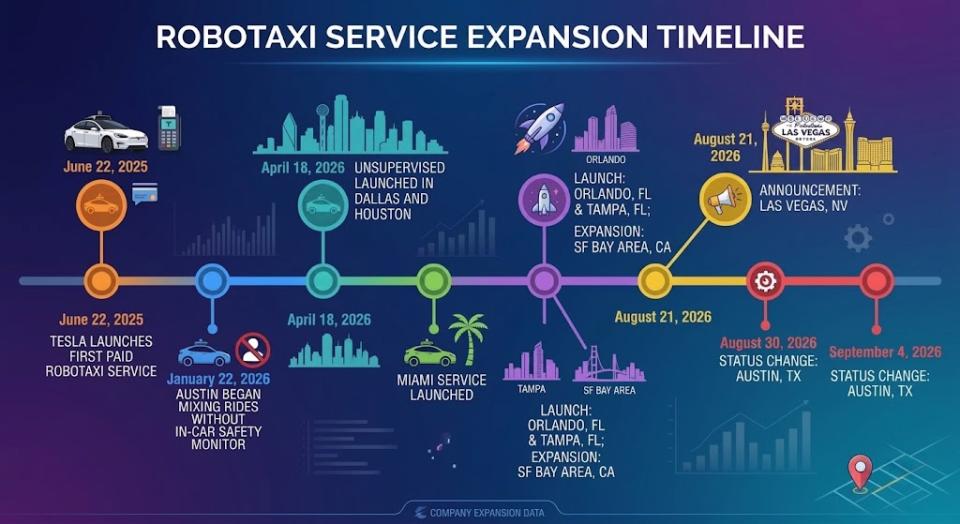
Tesla Robotaxi business expansion timeline. Source: Tesla owner tracking website Basenor
However, the promotion pace in different markets is not consistent.
Austin, Dallas and Houston entered the Robotaxi operation stage earlier, while Miami, Orlando and Tampa launched the service in July this year, and Tesla directly adopted the unsupervised operation mode in these cities.
The San Francisco Bay Area still requires safety drivers at present, and the service uses California's TCP commercial passenger transportation license, which does not belong to the fully driverless Robotaxi deployment.
At the Q2 earnings call on July 22, Ashok Elluswamy, Vice President of Tesla AI Software, revealed that the company's total unsupervised driving mileage in six cities across two states (excluding the San Francisco Bay Area) has exceeded 600,000 kilometers. Tesla also disclosed that it continued to expand the unsupervised operation area in Austin in the second quarter.
It can be seen from the expansion sequence that Tesla first chose markets with relatively loose regulatory conditions. Texas has relatively few restrictions on the commercial operation of self-driving vehicles, and Florida's state-level policies also leave a large space for self-driving ride-hailing services. Tesla can use geofencing to limit the operation scope in these places, and then expand gradually.
California is different. Tesla still needs safety drivers in the Bay Area, and its self-driving business is subject to multi-layer supervision from the DMV, CPUC and other authorities.
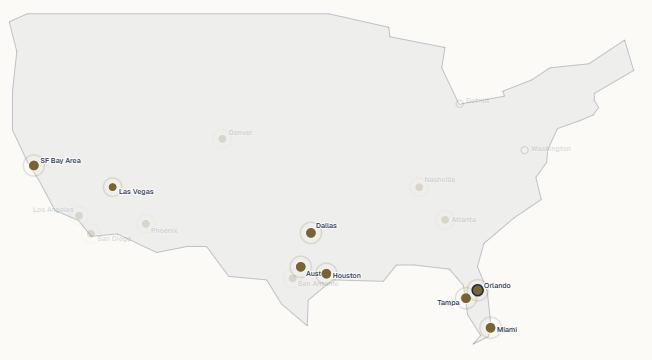
Tesla's Robotaxi business has expanded to seven cities. Source: Independent tracking firm DockDuty
The next targets will be Phoenix and Las Vegas. Tesla has listed Phoenix as "in preparation", and Las Vegas received approval from the state of Nevada on August 20, allowing up to 5,000 fully self-driving vehicles to be deployed in the first year. However, formal passenger carrying still requires completion of procedures including vehicle inspection, insurance, rate filing and App review, and airport services also need separate approval.
There seem to be quite a few markets, but in the entire U.S. travel market, Tesla's Robotaxi is still in its early stage. The company has not disclosed the full fleet size, nor the weekly order volume. There are also different calibers in external statistics, some counting registered vehicles, some counting actually operating vehicles, and some counting unsupervised vehicles.
What can be confirmed at present is that the proportion of Cybercab in Texas's self-driving fleet is still relatively low. Its entry into operation means that this dedicated Robotaxi has entered commercial operation, but there is still a long way to go before forming large-scale transport capacity.
What Tesla needs to solve at present is to replicate the verified operation model to more vehicles.
04 The Remaining Barriers Cybercab Needs to Cross
The number of Cybercab units actually put into operation is still very small, which is far from Tesla's already installed annual production capacity of more than 125,000 units. There are several links in between: manufacturing, software, regulation and operation.
At the beginning of September, the National Highway Traffic Safety Administration (NHTSA) launched a review to investigate Tesla's self-certification process for Cybercab, involving an estimated maximum of about 1,000 vehicles. The investigation focuses on the technical documents and certification basis Tesla used to prove that the vehicles comply with federal motor vehicle safety standards, including whether the company has determined that some traditional safety standards do not apply to Cybercab.
Passenger rules also define the actual boundary of the current Robotaxi business. According to Tesla's current regulations, users over 18 years old can make reservations and ride alone. The Model Y Robotaxi allows minors aged 8 to 17 to ride, but they must be accompanied by an adult throughout the journey, and children under 8 years old are prohibited from riding.
Cybercab has stricter age restrictions: minors aged 13 to 17 can ride with an adult companion, and children under 13 years old are prohibited from riding. When it comes to child safety seats and booster seats, passengers also need to comply with local regulations, and prepare and install the equipment correctly on their own.
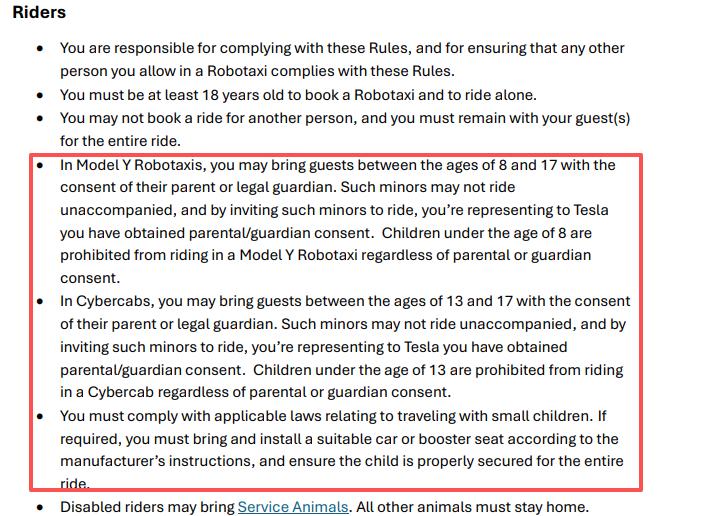
Tesla Robotaxi passenger rules. Source: Tesla official website
Tesla currently has no separate Robotaxi policy for students, and has not announced campus commuter services or student discounts.
For Cybercab, the 45 units are only the first batch of vehicles entering the operation network. The key in the future is how fast the produced vehicles can join the fleet, how many orders each vehicle can complete per day, and whether unsupervised operation can be replicated from several limited areas to more cities.
If this step can be successfully implemented, the revenue structure of automakers will also change. After a vehicle is sold, it can still remain in the operation network to continuously meet passenger travel demands.
For Tesla, the Cybercab story has only just moved from "being built" to "being on the road".
Special translator Jin Lu also contributed to this article