Some references for China from the "completed property sales" model in South Korea's real estate sector.
Shifting from pre-sale of off-plan properties to a sales model closer to completed properties, South Korea already ran trials more than two decades ago. South Korea refers to sales conducted before and after the start of construction as "pre-allotment", which roughly corresponds to China's pre-sale of off-plan properties; delaying the sales node to 60%, 80% or even later of the project progress is defined as "post-allotment", equivalent to "near-completed property" sales.
Over the past two decades, South Korea's "post-allotment reform" (near-completed property sales) has been advanced multiple times and slowed down multiple times, forming the current dual-track state: public residential development adopts the "post-allotment" model, while private residential development projects are not mandated, and land, loans and other means are used to encourage and guide development enterprises to implement "post-allotment". In any case, the "post-allotment" reform has had a significant impact on the loan scale, capital return rate and interest expenditure of development projects. The experience of South Korean development enterprises may serve as a certain reference for China's real estate industry at present.
The national conditions, regulatory systems and market environments of China and South Korea are quite different, so the impact generated by South Korea's "post-allotment" reform may not be replicated in China. The greater value of the experience and impact of South Korean development enterprises lies in providing a visualized reference for observing and understanding the impact on development enterprises after the sales and payment collection nodes are moved backward.
01
South Korea's "pre-allotment" system took shape from the late 1970s to the early 1980s. After residential enterprises obtain land ownership, sales guarantee and other conditions, they can pre-sell properties during the engineering construction stage. In the payment arrangement for home buyers, the "contract payment" and "mid-term payment" are paid successively before completion, which can accumulate to 70% to 80% of the housing price, and the mid-term payment is usually settled through bank loans. As a result, developers can continuously obtain sales payment returns during the construction process.
In 2003, South Korea launched the "post-allotment" reform. In 2004, the Roh Moo-hyun administration announced a roadmap: public residential projects were piloted first, and then the project progress time points allowed for sales were gradually raised. According to the original plan, by 2011, the sales time point should be moved backward to after the project progress reached 80%. For private residences, policies such as low-interest funds and public land were adopted to encourage participation.
However, in 2007, the South Korean government postponed the implementation time by one year on the grounds of market supply and demand pressure. This arrangement made the "post-allotment" reform exactly encounter the 2008 global financial tsunami. To cope with the impact of the financial crisis, the South Korean government canceled the "post-allotment" requirement for "reconstruction projects" (equivalent to China's urban renewal projects), and the Roh Moo-hyun administration's "post-allotment" reform roadmap was partially stagnated at that point. The reform was not restarted until 10 years later.
In 2018, the "post-allotment" reform was restarted. The public residential sector is the main implementation target. Since 2019, such residences can only be sold after the project progress reaches 60%. For private residential projects, the government continues to guide participation through incentives. The Ministry of Land, Infrastructure and Transport of South Korea summarized this as "prioritized introduction in the public sector, and expansion through incentives in the private sector".
Compared with other regions, Seoul has implemented the policy with greater intensity. The current saleable residences of the Seoul Housing and Communities Corporation are generally sold to the market when the project progress reaches about 90%. Private development projects continue to be dominated by pre-allotment, and the number of projects implementing post-allotment is very limited.
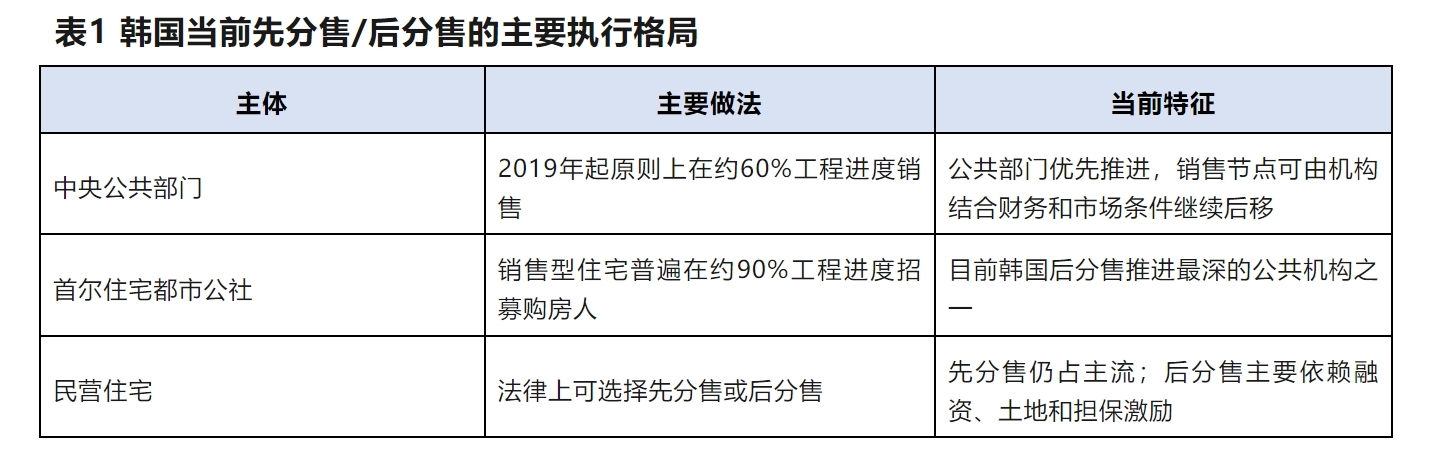
Data source: 2024 Residential Business Manual by the Ministry of Land, Infrastructure and Transport of South Korea, 2025 Research by the Korea Housing Finance Corporation, public information released by Seoul Housing and Communities Corporation.
02
In 2017, post-allotment once again became the focus of discussion in the South Korean National Assembly and the government. Subsequently, the Korea Ratings Corporation conducted a study on 9 residential development projects that it actually participated in rating in that year.
The Korea Ratings Corporation is one of the three full-license major credit rating agencies licensed by the Financial Services Commission of South Korea, which has long been engaged in enterprise credit and real estate project financing evaluation. In this study, 9 projects originally designed according to the pre-allotment model were uniformly assumed to be sold after the project progress reached 80%, and then the changes in financing demand, financial expenses and self-owned capital were compared. The samples covered 4 projects in the capital area and 5 local projects, with a construction period of 21 to 48 months.
The research results show that under the "pre-allotment" system, when 9 projects advance to 80% of the project progress, 80% to 95% of the total project cost has usually been expended. At the same time, 60% to 80% of the sales revenue has been collected. If sales are postponed to after 80% progress, almost no home purchase payment will enter at the same stage, while expenditures such as land payment and project payment will proceed as usual. Developers can only obtain additional financing to ensure that the project reaches the saleable node, which is 80% of the total project.
The funding gap is immediately reflected in the financing scale. The project financing loans required for the 9 projects reached 1.6 to 4.3 times of the original plan, and the financial expenses reached 1.7 to 2.9 times. Bank loans cannot cover all funding demands, so developers also need to supplement their capital. The Korea Ratings Corporation further assumed that financial institutions control the loan ratio at 60%, that is, the maximum loan can cover about 60% of the project value. Under this condition, 8 out of the 9 projects need to increase self-owned capital, with the investment scale reaching 1.9 to 6.3 times of the original plan.
Although "post-allotment" increases interest and financing expenses, it can also save expenditures such as independent sample room construction, site lease, and pre-sale guarantee fees. The calculation by the Korea Ratings Corporation shows that the net new cost of most projects accounts for about 1% to 2% of the total revenue, and the projects under greater pressure reach about 5%. If the financing interest expenditure increases by another 30% on the basis of the original plan, except for one project, the pre-tax profit margin of the remaining projects will drop by about 3 to 11 percentage points compared with the pre-allotment plan.
What has a more direct impact on the operation of developers is the upfront capital volume: one project requires more loans and self-owned capital, and the number of projects that the same amount of capital can leverage simultaneously will decrease accordingly.
03
After the capital threshold is raised, will the market be concentrated among large enterprises?
A 2020 report by the Korea Land & Housing Institute pointed out that "post-allotment" may weaken the survivability of small and medium-sized residential enterprises with weak financial structures, and may also give large enterprises with strong brand and financing capabilities the opportunity to expand their market share. However, the report also put forward another possibility: when home buyers can directly see residences that are nearly completed, some small and medium-sized enterprises with strong product capabilities may also gain opportunities by virtue of their quality.
Statistics from the Mirae Asset Securities Research Center show that the national apartment allotment share of the top 10 enterprises in construction capacity was about 26% in 2018, 24.5% in 2019, 25.5% in 2020, 23.5% in 2021, and 23.8% in 2022. In the first four years after the restart of the post-allotment reform in 2018, the market share of leading enterprises did not continue to rise.
Changes emerged in 2022. In that year, under the combined impact of interest rate hikes, falling housing prices and weakening sales in South Korea's real estate market, the financing risks of real estate projects were intensively exposed, and the financing market tightened rapidly. In September, the default of the "Legoland Korea Resort" project notes in Gangwon Province triggered market panic, a large number of real estate projects faced difficulties in loan renewal and refinancing.
After this crisis, the market share of the top 10 enterprises rose to 29.8% in 2023, and further reached 34.5% in 2024; the change in Seoul was faster, the market share of the top 10 enterprises was 31% in 2022, rose to 56% in 2023, and reached 61% in 2024. Due to the existence of the real estate project financing crisis in 2022, the "post-allotment" reform cannot be simply regarded as the direct cause of the increase in market concentration. Moreover, South Korea has not fully implemented the "post-allotment" system.
Figure 1 Changes in the Apartment Allotment Share of the Top 10 Enterprises by Construction Capacity in South Korea
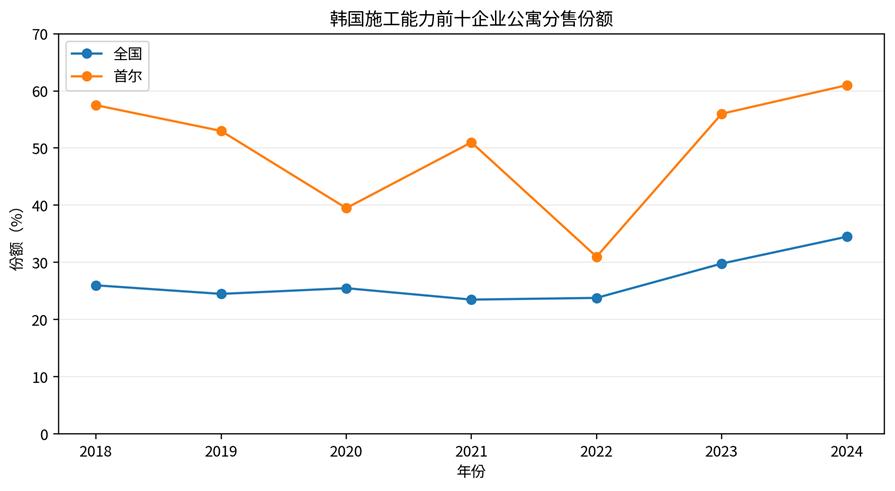
Source: REPS, 2025 Construction Industry Outlook by Mirae Asset Securities Research Center.
In terms of the number of enterprises, according to the statistics of the Korea Construction Association, there were 7,607 enterprises in 2018, which increased to 10,049 in 2022, and fell back to 9,390 in 2023. That is to say, in the years after the restart of post-allotment, the number of market participants was still increasing, and the contraction of the number of enterprises mainly occurred after 2022, which should still be related to South Korea's real estate financing crisis, it is difficult to prove that "post-allotment" directly produces the effect of reducing the number of enterprises.
A 2025 study by the Korea Housing Finance Corporation targeting 362 development practitioners shows that the loan interest rate of real estate project financing is one of the important variables affecting whether enterprises choose post-allotment.
For China's real estate sector, the reference provided by South Korea's "post-allotment" reform lies in presenting a picture of capital pressure test in advance — when sales payment collection is greatly postponed, the financing structure, capital adequacy ratio and product competitiveness of development enterprises will jointly determine whether they can survive a longer construction cycle. Facing up to the possible difficulties is exactly the beginning of overcoming them.
As we emphasized earlier, South Korea has not fully implemented completed property sales, and the project progress requirement of "post-allotment" is also different from China's 828 new real estate policy. Therefore, after China implements completed property sales, the impact on the capital pressure of real estate enterprises and project return rate may be very different from that of South Korea. Our interviews and surveys with some enterprises found that, putting aside the severe factor of capital pressure on real estate enterprises, the project return rate alone will drop by at least 11 to 12 percentage points, and at most 17 to 18 percentage points. It is hoped that when formulating implementation rules, all localities will listen more to the voices of various market entities, so as to make the policy implementation more stable and conducive to the implementation of the central government's decision of "stabilizing the real estate market".
This article is from the WeChat Official Account "Youke Real Estate", author: Youke, authorized for release by 36Kr.