Shanghai's residential rental prices have ranked first among 50 cities for 5 consecutive months.
In August, the concentrated release period of rental demand for the college graduation season is drawing to a close, and the national housing rental market has cooled down compared with July. The average residential rent across 50 cities continues to rise, but the month-on-month growth rate has narrowed significantly. Driven by Shanghai and Shenzhen, the average rent in first-tier cities continues to rise, among which Shanghai's month-on-month growth rate has ranked first among the 50 cities for 5 consecutive months.
In August, the year-on-year decline of residential rent in 50 cities has dropped to the lowest level in nearly 24 months
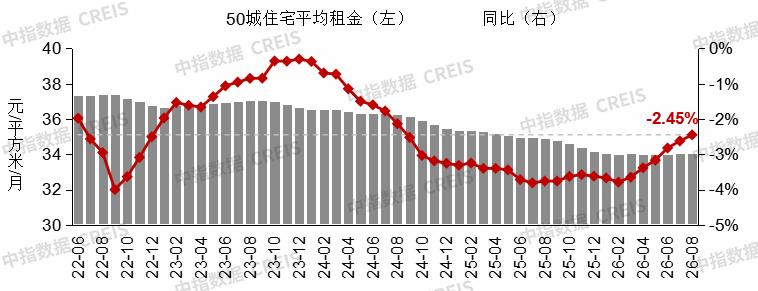
According to the China Index Academy's 50-city residential rental price index, in August, the average residential rent in 50 cities stood at 34.02 yuan/square meter/month, up 0.03% month on month, with the growth rate narrowed by 0.10 percentage points compared with July; it fell 2.45% year on year, and the decline narrowed by 0.17 percentage points compared with July. In August, the graduation season effect diminished significantly, the popularity of the housing rental market in key cities saw a seasonal decline, and the upward momentum of residential rents weakened to some extent.
It is worth noting that the average year-on-year decline of residential rents in 50 cities has continued to narrow since March 2026, and by August, the year-on-year decline has narrowed to the lowest level in nearly 24 months, showing signs of bottoming out and stabilizing of residential rents in key cities.
Figure: Average residential rent and year-on-year change in 50 cities
Driven by Shanghai and Shenzhen, the average rent in first-tier cities continued to rise month on month in August
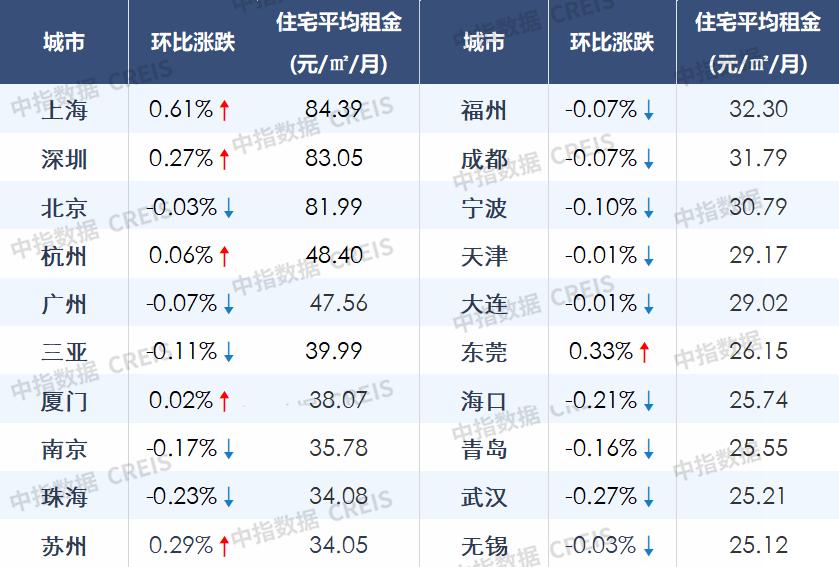
In August, the supporting effect of the graduation season effect on rental demand weakened, and the trend of average rent in cities of all tiers diverged significantly. According to the monitoring of China Index Academy, in August, the average rent of ordinary residential properties in first-tier cities rose 0.23% month on month, with the growth rate narrowed by 0.15 percentage points compared with July. Among them, the rents in Shanghai and Shenzhen continued to rise month on month, up 0.61% and 0.27% respectively, while the rents in Beijing and Guangzhou turned to a slight month-on-month decline. The average month-on-month decline in second-tier cities expanded to 0.09%, among which the rents in Suzhou and Hangzhou continued to rise, while those in Tianjin and Chengdu turned to decline. The representative third- and fourth-tier cities saw a 0.02% month-on-month increase in rent, the same as that in July.
From the perspective of cumulative rise and fall during the year, the foundation for bottoming out of rents in first-tier cities is relatively solid. From January to August 2026, the average rent in first-tier cities rose by 1.21% cumulatively, and the growth rate continued to expand compared with July; the cumulative decline in second-tier cities was 1.29%, and that in representative third- and fourth-tier cities was 0.75%, both of which narrowed compared with the same period in the past two years, and the overall market adjustment momentum has eased.
Shanghai's month-on-month rent growth ranks first among 50 cities for 5 consecutive months, with rents in municipal districts continuing the general upward trend
In August, as demand gradually stabilized, rents in key cities returned to the stage of normalized adjustment. According to the monitoring of China Index Academy, in August, residential rents in 50 cities recorded 15 rises, 34 falls and 1 flat month on month, the number of cities with rising rents decreased by 9 compared with July. Among the top 20 cities in terms of residential rent, a total of 6 cities saw month-on-month increase, 6 less than that in July.
From the performance of specific cities, in August, the rental rents in Beijing, Tianjin and other places ended the continuous rise for many consecutive months and turned to a slight decline; the residential rental markets in Shanghai, Shenzhen and Suzhou still maintained high activity, and price expectations continued to rise, among which Shanghai's residential rent month-on-month growth rate has ranked first among the 50 cities for 5 consecutive months.
Table: Performance of top 20 cities in residential rent of 50 cities in August 2026
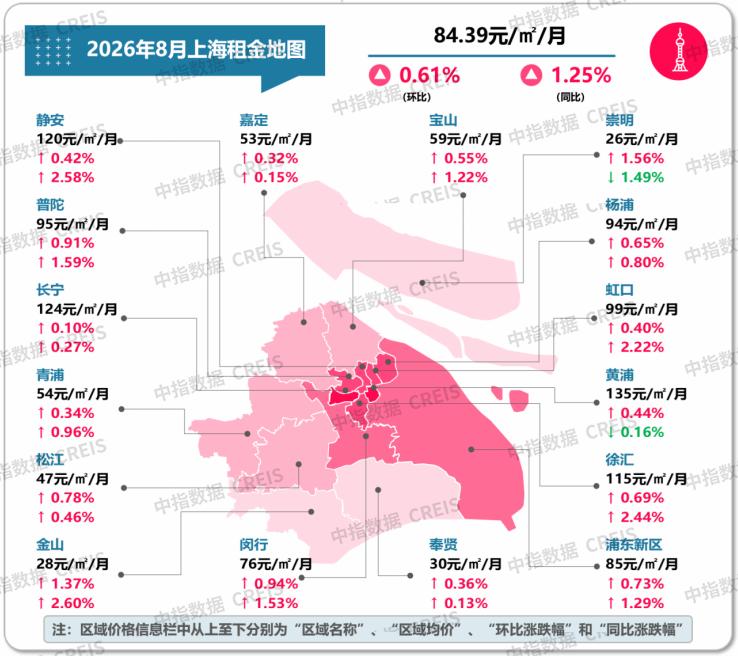
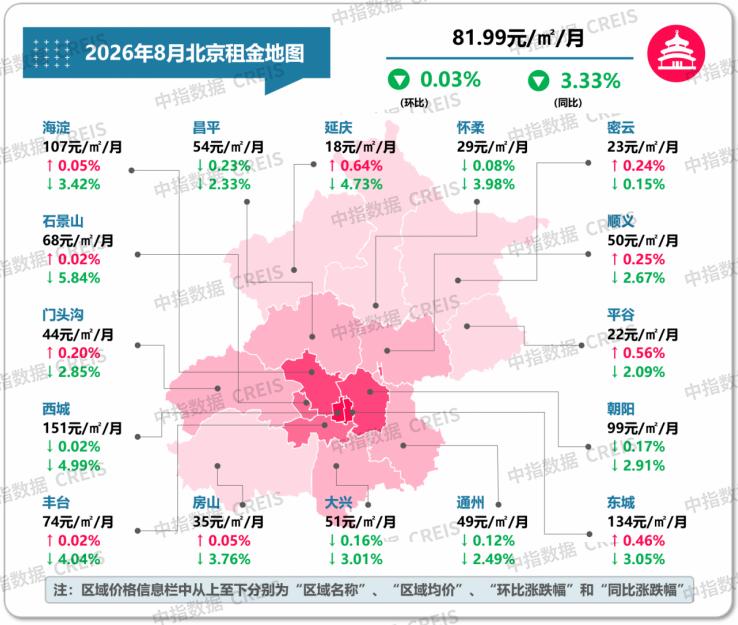
Combined with the internal rent performance of cities, in August, the residential rents in Shanghai's municipal districts continued the general upward trend, among which the rent growth in Jinshan, Minhang, Putuo, Pudong New Area, Xuhui and other districts was relatively prominent, while the growth rate in Jiading, Qingpu, Fengxian and other districts was below 0.4%. The rents in Shenzhen's municipal districts rose in 8 districts and fell in 1, with the rent growth in districts with prominent industrial advantages such as Futian, Bao'an and Nanshan relatively high, only the rent in Pingshan adjusted slightly. The residential rents in Beijing's municipal districts rose in 10 districts and fell in 6, the number of rising districts decreased by 5 compared with July, which led to the average rent of the whole city turning from rising to falling, among which the rents in municipal districts with large rental market scale such as Chaoyang, Daxing and Changping all declined. The residential rents in Guangzhou's municipal districts rose in 8 districts and fell in 3, the rent changes in all districts were relatively gentle, among which the three central districts of Tianhe, Yuexiu and Haizhu were flat or slightly down month on month.
Figure: Residential rent map of Shanghai and Beijing in August 2026
The average rent of 50 cities in September faces slight adjustment pressure, and the market will return to the main theme of divergence
The housing rental market has obvious characteristics of seasonal fluctuation. Judging from the trend over the years, the "return-to-work tide" in March and the "graduation season" from June to August are the traditional peak seasons for housing rental demand throughout the year. After September, with the fading of seasonal effects, the housing rental market will enter a normalized stage with relatively stable demand.
Looking ahead to the subsequent rent trend, it is expected that in the short term, affected by the return of demand to stability while the supply of rental housing remains at a high level, the average residential rent in key cities will face certain adjustment pressure. However, considering that rents have undergone continuous adjustments in the past few years, the downward space has been greatly narrowed, and it is expected that rents in key cities in September will be dominated by narrow-range fluctuations and adjustments.
While the rental demand in first-tier cities has stronger resilience, judging from the rent changes in Beijing and Guangzhou in August, although it shows the characteristics of seasonal decline, combined with the cumulative change of rent during the year, the foundation for bottoming out of rent in first-tier cities has been gradually consolidated, and the overall trend is expected to remain stable.
This article is from the WeChat official account "China Index Academy", the author is China Index Academy Research, and authorized by 36Kr for release.