Among Moore, Muxi, Biren and Tianshu, who is faring the best?
In the past few years, domestic GPU companies have never lacked financing, valuations, and stories of "domestic substitution". Now, it is time to submit their exam papers.
Recently, four listed domestic GPU companies, Moore Threads, Muxi Co., Ltd., Biren Technology, and Iluvatar CoreX, have successively released their financial reports. In the first half of 2026, Moore Threads had the highest revenue scale, reaching 1.736 billion yuan; Biren Technology's revenue increased by nearly 20 times year-on-year, with the fastest growth rate; Muxi Co., Ltd. and Iluvatar CoreX have achieved book profits. Behind the four semi-annual reports lie four different domestic GPU paths.
However, book profit and loss do not mean the outcome has been decided. The ranking given by the capital market is not consistent with the financial reports. Muxi Co., Ltd. and Moore Threads are listed on the A-share market, with market capitalizations of around 250 billion yuan each, while Biren Technology and Iluvatar CoreX are listed on the Hong Kong stock market, with market capitalizations of just over 100 billion Hong Kong dollars each.
Among the "Four Little Dragons" of domestic GPUs, who is the most competitive? We compared the four companies from the dimensions of revenue, growth rate, profit, R&D investment, market value and future space. It should be noted that there is still one contestant missing in this comparison - Enflame Technology.
It has not been listed yet and there is no comparable financial data, but it is already standing at the door of the capital market: On August 31, the company announced that its IPO offering price was 142.18 yuan per share, with an estimated fundraising of 6.119 billion yuan, and it opened online and offline subscriptions on September 2. Calculated at the offering price, the post-issuance market value is about 61.2 billion yuan. When it is listed, the "Four Little Dragons" will become five, and the ranking is likely to be reshuffled.
01. Four Semi-Annual Reports, the Four Little Dragons Begin to Diverge
The first indicator is revenue.
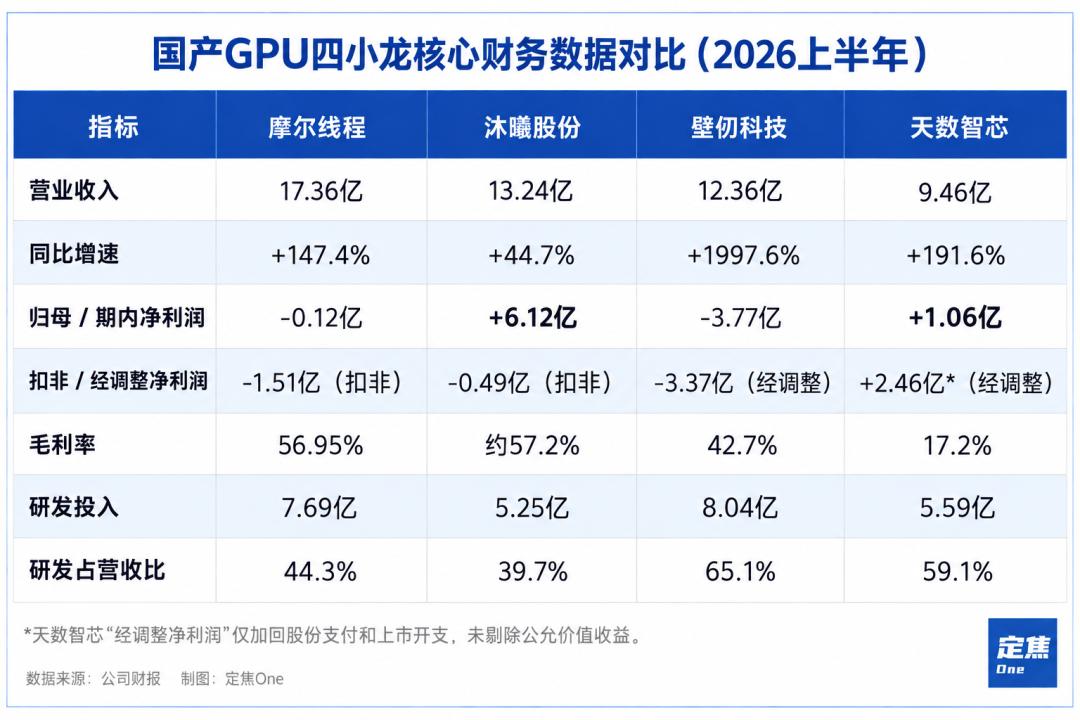
In the first half of 2026, Moore Threads achieved a revenue of 1.736 billion yuan, the largest among the four companies; Muxi Co., Ltd. had a revenue of 1.324 billion yuan, Biren Technology 1.236 billion yuan, and Iluvatar CoreX 946 million yuan. The ranking of the four is Moore Threads > Muxi > Biren > Iluvatar.
From the perspective of revenue structure, the absolute main force of all four companies is the sales of GPU hardware, accounting for more than 90% of the total revenue, but the products and delivery forms are different. The differences lie in two points: First, what is this card mainly used for? Training large models has the highest requirements for performance, video memory, and interconnection, and the cards are also the most expensive; running inference (which can be understood as running already trained models) has a lower threshold, but once AI applications are scaled up, the demand is much greater; in addition, there are specialized directions such as graphics rendering and scientific computing. Second, in what form is it delivered? An acceleration card, a server, or a complete cluster with more than a thousand cards, the price and delivery difficulty differ by orders of magnitude.
Moore Threads' cloud products contributed 1.693 billion yuan, accounting for 97.5% of the total revenue. According to the financial report caliber, it mainly includes cloud intelligent computing boards, intelligent computing all-in-one machines, and intelligent computing clusters; Muxi did not split the revenue of product lines, and classified it all under "GPU product sales". From the business description, it covers the Xiyun C series for integrated training and inference, Xisi N series for intelligent computing inference, Xisuo X series for scientific intelligence, and Xicai G series for graphics rendering, and the respective contribution proportions are not disclosed.
94.5% of Biren Technology's revenue comes from "intelligent computing solutions", mainly the large-scale delivery of the Bili series general-purpose GPU products and large intelligent computing clusters. In addition, software revenue is listed separately for the first time, about 65 million yuan, accounting for 5.3%; Iluvatar CoreX has the most detailed split: general-purpose GPU products account for 96.9% of total revenue, of which the inference series is 654 million yuan, accounting for 69.2%, and the training series is 262 million yuan, accounting for 27.7%.
The second indicator is profitability. The two companies with good-looking book results have not actually made profits from their main business; the two companies with poor-looking book results, one is the closest to making profits, and the other has the most explosive growth rate.
Let's look at the profitable ones first. Muxi's attributable net profit is 612 million yuan, the highest among the four. However, looking at the profit statement, the 887 million yuan income caused by the change in fair value of transactional financial assets (floating profit from investment) accounts for 105.75% of the total profit. The company marked in the financial report that this sum of money "is not sustainable". After deducting this kind of "unexpected income", Muxi still lost nearly 50 million yuan;
The 106 million yuan net profit of Iluvatar CoreX is of similar nature: there is 760 million yuan of fair value income in the profit statement, which comes from the equity of Shenghe Jingwei held by Iluvatar CoreX at a cost of 100 million yuan. Now its book value is 856 million yuan, which can be called a magic investment, but it has little to do with selling GPUs.
Then look at the two companies that are still in a loss state. Moore Threads' attributable net loss is only 11.56 million yuan, narrowing by 95.7% year-on-year. A caliber that few people notice in the financial report is: after excluding the impact of share-based payment, the company's net profit is about 83.53 million yuan. Excluding the equity incentive account, Moore Threads' net profit caliber has turned positive, but the company's operating profit is still at a loss.
Biren lost 377 million yuan, which seems to be the worst, but its growth rate is the most "explosive". In the first half of the year, revenue increased by 1997.6% year-on-year, losses narrowed by 76.4% year-on-year, and gross margin rose by 10.8 percentage points to 42.7%.
However, looking only at revenue and profit is not enough to judge who is more "competitive". GPU is a typical business with high R&D investment. The other side of revenue growth is continuous large-scale R&D expenditure.
In the first half of the year, Moore Threads' R&D investment was 769 million yuan, accounting for 44.3% of revenue; Muxi Co., Ltd.'s R&D investment was 525 million yuan, accounting for 39.65% of revenue; Biren Technology's R&D expenditure was 804 million yuan, accounting for about 65% of revenue in the same period; Iluvatar CoreX's R&D expenditure was 559 million yuan, accounting for 59.1% of revenue.
Moore Threads focuses on promoting the Huashan and Lushan chips under the "Huagang" architecture and related applications; Muxi continues to promote the R&D of the second-generation high-performance general-purpose GPU; Biren stated that the growth of R&D expenditure is mainly due to the R&D process of new products and the expansion of R&D team size; Iluvatar said it is due to the increase in material consumption and tape-out expenses, as well as the expansion of the R&D team.
Under such high R&D intensity, whether a business is profitable is first reflected in the gross margin.
Moore Threads' gross margin reached 56.95% in the first half of the year, and Biren Technology's was 42.7%; Muxi did not disclose this data. Calculated based on the gross profit of the first half of the year, this value is about 57.2%, a slight year-on-year increase of 1.1 percentage points. The performance of the three companies is quite decent among domestic chips.
However, the overall gross margin of Iluvatar CoreX dropped sharply from 50.1% in the same period last year to 17.2%; but the gross margin of its GPU products still reached 43.9%, of which the gross margin of the training series was 64.5% and that of the inference series was 35.6%. The sharp decline in overall gross margin is partly due to changes in product structure, and also related to the 171 million yuan gross loss and 72.21 million yuan impairment of semiconductor components. The financial report states that "server components are provided to several customers at a price lower than the procurement cost", and the company explained that it is to maintain long-term customer relationships.
In addition to R&D, the four companies have spent a lot of money elsewhere. Capacity expansion, raw material stocking, sales and management expenses are all eroding profits, and the most intuitive manifestation is operating cash flow.
In the first half of the year, the net cash flow from operating activities of Moore Threads was -2.169 billion yuan, and that of Muxi was -1.297 billion yuan. The explanation for both is "increased operating procurement expenditure". In order to ship in the second half of the year, they are pouring money into the supply chain.
Combining the above information, we can see the positions of the four companies: Moore Threads ranks first in scale and first in gross margin, but has not yet made a profit, mainly stuck in burning money for the next round of expansion; Biren Technology rushed out from a very low base in the first half of last year, with both revenue and gross margin improving, but its R&D investment is the highest among the four, and there is still a way to go before profitability; Muxi Co., Ltd. has the highest book net profit, but it is mainly supported by floating investment profits, and its main business has not turned positive yet; Iluvatar CoreX was the first to turn a profit on the book, also relying on investment income, and the gross margin of its main business is still dragged down by non-core businesses.
02. Does the Stock Price Trend Not Match the Report Card?
The semi-annual report is a report card, and the stock price is another answer given by the capital market, and the two are not consistent.
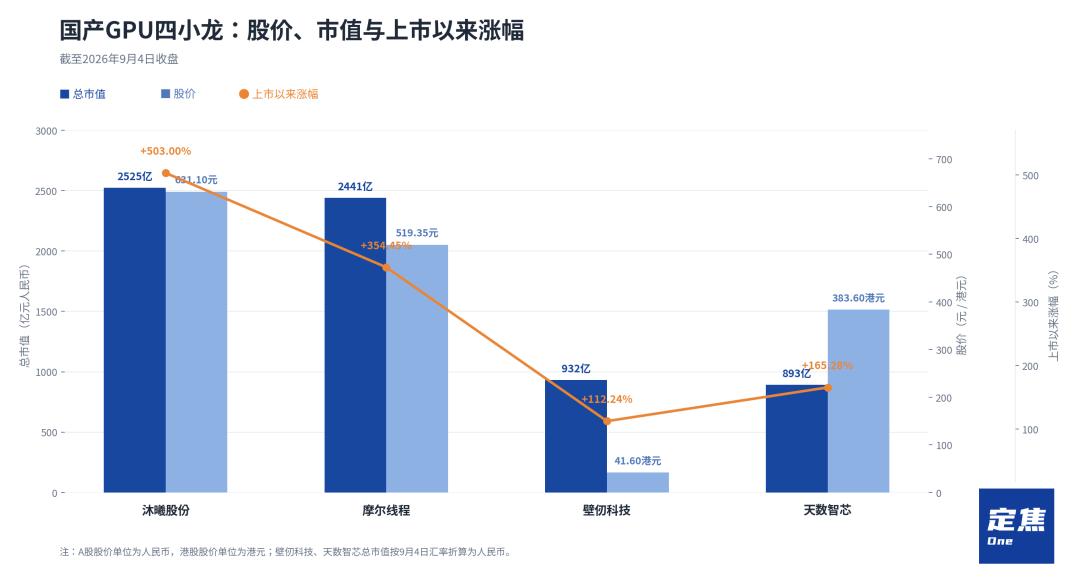
As of the close on September 4, Muxi Co., Ltd. was quoted at 631.1 yuan, with a total market value of 252.5 billion yuan; Moore Threads was quoted at 519.4 yuan, with a total market value of 244.11 billion yuan. The two companies are star targets on the A-share Science and Technology Innovation Board, while the two Hong Kong stock companies are at a lower level: Iluvatar CoreX is quoted at 383.6 Hong Kong dollars, with a total market value of 103.26 billion Hong Kong dollars (about 89.3 billion yuan); Biren Technology is quoted at 41.6 Hong Kong dollars, with a total market value of 107.82 billion Hong Kong dollars (about 93.2 billion yuan).
From the perspective of stock price performance, all four companies have experienced substantial increases since their listing. As of September 4, Muxi Co., Ltd. has accumulated a 503% increase from the offering price, and Moore Threads has accumulated a 354.5% increase; the two Hong Kong stock companies have relatively restrained increases. Since their listing in January this year, Iluvatar CoreX and Biren Technology have accumulated increases of 165.3% and 112.2% respectively.
However, the stock prices of the four companies have not been rising all the way. After listing, Moore Threads once rushed to a high point of 954.99 yuan, and now it has retreated by more than 40% from the high point; Muxi Co., Ltd. also touched a stage high of 997.52 yuan in July, and now it has retreated by more than 30% from the high point. The fluctuations of the two Hong Kong stock companies are also not small. Biren Technology has retreated by about 40% from its highest point since listing, and Iluvatar CoreX has retreated by more than 50%.
On the whole, all four companies have experienced a rapid rise in valuation in the early stage of listing, and then retreated to varying degrees. The capital market's enthusiasm for domestic GPUs remains high, but the stock price has gradually moved from the initial rapid pricing to a re-examination of the performance fulfillment ability.
Let's look at the market value ranking of each company in detail.
Moore Threads ranks first in revenue scale, but Muxi Co., Ltd. ranks first in market value; Biren Technology, whose revenue growth rate is nearly 20 times, ranks second from the bottom in market value; Iluvatar CoreX, which has turned losses into profits on the book, has not exceeded Moore Threads, which is still at a loss. The capital market is no longer simply grading today's report cards. It cares more about who may become the next real domestic GPU leader in the true sense.
How big is the gap? Based on the market value on September 4, and simply annualizing the first half-year revenue, Muxi's price-to-sales ratio (PS) is about 95 times, Moore Threads is about 70 times. After converting the Hong Kong dollar market value into RMB at the exchange rate of the day, Iluvatar CoreX is about 47 times, and Biren Technology is about 38 times. As a reference, NVIDIA, which has entered a mature profit stage, has a PS of less than 20 times according to the TTM caliber.
Of course, this is only a rough comparison. The four companies are still in a stage of rapid growth. Simply multiplying the half-year revenue by two cannot accurately represent the full-year revenue, and the valuation systems between different listing markets are not exactly the same.
A senior investor focusing on the semiconductor industry told "Dingjiao One" that it is difficult to price such companies with traditional calculation methods now, because profits have not yet been fully realized, and the market is actually pricing future revenue and market share.
"What investors buy is not how much profit it has today. If the market believes that there will be a 100 billion or even larger market for domestic GPUs in the future, and this company has the opportunity to take a considerable share of it, then the seemingly high PS may be accepted by the market," he said.
According to this logic, the current market value of the four companies actually corresponds to different expectations.
Muxi gets the highest market value, and the market is betting on its general-purpose GPU capabilities, domestic supply chain, and relatively clear profit expectations. The Xiyun C600 was officially mass-produced in the first half of 2026, and the company also gave a break-even timetable in the prospectus, pointing to 2026 at the earliest; the background of its founder Chen Weiliang as the head of AMD's GPU design team further adds weight to this story.
Moore Threads follows closely, and what supports its valuation is "scale + ecology" - the largest revenue volume among the four, as well as the MUSA software ecology and the platform imagination brought by full-featured GPUs. In the first half of the year, its revenue has exceeded the full-year revenue of 2025. The flagship intelligent computing cluster MTT S5000 has achieved large-scale sales, and the fifth-generation "Huagang" architecture and two new products, Huashan and Lushan, have also been announced. In addition, its founder Zhang Jianzhong was formerly the general manager of NVIDIA China, and this imagination of "China's NVIDIA" has allowed it to obtain a market value second only to Muxi.
The market value of Biren and Iluvatar is not cheap in the Hong Kong stock pricing system, and they need to prove another logic with subsequent performance.
Biren Technology is betting on "system-level solutions + high growth rate". It needs to prove that the nearly 20-fold revenue growth rate is not a one-time jump under a low base, and whether its next-generation flagship chip BR20X, which will be commercially