Did Claude solve the Millennium Prize Problems? Terence Tao: I never said that.
In the past day, a mathematical rumor about Claude has spread rapidly across social media platforms.
Yesterday, content creator Andrew Curran posted a "prediction" that Anthropic has solved one of the Millennium Prize Problems, specifically the existence and smoothness problem related to the Navier-Stokes equations. The results are currently under expert review and may be announced to the public before Anthropic's IPO.
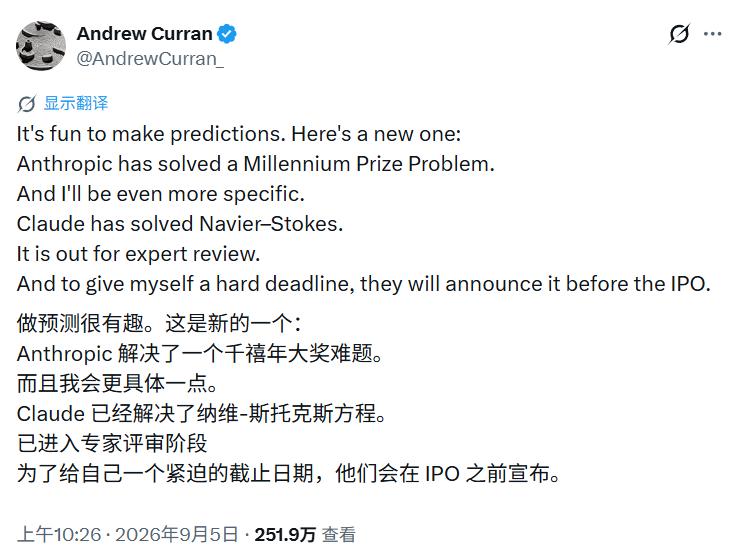
This post quickly gained more than 2.5 million views and was reposted by an increasing number of accounts.
As of now, no corresponding papers, proof texts or expert review materials are available through public channels, and the Clay Mathematics Institute still lists the Navier-Stokes existence and smoothness problem as an unsolved Millennium Prize Problem.
However, this rumor does not come out of nowhere. One of its important backgrounds comes from a set of posts released by mathematician Terence Tao two days ago.
A Hypothetical Scenario About AI
On September 3, taking the Navier-Stokes equations as an example, Terence Tao discussed the possible impacts on mathematical research after AI solves major open mathematical problems.
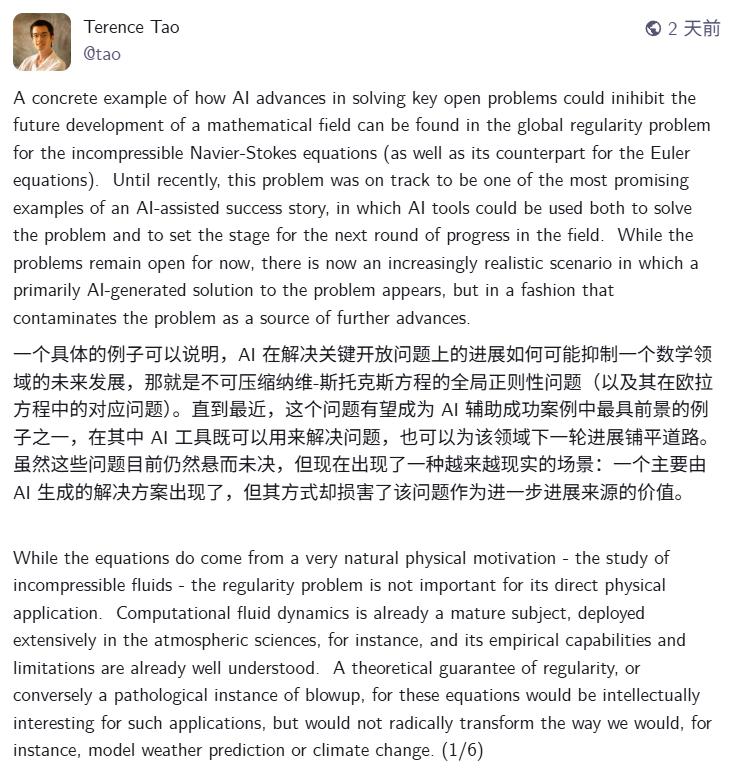
https://mathstodon.xyz/@tao
The Navier-Stokes equations describe how fluids such as water and air move. The truly unresolved problem for mathematicians is whether, starting from a smooth initial state in the three-dimensional incompressible case, the solution can remain smooth at all times, or whether a singularity will form in a finite period of time. This problem has been listed as a Millennium Prize Problem by the Clay Mathematics Institute, with a prize of 1 million US dollars.
In his post, Terence Tao envisioned a possible future research process: an autonomous AI system with massive computing resources can continuously try different mathematical constructions, analyze the causes of failures, adjust plans, verify results, and finally form an extremely complex candidate proof, which is then machine-verified using formal proof systems such as Lean.
His focus is on how the mathematical knowledge generated in this process can be preserved.
In traditional mathematical research, a difficult problem often generates a large number of by-products over years of exploration: new lemmas, new tools, new research directions, and problems worthy of further research later. Terence Tao is worried that if AI completes the entire set of explorations in a closed environment, and humans finally get a fully verified result, many valuable intermediate paths may be difficult to enter the mathematical community.
The scenario described in the post is quite specific: AI searches for candidate structures, conducts numerical tests, generates a huge Lean proof file, and finally solves the Navier-Stokes regularity problem.
As a result, the familiar plot on the Internet emerged.
Some people began to speculate whether Terence Tao had access to undisclosed information. Discussions quickly appeared on social platforms about "whether Terence Tao is implying that Claude has solved Navier-Stokes", and then Curran gave a more explicit prediction: "Claude has solved Navier-Stokes." This statement spread rapidly as a result.
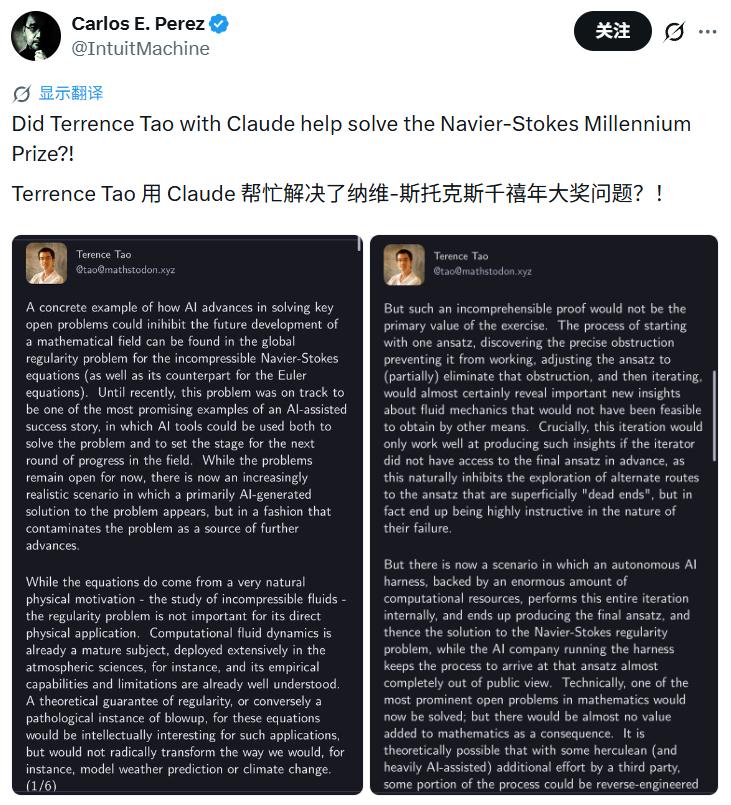
As the speculation grew, Terence Tao later made a dedicated clarification.
He took a cautious attitude: at present, he is not aware of any major new progress on the Navier-Stokes problem, and the previous discussion was a hypothetical AI research scenario. At the same time, judging by the current speed of AI technology development, this scenario already has a certain degree of practical possibility.
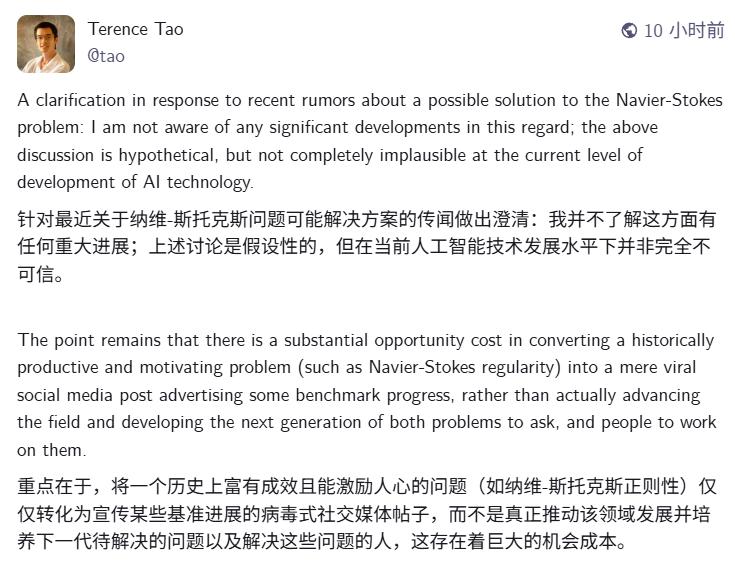
He then talked about the "opportunity cost".
Open problems like Navier-Stokes have been driving the generation of new methods, new problems and new researchers for decades. If AI can quickly get the final answer, the mathematical community will then need to consider how to re-precipitate the processes, methods and failed routes in machine exploration into mathematical knowledge that humans can understand and inherit.
This has gradually become a practical issue in AI mathematical research.
AI Is Changing the "Scarce Resource" in Mathematics
Why did this rumor become so popular?
In recent months, AI has indeed successively crossed several thresholds in the field of mathematics that were hard to imagine in the past.
Yesterday, Anthropic announced Claude's formalization work on Fermat's Last Theorem.
https://www.anthropic.com/research/formalizing-fermats-last-theorem
Fermat's Last Theorem was proven by mathematicians including Andrew Wiles as early as the 1990s. For decades, the mathematical community has been hoping to fully translate this extremely complex proof into formal languages such as Lean, so that computers can gradually check every step in it.
Anthropic stated that Claude basically independently completed end-to-end Lean formalization in 11 days, with the final code size reaching about 13 million lines. About 30,300 machine-verifiable theorems were generated during the process, of which about 29,500 were included in the final proof. Mathematician Kevin Buzzard, who participated in the long-term Fermat's Last Theorem formalization project, also gave a positive evaluation of this result.
Go back one month earlier.
On August 10, Anthropic announced that an undisclosed Claude research model made progress on a related problem when attempting the Riemann Hypothesis: it raised the known lower bound of the proportion of zeros of the ζ function that satisfy the Riemann Hypothesis condition from 41.6% to 67.2%. The Riemann Hypothesis is closely related to the distribution of prime numbers and is also one of the Millennium Prize Problems.
https://www.anthropic.com/research/riemann-zeta
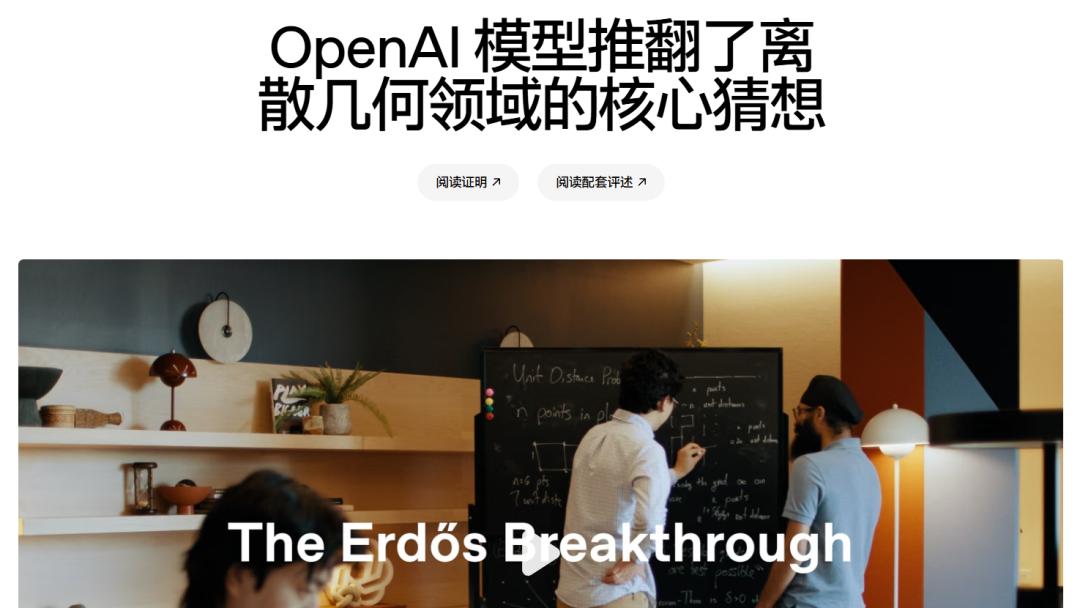
In May this year, OpenAI also announced a result in discrete geometry. A general reasoning model constructed a new unit distance point set, overturning a long-standing conjecture around the Erdős plane unit distance problem. The relevant proof was subsequently checked by external mathematicians. This result solves an important conjecture in this problem, and there is still room for further exploration of the entire unit distance problem.
https://openai.com/zh-Hans-CN/index/model-disproves-discrete-geometry-conjecture/
By August, OpenAI also released ten results in mathematics and theoretical computer science in a centralized manner, including solutions or substantial progress to multiple long-standing open problems.
https://openai.com/zh-Hans-CN/index/ten-advances-in-mathematics/
A few years ago, the most notable achievement of large models in the field of mathematics was still solving Olympiad math problems. Now, research objects have begun to expand to open problems, paper-level results and large-scale formal proofs.
The impact of AI on the mathematical community has also begun to shift from how many problems it can solve to what mathematicians will be mainly responsible for in the future.
One change is that the importance of verification is on the rise.
Language models can quickly generate a huge number of mathematical derivations, while they may also produce very hidden errors. Proof assistants like Lean can split proofs into forms that machines can check step by step. As the speed of AI-generated proofs increases, formal verification is becoming an increasingly important infrastructure. Terence Tao has repeatedly emphasized before that the bottleneck in future mathematical research may gradually shift to checking, sorting and understanding.
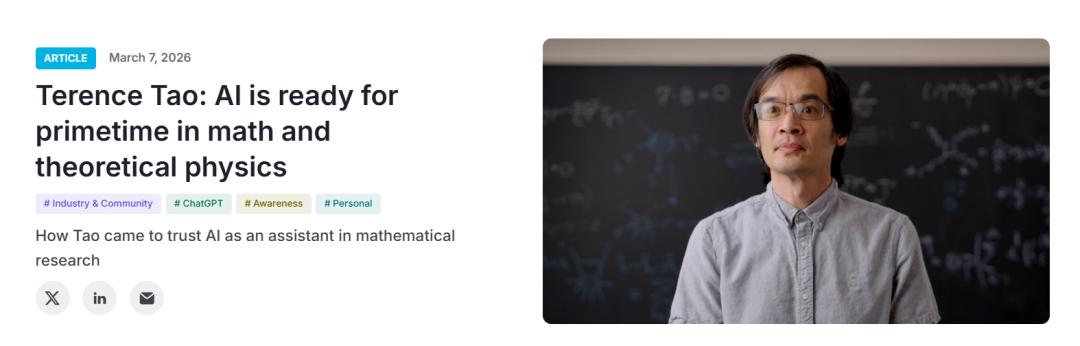
https://academy.openai.com/public/blogs/terence-tao-ai-is-ready-for-primetime-in-math-and-theoretical-physics-2026-03-06
The second change occurs in the division of labor among mathematicians.
If routine derivation, literature search, computational experiments and even part of the proof can be handed over to AI, human researchers will invest more energy in areas that may shift to topic selection, proposing appropriate conjectures, designing research routes, and refining machine-generated results into new theories that can be explained.
Terence Tao calls this future a "Big Mathematics" model: complex problems are split into many modules, humans, AI and formal proof systems participate together, and the results are recombined through machine verification.
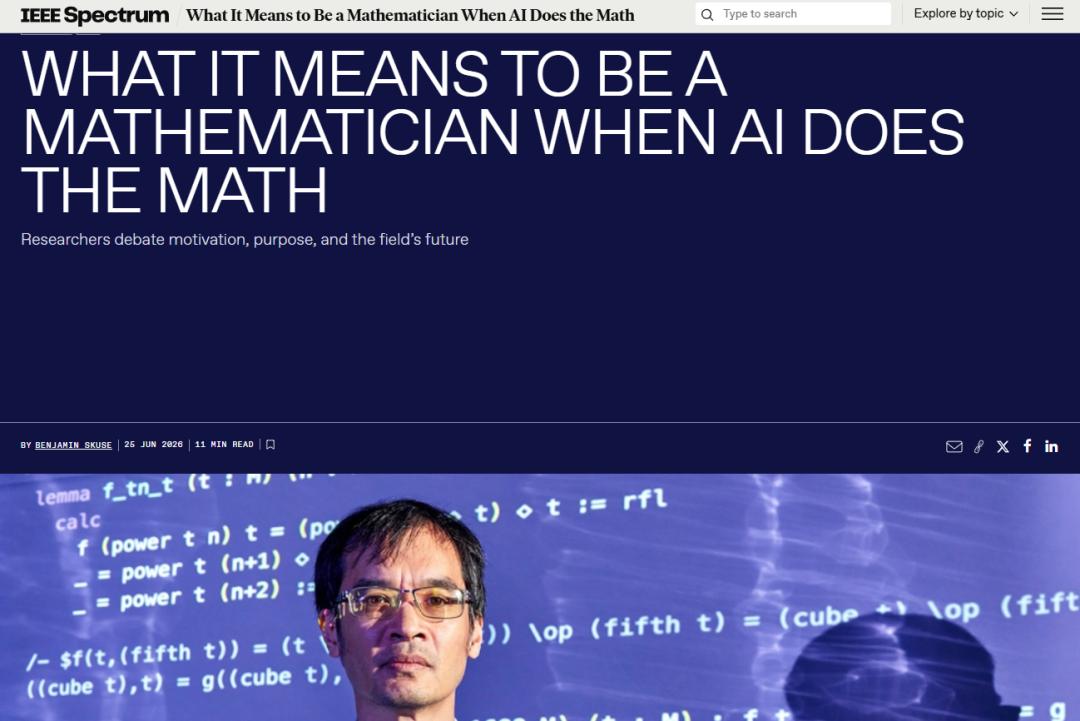
https://spectrum.ieee.org/ai-in-mathematics
When answers are becoming more and more "cheap", what counts as the truly scarce part of mathematical research?
In the past, an important open problem could support a research direction for decades. The detours that mathematicians took around it could themselves give birth to new theories. If AI greatly compresses this process, the final answer will come faster, and at the same time it will require the mathematical community to redesign a set of methods for preserving research processes, allocating contributions and cultivating the next generation of researchers.
Terence Tao took Navier-Stokes as an example this time to discuss exactly this change.
As for whether Claude has really conquered this Millennium Prize Problem, it is still at the stage of social media rumors for the time being.
But this somewhat farcical discussion has already illustrated one thing: a few years ago, "AI solving a Millennium Prize Problem" was probably closer to a sci-fi setting; by 2026, people have begun to seriously think about what the mathematical community should do if it really happens.
Reference links:
https://x.com/AndrewCurran_/status/2096062392442724805
This article is from the WeChat Official Account , authored by a mathematics-focused contributor, and published with authorization from 36Kr.