The 5 most profitable listed medical device enterprises, one of which gains profits from investment and another makes its earnings by selling gloves.
Written by | Zhang Jing
The 2026 semi-annual report disclosure season has concluded, and 175 A+H listed medical device companies have handed in their performance reports.
If you only look at one figure, you will feel that the industry has recovered: 140 A-share medical device companies recorded a total revenue of 1.31411 trillion yuan in the first half of the year, 64.3% of the enterprises achieved positive revenue growth, and the median revenue growth rate was 4.18%.
But if you list the net profit ranking, you will find a completely different picture: among the 10 most profitable companies, one relies on investment, one sells gloves, and 6 have declining profits.
The "profit quality" of the medical device industry is undergoing an unprecedented test.
This is the truth of the medical device industry in the first half of 2026: it is not a simple "recovery" or "pressure bearing", but a profound structural differentiation. 175 enterprises are being reclassified: some are building dams, some are swimming naked, and some have set sail for faraway destinations.
Let's use two lists to reveal the hidden cards of this industry.
The 10 most profitable companies: The first place leads by a large margin, the second place is "not doing its proper business"
First look at the most intuitive list: who makes the most money.
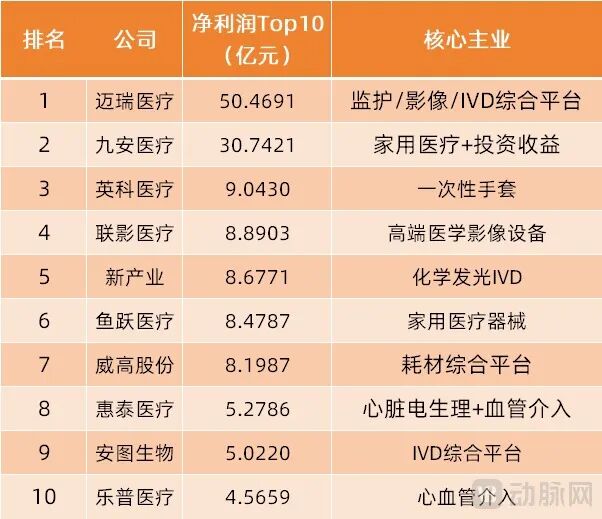
(Data source: 2026 semi-annual reports of respective companies; calibre of net profit is adopted)
This list contains a large amount of information, and several figures are worth careful consideration:
First of all, the first place leads by a large margin, but its profit is shrinking. Mindray Medical took the lead with a net profit of 5.047 billion yuan, which is 1.6 times that of the second-ranked Andon Health and 5.6 times that of the third-ranked Intco Medical. Among the total net profit of 20.928 billion yuan of 140 A-share medical device companies, Mindray alone accounts for 24%: nearly a quarter of the industry's profits are earned by one company.
However, Mindray's attributable net profit fell by 5.37% year on year, and the non-recurring profit and loss deducted net profit fell by 3.32%. Even the industry leader has begun to "increase revenue without increasing profit" (revenue +6.00%, profit -5.37%), which in itself is a strong signal: the downward pressure on the profit margin of the medical device industry is greater than expected.
Secondly, the second place is "not doing its proper business", earning 3 billion yuan through investment. Andon Health's net profit in the first half of the year was 3.074 billion yuan, a year-on-year surge of 234%, ranking second among all A-share medical device companies. But its revenue was only 531 million yuan, down 30.58% year on year.
The 3 billion yuan net profit is credited to investment income: in the first half of the year, the valuations of AI and hard technology companies invested by Andon Health previously, including Moonlight (Kimi), DeepSeek, domestic GPU enterprise MetaX, and Agibot Robotics, continued to skyrocket, jointly pushing up Andon Health's overall fair value change gains.
A medical device company's income from investment far exceeds the profit from its main business, and it ranks second in the profit list by "investment", which in itself is a black humor of the industry.
What is more humorous is that in August 2026, Kimi and DeepSeek launched a new round of financing, and their valuations rose again. For example, Kimi's post-money valuation after Series F financing in July was 35 billion US dollars, and its pre-money valuation in August reached 50 billion US dollars. Barring any accidents, Andon Health will make huge profits again.
Thirdly, companies selling gloves are more profitable than those selling imaging equipment and high-value consumables. Intco Medical's main business is disposable PVC gloves and nitrile gloves. Its net profit in the first half of the year was 904 million yuan, ranking fourth, surpassing United Imaging Healthcare (889 million yuan), Snibe Diagnostic (868 million yuan), Yuwell Medical (848 million yuan) and many other enterprises.
In terms of net profit margin, United Imaging Healthcare, which focuses on high-end medical imaging equipment, recorded revenue of 7.052 billion yuan and net profit of 889 million yuan in the first half of the year, with a net profit margin of 12.6%; Intco Medical, the leader of low-value consumables, recorded revenue of 6.909 billion yuan and net profit of 904 million yuan, with a net profit margin of 13.1%.
The logic behind this is: although high-end medical equipment has high technical barriers, its R&D investment is large, sales expenses are high, and price wars are intensifying, so its net profit margin is not necessarily higher than that of "low-end" consumables. Especially under the dual pressure of volume-based procurement and domestic substitution, the profit margin of high-end medical equipment is being continuously compressed.
However, when switching to the calibre of attributable net profit, the pattern will reverse: Affected by the profit diversion from minority shareholders of its joint venture subsidiary, Intco Medical's attributable net profit was 837 million yuan, lower than that of United Imaging (897 million yuan), Snibe Diagnostic (868 million yuan), Yuwell (843 million yuan) and other enterprises.
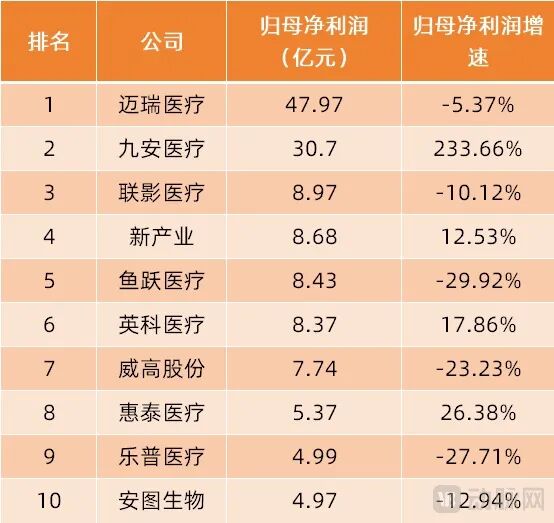
(Data source: 2026 semi-annual reports of respective companies; calibre of attributable net profit is adopted)
This means that the shareholders of listed companies such as United Imaging, Snibe Diagnostic and Yuwell actually enjoy a higher profit level than that of Intco.
Finally, 6 of the top 10 companies have declining profits, and it is getting harder and harder to make money in the industry. For example, Yuwell Medical's attributable net profit fell by 29.92% year on year, Lepu Medical's fell by 27.71% year on year, Weigao Group's fell by 23.23%, and Autobio Diagnostics' fell by 12.94%.
Moreover, among the 140 A-share medical device companies, 71 have negative net profit growth, accounting for 50.7%. Half of the companies earned less in the first half of this year than in the same period last year. The median non-recurring profit and loss deducted growth rate is as low as -3.32%, and more than half of the listed companies have declining profitability in their core main business.
Even the most profitable leading companies in the industry are facing declining profits, so the situation of small and medium-sized companies can be imagined.
The 10 companies with the fastest revenue growth: The first place sees a 30-fold increase
After looking at "who makes the most money", let's look at "who grows the fastest". Revenue growth rate is the most intuitive indicator to observe the vitality of enterprises.
This statistics integrates the data of A+H share listed medical device companies, and ranks them according to the year-on-year revenue growth rate. The top 10 enterprises in terms of industry growth rate are as follows:
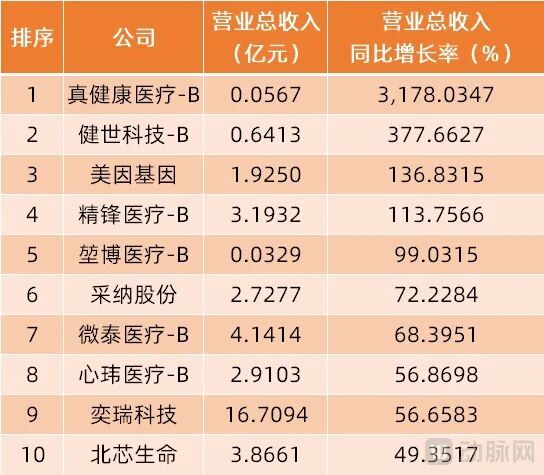
(Data source: 2026 semi-annual reports of respective companies)
At first glance, this list is quite shocking. Zhenjiankang Medical's revenue increased by 31 times, Wuhan Bioscience's growth is close to 4 times, Meiyin Gene and Accuray Medical also doubled their revenue. Growth rates of 3000%, 300% and 100% are "explosive" performance in any industry.
But if you take a closer look at the revenue figures, you will find a somewhat awkward fact: the companies with the most rapid growth actually have very small revenue volume. Zhenjiankang Medical's half-year revenue is only 5.67 million yuan, Broncus Medical's is only 3.29 million yuan, and Wuhan Bioscience's is only 64.13 million yuan. Revenue at the million and ten million yuan level increases by several times or even dozens of times, which is more of a "from 0 to 1" start, rather than a "from 1 to 10" expansion.
However, this also shows that their business models have been verified and their products have been recognized by the market. High growth rate means that products are accelerating their release and market demand is expanding rapidly.
If we jump out of a single list and look at all 175 A+H share medical device enterprises, we can find that the growth of different enterprises is backed by diversified growth paths spawned by different segmented tracks and business models, which can be divided into four categories.
The first category is cycle recovery type, such as Intco Medical, Bluesail Medical, China Red Medical, etc.
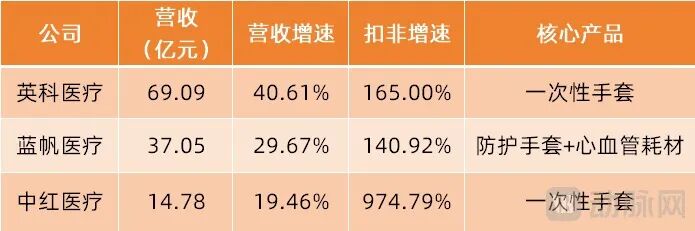
(Data source: 2026 semi-annual reports of respective companies)
The growth logic of these three enterprises is highly consistent: the orders of the glove business have increased, and both sales volume and unit price have rebounded.
First of all, let's talk about sales volume. After the disposable glove industry experienced large capacity expansion and market contraction, supply exceeded demand and prices plummeted, many small and medium-sized enterprises were eliminated. After two years of capacity clearance from 2024 to 2025, the global demand for the glove market finally recovered steadily, and the order volume of leading enterprises increased significantly. This is a typical cyclical recovery growth.
Then let's talk about unit price. The fluctuation of crude oil prices drives the cost of core raw materials such as nitrile latex and PVC to rise, the cost pressure is transmitted to the downstream, and the supply-demand pattern is improved, so the price of glove products has recovered.
The most illustrative is the profit growth rate. Intco Medical's non-recurring profit and loss deducted net profit increased by 165%, Bluesail Medical's increased by 141%, and China Red Medical's increased by 975%. The profit growth rate is much higher than the revenue growth rate, indicating that this round of growth of Intco, Bluesail and China Red is a simultaneous rise in volume and price, and their profitability is recovering rapidly.
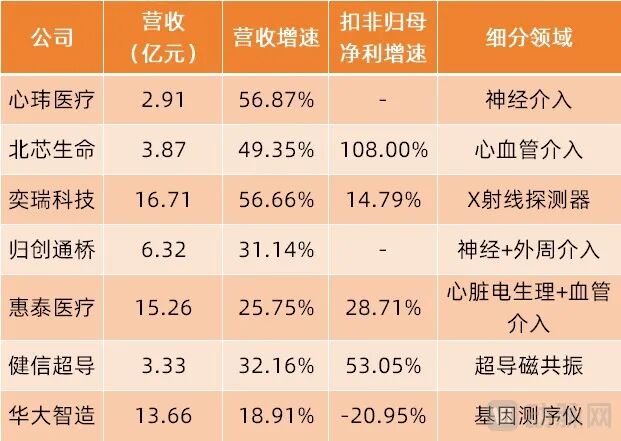
The second category is domestic substitution type, such as Sinovation Medical, Pulse Medical, Acrosome, iRay Technology, etc.
(Data source: 2026 semi-annual reports of respective companies)
The core of the growth of this type of enterprises is the domestic substitution dividend driven by policies, products and supply chains, which will not be elaborated here.
It is worth mentioning that among the above enterprises, the substitution pace of different segmented tracks is differentiated:
iRay Technology in the imaging component track has completed the import substitution in the domestic market, and further entered the global supply chains of GE, Siemens and Philips, realizing two-way substitution at home and abroad;
In the high-value interventional consumables track, Hui Tai, Pulse Medical, Sinovation Medical and Acrosome continue to seize the existing market share of Johnson & Johnson, Boston Scientific and Medtronic in the fields of electrophysiology, IVUS and neuro-intervention, and the surgical consumables that were previously monopolized by imported products are gradually released in hospitals;
The superconducting magnetic resonance of Jianxin Superconducting, targeting primary and mid-range hospitals, breaks the long-term monopoly of overseas manufacturers in the field of magnetic resonance equipment.
Of course, domestic substitution is not all smooth sailing. Some tracks still face customer stickiness of imported brands and academic barriers in hospitals. After domestic players pour in, internal price competition intensifies, resulting in the phenomenon of "high revenue growth but pressure on profits". Wuhan Huada Medical is a typical case. Its revenue maintains double-digit growth, but it is still in a loss state at the non-recurring profit and loss deducted level, and the substitution process still requires continuous investment.
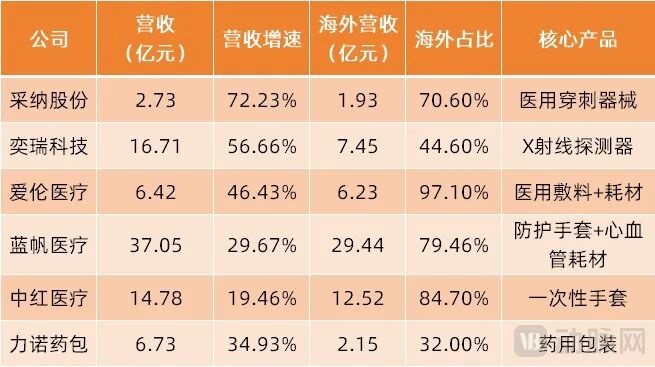
The third category is overseas expansion driven type, such as iRay Technology, Ailun Medical, Adopt Medical, Linuo Pharmaceutical Packaging, etc.
(Data source: 2026 semi-annual reports of respective companies)
Overseas expansion has become a recognized second growth curve for medical device enterprises, but different enterprises have huge differences in their overseas expansion modes and growth logic.
Among the above enterprises, some are low-value consumables enterprises adopting ODM/OEM mode, such as Ailun Medical and Adopt Medical. Relying on the cost advantage of domestic manufacturing, these enterprises produce for overseas brands, and their products are directly sold to Europe, America and the global market, with a very high proportion of overseas revenue.
The growth of such enterprises benefits from the recovery of global downstream demand on the one hand, and the expansion of orders from large overseas customers on the other hand. Their advantage lies in fast volume growth, but their shortcoming is weak independent brand, and their profits are greatly affected by the bargaining power of downstream customers.
The other part are hardware and component enterprises with independent brands, represented by iRay Technology and United Imaging Healthcare. Such enterprises are not simply exporting OEM products, but directly participating in global market competition by virtue of their product and technical strength.
iRay Technology's overseas revenue growth rate exceeds 100%, and it has entered the supply chains of global leading imaging equipment manufacturers; United Imaging Healthcare's overseas revenue reached 1.765 billion yuan, a year-on-year increase of 54.45%, and the Asia-Pacific market achieved explosive growth, which indicates that China's high-end medical device products already have global competitiveness.
It should be noted that overseas expansion will also face practical challenges: overseas geopolitical policy barriers, overseas channel construction investment, and exchange rate fluctuations will erode the profits of enterprises, and the growth of overseas sales volume does not mean the simultaneous release of profits.
The fourth category is track dividend type, such as MicroTech Medical, Accuray Medical, Cofoe Medical, Resvent, Angelalign,