Dreame, which made a big fanfare for its car-building business, only lasted for a year.
Building cars has never been a simple "money-only pass" transaction. As China's automotive market officially bids farewell to the high-speed incremental growth period and fully enters the stock competition stage, the brutal rivalry between automakers has only just begun. Entering the automotive manufacturing sector across different industries at this moment is no less than a challenge of hell-level difficulty.
Dreame, a brand famous for its sweeping robots, finally saw new progress nearly a year after its official announcement of entering the automotive industry — not launching the rumored "Bugatti-Veyron-alike" model, but declaring that "it will no longer make cars".
On August 25, Dreame Technology released the Statement on the Company's Strategic Focus and Business Development, mentioning that it will further focus on four main business directions: smart home, outdoor yard, smart mobility, and embodied intelligence, with no mention of automobiles at all. About a week later, relevant sources confirmed to the National Business Daily that the automotive business will abandon mass production, only retain technical reserves, and be incorporated into the management of the Industrial Research Institute.
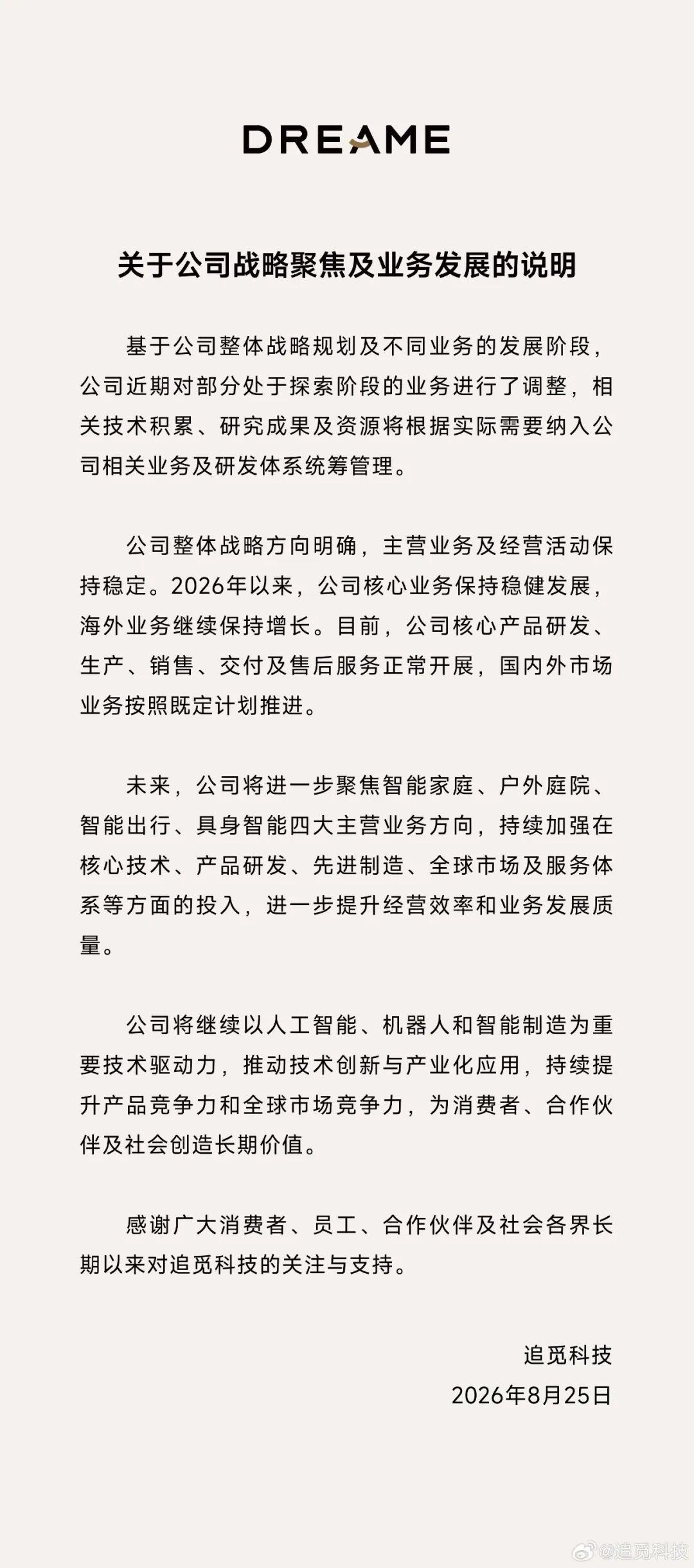
The statement released by Dreame Technology via Weibo on August 25. (Photo from Dreame Technology's official Weibo account)
The dust has finally settled. The world's fastest car thus missed a chance to get a new owner.
After large-scale layoffs, the size of Dreame's automotive team has shrunk from nearly 1,000 people at its peak to about 100 people. According to on-site visits by multiple media outlets weeks ago, a large number of idle workstations, live streaming rooms full of garbage all over the floor, and the Nebula NEXT 01 prototype car covered by car covers and enclosures in the underground parking lot could be seen in the office area — it is said that Dreame customized a total of 10 prototype cars, each with a cost of about 3 million yuan.
More than four months ago, automotive enthusiasts and tech enthusiasts saw this supercar claimed to reach a top speed of 500 km/h in Beijing, China and San Francisco, the United States respectively. Audiences who came for its reputation could only take it as a check-in material, because there was a waist-high fence around the prototype, so they could not get close to it, let alone see the interior design of the vehicle clearly.
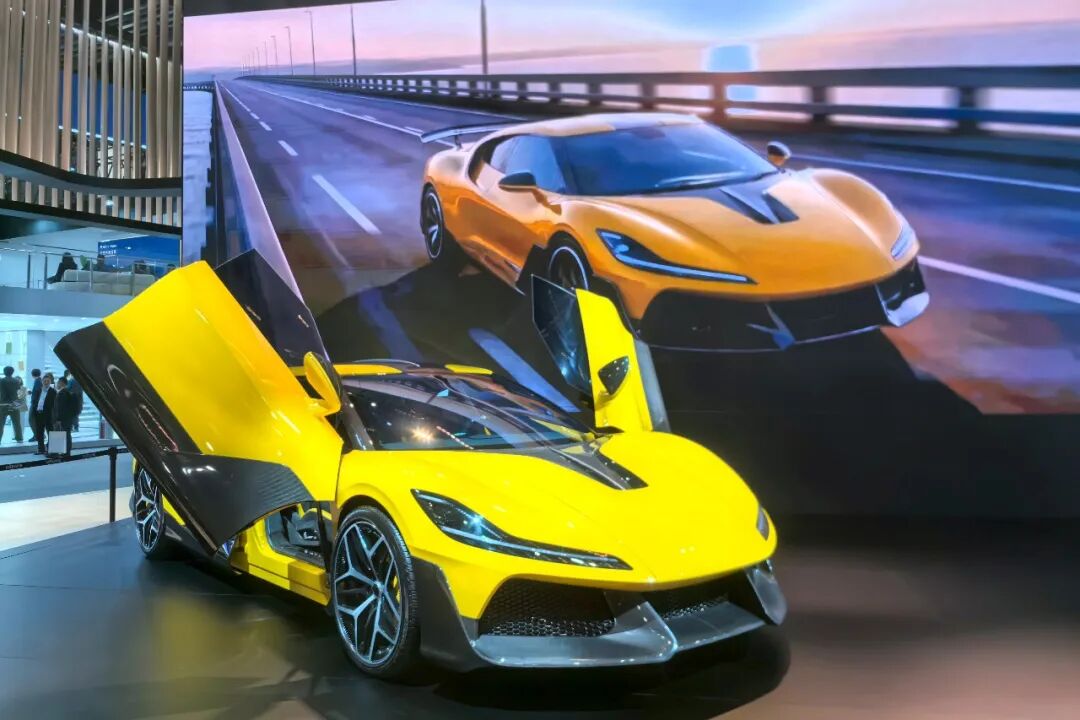
Dreame participated in the 2026 Beijing Auto Show in April this year and displayed multiple prototype cars on its booth. (Photo by Forrest)
At that time, people were all concerned about the same question: Could Dreame mass-produce its first vehicle as scheduled in 2027? Of course, this huge question has now been reduced to a gray joke on the Internet.
Dreame's hasty end to its car-making dream inevitably reminds people of another old acquaintance who once entered the automotive industry in a high-profile manner — Jia Yueting. If Jia Yueting has been following Dreame's car-making developments, it is unknown whether he would sympathize with Dreame while missing the moment of "making LeEco great again".
Dreame's car-making dream, one-year shelf life
August 28, 2025, an ordinary but crazy Thursday. Before the tech and automotive circles could even catch up with the "Crazy Thursday" memes of the day, a huge breaking news exploded in both industries:
Dreame officially announced its entry into the automotive industry, and it planned to build "the fastest car in the world".
The words came from Yu Hao, the founder of Dreame. At that time, he announced at the Shanghai launch event that Dreame "officially started making cars from today", and that it would build vehicles targeting the top supercar Bugatti Veyron, with a guarantee of realizing mass production in 2027.
In his open letter, he passionately envisioned Dreame's automotive business: "Car manufacturing is the crown of industry, the ultimate battlefield of technology, and also a 'survival against all odds' expedition. Great dreams are always born out of fearlessness."
Such enthusiasm stems from Yu Hao's own connection with automobiles. Dreame once stated that as early as 2013, Yu Hao and his team wrote the first car-making business plan at Skyworks of Tsinghua University, with the target directly set on the world's fastest supercar, the Bugatti Veyron.
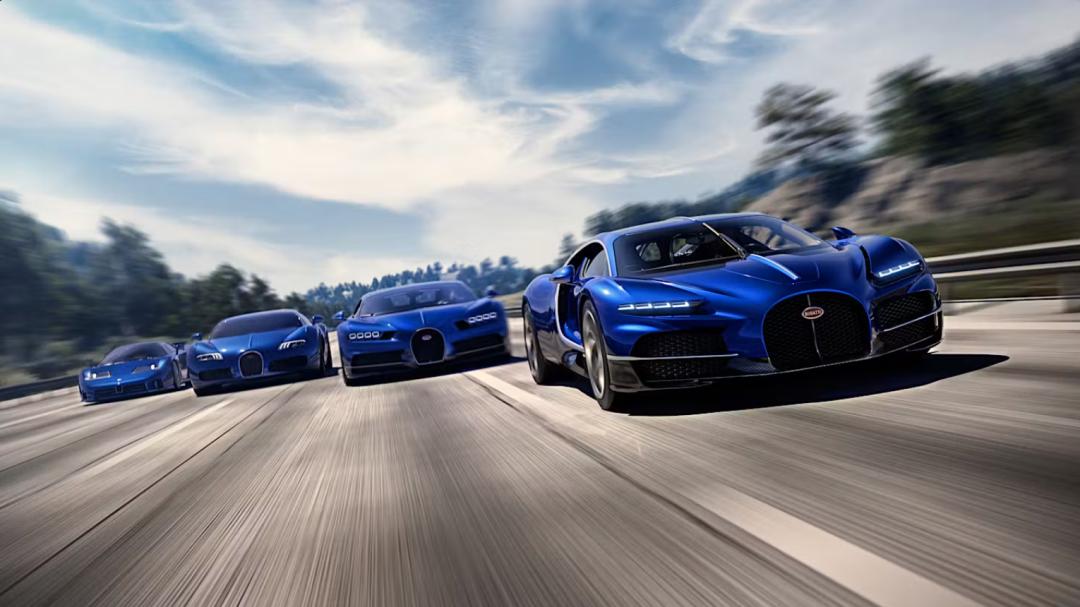
Bugatti Veyron is the fastest car in the world, and Yu Hao regarded it as the benchmark for car manufacturing back when he was studying at Tsinghua University. (Photo from Bugatti official website)
This car-making plan continued after he founded Dreame. Ma Junye, former President of Dreame Starry Sky Program, once revealed in a public occasion that Dreame's automotive team began secret preparation as early as 2021 to 2022, with a starting node almost synchronized with that of Xiaomi Auto. By February 2023, the car-making project was officially named "Starry Sky Program", and a series of automotive business companies under this name were established one after another since November 2024.
The period around 2021 was the boom of cross-industry car manufacturing in China. New car-making forces fought fiercely in the automotive circle, while bystanders were also eager to take action. In the sweeping robot sector, Dreame's direct competitor Roborock officially announced the launch of car manufacturing in 2021, and launched its first model Jishi 01 two years later, with a starting price of 349,900 yuan.
But Dreame refused to make cheap cars. In Yu Hao's view, the technical route of Dreame Auto should match or even surpass Tesla, aiming to not only become an automaker, but also a top global automaker. Yu Hao even once claimed on social media that there are only three people in China who truly understand automotive design: Lei Jun, Yu Chengdong, and himself.
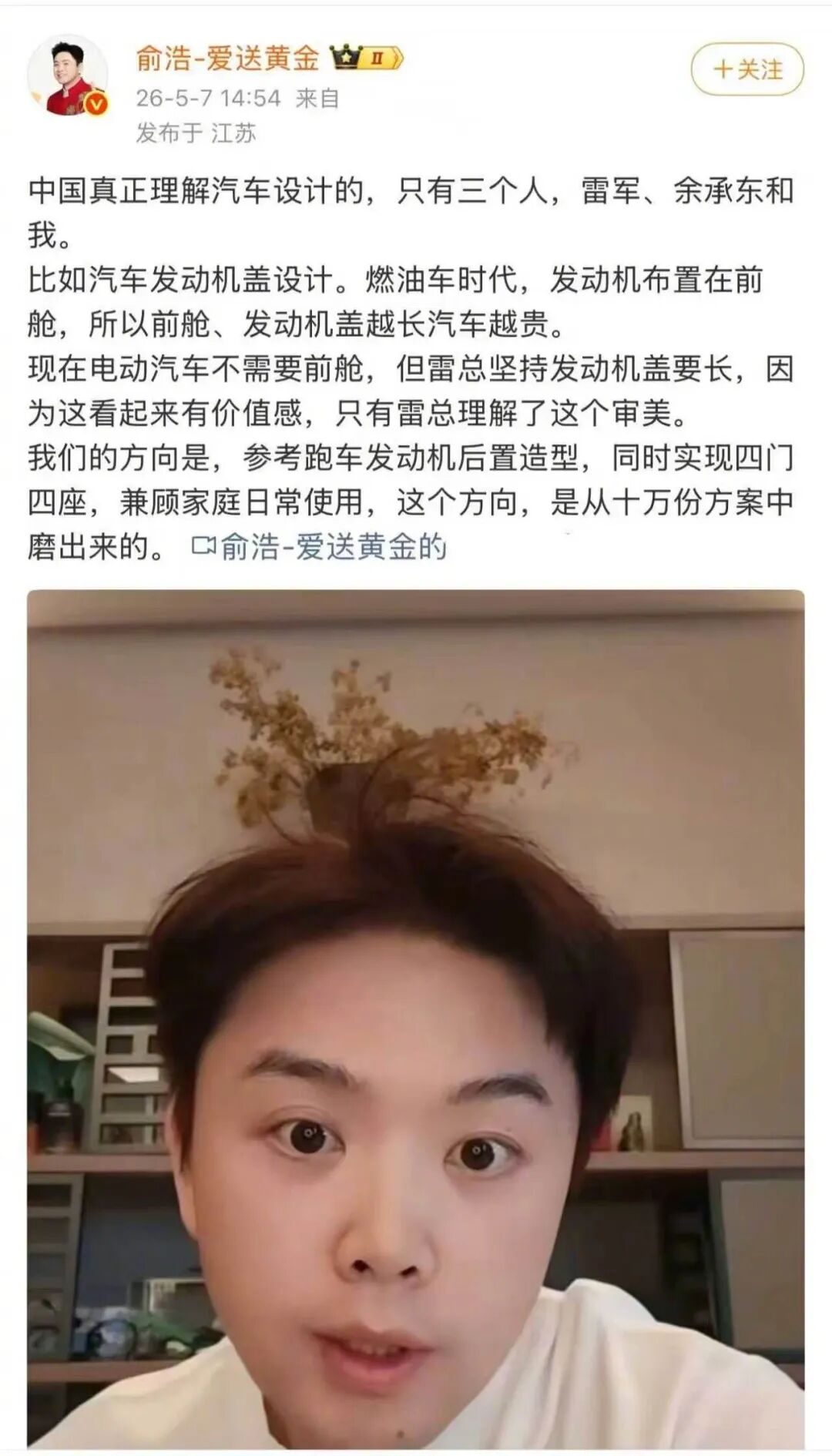
Yu Hao once stated bluntly on his Weibo that the only three people in China who truly understand automotive design are "Lei Jun, Yu Chengdong and me", and this Weibo post is no longer visible at present. (Photo from Yu Hao's personal Weibo account)
So when Dreame announced that it would make cars, most people thought he was joking. But a series of subsequent actions made the outside world feel that "this seems to be feasible":
On September 12, 2025, only two weeks after the official announcement, Dreame Auto completed its first round of financing, built a cross-industry car-making team of nearly 1,000 people, and even claimed that it was selecting a site to build a factory near Tesla's Gigafactory in Berlin, Germany; at the end of the month, it announced that it had received orders exceeding 150 billion yuan.
In the first four months of 2026, Dreame Auto's actions attracted even more attention:
In January, it released the Nebula NEXT 01 concept car at the Consumer Electronics Show (CES), claiming to be equipped with four-motor four-wheel drive and achieve 100km/h acceleration in 1.8 seconds;
In February, its advertisements were successively launched on the broadcast platform of the National Football League "Super Bowl" and the China Media Group Spring Festival Gala;
In March, three concept cars appeared at the site of the Appliance & Electronics World Expo (AWE);
In April, it participated in the Beijing Auto Show, and on the 27th of the same month, it launched the Nebula NEXT 01 JET Edition "rocket car" equipped with solid rocket boosters in Silicon Valley, USA, claiming that its 100km/h acceleration only takes 0.9 seconds.
Heavy news came one after another, superimposed on the natural traffic aura of Yu Hao himself on social media, Dreame Auto completely aroused public attention, but more and more doubts also emerged.
Under every trending topic, people cared about core information such as the battery capacity, cruising range, whole-vehicle certification, production location, and relevant supplier list of Dreame Auto, but Dreame never disclosed any of these details.
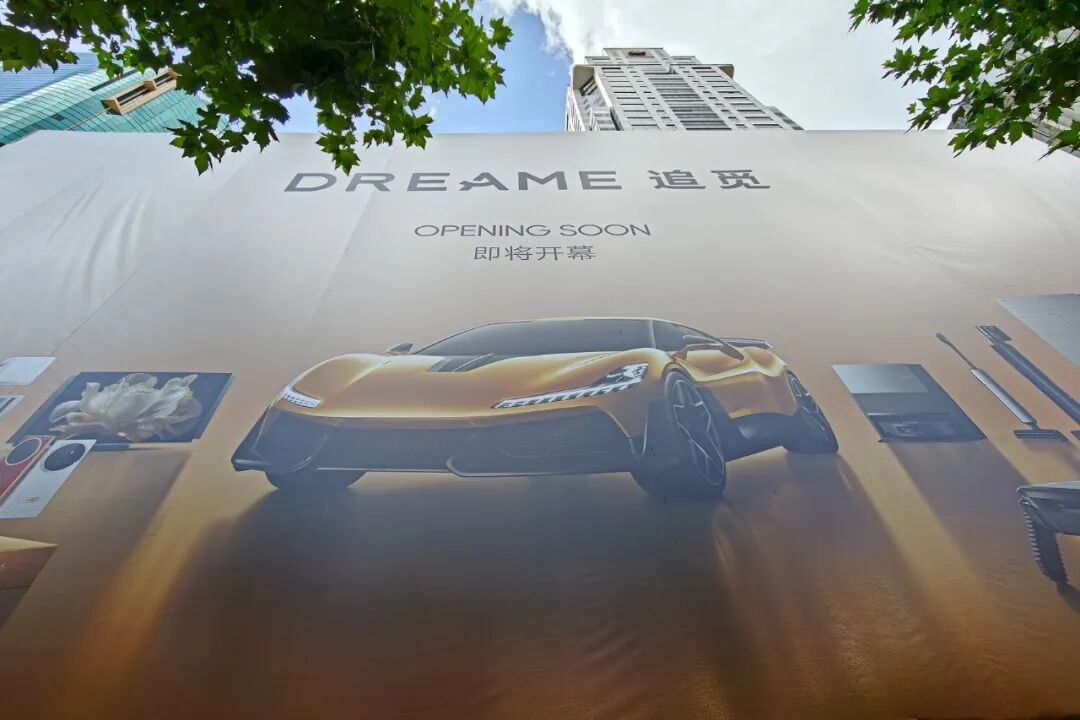
Dreame did not disclose details of core information including battery capacity, cruising range, whole-vehicle certification, production location, and relevant supplier list. (Photo from Visual China)
Before the onlookers could see the true appearance of the "Bugatti-Veyron-alike" model, risks and negative backlash came rapidly along with Yu Hao being banned from posting on Weibo.
In June this year, Dreame's automotive business was stripped of its independent entity and incorporated into the management system of the Industrial Research Institute, followed by a wave of layoffs. The final outcome after several rounds of layoffs is the business development statement at the beginning of the article — at this point, it was just three days short of a full year since Dreame high-profile announced its entry into the automotive industry.
Disorderly expansion of "scrambling for territory"
In the high-speed development era of new energy vehicles, the "curve overtaking" brought by Dreame did have enough room for imagination — the dream that Chinese people are capable of developing supercars comparable to the Bugatti Veyron sounds very appealing.
But the prerequisite for looking up at the stars is to be down-to-earth. After Yu Hao's Weibo account was banned, some media visited Dreame Auto's registered address in Shanghai and the "legendary production base" on site, and found that the former had no actual office signs, while the latter was still just a wasteland.
More importantly, Dreame never obtained the core automobile manufacturing qualification. Since 2022, the Ministry of Industry and Information Technology has in principle no longer added new production qualifications for new energy passenger vehicles. At present, the only representative of new car-making forces that can obtain the car manufacturing qualification through the conventional path is Lei Jun's Xiaomi Auto.
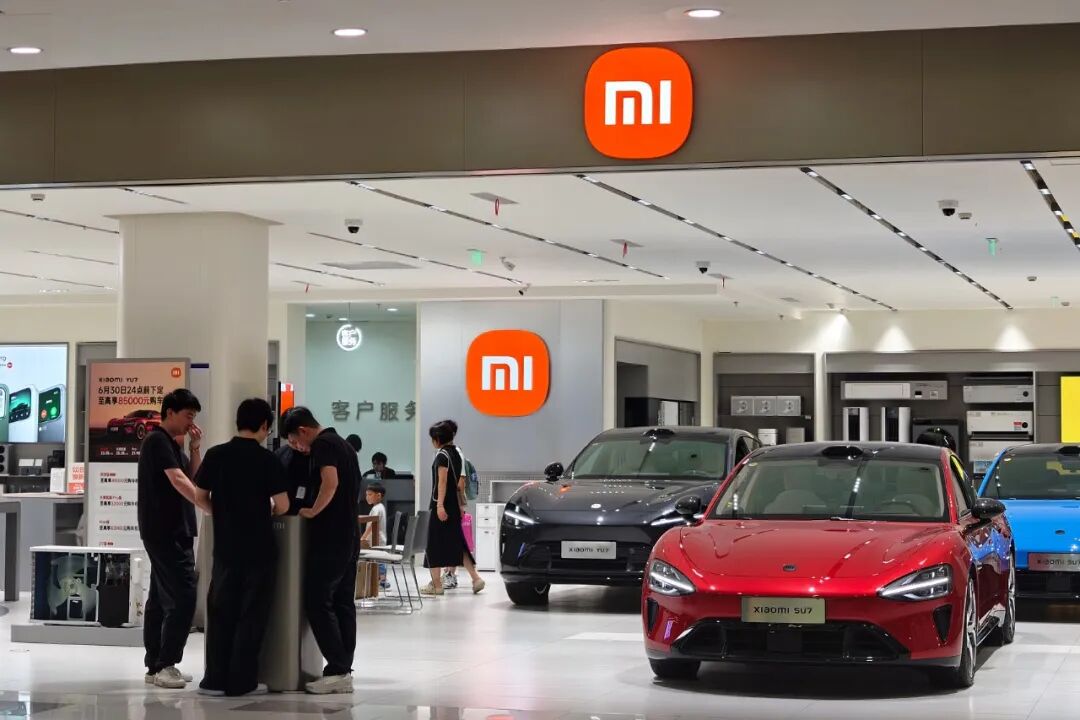
Xiaomi Auto is the only new car-making force that obtained the car manufacturing qualification through the conventional path after the new regulations of the Ministry of Industry and Information Technology were announced in 2022. (Photo from Visual China)
Although Dreame once revealed at the press conference held in Silicon Valley, USA in April this year that it planned to adopt the "Huawei model" to make cars, and there were rumors that it had extended an olive branch to traditional automakers such as Chery and Zotye, all of these automakers denied the news one by one.
With no factory, no qualification, no cooperative partners, plus media reports that Dreame's business logic for car manufacturing was "obtain financing first and then carry out R&D" rather than investing in R&D first and then generating output, under the superposition of various factors, it is simply a fantasy for Dreame to become "the greatest automotive brand in human history" from scratch within two years.
Apart from the car-making project, a number of innovative businesses that Dreame previously "focused on incubating" are also shrinking or shutting down simultaneously.
How many products does Dreame have? Before 2025, the answer to this question was cleaning home appliances represented by sweeping robots; but after 2025, Dreame suddenly proposed to become a "borderless" ecological enterprise, with product directions extending from cleaning home appliances to mobile phones, automobiles, and then completely breaking through the boundaries of hardware.
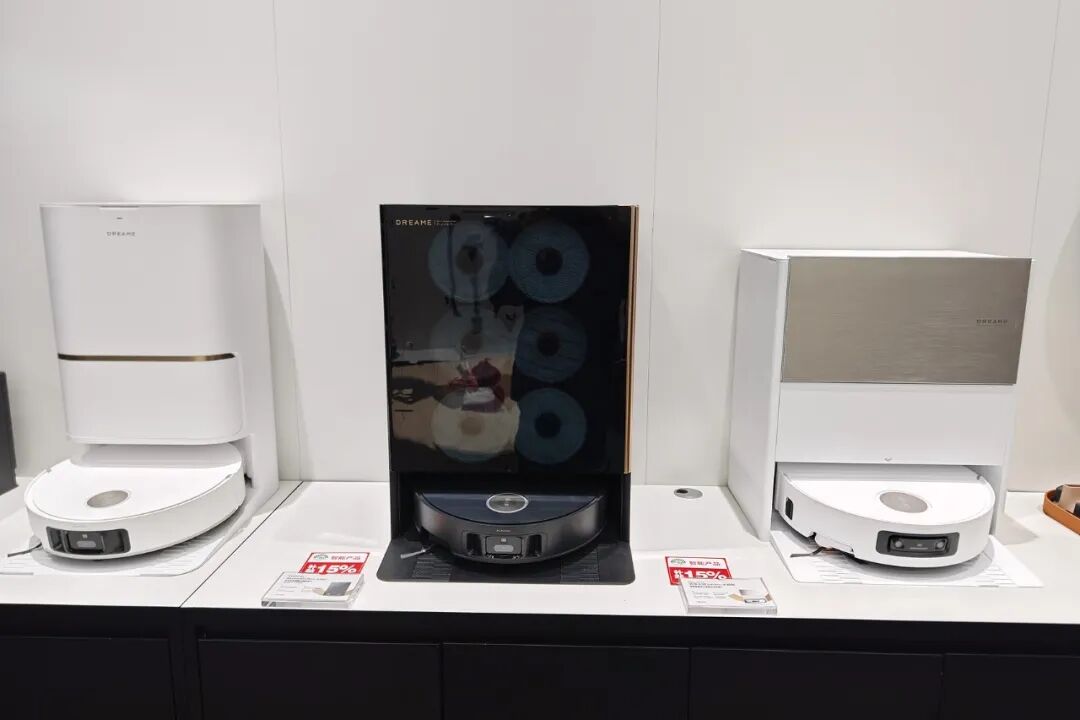
Dreame's main business used to be cleaning home appliances represented by sweeping robots. (Photo from Visual China)
According to reports from media such as South Finance Media, during the craziest period of expansion, Dreame had 15 internal incubators, and more than 200 BUs (Business Units) advancing in parallel, with a maximum of 28,000 people in the Feishu group. These BUs cover fields ranging from satellites, chips, and automobiles to milk tea, hot pot, and stationery — almost all existing categories in human society, Dreame wanted to redo them all.
Corresponding to the widely spread business layout is the overwhelming personal image promotion of Yu Hao himself on social media since the beginning of this year. At the craziest time, Yu Hao posted 117 Douyin videos, 75 Weibo posts, and 45 Xiaohongshu notes a day, implanting himself into everyone's mobile phones everywhere: "Why is Dreame everywhere?"
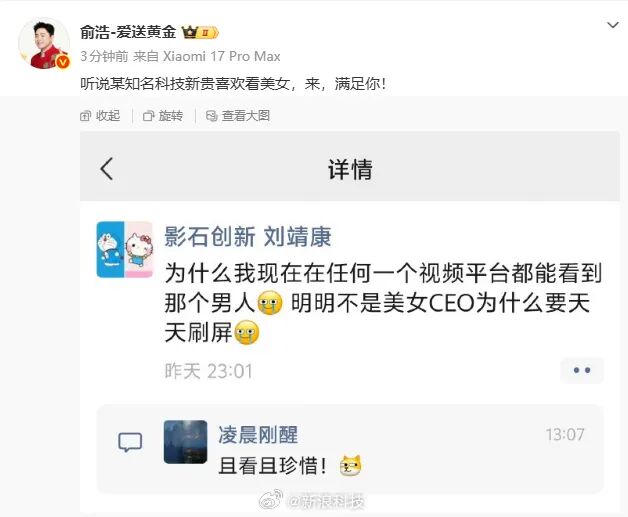
Liu Jingkang, CEO of Insta360, once posted on Moments complaining that "Dreame is ubiquitous on short video platforms", Yu Hao later "fought back" on Weibo, and even released multiple videos of his own image processed to be feminized by AI. These videos and this Weibo post are no longer visible at present. (Photo from Sina Tech)
It is obvious that Yu Hao wants to learn from Lei Jun, CEO of Xiaomi, to become a knowledgeable tech geek on the Internet. After all, Dreame was once part of the Xiaomi ecological chain in its early years.
But in the market, Dreame is more often discussed together with LeEco. Back then, LeEco took "ecological anti-integration" as its slogan, expanding its business from video websites to multiple fields such