Smartphone Market in Q2 2026: Huawei Takes the First Place, Apple Wins Effortlessly, Xiaomi Sees a 20% Decline
People who are planning to replace their mobile phones have recently found that cheap models are getting fewer and fewer.
On September 1, multiple available models from Huawei, Honor and Xiaomi adjusted their prices at the same time, with the increase ranging from several hundred yuan to over one thousand yuan. In the second quarter of this year, some manufacturers could not hold on any longer and raised prices in an earlier round, at the cost of losing market share.
Counterpoint data shows that in the second quarter of 2026, Huawei's share in China's smartphone market reached 23%. Apple ranked second with 18%, followed by vivo, OPPO, Xiaomi and Honor accounting for 16%, 15%, 12% and 11% respectively.
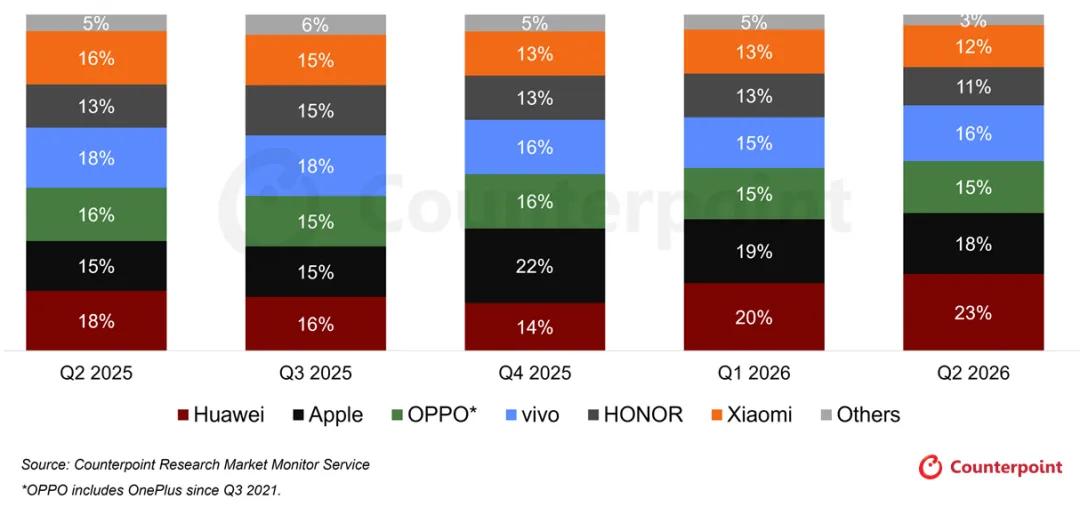
A year ago, Huawei's market share was 18% and Apple's was 15%. Now the combined share of the two companies has risen from 33% to 41%. Xiaomi's shipment volume in the second quarter fell by more than 20%, the largest decline among the six mainstream manufacturers.
While market share is concentrating on Huawei and Apple, the number of mobile phones bought by Chinese consumers is decreasing. Counterpoint data shows that manufacturer shipments only decreased by 1% in the second quarter, while terminal sales dropped by double digits year-on-year. Shipment statistics count the mobile phones that manufacturers deliver to distribution channels, while terminal sales statistics count the mobile phones actually purchased by consumers.
A practitioner in the mobile phone industry told "Dingjiao One" that manufacturers, worried about the continuous price hike of memory, purchased materials in advance and also pushed more mobile phones to distribution channels. Channel stock preparation propped up the shipment volume in the second quarter, so the shipment data was better than the terminal sales performance.
Then look at the global market. Omdia data shows that global shipments in the second quarter decreased by 6% year-on-year, and the top five are still Samsung, Apple, Xiaomi, OPPO and vivo. The ranking did not change, but the shipment situation varies greatly. Samsung and Apple maintained growth, while Xiaomi, OPPO and vivo decreased by 26%, 17% and 18% respectively. Shipments all declined in the markets of India, Southeast Asia, Latin America, the Middle East and Africa, which Chinese domestic manufacturers use to expand their scale.
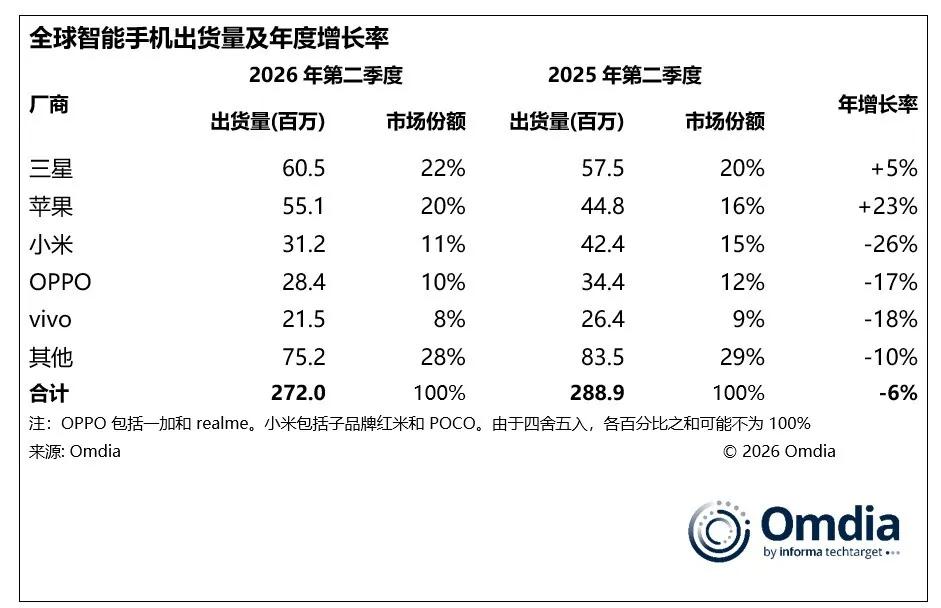
Huawei did not enter the global top five, and the recovery of its mobile phone business is still mainly focused on the domestic market. It takes time for re-investment in overseas channels, application ecosystem and brand building. Transsion ranks sixth in the world, continuing to hold its territory mainly in Africa.
The market changes in the second quarter are related to the price hike of memory. For the same price increase, low-cost models with thin profit margins cannot hold on first. Xiaomi, OPPO and vivo have begun to reduce some low-priced models, and adjust new products to higher price ranges.
The price hike of memory first squeezed the profit of low-cost mobile phones. Xiaomi, OPPO and vivo started to reduce some low-priced products and shift new products to higher price bands. As a result, the average selling price of mobile phones rose, while shipments continued to decline.
There were still low-cost materials purchased earlier available in the second quarter, and channels also received a batch of goods in advance, so part of the pressure was pushed to the later period. After high-priced materials are used in new phones and channels start to digest inventory, it will become clearer whether each manufacturer can stabilize sales volume and profit.
01. Huawei expands its lead, Xiaomi sees the largest decline
It is only a matter of time before mobile phone manufacturers raise prices. The key is who can postpone the price increase, and how many users can be retained after raising prices.
In the second quarter of this year, OPPO, vivo, Xiaomi and Honor have raised prices of some of their products, and the market share of all four has declined. The prices of Huawei's main mobile phones and iPhones are relatively stable, and the two have gained more market share.
First look at Huawei and Apple, which raised prices later.
Huawei was able to postpone the price increase in the second quarter, which Omdia attributes to its vertical integration and supply chain control. But price can only explain part of the incremental growth. The additional 5 percentage points of market share Huawei gained is also related to the restored supply of mass-market products.
In the past two years, the recovery of Huawei's mobile phone business mainly relied on high-end lines such as Mate and Pura, while high-volume series such as Enjoy were still restricted by chips and complete machine supply. In the second quarter of this year, the Kirin 5G chip was reintroduced into the Enjoy series. The main models mentioned by Counterpoint include Mate 80, nova 16 and Enjoy 90 Pro Max. The Mate series continues to cover the high-end market, while nova and Enjoy supplement the mid-range and mass price points, making it possible for the accumulated brand demand to be converted into larger shipment scale.
When Android manufacturers generally raised prices, the price of iPhone did not increase synchronously. Consumers who originally hesitated between Android flagships and iPhones found that the price gap between the two sides narrowed. Counterpoint also mentioned that channels, worried about subsequent price hikes, increased the inventory of the base iPhone 17 model in advance. The growth of Apple this quarter is driven by both the relative price attractiveness and channel stocking.
Apple's financial results also confirm the growth of iPhone in this quarter. In the quarter ending June 27, iPhone revenue increased by 21.7% year-on-year, and revenue in Greater China increased by 22.4%. Apple said the latter was mainly driven by iPhone sales.
The four manufacturers that raised prices earlier all saw shipment declines, with Xiaomi being the most affected.
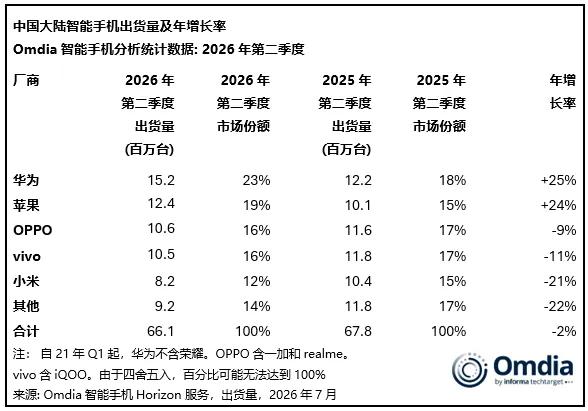
According to Omdia's statistics, Xiaomi's shipments in the Chinese market fell by 21%. Xiaomi gave two reasons in its financial report: first, it actively adjusted its product matrix and reduced mid-to-low-end mobile phones; second, the price hike of key components such as memory dragged down global demand. The simultaneous decline in domestic and overseas markets also indicates that weakening consumer demand is affecting sales.
The above practitioner added that Xiaomi's proportion of low-priced products is relatively high among the six manufacturers, so more models need to be adjusted in this round of price hikes.
After OPPO, vivo and Honor raised prices, they only maintained their basic market share, failing to capture the market "yielded" by Xiaomi.
Under Counterpoint's statistical caliber, vivo ranks ahead of OPPO; after Omdia combines the statistics of OPPO, realme and OnePlus, OPPO shipped 10.6 million units and vivo shipped 10.5 million units. The two have close market shares.
The changes in China's market in the second quarter reflect that competition has entered a more difficult stage. It is difficult to further increase market share solely by relying on flagship phones, while retaining a large number of low-priced models will drag down profits. Huawei has restored full coverage from mass-market products to flagship phones, and Apple's high-end positioning and profit margin make it more resilient to rising costs. The remaining four manufacturers need to solve the problem of finding enough consumers who are willing to raise their budget while reducing low-priced models.
02. Chinese domestic mobile phone brands see widespread decline in overseas market share, which flows to Samsung and Apple
When the domestic market becomes too competitive to generate growth, going overseas has been the standard practice for Chinese domestic manufacturers in the past few years.
In the past few years, Xiaomi, OPPO and vivo have expanded their shipments by relying on markets such as India, Southeast Asia and Latin America, entering and staying in the global top five for a long time.
In the second quarter, these major markets cooled down at the same time, and Xiaomi was the most widely affected, with global shipments reduced by more than 11 million units. Its overseas market is more dispersed than that of OPPO and vivo. This structure can quickly increase sales when the market is booming, but when multiple regions decline together, the impact will be reflected in the total volume faster.
Specifically for the six major overseas markets, the pressure faced by each manufacturer is different.
In India and Southeast Asia, Chinese domestic brands still rank at the top, and the decline in shipments is mainly due to the shrinking of the overall market.
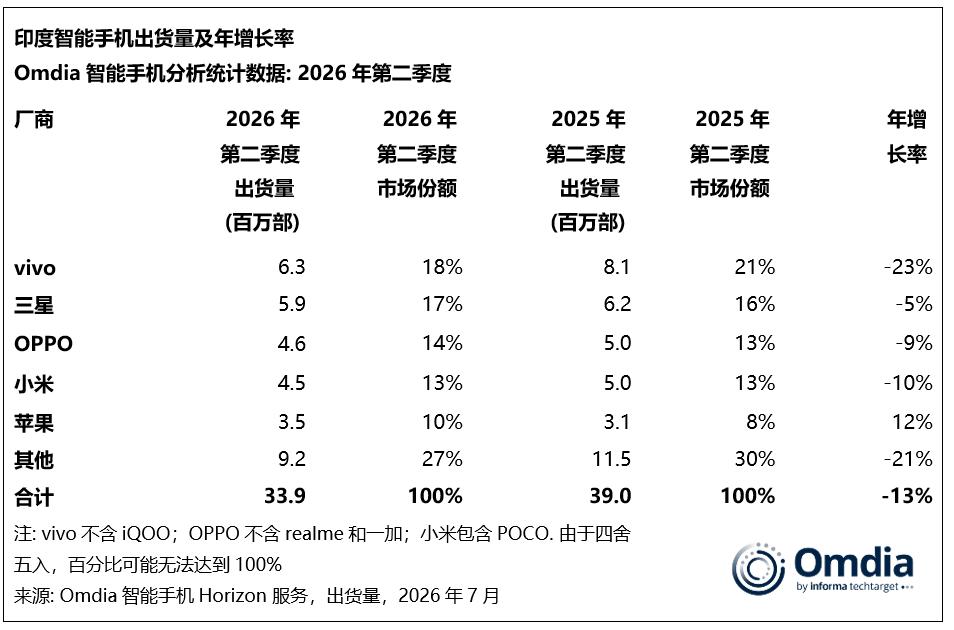
In the second quarter, India's smartphone market fell by 13% year-on-year. vivo still ranks first with shipments of 6.3 million units, only 400,000 units more than Samsung; OPPO and Xiaomi also remain in the top five. Chinese domestic brands maintained their rankings, but their sales still declined along with the market, and vivo's leading position is not very stable.
The situation in Southeast Asia is more severe. Shipments in the second quarter fell by 23%, dropping to the lowest level since 2014. Xiaomi's decline is close to the overall market trend, and its market share has not changed significantly; OPPO and vivo are also affected by the market contraction.
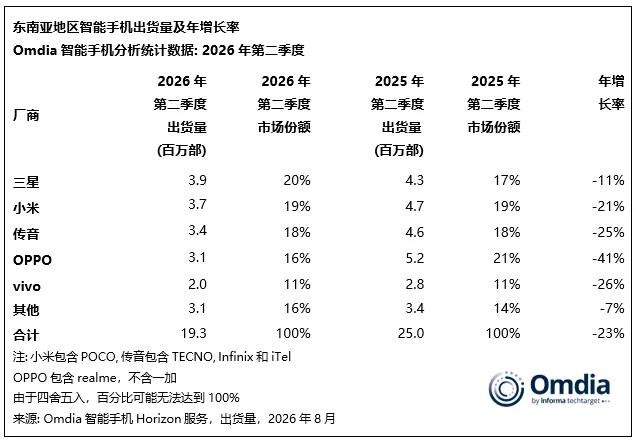
In the Indian and Southeast Asian markets, the channels and user base of Chinese domestic brands are still there. The main reason for fewer mobile phone sales is the overall market contraction. In Latin America, the Middle East, Africa and Europe, Chinese domestic manufacturers face an extra layer of pressure, their decline exceeds the overall market, and they have given up part of the market share.
Samsung is the most obvious beneficiary in Latin America, the Middle East and Africa. The overall Latin American market decreased by 12%, while Samsung's shipments increased by 9%; while the Middle East market concentrated to Samsung, the shipments of Xiaomi and Transsion decreased by 50% and 40% respectively. Similar changes have taken place in Africa: Samsung maintains growth, while Transsion, Xiaomi and OPPO have declined to varying degrees.
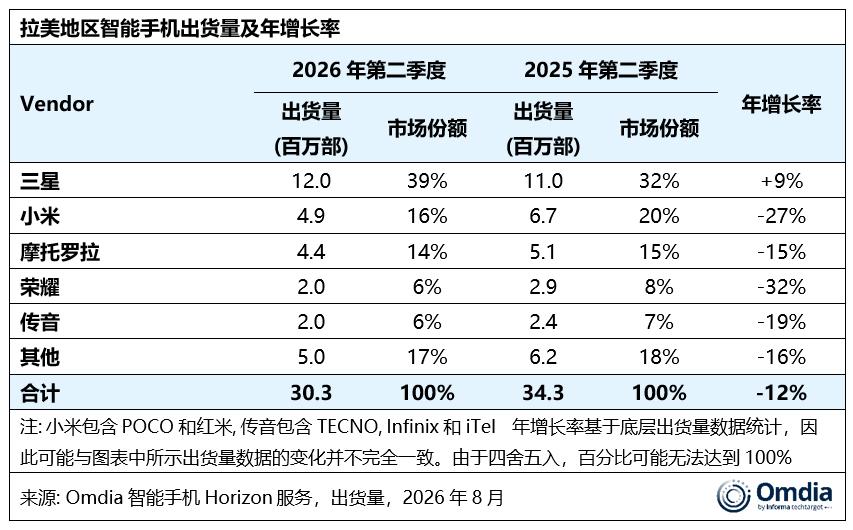
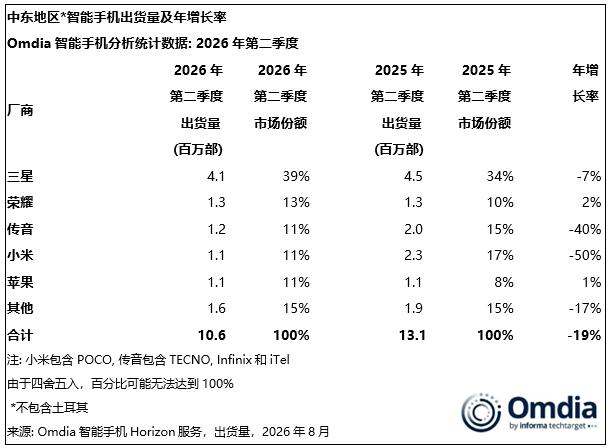
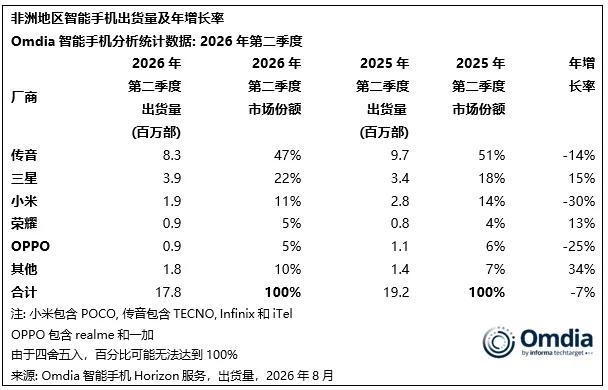
Samsung can capture these market shares in emerging markets relying on more complete product coverage. After the demand for low-priced products decreases, it still has mid-range and flagship phones for sale. Operator cooperation, installment payment and trade-in programs can also reduce the one-time purchase pressure on consumers. Xiaomi, Transsion and OPPO rely more on entry-level products locally, so their original volume advantage is more greatly affected.
Honor is an exception. It still sees growth in the Middle East and Africa, mainly relying on products priced above 300 US dollars and the South African market; in the same period, its shipments in Latin America decreased by more than 30%. This shows that Chinese domestic brands still have opportunities in some countries, but partial growth cannot make up for the gap in other markets for the time being.
The share change in Europe is more concentrated. Over the past year, the combined share of Xiaomi, OPPO and Honor has dropped from 29% to 22%, a decrease of 7 percentage points. The share of Apple and Samsung has both risen to 34%.
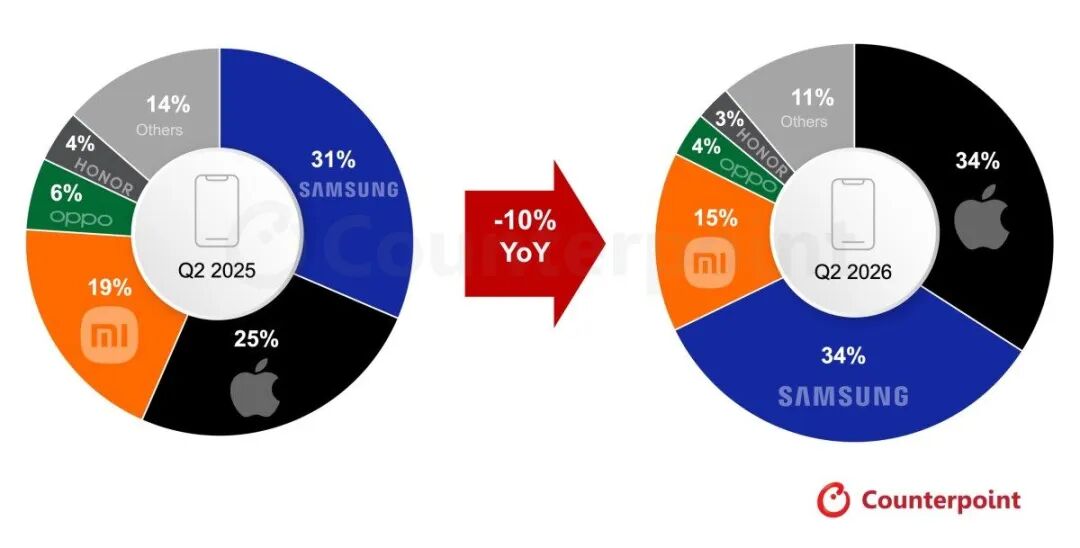
Changes in smartphone market share in Europe in the second quarter of 2026, source / Counterpoint data
European users have a higher proportion of purchasing mid-to-high-end mobile phones, and operator channels and installment consumption are more mature. After Android mobile phones generally raise prices, Samsung can cover more price ranges, and some consumers who are willing to increase their budget choose iPhone.
Looking at the six markets, the share yielded by Chinese domestic manufacturers mainly flows to two brands. Samsung gains more share in emerging markets, while Apple's advantage expands mainly in Europe and the high-end market. Honor still has growth in a few regions, which does not change the overall pressure faced by Chinese domestic Android manufacturers.
The top 10 best-selling models in the world announced by Counterpoint for the second quarter are all from Apple and Samsung, with 5 models for each, and the two together account for 26% of global mobile phone terminal sales.
The ranking of the global top five in the second quarter did not change, but growth is concentrated in Apple and Samsung. Although Xiaomi, OPPO and vivo have kept their rankings, their shipments have decreased significantly. After the market shrinks, manufacturers that can sell popular products across regions are more likely to survive the industry cycle.
03. Fewer low-priced mobile phones does not equal consumption upgrading
In the second quarter, the average selling price of mobile phones is rising, but the shipment volume of low-priced mobile phones is declining. Putting these two changes together, it is easy to think that consumers have all bought more expensive mobile phones, but the actual situation is not that simple.
Memory prices are still rising. The demand for high-end memory from AI servers has increased, and DRAM (running memory) and NAND (storage space) used in mobile phones are also affected. TrendForce predicted in May that the average contract price of LPDDR4X in the second quarter would rise by 70% to