Alibaba has added another Agent internal horse-racing program.
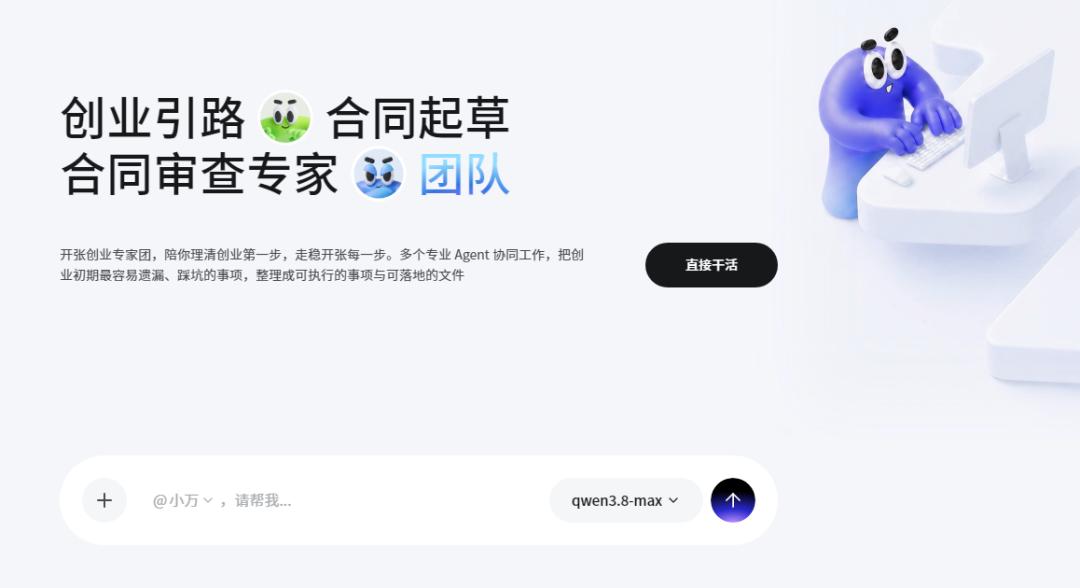
On September 2, Alibaba launched another Agent product, named "All Boundless".
According to Alibaba Cloud's definition, this is an enterprise-level "human-Agent collaboration platform". Complex tasks can be split into multiple Agents, with humans and Agents participating in the project together, and the processes and results will eventually be deposited into the enterprise account.
In the past, one Agent worked for people, but now a group of Agents work together.
The direction is not unexpected, what surprises people is the timing. A month ago, Alibaba just completed a round of integration of its Agent products.
QoderWork, MuleRun and Wukong from the DingTalk ecosystem were re-integrated into Qianwen Office. One is responsible for computer operation, one emphasizes cloud execution, and the other relies on enterprise collaboration. These three different routes were eventually brought under the "Qianwen" product line.
It looks like a convergence. A month later, All Boundless was launched.
In terms of product positioning, they are different. Qianwen Office focuses on office scenarios, All Boundless emphasizes human-multi-Agent collaboration, Bailian targets developers, and DingTalk holds the enterprise organizational relationship.
Each of them has its own unique position, and all have reasons to continue to exist.
『Alibaba has always been good at the "horse racing" mechanism』
Alibaba is no stranger to the horse racing mechanism. When the market outlook is unclear, the company allows different teams to advance in parallel, and finally leaves the choice to users and business results. Compared with betting on the right future from the very beginning, this is a more realistic approach for large companies.
The Agent track is particularly suitable for the horse racing model. Because up to now, there is still no standard answer to what an enterprise Agent should look like.
It can be hidden in a chat box, operate a computer, access office software, or even become a new entry above all software.
Alibaba has enough cards in hand. Qianwen has large language models, Alibaba Cloud has computing power and enterprise customers, DingTalk has organizational relationships, and Bailian connects developers. In the Agent era, each of these business segments has the opportunity to move forward one step further.
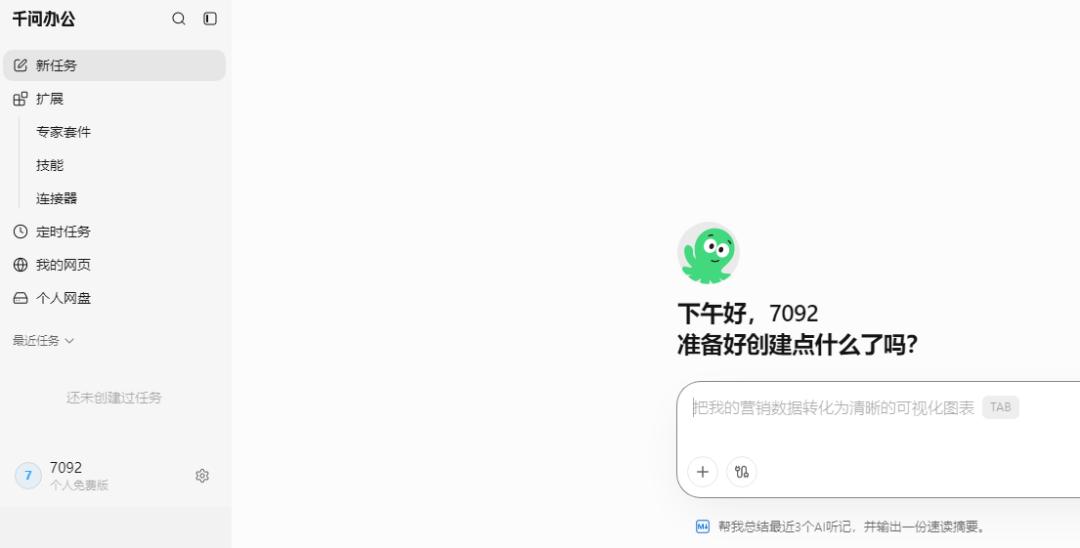
Therefore QoderWork can do it, Wukong can do it, and MuleRun can also do it. Later they were merged into Qianwen Office, and now All Boundless has been launched.
This does not necessarily mean that the previous integration failed. The fact is that when every team in a company is capable of building Agent products, "who will develop the product" has never been the hardest problem.
The hard part is who will stop developing it.
The real troublesome part of the horse racing mechanism for large companies often lies here: it is not that there are no good products, but that every "horse" behind has a set of sufficiently valid reasons to exist.
Alibaba now has many such reasons. What it still lacks is an answer that makes all other reasons no longer that important.
『Does the cloud business need Agents more than enterprises?』
The future depicted by All Boundless is very attractive. In the future, a company will not only have employees, but also a large number of Agents. There are Agents for sales, customer service, procurement, and finance.
Behind 1000 employees, there may be thousands of AIs running. For enterprises, this is productivity; for cloud vendors, this is computing volume.
Agents will not stay quietly like traditional software. They need to call models, search for information, read databases, use APIs, and then assign tasks to other Agents.
The busier the Agents are, the busier the cloud will be. This is a business that fully aligns with the interests of Alibaba Cloud. Of course, as long as enterprises gain more value than they pay, there is no problem at all.
The only problem is that enterprises will not pay for the concept of "Agent" in the end.
Business owners will look at other metrics: how many fewer employees they need to recruit, how much faster the process is, how much costs are reduced, and how much revenue increases.
If an Agent costs 1000 yuan and saves 5000 yuan, the decision to adopt it is very easy. But if it only allows employees to make 5 copies of PPT a day instead of 3, the situation is not that attractive anymore.
In the past two years, what the AI industry is best at proving is that "it can do it". Sooner or later, enterprise purchasers will ask another question:
Why should we spend money to let it do that?
When Agents are actually included in the enterprise budget, this question will be far more important than model parameters. Especially for a company that sells models, cloud services, databases, search services and Agent platforms at the same time.
『The position of DingTalk』
Compared with All Boundless, the position of DingTalk may be more worth studying.
In the past few years, if Alibaba wanted to find an entry point for enterprise AI, DingTalk was almost a ready-made answer.
Address books, approval processes, workflows, permissions and organizational relationships are all stored there. AI enters DingTalk, and then DingTalk becomes the entry point for enterprise Agents. This path is very smooth.
But now, things have changed a little. Wukong has been merged into Qianwen Office, which then integrates into DingTalk; Alibaba Cloud has its own Agent platform, Bailian serves developers, and Qianwen is increasingly becoming the unified brand of Alibaba's AI business.
It used to be that AI entered DingTalk. Now, DingTalk is also starting to integrate into the AI system.

The organizational relationships, permissions and workflows accumulated by DingTalk over the past decade are still important, but they may gradually move from the places visible to users to the back end behind Agents.
The entry point has not disappeared. There is just an extra layer in front of it, which may be a good thing for Alibaba.
What this means for DingTalk is still hard to tell for now.
『Who will end the horse racing game』
From Qianwen to Alibaba Cloud, from Bailian to DingTalk, and then to Qianwen Office and All Boundless, Alibaba is putting more and more resources into the Agent track.
Each business segment can find its own position. This is also where the problem lies.
In the early stage of the market, having multiple "horses" is not a bad thing. No one knows where the end point is, and running multiple routes is even safer.
But the really difficult part of the horse racing mechanism is never getting the horses to run. Instead, it is deciding which horses do not need to run anymore after the race has reached a certain stage.
QoderWork, Wukong and MuleRun have already gone through such a selection process once.
Now All Boundless has stood on the track again. Maybe it will stand out, maybe Qianwen Office will, maybe the final real entry point will still belong to DingTalk, or even maybe none of these names will be that important in the end.
It is still too early to draw a conclusion. But Alibaba already has more and more horses in hand.
The next new horse is probably not the scarcest resource.
This article is from the WeChat official account "Singularity Pai AI", written by Wang Chengcheng, and published with authorization from 36Kr.