$12.9 billion, Nvidia acquires Hugging Face, 18 million developers have their "home base raided" by Jensen Huang
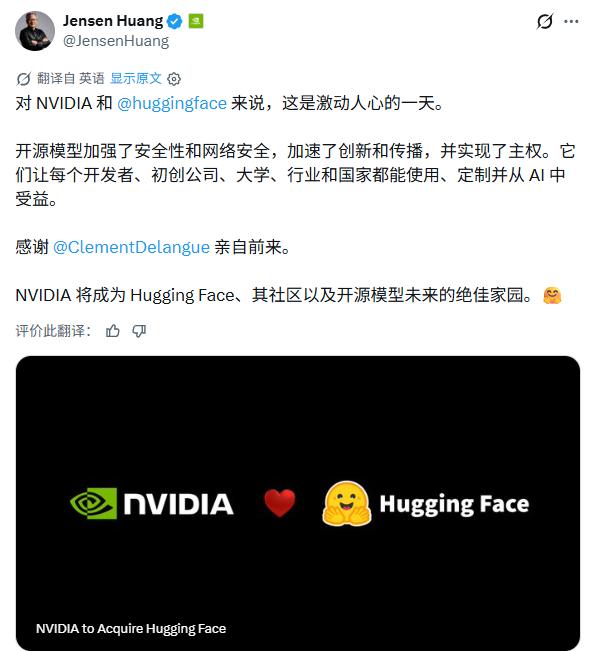
On September 3 local U.S. time, Jensen Huang, CEO of NVIDIA, announced on the company's official blog that NVIDIA has agreed to acquire Hugging Face, an AI development platform, for $12.9303 billion.
After the transaction is completed, Hugging Face will join NVIDIA while retaining its positioning as an open platform.
In this deal, NVIDIA is acquiring an AI development platform that gathers more than 18 million developers, researchers and creators. At present, there are over 3 million models, 500,000 datasets and 1 million applications on Hugging Face, and more than 200,000 companies come here to find, evaluate, customize and deploy AI solutions.
For NVIDIA, this acquisition will help extend its business layout to the upstream of the AI industry chain and the developer side. In the past, NVIDIA mainly provided computing power for model training and inference through GPUs. Now it is beginning to directly enter the ecosystem of models, data, development tools and applications.
01 Focusing on 18 Million Developers
In this transaction, NVIDIA will pay approximately $11.9 billion to Hugging Face investors, and up to $1 billion will be used for employee retention in the form of equity.
Calculated by transaction size, this will become the second largest acquisition in NVIDIA's history, second only to the approximately $20 billion acquisition of most assets of Groq in December 2025. In 2019, NVIDIA acquired Israeli chip company Mellanox for nearly $7 billion, which has long been ranked as one of the company's largest acquisition transactions since then.
Jensen Huang revealed in the announcement that Clément Delangue, CEO of Hugging Face, took the initiative to contact him when considering the next stage of development for the company. Delangue later also confirmed that the Hugging Face team took the initiative to discuss cooperation with Jensen Huang.
Hugging Face was founded in 2016, with founders including Delangue, Julien Chaumond and Thomas Wolf. The company originally started from a chatbot project, and later developed into an open platform for AI developers.
Companies such as NVIDIA, Google, Amazon, Intel and Salesforce were all investors of Hugging Face previously.
Three years ago, Hugging Face was valued at $4.5 billion when it completed a round of financing. Now the acquisition price offered by NVIDIA reaches $12.9303 billion, with its valuation nearly tripling in three years.
This is also the most direct value of NVIDIA's acquisition: Hugging Face already has a mature developer community and a complete platform formed around models, data and applications.
02 HF Does Not Need to Be Tied Exclusively to NVIDIA
After NVIDIA acquires Hugging Face, the most concerned issue is whether the platform will gradually shift to NVIDIA's own hardware and technology system.
Jensen Huang gave a very clear answer: Hugging Face will continue to serve as an open platform for the entire AI ecosystem. Developers can still independently choose models, frameworks, cloud services, inference service providers and computing platforms, use Hugging Face for development and deployment, and are not required to adopt NVIDIA's computing resources.
Hugging Face will also continue to support open-source models and open-weight models from different developers and institutions, and support multi-cloud and multi-accelerator development and deployment. After the transaction was announced, Delangue said that the platform will remain open, independent and not tied to any specific computing platform, and the founders and team of Hugging Face will all stay in their positions.
NVIDIA has been investing in open-source AI for many years, and is the largest contributor of open models and data to Hugging Face. At present, NVIDIA has released more than 500 models and 250 open datasets on Hugging Face, and at the same time develops its own models, software libraries and tools in an open manner for developers to use, modify and further iterate.
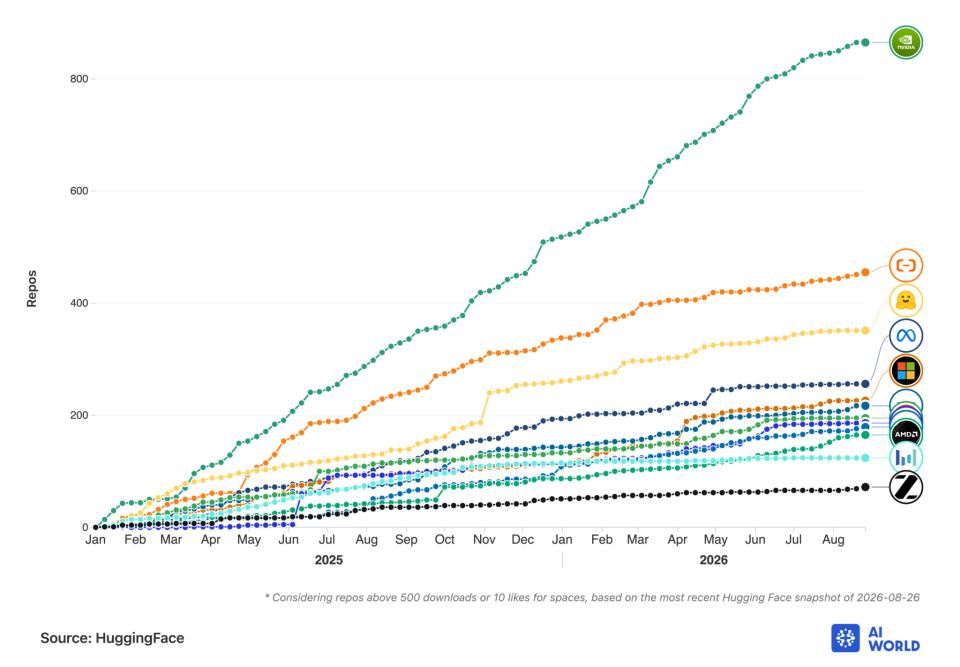
Jensen Huang also participated in writing an open letter on the importance of open weights this year. He believes that open weights can expand the scope of AI usage, allowing startups, commercial institutions, universities and public institutions to leverage existing advanced capabilities without training every model from scratch, and select appropriate models for different tasks.
From NVIDIA's perspective, open models, data and tools can lower the threshold for AI adoption and allow more enterprises and institutions to participate. Jensen Huang also believes that AI can achieve faster development through the joint efforts of more developers.
Delangue previously called NVIDIA "the king of open-source AI in the United States". When announcing the transaction, he said that NVIDIA will continue to increase its investment in open-source AI and support Hugging Face's mission. Hugging Face hopes to make open source the default way to build AI, and its long-term goal is to let 100 million AI developers own their own intelligence instead of renting others' intelligence.
For NVIDIA, what Hugging Face provides is more than just a model hosting website. The platform also includes datasets, software libraries and cloud services, where developers can collaborate, test and share models and tools. NVIDIA said that its own infrastructure, engineering capabilities and global resources can help Hugging Face improve platform reliability, security, model evaluation, inference and deployment capabilities.
03 NVIDIA Does Not Want to Only Sell GPUs
NVIDIA's acquisition of Hugging Face also comes with a more realistic pressure: its largest customers are building their own AI chips.
Meta, OpenAI and Microsoft are all developing self-developed AI chips, hoping to reduce their dependence on NVIDIA GPUs. NVIDIA is currently the world's largest manufacturer of AI accelerators, but these customers are also one of the company's largest sources of revenue. As customers gradually increase their own computing capabilities, NVIDIA needs to face possible changes in GPU demand.
Reuters commented that acquiring Hugging Face can help NVIDIA maintain its connection with developers. Developers can collaborate, test models and share tools on the platform. Even if some enterprises adopt their own chips in the future, model development activities may still continue to occur on the Hugging Face platform.
At the same time, enterprises' demand for open-weight models is increasing. The high cost of AI deployment is pushing enterprises to find models that can be deployed on their own. Chinese companies such as DeepSeek and Zhipu AI have launched products that are close to top U.S. models in some tasks including code generation, with lower cost.
NVIDIA itself has also participated in this competition. The company's Nemotron model is widely used in the open AI ecosystem. After acquiring Hugging Face, NVIDIA will have direct access to a platform that gathers developers, models, data and tools, and these development activities may also provide more information for model R&D and product improvement.
Special contributor Jin Lu also contributed to this article
This article is from "Tencent Technology", author: Su Yang, editor: Xu Qingyang, published with authorization from 36Kr.