Where has the money of the US "Magnificent Seven" stocks gone amid the collective cash drain under the 11 trillion yuan worth of orders?
AI has split the "Magnificent Seven" of US stocks into three categories: the shovel sellers, the heavy bettors, and the bystanders.
No matter which category they fall into, the unified result is that once they are tied to AI, their free cash flow will deteriorate sharply, and this applies to Nvidia, Google, Microsoft, Amazon, and Meta.
Faced with the historic opportunity brought by AI, almost all tech giants are growing their business, but at the same time they are burning through cash. Where on earth has all the money gone?
Soaring Market Value and Expanding Scale
In 2018, Apple's market value exceeded the $1 trillion mark, making it the world's first technology company with a market value of over $1 trillion.
Over the past 8 years, the world has changed dramatically. Not only has the top spot for the highest market value tech company changed hands, but the scale of market value is also completely incomparable to the past.
Standing right at the center of the AI boom, Nvidia firmly ranks first in the world with a market value of about $5.4 trillion. Apple remains stable, ranking second with a market value of $4.7 trillion. Google follows with around $4.1 trillion, surpassing Microsoft's $3.7 trillion.
Once, Jeff Bezos became the richest man in the world thanks to the surge in Amazon's stock price. Now, Amazon's market value has not maintained its strong momentum, ranking in the lower-middle tier among the seven major tech stocks. Meta and Tesla rank at the bottom, one due to its own strategic wavering, and the other due to intensified industry competition. Tesla has dropped out of the top 10 global companies by market value, surpassed by its sibling company SpaceX.
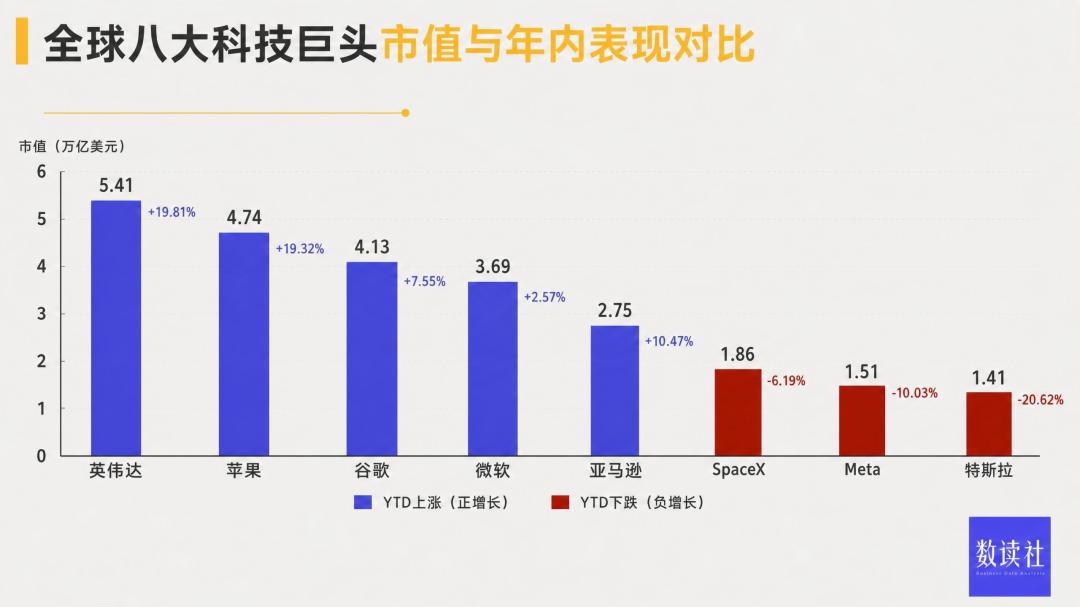
The performance of the Magnificent Seven does not have major problems. All of them maintain growth, and there is a high consistency between their performance and stock price.
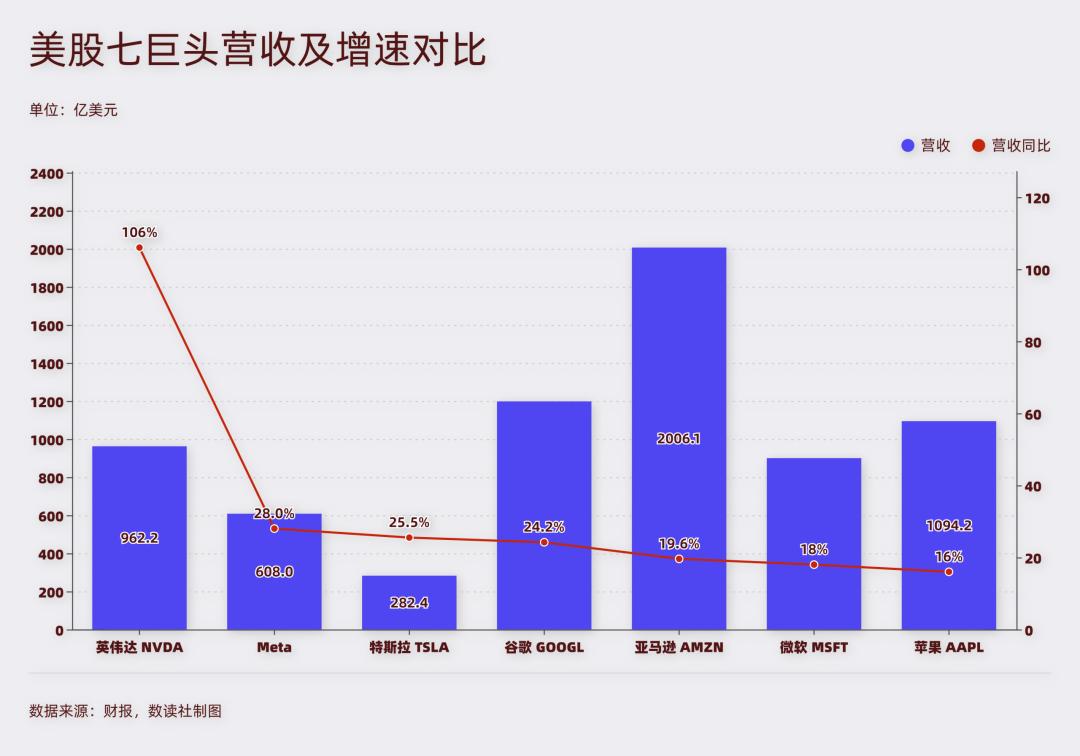
Nvidia, the company with the highest market value, also has the fastest performance growth. Its revenue in the second quarter reached $96.22 billion, up 105.85% year on year. Its net profit hit $59.69 billion, surging 125.90% year on year. This achievement was realized on the basis of the already large base that saw consecutive doubling growth in 2023 and 2024, followed by a 59% growth in 2025.
Due to the difference in its main e-commerce business, Amazon still has the highest revenue among the seven companies, with its $200.6 billion revenue twice that of Nvidia. Apple is the giant with the slowest revenue growth among the seven, which shows that AI is indeed the biggest growth opportunity at present.
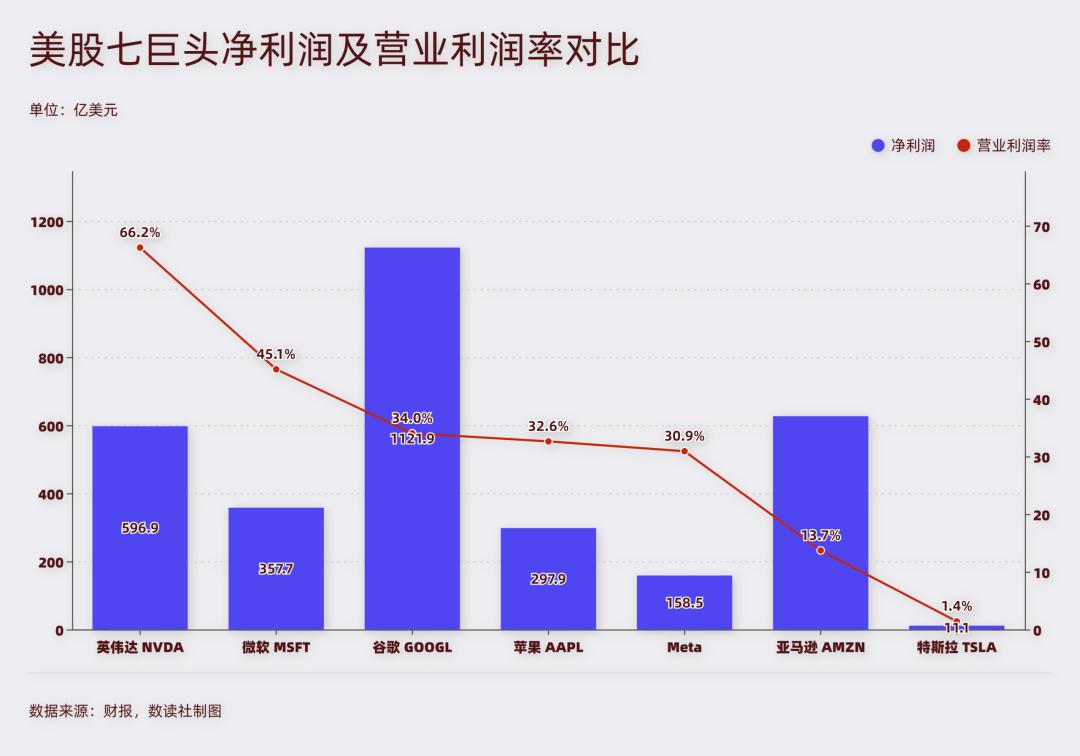
Google is the most profitable company in the second quarter. Thanks to its investment in SpaceX, it recorded $98 billion in floating equity gains in its net profit, pushing its net profit in the second quarter to $112.2 billion, even exceeding its revenue scale. The same situation happened to Amazon: as it invested in Anthropic, it gained $53.4 billion, driving its net profit up by 244%.
Excluding non-recurring gains and losses, the most profitable company is undoubtedly Nvidia, whose net profit in the second quarter reached $59.69 billion.
Meta and Tesla are still in the same difficult situation, both seeing a decline in net profit. Among them, Tesla's net profit was only $1.114 billion, down 5% year on year. After declining in the same period of 2024 and 2025, it declined again. The fierce competition from Chinese manufacturers has put Tesla under huge pressure.
Overall, the general trend of the seven US stock giants is still growth, and their market value is also rising continuously. However, with expanding scale and stable profitability, all the giants are burning cash.
Staggering Capital Expenditure
In his famous 1997 letter to shareholders, Jeff Bezos once said straightforwardly: "If we have to choose between the beauty of corporate financial statements (referring to net profit) and the reality of free cash flow, we will choose free cash flow."
But obviously, in the face of the general trend of AI, the principle that Bezos has adhered to for 30 years has also been broken.
In the past 12 months, Amazon has rarely seen cash outflow, with free cash flow turning to a net outflow of $7.6 billion.
Other companies are not in a much better situation. Google's free cash flow turned negative for the first time in decades. Tesla's free cash flow turned negative again after many years.
Meta's free cash flow fell by about 91% year on year.
Microsoft's free cash flow fell back to $15.8 billion, $9.9 billion less than two quarters ago.
Nvidia's free cash flow was $21.341 billion, $27.2 billion less than the $48.554 billion in the first fiscal quarter.
Only Apple, the bystander, has a free cash flow as high as $110.2 billion.
The reason for the sharp shrinkage of free cash flow lies in capital expenditure.
Google raised its capital expenditure expectation to between $195 billion and $205 billion. It just raised the expectation last quarter, and this time it raised it by another $15 billion on the original basis.
Microsoft's capital expenditure doubled, rising nearly 110% year on year to $35.8 billion, about 1.6% higher than analysts' expectations. Its capital expenditure in the past fiscal year was $115.95 billion, up nearly 80% from the previous year.
Amazon's capital expenditure in the second quarter reached $54.2 billion, far higher than the $32.1 billion in the same period last year; its full-year capital expenditure guidance was also raised from $200 billion at the beginning of the year to $220 billion.
Meta raised the lower limit of its 2026 capital expenditure expectation from $125 billion to $130 billion, while keeping the upper limit unchanged at $145 billion.
Tesla's full-year capital expenditure will exceed $25 billion, which is mainly used for productive assets, including the Optimus production line, Cybercab factory, lithium iron phosphate factory, semi-trailer truck production line, self-built semiconductor factory and the full industrial chain production line of photovoltaic in the US. More importantly than Tesla is its sibling company SpaceX, this newly listed giant recorded capital expenditure of about $18.4 billion in the second quarter, compared with only $2.83 billion in the same period last year, 86% of which was related to AI business.
Google, Microsoft, Amazon and Meta alone will spend more than $670 billion on capital expenditure in the whole year, a capital scale comparable to the total GDP of many countries.
In this process, Nvidia, the "shovel seller", seems to be the biggest beneficiary. However, its free cash flow has still been cut in half. The core reason is that these giants purchasing computing power have no spare capacity. As a result, Nvidia's accounts receivable have risen sharply, reaching $63.059 billion at the end of the second quarter, up 64% in just one quarter. The pressure from buyers will also be transmitted to Nvidia.
Facing such huge capital investment, why are these giants so bold to spend money?
Confidence Brought by Order Backlog
AI is indeed an opportunity right in front of us, and all the giants are in a state of supply falling short of demand.
According to the financial report, Microsoft's remaining performance obligation (RPO) reached $6780 billion. A year ago, Microsoft's commercial backlog was about $3680 billion, which has now increased to $6780 billion.
Google is no less impressive. The backlog of cloud business that has been signed but not yet recognized as revenue has increased to $5140 billion.
Amazon's AWS backlog is $4960 billion. CEO Andy Jassy said, "Even if the full-year capital expenditure is raised to $220 billion, the computing power supply in 2026 still cannot meet all the needs of customers, and a large number of computing power orders for 2028 have been locked in advance."
In addition, Nvidia has $279 billion in supply and capacity commitments.
All AI giants are in a state of supply shortage. The backlog of Google, Microsoft and Amazon alone has reached $16.9 trillion, which is significantly higher than their capital expenditure. This is the confidence of these giants.
However, the giants rely on AI, but they do not only rely on AI. Relying on AI means that all the growing orders are related to AI. Not only relying on AI means that all the giants want to be AI shovel sellers, rather than personally developing AI applications.
At present, among the AI giants, only Google, Meta and Elon Musk's SpaceX have large model products. The large models of these three platforms are successful, but they lag behind OpenAI and Anthropic. They are more like strategic layouts, with input-output ratio far lower than "selling shovels".
Nvidia is the most powerful proof of shovel sellers. Its core business is the data center business, whose revenue proportion has increased from 50% in the first half of 2022 to 92% in the first half of this year, with revenue rising from $7.5 billion to $164.3 billion. This business is still maintaining doubling growth.
Jensen Huang said that now, computing power itself is a source of revenue. If there were no supply constraints, the company's performance outlook for fiscal 2028 would be "much higher".
Nvidia's presence is ubiquitous. Counterpoint data shows that 92.4% of independent AI models around the world rely on Nvidia chips for training and inference.
Selling chips is so attractive that the giants all want to get a share of the pie.
Google's self-developed AI dedicated TPU chip, the 8th generation, is expected to be mass produced next year. In April this year, it was reported that Anthropic planned to purchase 1 million Google TPU chips. Meta has reached a TPU rental agreement with Google, and OpenAI has also begun to rent TPU to support product operation.
Amazon released its first AI training chip Trainium in 2021, and is currently planning to directly sell its self-developed chips to third-party customers.
Directly providing chips has too high technical threshold, so providing cloud computing power has become a more appropriate choice. As a result, the cloud business of several major companies among the seven giants is getting more and more attention.
In the second quarter, Amazon's AWS cloud business revenue was $42.23 billion, up 36.8% year on year. It is the most dynamic business of Amazon and also the cloud service provider with the highest global market share at present.
Google's cloud business revenue was $24.77 billion, up 81.8% year on year, making it the second largest business. Microsoft's intelligent cloud revenue was $39.31 billion, up 31.6% year on year, which has surpassed the productivity and business process services represented by Office to become Microsoft's largest business.
Meta also adjusted its strategy this year, and is preparing to build a cloud infrastructure business called "Meta Compute", selling AI computing power and model access rights to external parties.
In addition, the AI business revenue of Elon Musk's SpaceX reached $2.56 billion, surging 247.5% year on year. But the real support of this business is also computing power rental, whose major customer is Anthropic. Having seen the benefits of computing power rental, Musk will further expand the business. At present, the most noteworthy one is the space computing power infrastructure.
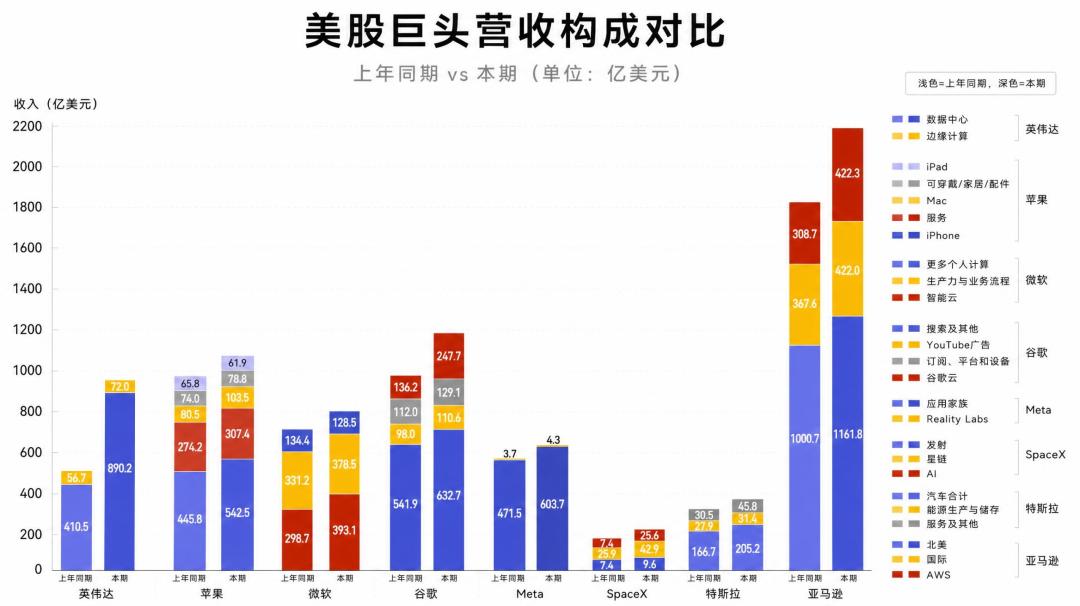
In other words, among the seven giants, except Apple, almost all of them are "shovel sellers" of chips and computing power. Nvidia is in the upstream, Google, Microsoft and Amazon are in the midstream, and the downstream are AI models and Agents.
Therefore, it is AI models and Agents that nourish cloud business giants such as Google, Microsoft and Amazon, further nourishing the upstream supply chain such as Nvidia, Samsung Electronics and SK Hynix, and then stimulating the semiconductor raw material industrial chain.
In this chain, the upstream industrial chain is the one that really makes money, and large models generally need to spend a lot of money to "buy shovels".
The obvious question in this part is that Nvidia is deeply involved in the computing power construction of the giants. Nvidia provides investment, equity or financing guarantees to AI start-ups or partners, and these companies then use the funds to purchase Nvidia's GPU chips. It is questionable whether the cloud "living water" is sufficient.
Is there such a huge demand in the downstream? According to Bloomberg, Anthropic disclosed to investors that its preliminary revenue in Q2 exceeded $11.5 billion, and by the end of July this year, the company's annualized revenue run rate (ARR) had reached $65 billion.
This figure is very high and the growth rate is very fast, but at present, it is not at the same order of magnitude as the $16.9 trillion order backlog and $670 billion capital expenditure.
The key reason is that the market of the seven giants cannot be supported only by the United States and several scattered developed countries. Moreover, large models from China have put great pressure on American large model companies.
The Unconventional Apple
According to Reuters, people familiar with the matter disclosed that Chinese AI startup Moonshot AI is negotiating revenue sharing agreements with Microsoft, Amazon and Google.
The agreement will allow these American cloud giants to host its flagship model Kimi K3, and draw 30% of the revenue share for services related to the K3 model.
If the cooperation is reached, this will become the first major revenue sharing cooperation between a Chinese AI company and a mainstream American cloud enterprise.
The fundamental reason why Microsoft, Amazon and Google are willing to negotiate with Kimi is that Chinese models have high cost performance.
Anthropic and OpenAI's large models may have absolute leading performance, but these two leading companies want to take the scarcity of cutting-edge models as a bargaining chip for pricing, which leads to their high prices that will dissuade a large number of enterprises.
In the early stage of AI market cultivation, price is largely the threshold. Only low prices can attract more users and gain long-tail traffic. This is the logic of Chinese large models.
According to OpenRouter data, from August 24 to August 30,