Sam Altman confirmed for the first time that OpenAI will independently research and develop humanoid robots.
OpenAI is no longer content to merely act as the "brain" for robots.
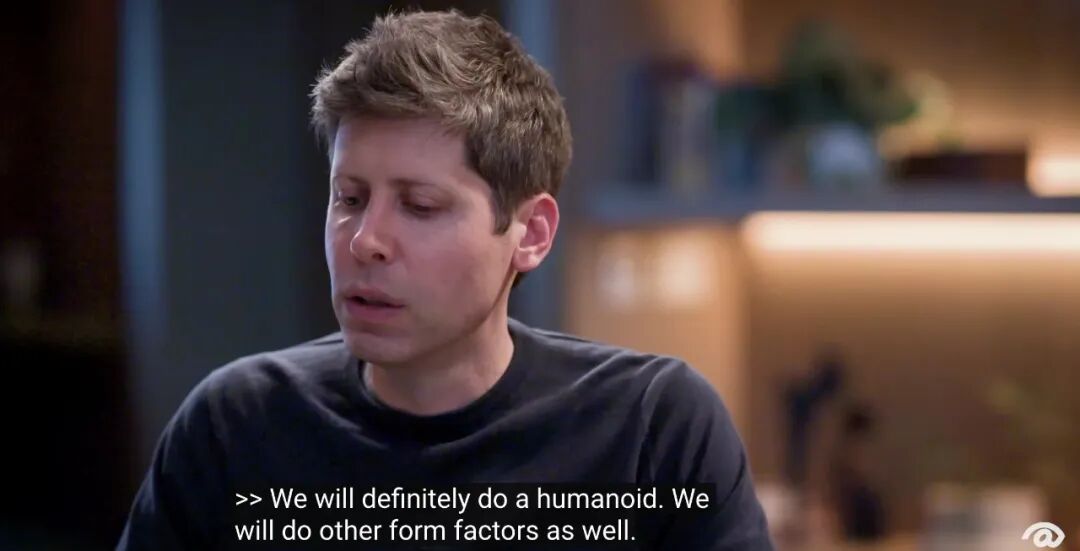
On September 2 local time, OpenAI CEO Sam Altman explicitly stated for the first time on the "Sources" podcast that OpenAI will independently develop humanoid robots on its own.
When the host asked whether OpenAI would build humanoid robots, Altman gave a very straightforward answer: "We will definitely build humanoid robots, and we will also build robots of other forms."
This statement has basically put an end to the long-standing speculation from the outside world. Over the past few years, OpenAI has been active in the robotics industry mostly as a model provider and investor; now, it has decided to extend its reach to robot bodies themselves.
Altman explained that OpenAI's choice of humanoid form is not to make robots look more like humans, but because the real world itself is built around the human body.
Doorknobs, stairs, keyboards, kitchens, cars, and a large number of mechanical equipment in factories are all designed with human beings at the center in terms of size and operation mode. Instead of retransforming the entire physical environment, it is more reasonable to give robots a body structure close to that of humans.
"The world is largely designed for humans," Altman said. Whether it is opening doors, using computers, operating equipment, or cleaning kitchens, a humanoid structure makes it easier to adapt to the world that humans have already built.
However, this does not mean that OpenAI's first robot will directly enter ordinary households.
Altman made it clear that home companion robots are not the top priority at this stage. In the short term, OpenAI is more focused on industrial infrastructure, especially robots that can assist skilled workers in building and operating data centers. In such scenarios, robots do not necessarily have to be humanoid. Altman revealed that OpenAI will also develop special robots suitable for data centers, adopting different body structures according to specific tasks.
As for what the final robot will look like, he believes that is not the most critical issue. "What really matters is figuring out how to create the 'brain' that makes robots work."
This is also the part that OpenAI is most familiar with.
01 Left the field six years ago, now making a comeback
OpenAI is not conducting robotics research for the first time.
As early as 2017, OpenAI began exploring how to enable robots to transfer capabilities learned in virtual environments to the real world. In 2018, its robotic hand Dactyl was already able to independently rotate blocks; in 2019, OpenAI trained a robotic hand to restore a Rubik's Cube with one hand, which once became one of the most high-profile projects in the field of robot reinforcement learning at that time.
But around 2020, OpenAI stopped the research of its original robotics team.
The reason is not complicated: there is too little data.
Language models can obtain massive amounts of text from the Internet, and vision models can also learn from images and videos, but the motion data required by robots is both expensive and scarce. Every grasp, walk and operation involves friction, weight, collision and error in the real physical world, and the training speed is far behind that of purely digital models.
OpenAI then concentrated its resources on large language models, and launched ChatGPT at the end of 2022.
Six years later, the situation has changed.
Multimodal models are now able to understand text, images, videos and sounds at the same time; video generation models have begun to learn the basic laws of object motion and the real world; training methods such as simulation, synthetic data and teleoperation are also maturing rapidly. The data problem that previously restricted the development of robots, although far from being solved, has seen new breakthrough paths.
OpenAI has also started to rebuild full-fledged robotics capabilities.
At present, OpenAI's official website is recruiting engineers in multiple directions including robot software, electrical engineering, firmware and product safety. The job responsibilities cover circuit design, PCB, sensors, embedded systems, robot control, data collection, fault handling and mass production preparation and other links.
Among them, some robotics positions offer an annual salary of up to 445,000 US dollars, plus equity. These recruitment information means that what OpenAI wants to do is no longer just a general-purpose model that can be connected to different robots, but a complete robot system composed of models, software and hardware.
02 From investing in robots to building robots in person
Before deciding on independent research and development, OpenAI tried to enter the physical world through investment and cooperation.
In 2023, OpenAI led a $23.5 million financing round for humanoid robot company 1X. 1X later launched NEO, a humanoid robot for home scenarios, hoping to bring robots into the living rooms and kitchens of ordinary people.
In 2024, OpenAI participated in Figure's $675 million financing, and signed a cooperation agreement with it, planning to install OpenAI's multimodal model into Figure's humanoid robots. The two sides later demonstrated a video of the robot identifying items on the table, talking to people and handing over an apple.
But this cooperation only lasted for about a year.
In February 2025, Brett Adcock, founder of Figure, announced the termination of cooperation with OpenAI, and instead developed a fully self-developed end-to-end robot model. Since then, Figure has launched the Helix model, further emphasizing that robot hardware and artificial intelligence must be jointly trained.
By 2026, Adcock even said bluntly that Figure and OpenAI will become competitors.
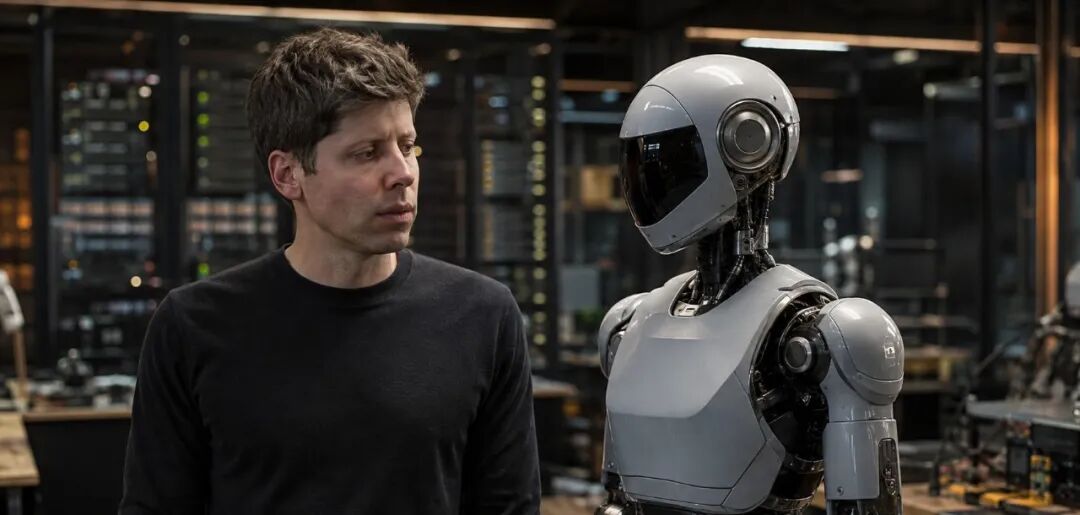
Now, with Altman's first confirmation of self-developed humanoid robots, OpenAI's identity has changed: it is no longer just standing behind robotics companies to provide models, but preparing to directly enter the competition arena.
This also means that in the future, OpenAI will not only compete with large model companies including Anthropic, Google and High-Flyer, but also with robotics enterprises that have entered the stage of complete machine R&D and delivery, such as Tesla Optimus, Figure, 1X, Unitree Robotics, UBTECH and Agibot.
03 What OpenAI really wants is the "physical world entry"
Humanoid robots are becoming the next must-contested battlefield for large artificial intelligence companies.
The reason is not hard to understand. At present, large models mainly exist in mobile phones and computers, capable of writing articles, generating codes and processing files, but it is difficult for them to directly change the physical world. Only when the model has a body that can walk, grasp and operate, can artificial intelligence truly enter factories, warehouses, data centers and households.
For OpenAI, robots may also become a larger entry point after ChatGPT.
Its advantages are very obvious: it has the world's leading multimodal models, sufficient computing power, capital and a huge user base, and also has the ability to generate training data through simulation and generative models.
But its shortcomings are equally obvious.
Humanoid robots are not an enlarged version of ChatGPT. Joints, motors, reducers, sensors, overall machine heat dissipation, real-time control and safety redundancy, every item requires long-term accumulation. It is not difficult to make a robot complete a task once in a demo video. The real difficulty is to make it work continuously for hours, remain stable in unfamiliar environments, and have a sufficiently low cost.
Enterprises including Tesla, Figure, Unitree and Agibot have been operating in hardware, supply chains and real scenarios for several years. OpenAI has a powerful "brain", but it is still unknown whether it can create a reliable, flexible and mass-producible "body".
Up to now, OpenAI has not announced the name, appearance, technical parameters, prototype and mass production schedule of its humanoid robot. Altman's statement represents a strategic direction, and does not mean that the product is close to release.
But this statement is still very important.
Altman once said that he hopes everyone will own a personal robot in the future, to complete the work that people do not want to do for them. Now, OpenAI has taken a clearer step towards this goal.
ChatGPT brought OpenAI into the computers and mobile phones of hundreds of millions of people. Next time, it wants to enter factories and data centers, and finally into everyone's home.
This article is from the WeChat official account "Xin Smart Headlines", Author: Mian Mian, Editor: Maya, published with authorization from 36Kr.