Leveraging AI to break the "stop-after-checkup" dilemma, iKang teams up with Huawei to address the "health debt" of working professionals.
Overtime work, prolonged sitting, and constant emotional stress have become the daily norm for modern office workers.
According to statistics from iResearch, over 70% of office workers have three or more "red flags" in their physical examination reports; easy fatigue, poor sleep, hypertension, hyperglycemia, hyperlipidemia, nodules and cervical spondylosis have almost become the "standard configuration" for office workers. In particular, the group of office workers aged 31 to 35 has become a "high-risk area" for developing nodules.
Behind these figures lies an awkward reality: the vast majority of people only pay attention to their health status the moment they receive their annual physical examination report. The report is stored in mobile phones, and after checking several marked abnormal indicators, it is put aside and forgotten. Right after the physical examination, the health management process that was just about to start comes to an end.
This also leads to a fragmented situation in the workplace health management of "office workers": enterprises are responsible for purchasing physical examination packages, medical institutions are responsible for conducting examinations, and the rest is left to the employees themselves.
So, is there a possibility to make health management no longer just a once-a-year ritual, but truly integrated into daily life and receive continuous attention?
Recently, iKang tried to give the answer through the "AI Life Exhibition" held at Langyuan Station in Beijing. This exhibition, which integrates medical science popularization, technological experience and avant-garde art, presents health risks and proactive health concepts to the public in a vivid way.
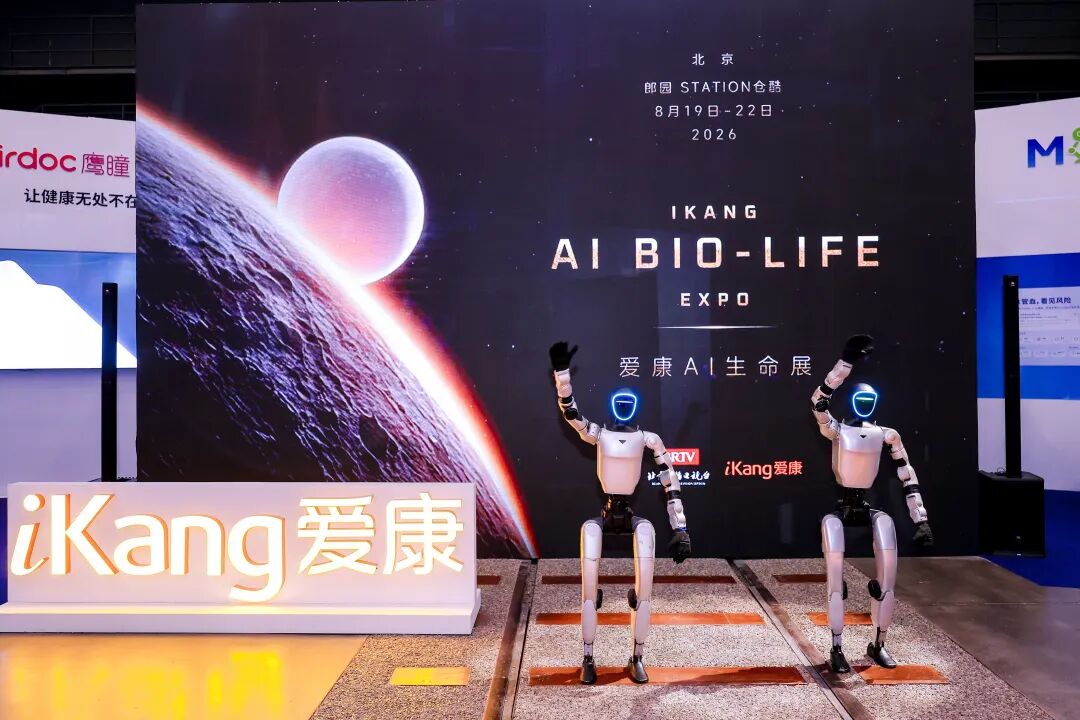
Scene of iKang AI Life Exhibition
36Kr noticed that an immersive workplace health experience space based on the "Health Office" was specially set up at the site of the "iKang AI Life Exhibition", covering six functional areas: intelligent detection, health management platform, first-aid drill, health consultation, psychological care, and rehabilitation physiotherapy. At the "Exchange Meeting on High-Quality Development of Employee Health in the AI Era" held concurrently with the exhibition, the health management intelligent agent jointly built by iKang and Huawei Cloud was officially launched. With the help of AI, it creates a full closed-loop health management service of "health file creation → customized plan → personalized intervention → dynamic monitoring → intelligent warning", providing a feasible technical path to solve the long-standing problem of "valuing examination while neglecting management" in the workplace health industry.
Against the backdrop of the large model wave sweeping across all industries, the big health sector is also undergoing profound changes. From the perspective of ordinary office workers, can AI really resolve the accumulated "health debt" of working people over the years?
From Once a Year to Online Every Day: AI Fills the "Time Blind Spot" of Annual Physical Examinations
For the vast majority of people, the annual physical examination is more like a once-a-year "health snapshot". However, the biggest limitation of the snapshot is that it can only capture the physical state at the moment of the examination. During the long one-year interval between two physical examinations, blood pressure fluctuations, continuous deterioration of sleep, and indicator drifts caused by stress are all in the monitoring vacuum zone. Many chronic problems are quietly aggravated during this unattended time window.
Due to limited manpower and high cost, in the past, it was difficult for "office workers" to achieve regular health tracking. The intervention of the workplace "Health Office" and the empowerment of AI are breaking the dual limitations of time and manpower.
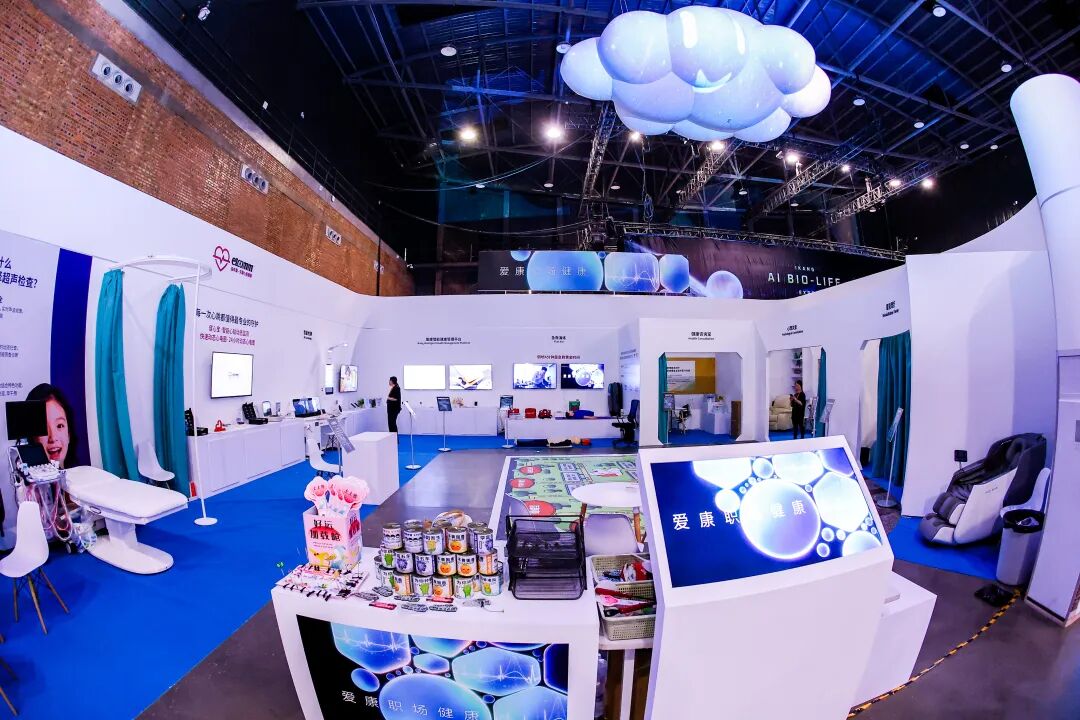
Workplace Health Exhibition Area of iKang AI Life Exhibition
The integrated service model of "risk screening - daily monitoring - intelligent assessment - precise intervention - continuous follow-up" can be experienced one by one at the workplace health exhibition area of this "iKang AI Life Exhibition". This standardized "Health Office" can be directly deployed inside the enterprise park. Employees can use the fragmented time during lunch break to complete more than ten core physiological indicator tests such as blood pressure, blood glucose, and electrocardiogram, and the test data is imported into the personal dynamic health file in real time.
In addition, when the system identifies continuous abnormal fluctuations in indicators, it will actively trigger risk reminders, so that people no longer have to wait for the next year's physical examination to find out the alarm signals from their bodies.
Zhang Ligang, Founder and CEO of iKang Group, introduced that from his observation, in the actual implementation process, the construction of conventional health testing equipment and first-aid systems, as well as employees' mental health, have gradually become rigid demands for enterprises.
"For example, under our advice, many enterprises are equipped with defibrillators and regularly train their employees to learn cardiopulmonary resuscitation (CPR). For enterprises with outdoor operation scenarios such as the State Grid system, we also advise employees to take electrocardiogram examinations before outdoor operations to prevent sudden cardiac risks caused by abnormalities such as atrial fibrillation and premature beats, and ensure the life safety of operating personnel. At the same time, as the "three highs" problem is very common in the current workplace, many enterprises hope to test their employees more conveniently. We will equip corresponding equipment in the "Health Office" as needed, and on-site medical staff will also focus on employees with health risks and regularly track their lifestyle adjustments."
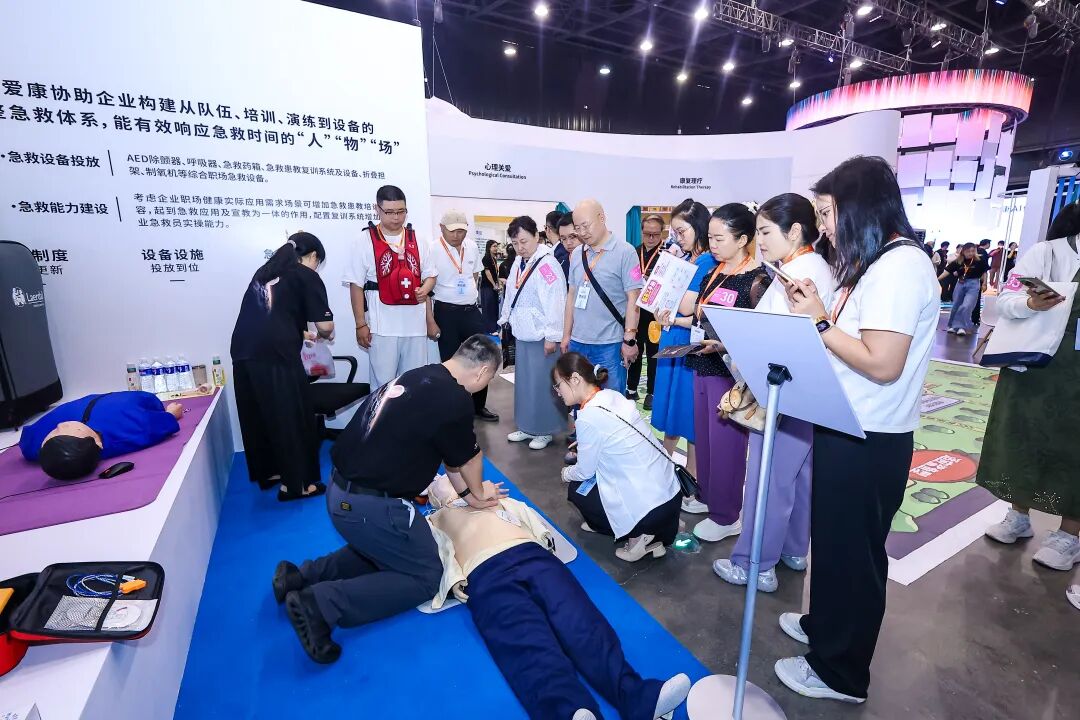
Cardiopulmonary Resuscitation (CPR) First-aid Teaching at iKang AI Life Exhibition
According to data from iKang, it has now covered more than 30 cities, built 178 workplace health promotion centers/Health Offices, and served hundreds of thousands of enterprise employees.
The value of this model is not only to improve convenience, but also to solve the pain point of long-term fragmentation of office workers' health data. In reality, physical examination data is stored in the system of physical examination institutions, sleep and heart rate data are stored in smart watches, and diet records are scattered in various apps... Data from different sources are isolated from each other, making it impossible to piece together a complete personal health profile, and subsequent health judgments naturally lose their foundation.
The core mission of the workplace "Health Office" and dynamic health files is to form a continuously updated personal health baseline. Only by establishing this complete data base can AI carry out practically referential risk identification, so that health monitoring can shift from the annual "snapshot" to the "dynamic image" of all-weather continuous recording.
"AI does not define life, but helps people understand life." Zhang Ligang explained the positioning of AI in the health field. The value of technology is to make those originally invisible health risks visible, and visibility is the starting point of proactive health.
Say No to "One-Size-Fits-All": AI Understands Office Workers Better
When the dynamic health file completes the collection of various health indicators, new problems emerge: even if employees see their own health risks clearly, it is still difficult to implement medical advice in the real workplace where overtime is normalized, people sit for long hours, and takeout is ordered very often. The public does not fail to understand the importance of health, but it is difficult to get an actually executable improvement path that adapts to their own work situation.
Traditional health management is difficult to resolve this contradiction. In the face of hundreds and thousands of enterprise employees, it is difficult to achieve personalized solutions for everyone by relying on manual work, and only health guidance based on standardized templates can be output.
The health management intelligent agent and full-process joint solution created by iKang and Huawei Cloud are targeting this key gap from "data input to personalized solution output". It does not simply read the abnormal values on the physical examination report, but can call all the information in the dynamic health file, and incorporate multi-dimensional information such as post attributes, daily work and rest, sleep and heart rate collected by smart wearable devices into the calculation.
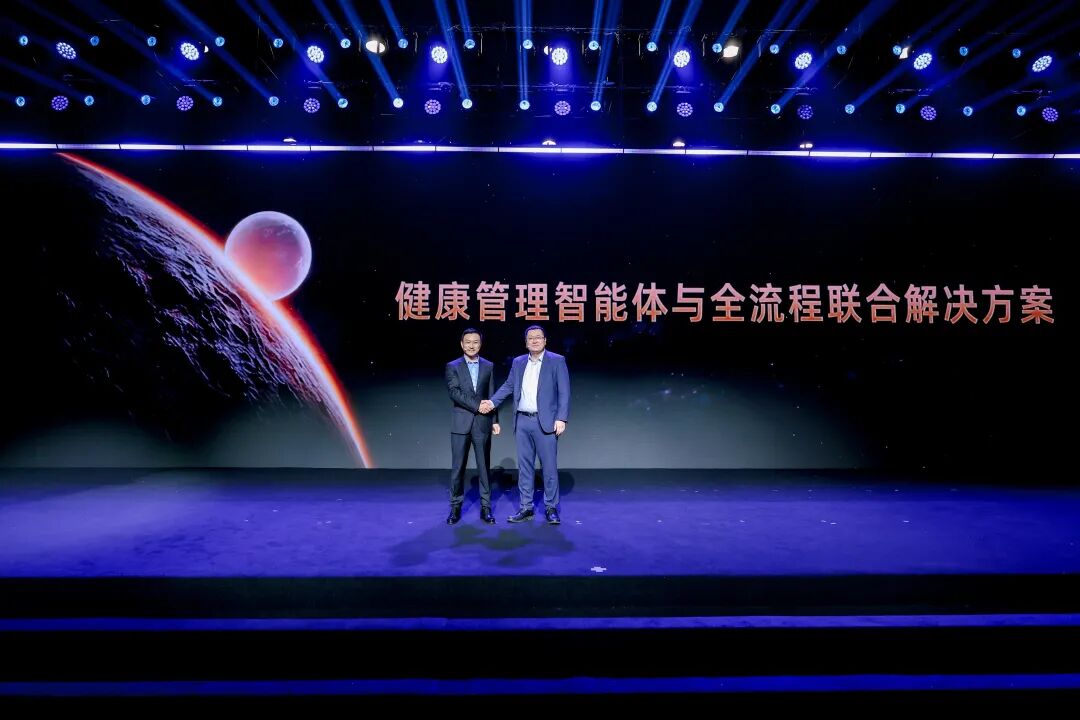
The health management intelligent agent and full-process joint solution jointly built by iKang and Huawei Cloud were officially launched
Talking about why this solution upgrade is carried out, Zhang Ligang said that the core demand of workplace health is to deliver the "private doctor service" that only a few people can enjoy in the past to ordinary enterprise employees on a large scale through AI. "iKang holds 80 million compliant physical examination data accumulated over years and practical experience in full-scenario health management, while Huawei Cloud outputs powerful medical logical reasoning, authoritative guideline analysis and intelligent retrieval capabilities. The combination of the two can make the intelligent agent better understand the physical signals of the workplace population."
It is worth emphasizing that after the AI generates intervention suggestions, they will also be manually verified. Zhang Ligang clarified three bottom lines: all core systems are deployed on private clouds and have passed the Class III certification of the national information security level protection; unless it is a real-name testing project required by national regulations, all third-party test samples are submitted for testing with coded labels without real names, to maximize the protection of user privacy; all solutions generated by AI are manually reviewed and issued by professional doctors, so as to balance the large-scale efficiency of the intelligent agent and the rigor of medical services.
For a long time, the health management industry is highly dependent on human experts. To achieve large-scale implementation, standardization is required, while personalization often means high costs. The arrival of AI is rewriting this equation. Relying on the health management intelligent agent, AI completes a large number of preliminary screenings and draft plans, and doctors focus on review and key decision-making, making a health management model that balances professionalism, reliability, large-scale implementation, and individual customization a reality.
"AI is like the navigation system of an airplane, while medical professionals are the captain. The navigation can complete massive calculations and risk warnings, but the one who finally makes decisions and executes must be the captain," Zhang Ligang believes. The collaboration between the two can better complete health management.
Enterprise Workplace Health: From "Welfare Procurement" to System Construction
When AI completes the closed loop of personal-level data filing, risk assessment and personalized intervention, this digital capability further extends outward, which is promoting a paradigm shift in the enterprise-side workplace health service model.
Looking back at the development of domestic workplace health, the industry has roughly gone through two stages. In the first stage, enterprises hardly intervened in employee health management, leaving all responsibilities to individual employees. In the second stage, enterprises regard the group annual physical examination as a standard employee welfare, and the completion of procurement is regarded as the end of delivery.
Nowadays, AI technology is pushing the industry to the third stage, that is, taking physical examination as the entry point, building a full-cycle active protection network of "personal health data filing - personalized intervention implementation - empowering enterprise organizational health capabilities" with the help of large models and intelligent hardware.
The practical necessity of this system construction is particularly prominent in unexpected workplace health incidents. An increasingly prominent example in recent years is that most enterprises equate health management with physical examination and science popularization, ignoring the potential life safety risks in the workplace. Emergencies such as sudden cardiac death induced by overwork require enterprises to have both regular health risk management and control capabilities and on-site emergency response capabilities, both of which are indispensable.
In the solution given by iKang, the workplace "Health Office" has taken the construction of first-aid capabilities as an independent module. From regular training of cardiopulmonary resuscitation (CPR), configuration of AED, first-aid kits and other equipment, to the construction of three-tier personnel echelon of safety volunteers, first-aid personnel and first-aid experts, and then to regular practical drills, a complete response mechanism has been formed.
iKang highlighted the "13520" rescue guideline implemented by a technology giant it serves, which is of great reference value: after an employee suddenly falls to the ground, people around will call the police and start the rescue within 1 minute, security personnel will arrive at the scene within 3 minutes, on-site medical staff will arrive and carry out rescue within 5 minutes, and the ambulance will arrive at the scene within 20 minutes. "Regular training is required. Even if no one falls down, drills must be conducted to ensure the normal operation of the system."
These preparations may not be used in normal times, but once an emergency occurs, the difference between having them and not having them is the difference between life and death.
In terms of policy, the "15th Five-Year Plan" for National Health issued by the State Council has clearly proposed to "strengthen the monitoring of chronic diseases and their risk factors, develop the full-chain services of prevention, treatment, rehabilitation and management, and improve the system of early screening, early diagnosis and early treatment", as well as "promote the construction of healthy enterprises" and "improve the comprehensive prevention and control strategies for work-related diseases".
In other words, the national policy orientation is shifting from "treating diseases as the center" to "people's health as the center". At the same time, the work of "pilot project for high-quality workplace health management" is also being promoted nationwide, and iKang has become one of the first batch of shortlisted pilot units.
For enterprises, this means that employee health management is no longer just a "welfare option", but a "rigid requirement". Zhang Ligang also emphasized: "Employee health is the foundation for the continuous development of an enterprise. The long-term competitiveness of an enterprise ultimately comes from people. Only when employees are in good health and stable state can the innovation, execution and cohesion of the enterprise have a foundation. Therefore, continuous health management should not be regarded as an extra expense 'beyond physical examinations', but as a basic investment for the sustainable development of enterprises."
Policies are promoting, technology is advancing, and enterprises are implementing. For "office workers", the most practical change may be: in the future, finally, someone is willing to take charge of your health for you.