Meta's new model matches the performance of Fable 5, Mark Zuckerberg says: it is open-source and so affordable that you won't even bother doing the math.
The money Mark Zuckerberg spent last year finally seems to be paying off...
Meta's newly released model Muse Spark 1.3 is already competing head-to-head with Fable 5.
In the latest Artificial Analysis ranking, Muse Spark 1.3 Max scored 62 points.
It is on a par with Fable 5 and 5.1 xhigh.
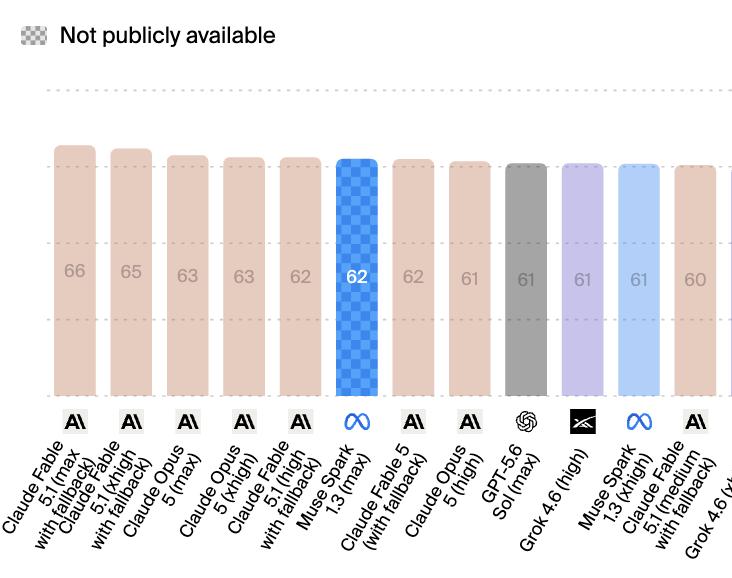
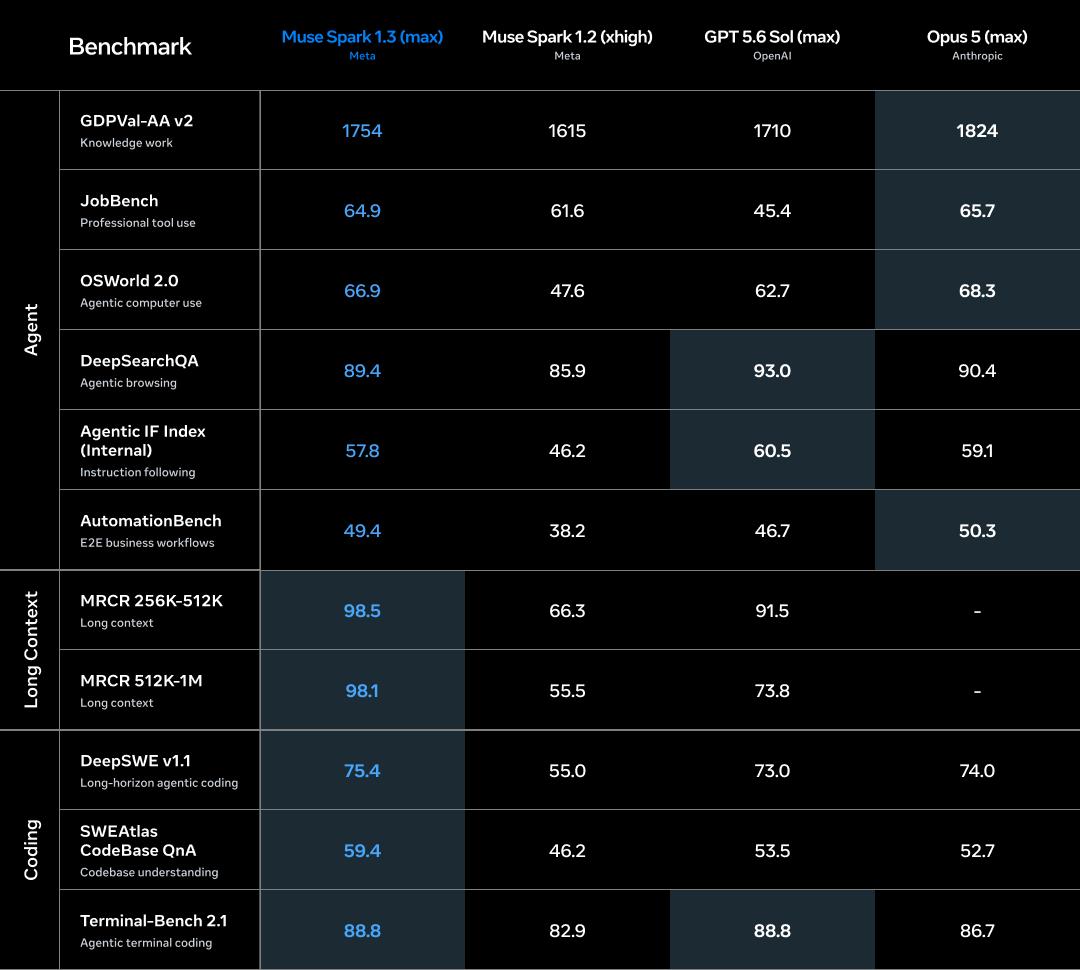
Digging into the detailed metrics, Muse Spark 1.3 in the Coding and Agent segments has begun to outperform Opus5 max, which previously had a higher overall score.
For Meta, this development is particularly noteworthy.
After the release of Llama, Meta remained quiet in the top-tier large model track for a long time, and was once left far behind by its competitors.
Not long ago, the superintelligence team that Mark Zuckerberg built at huge expense last year also experienced the "unexpected incident" of Yu Jiahui leaving the company.
Last year, he was poaching talents across Silicon Valley with generous offers, but this year a core researcher left first. People started to worry that this high-priced team might end up fizzling out after a strong start.
Just as everyone was waiting to see what would happen next with this sky-high priced team —
The new model was rolled out first.
Muse Spark 1.3: Extremely Capable and Surprisingly Low-Cost
On September 2, Meta officially released Muse Spark 1.3.
This is the fourth version of Muse Spark in just a few months after its debut in April this year.
The first generation of Muse Spark launched in April; version 1.1 in July; 1.2 in August; and now shortly after the start of September, 1.3 is released.
Mark Zuckerberg personally promoted the new model this time, stating that Muse Spark 1.3 represents the biggest improvement in the entire series so far for Coding and Agent work.
He also made a bold statement that the performance is so strong that —
It is so cheap that there is almost no need to calculate the cost.
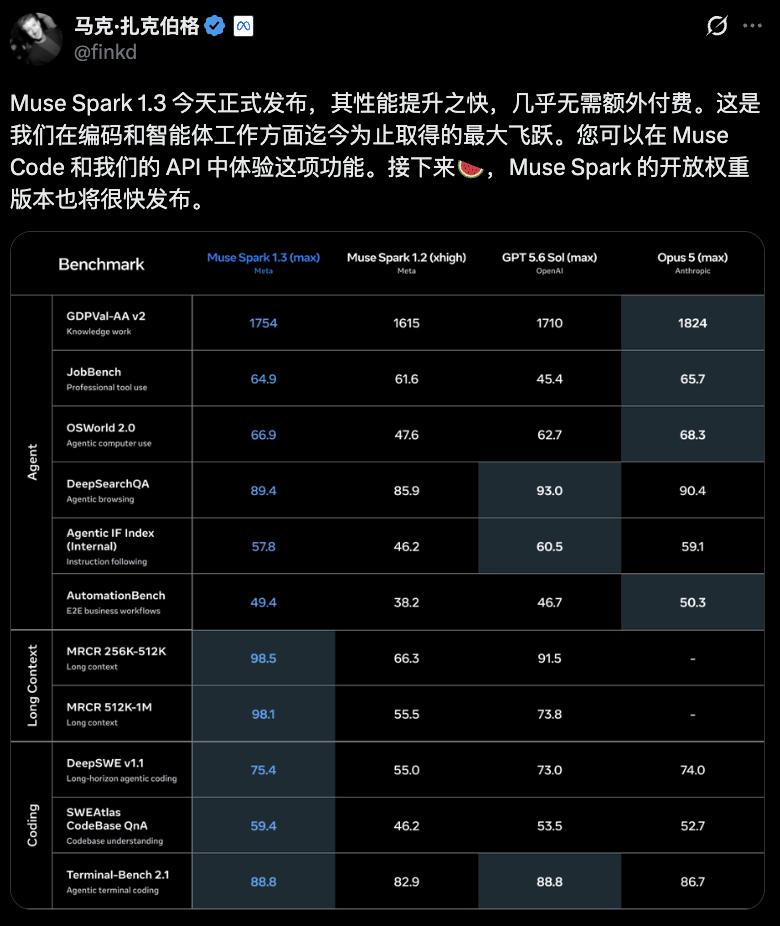
According to Meta's internal comparison data, Muse Spark 1.3 reduces tool calls by about 20% and Token consumption by 25% on average compared with version 1.2. It also cuts down on unnecessary ineffective rounds, and is better at remembering the initial requirements in long-horizon tasks.
Plenty of users have started to test the model in practice.
For example, some users ran a comparison test between Muse Spark 1.3 and 1.2 with the same Prompt.
They generated a self-contained HTML file at one go, in which three collectible 3D Viking figurines were made: a Viking helmet, a diamond-encrusted battle axe, and a longship carrying crew members.
The cost is roughly the same, at $0.08 for one and $0.1 for the other, but the detail and texture of the work produced by version 1.3 are significantly better.
Other users directly tested Muse Spark 1.3 Ultra Contributor and Fable 5.1 xHigh for nearly two hours.
Both models were given the same Prompt, which included a rule that puts a heavy burden on the model:
After each generation, an independent Judge would score the output. The model cannot stop until the score reaches 9.5/10, and has to revise the output on its own.
Then Muse Spark 1.3 just kept running... In two hours, it completed 20 consecutive rounds of self-improvement, and launched 3 Agents in each round, which amounted to more than 60 Agent runs in total.
And the total cost of the whole process was less than $1.
To sum up: Extremely productive, extremely cost-effective.
The standard API price of Muse Spark 1.3 remains the same as that of version 1.2:
$1.25 per million input Tokens, $4.25 per million output Tokens, and $0.15 for cached input.
According to the calculation of Artificial Analysis, the cost per Intelligence Index task of 1.3 xhigh is about $0.55.
The GPT-5.6 Sol Max and Grok 4.6 High in the same tier cost about $0.95 and $0.94 respectively.
Moreover, Muse Spark itself is only a lighter-weight model line in the Muse series, and there are larger models coming later.
After releasing version 1.3 this time, Mark Zuckerberg also did not forget to preview two more things:
Muse Spark will have its weights open-sourced, coming soon.
And that highly anticipated product that everyone has been waiting for for a long time.
Meta, which once seemed a bit quiet in the cutting-edge model competition, is now moving back to the center of the stage.
The sudden acceleration of Muse Spark in recent months also means that the massive talent recruitment campaign Mark Zuckerberg launched last year is finally delivering results.
The team recruited by Mark Zuckerberg last year is starting to deliver results
Last summer, Meta set up its superintelligence lab, and Mark Zuckerberg traveled all across Silicon Valley to recruit top talents.
A group of highly notable researchers who joined Meta from OpenAI include Shengjia Zhao, Jiahui Yu, Hongyu Ren, Shuchao Bi and others.
Rumors of sky-high compensation packages spread everywhere, and everyone was curious:
What kind of breakthrough technology could this top-tier team develop?
Unexpectedly, before the breakthrough technology came, the situation took a sudden turn: Yu Jiahui announced that he would leave Meta to start his own business.
The departure of a core researcher naturally made the public re-evaluate this star team that had not been established for very long.
But looking at it now, the progress has not been delayed.
And after the new version was released, several core researchers came forward to reveal the changes behind the scenes.
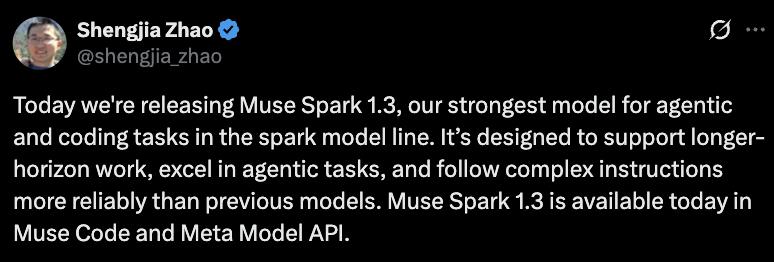
Shengjia Zhao directly called Muse Spark 1.3 the strongest Coding and Agent model in the current Spark model line.
He specifically mentioned three directions:
Longer-horizon work, stronger Agent task capabilities, and more reliable compliance with complex instructions.
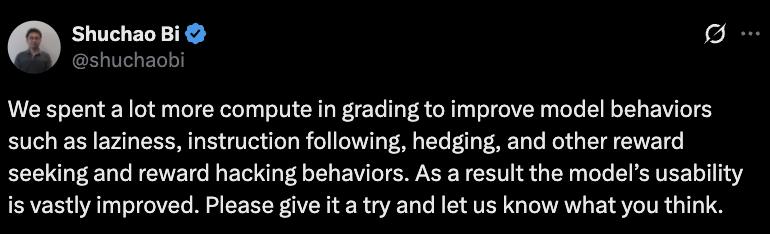
Shuchao Bi revealed more underlying details.
This time the team invested more computing power in the training phase for result score calibration.
It is designed to solve targeted problems such as the model being lazy, deviating from instruction execution, giving vague and evasive answers, as well as reward speculation and reward hacking.
After this round of processing, the usability of the model has been significantly improved.
Although Muse Spark 1.3 is very powerful, Mark Zuckerberg obviously does not intend to show all his cards at once.
The highly anticipated model that has been previewed for many times but not yet released, no one knows how big an impact it will make... We are all waiting for it.
Reference links:
[1]https://x.com/finkd/status/2095232032896946311?s=20
[2]https://x.com/aimlapi/status/2095248072154701847?s=20
[3]https://x.com/SPAC89/status/2095284969614475744?s=20
[4]https://x.com/shengjia_zhao/status/2095233023247880590?s=20
[5]https://x.com/shuchaobi/status/2095234300199543121?s=20
This article is from the WeChat official account "QbitAI", the author focuses on cutting-edge technology, and is authorized to be released by 36Kr.