Can you survive simply by inviting top A-list celebrities?
At 10:07 a.m. on August 28, Zhang Yixing posted a Weibo update.
By the afternoon of the same day, the post had gained over 1 million likes, 129,000 comments and 520,000 reposts, with a dedicated splash screen on Weibo launched simultaneously. The offline retail side moved even faster: the Klein blue tracksuit featured in the campaign was once on pre-order on JD.com with delivery scheduled for the next month, while Tmall's official account directed traffic to the product, giving out limited signed merchandise on a first-come-first-served basis until supplies ran out.
A brand that many people thought had long faded from the public view sold out completely on the very first day of its official announcement.
Yet the truly notable point is that this is the first time Off-White has appointed a brand ambassador in its 13 years of operation since its founding.
Why would a brand that has stitched "rebellion" into its core identity choose the most unambiguously safe public figure as its representative?
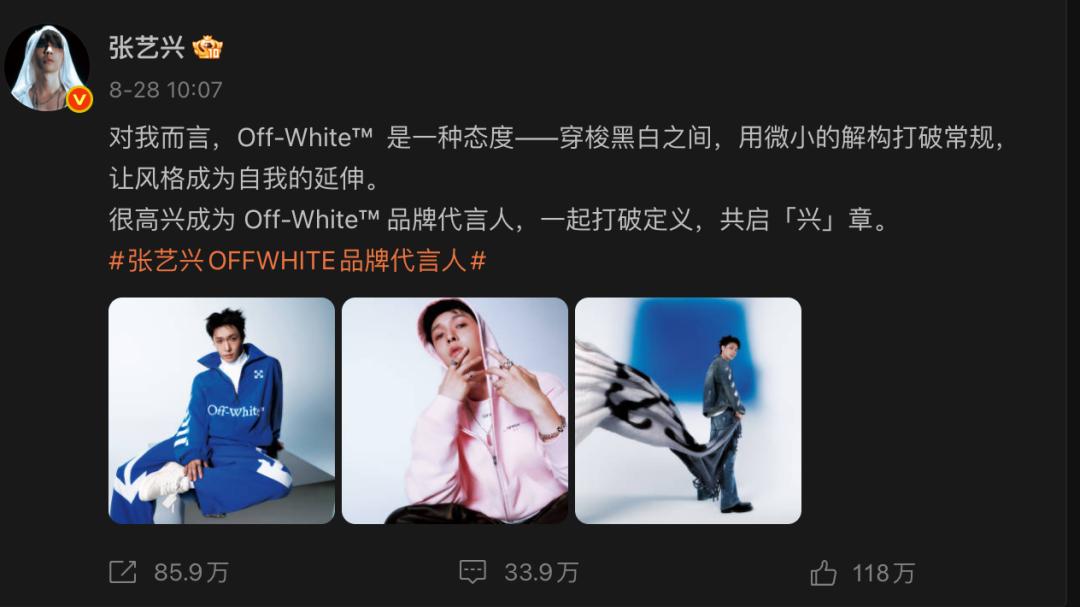
The first time in 13 years, but the core identity is gone
The streetwear industry used to never appoint brand ambassadors.
Since its founding in 1994, Supreme has never had a single brand ambassador. Off-White in the Virgil era followed the same rule: it relied on design and collaborative collections to gain attention, and celebrities bought its products with their own money to wear, rather than signing contracts to endorse it. This was not a cost-saving measure, but a fundamental principle.
What streetwear sells is a sense of exclusivity, that tiny information gap where people who wear the brand know it, and those who don't are unaware of it. Appointing an ambassador and laying that information gap out in the open is equivalent to erasing it deliberately.
Therefore, the act of "appointing a brand ambassador" essentially means that the product itself no longer has the power to drive traffic on its own.
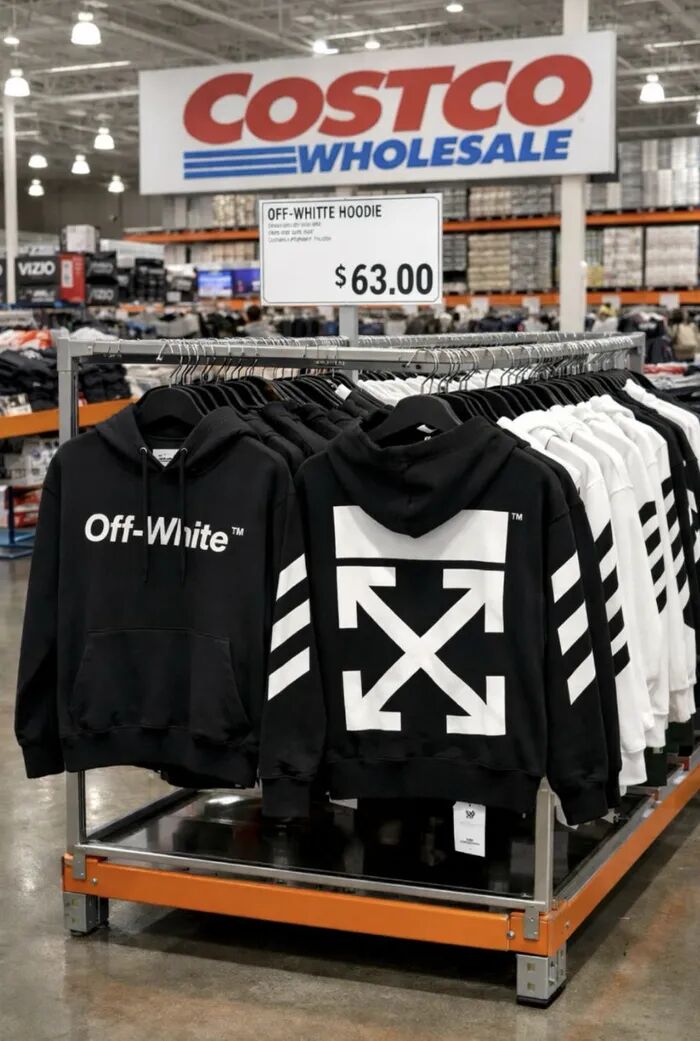
Speaking of which, Off-White has indeed reached this stage. Its last physical store in mainland China closed at Hangzhou Hubin Intime in late September 2024, and its Tmall flagship store has not been reopened to this day. In March this year, Off-White hoodies appeared on the shelves of Canadian Costco, priced at 84.99 Canadian dollars, equivalent to about 430 RMB; at the same time, Off-White products were sold at 19.99 US dollars in the US discount store ROSS, roughly 140 RMB, while the official price of the same style was 794 US dollars.
5500 RMB and 430 RMB, for the same iconic arrow logo.
Consumers do not need to understand what brand equity means. As long as they have seen that 430 RMB hoodie on Costco's shelves, the 5500 RMB official version will forever leave a question mark in their minds. This question mark has nothing to do with the ambassador, nor who the creative director is. The price anchor is something that is almost impossible to rebuild once it is broken through.
The turning point was 8 years ago
Most people attribute Off-White's decline to the day Virgil Abloh passed away. This statement is not entirely wrong, but it misplaces the timeline of the real turning point.
The real turning point came in March 2018. That month, LVMH appointed Virgil as the artistic director of Louis Vuitton's menswear line, making him the first African-American designer to hold this position in the brand's history. The entire industry was shaken, and LV CEO Michael Burke compared him to Karl Lagerfeld.
The glory was real. But at the same moment, three less favorable things happened.
First, Off-White shifted from Virgil's main business to a side project. Virgil was simultaneously in charge of LV menswear, Off-White, a large number of collaboration projects and DJ performances. In 2019, he publicly announced that he would take a break for several months due to excessive fatigue. The scarcest resource for a brand founder is their full attention, and most of his attention was diverted away.
Second, Off-White's brand equity was redefined. Previously it was "the name of a company that makes deconstructed fashion", but from that moment on, it became "a monetization tool for Virgil Abloh's personal IP". This transformation seemed like an upgrade at the time, but in hindsight it pulled the foundation out from under the brand. Personal IP cannot be inherited.
Third, and the most critical point, the brand no longer needed to build its own design system from then on. It only needed Virgil.
In 2019, Virgil himself once said that streetwear was not far from dying. This sentence has always been regarded as his prediction for the industry, but in fact it is more like a self-diagnosis report. That year, he had just held his solo exhibition "Figures of Speech" at the Museum of Contemporary Art Chicago, at the peak of his career. A person at the peak of their industry saying that their own business is about to end is usually not being humble.
In July 2021, LVMH announced that it would acquire 60% of Off-White's shares, with Virgil retaining 40%, and Italy's New Guards Group continuing to act as the exclusive distributor. The most easily overlooked detail of this deal is that LVMH did not buy Off-White the entire company, but Off-White LLC — the shell company that only holds the trademark rights. Design, production and distribution are all controlled by New Guards Group, the Italian multi-brand group that was acquired by Farfetch in 2019. What LVMH got was a set of trademarks, plus a talent who could help it incubate new brands and expand into the wine and tourism industries across sectors.
Four and a half months later, on November 28, 2021, Virgil Abloh passed away at the age of 41. The cause of death was cardiac angiosarcoma, a rare type of cancer that he had been privately fighting for two years.
The real underlying value of this transaction went from the moment of announcement to total depletion in just four and a half months.
What happened after that year requires a concept to describe. I call it "trademarkization": at the capital structure level, a brand degrades from a product-making company to a set of licensable trademarks. It is still operating, still holding fashion shows, still launching new products, but what drives it is no longer product logic, but licensing logic.
Off-White's trademarkization did not start on the day it was sold to Bluestar, it was already written into the structure of that July 2021 transaction.
In 2023, LVMH appointed Pharrell Williams to take over Virgil's position. This appointment made it very clear: the group's interest in "inheriting Virgil" lies on the LV side, not the Off-White side.
The streetwear category is being liquidated
In early 2023, Off-White closed four stores in Shanghai, Chengdu and Xi'an, followed by its Sanlitun Taikoo Li store in Beijing. On September 29, 2024, its last mainland store at Hangzhou Hubin Intime closed.
Zooming out, what happened in 2024 was far more serious than store closures. That year, all three giants of the streetwear industry changed ownership in the same summer.
In June, HanesBrands sold Champion to the brand management company Authentic Brands Group for 1.5 billion US dollars. In July, VF Group sold Supreme to eyewear giant EssilorLuxottica for 1.5 billion US dollars — four years earlier, VF bought it for 2.1 billion US dollars, selling it at a 30% discount and losing 500 million US dollars. In October, LVMH sold Off-White to New York-based brand management firm Bluestar Alliance for an undisclosed amount.
Three transactions, all in the same year. This is no longer a business problem for three individual companies, but an entire category being liquidated.
And the two decline paths among them perfectly demonstrate the most fundamental contradiction of this category.
Supreme's core asset is its weekly Thursday drop mechanism: limited quantity, raffle, hard to get. This mechanism spawned the gray industry of bot scalping, and also supported several times the premium in the secondary market. Its clever point is that it built its value on the fact that "most people cannot get it".
VF wanted to grow its revenue from 500 million US dollars to 1 billion US dollars. This essentially required Supreme to give up its sense of scarcity. After four years of operation, it only opened 17 stores worldwide, with revenue of 523 million US dollars in fiscal 2023, down 7.1% year on year, and net profit dropped from 82.4 million US dollars to 64.8 million US dollars. VF made a 735 million US dollar impairment provision for it in 2022. The scale was not achieved, but the brand's exclusive appeal was worn away first.
Asking a brand that lives on scarcity to expand its scale is essentially asking it to commit suicide.
Champion took another dead end: over-saturation of licensing. It recruited a large number of licensed distributors across different global markets, and counterfeit products flooded the market alongside popular items. Distributors discounted and cleared stock arbitrarily to recover payments, leading to the simultaneous collapse of the price system and brand reputation, with global sales declining for seven consecutive quarters. The number one reason pointed out in industry reviews was not design or marketing, but this very licensing and distribution system.
There is a counterintuitive control case here. Champion's China business was sold to Belle Group in 2023 for 104 million RMB, and Belle adopted a fully self-operated model, making the China market one of the few regions where Champion is still recording positive growth worldwide.
Self-operation can save the brand, but over-reliance on licensing cannot.
From a clothing-selling company to a set of tradable trademarks — this is their common end point.
In 2026, Off-White returned to China with an authorization contract from I.T, following exactly that latter path.
Can this comeback help it regain its past glory?
To be fair, Off-White is indeed still taking actions to revive.
This March, it returned to the official Paris Fashion Week schedule after missing it the previous year. After I.T took over, stores at Shenzhen MixC and Sanya Haitang Bay have been opened, and stores at Beijing Intime and Shanghai Jing'an Kerry Centre are also recruiting staff. Creative Director Ibrahim Kamara's 2026 autumn/winter collection themed around jazz legend Miles Davis has received fairly good feedback in small-scale fashion discussions.
All these are real, but they only prove that "the brand is still in operation", not that "the brand is reviving". To judge the real direction, we need to look at the flow of capital.
This March, Off-White hoodies were put on shelves at Costco, priced at around 430 RMB, and were snapped up by consumers.
On May 29, Hong Kong's I.T Group officially announced that it had obtained the exclusive distribution rights for Off-White in mainland China, Hong Kong, Macao and Taiwan.
On June 29, the brand launched its affordable sub-line L/AB c/o Off-White, priced from 45 to 225 US dollars, with 85 US dollar T-shirts and 155 US dollar footwear.
On August 28, it officially announced Zhang Yixing as its brand ambassador.
Putting these four actions together, they form a complete process: the affordable sub-line makes products accessible to more consumers, Costco and discount channels turn inventory into cash, I.T's exclusive distribution means the brand does not need to invest heavy assets to operate in the Chinese market itself, and the ambassador makes the market notice the brand again.
All four actions share one common feature: none of them require the brand to have independent product development capabilities.
This strategy is called "investment promotion-style revival". It means that the primary goal of a brand re-entering a market is not to sell products to consumers, but to prove to channel partners that the brand still has market appeal. The sell-out data on the first day of the official announcement is a roadshow material, and the real signing partners are sitting in the audience — I.T only signed the deal at the end of May, and it needed a reason to believe that the licensing fee was worth spending.
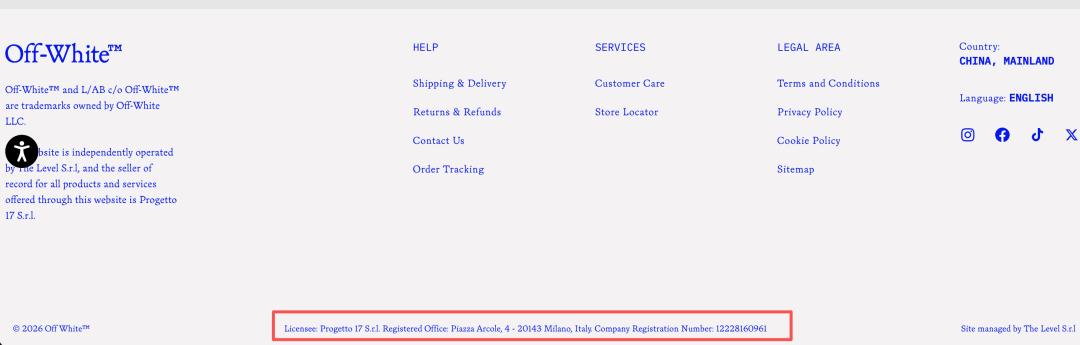
There is one supporting evidence. The legal statement at the bottom of Off-White's official website states that the website is independently operated by The Level S.r.l., and the sales entity for all products and services is Progetto 17 S.r.l. A fashion brand even outsources the operation of its own official website.
Now go back to the initial question: why Zhang Yixing. My colleague once discussed whether it would be more appropriate to appoint Wang Jiaer as the ambassador.
In fact, the answer does not lie in the celebrities, but in I.T's financial books. Having just obtained the distribution rights in May, it needed a high-profile move to tell shopping malls, consumers, and I.T itself, that the brand is back. Off-White's current pain point is not that "no one knows it", but that "people know it, but think it has lost its premium status" — the impression left by that batch of products sold at Costco needs to be erased.
To erase this impression, what is needed is not a more rebellious public figure, but exactly the most reliable public figure who is least likely to cause negative news. Zhang Yixing's commercial endorsement list in the past two years includes Transsion, Junpei Gold, Biohyalux, JD.com and other brands, making him a typical safe choice. International brands entering China choose to cooperate with him, and domestic brands seeking to upgrade their positioning also choose him.
The brand is not looking for a rebellious ambassador, but a low-risk ambassador. It uses Zhang Yixing's zero-negative public image to hedge against the high risks faced by the declining streetwear brand.
Can this path work?
Bluestar is a brand management firm. The business model of this type of company is very clear: buy well-known but stagnant-growth brands at low prices, split them into different product categories and regional markets, authorize them to operators, and collect licensing fees. They do not make products, do not operate retail, they run a licensing business.
People who run licensing businesses care about whether this season's products can be sold out, and whether the next licensing contract can be renewed, not what the brand will look like ten years later. In this interest structure, short-term sales growth and long-term brand building are inherently conflicting, and the short-term goal will always win.
Under this model, Off-White's fate in China will most likely be determined by I.T's distribution capabilities, rather than Off-White's own design capabilities.
When Bluestar took over the brand, a senior industry figure named Gary Wassner said a very straightforward sentence. He is the head of Hilldun, a firm that provides financing for fashion brands. He said LVMH selling Off-White means the luxury market has completely abandoned the brand, and Bluestar will most likely turn it into an affordable mass-market brand.
Two years later today, the 430 RMB hoodie and 85 US dollar T-shirt are making this prediction come true.
Closing remarks
Virgil has a famous "3% Original Theory": modify 3% of a classic design, and you can claim that it is a brand new work. This methodology was used to deconstruct the entire fashion industry back then, as a public mockery of traditional ideas about original design.
Now, the exact same