The most profitable logic in the upstream medical aesthetics industry is no longer valid.
-46.64%, -30.82%, -28.20%, -24.84%, -20.5%, turning from profit to loss.
In the first half of 2026, when the year-on-year attributable net profit performance of six companies including Haohai Biotech, Bloomage Biotech, Jinbo Biotech, Aimeike, Giant Biotech, and Sinocell Tech are arranged in sequence, a crack suddenly appears in the once solid high gross margin narrative of the upstream medical aesthetic industry.
The profit decline has extended all the way from hyaluronic acid, recombinant collagen, and equipment to comprehensive medical aesthetic companies.
East China Pharmaceutical Group still saw a slight 2.53% increase in net profit to RMB 1.861 billion, but its domestic medical aesthetic business revenue decreased by 52.46% to RMB 345 million, and its overseas medical aesthetic business revenue decreased by 36.59% to RMB 332 million.
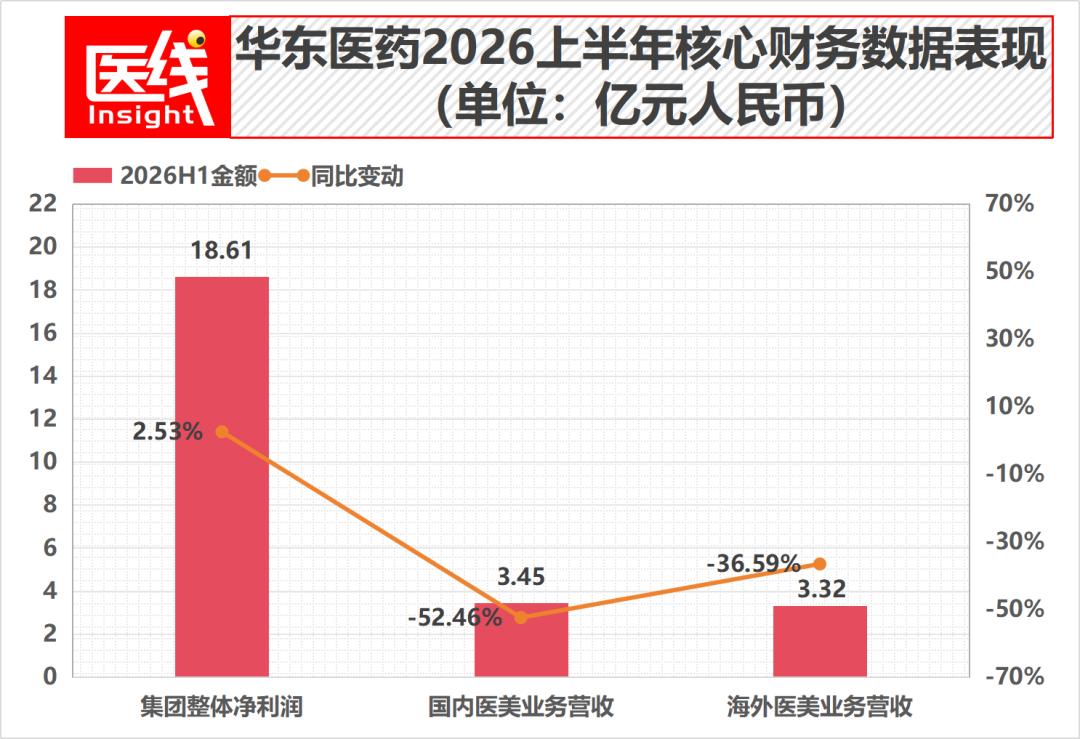
Data source: East China Pharmaceutical 2026 H1 financial report
At this point, among the eight representative leading enterprises, seven have seen net profit decline or obvious pressure on their core medical aesthetic businesses.
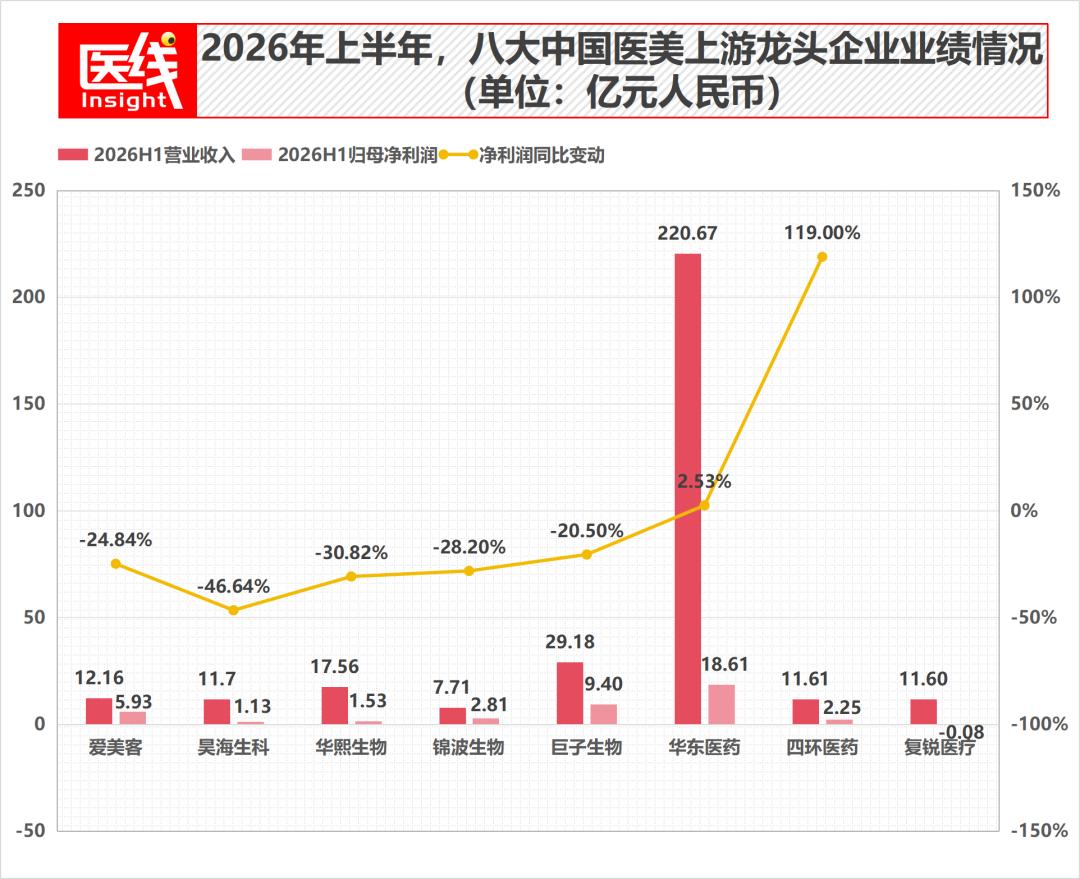
Data source: 2026 H1 financial reports of 8 companies, Sinocell Tech's financial report is denominated in US dollars, converted at the exchange rate of 1 USD to 6.78 RMB
It should be noted that in the past decade, the upstream medical aesthetic industry was once regarded as the business closest to a "money printer" in consumer healthcare.
The three major tracks of hyaluronic acid, recombinant humanized collagen, and botulinum toxin, as well as the supporting Class III medical device approvals behind them, together form a scarcity barrier.
Gross margins of 80% or even over 90%, high repurchase rates and rapid growth have continuously strengthened the capital market's imagination of "high growth, high gross margin, and anti-cyclicality".
But now, the industry landscape has completely changed.
01 Profit Collapse: Triple Squeeze from Price, Production Capacity and Traffic
It is difficult to explain the breadth of this round of decline by simply attributing the collective pressure on leading enterprises to weak consumption.
Looking horizontally at the interim reports, three more specific clues appear repeatedly.
The price defense line of basic materials is loosening, the depreciation pressure brought by new production capacity is rising, and the once efficient traffic channels are becoming more expensive. They act on selling price, cost and sales efficiency respectively, and finally converge on the income statement.
First, the price war is making the scarcity premium disappear.
The high gross margin of the upstream medical aesthetic industry in the past largely came from the scarcity of compliance licenses and the information gap in the initial launch period of products. The certification cycle for Class III medical devices is long, and enterprises that obtained licenses in the early stage could obtain high premiums in a market with limited supply.
By 2026, the structure of the supply side has changed.
Homogeneous compliant products continue to increase, with more options for monophasic and biphasic hyaluronic acid as well as recombinant collagen, and the bargaining power of medical institutions has expanded accordingly.
At the same time, downstream medical aesthetic institutions are facing customer acquisition pressure, and basic injection projects are frequently used for low-price drainage. Experience packages such as "99-yuan hyaluronic acid" and "299-yuan water-light needle" transmit price competition to the upstream along the industrial chain.
Haohai Biotech provides a typical sample.
In its interim report, the company points to "the intensified market price competition caused by the continuous issuance of new certifications for hyaluronic acid products" as an important reason for its underperformance.
During the reporting period, its hyaluronic acid product revenue decreased by 41.45% to RMB 203 million. Dragged down by the decline in the sales proportion of high gross margin products, the overall comprehensive gross margin of the company dropped from 70.17% in the same period of the previous year to 65.46%.
For enterprises that originally relied on high gross margin products to generate profits, a change in gross margin of nearly 5 percentage points is enough to significantly change the profit elasticity.
Price pressure has also begun to enter the recombinant collagen track.
Jinbo Biotech's overall gross margin during the reporting period dropped from 90.68% to 84.70%. The company explained that "price discounts were offered for some products to give back to the market".
In the stock competition, such price adjustments correspond to the enhanced terminal bargaining power and the increase of similar products.
This means that the era when basic materials obtained high premiums by relying on scarce supply is passing.
Products that can still maintain a high profit margin in the future need to rely more on real technological differences, clinical value and compliance thresholds.
Second, the production capacity challenge: the industry expansion cycle collides with the demand inflection point.
Price determines the revenue side, while production capacity begins to squeeze profits from the cost side. During the industry boom period from 2020 to 2023, leading enterprises generally expanded their production lines, hoping to use larger production capacity to meet the continuously growing demand.
However, there is a significant lag in fixed asset investment. When a batch of projects are completed and converted into fixed assets in 2025 and 2026, the market environment has already changed.
Accounting treatment makes this mismatch directly reflected in the income statement. After fixed assets are put into use, depreciation and amortization still need to be included in the current cost even if the production capacity is not fully utilized.
For industries with high gross margins, when sales growth cannot cover the new fixed costs, profit declines faster than revenue changes.
Jinbo Biotech's interim report clearly describes this process. In the first half of 2026, the company's operating cost increased by 47.34% year-on-year, while the revenue in the same period decreased slightly.
The financial report explains that the production workshop for recombinant humanized collagen for injection has been transferred to fixed assets, but the production capacity has not been fully released for the time being, so the depreciation and amortization of assets included in the product cost have increased.
The "growth reserve" during capacity expansion has become a fixed cost that takes time to digest after the demand slows down.
Haohai Biotech is also facing similar pressure. The medical device workshop and supporting facilities in its Songjiang new base project were put into use in February 2026, with new depreciation and amortization expenses exceeding RMB 21 million. Combined with the price competition of hyaluronic acid, the profit side is under double squeeze.
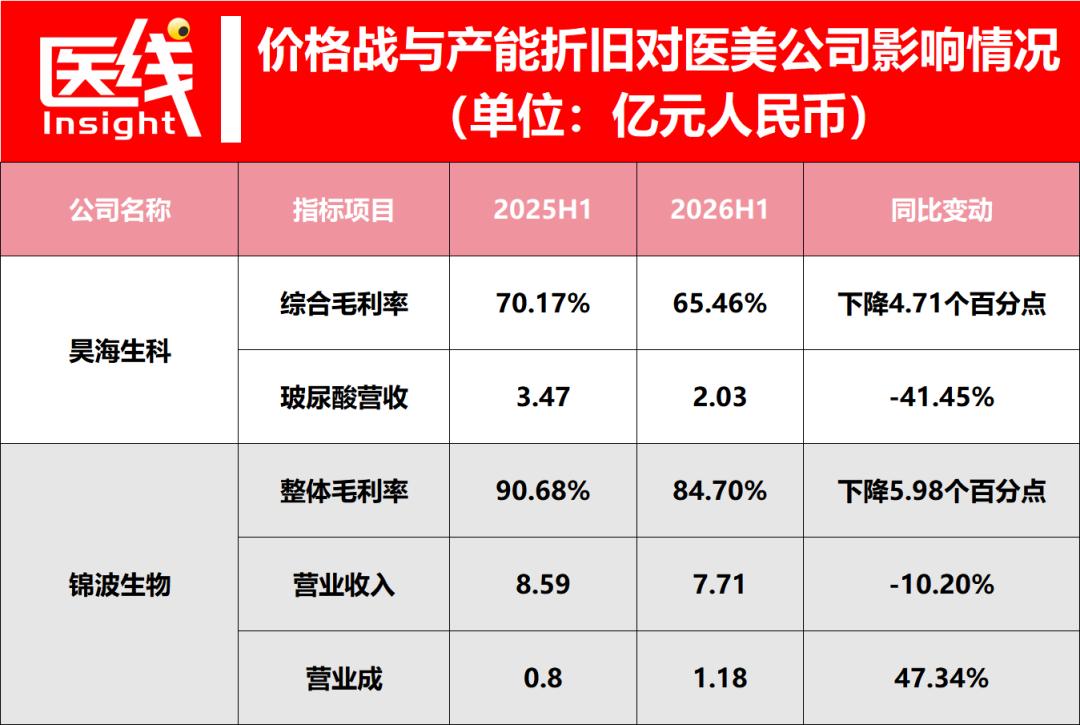
Data source: 2026 H1 financial reports of Haohai Biotech and Jinbo Biotech
The manufacturing attribute of the upstream medical aesthetic industry has thus become more prominent.
Production capacity planning, asset turnover and cost control are becoming as important as product innovation.
During the high prosperity period, enterprises competed on expansion speed, while in the stock stage, it is more of a test of who can truly convert production capacity into sales volume and cash flow.
Third, the traffic cost: brands start to pay for the old growth model.
The change comes from channels. In the past five years, the growth of light medical aesthetics, efficacy skincare and some household beauty devices has been highly bound to e-commerce platforms and live streaming sales.
Live broadcasts by influencers, top anchors and public domain placement can amplify GMV in a short time, but as traffic costs rise, brands need to pay higher and higher fees for this growth mode.
This typical model is "the lowest price across the network + high commission share". Top anchors not only charge slot fees and commissions, but also require brands to provide low-price mechanisms, and the contradiction between sales volume and profit is gradually expanding.
What's more tricky is that online low prices may also disrupt the price system of offline medical aesthetic institutions.
Giant Biotech has already experienced short-term pressure brought by channel adjustment. In the first half of 2026, the company's revenue decreased by 6.3%. The financial report links this to the adjustment of the sales structure of professional skincare products, including "the decline in revenue from influencer live streaming channels".
When brands reduce their dependence on influencer live broadcasts, their own channels and natural sales capabilities must take over, and the transition period will inevitably affect the revenue scale.
Bloomage Biotech's actions are more obvious. During the reporting period, the company's sales expenses decreased from RMB 808 million to RMB 599 million, a year-on-year decrease of 25.84%, which the financial report explained as "the year-on-year decrease in channel, promotion and publicity expenses of the skin science innovation and transformation business".
At the same time, the company's operating revenue decreased by 22.32% year-on-year. This set of data presents an active adjustment: reducing traffic purchases, accepting short-term revenue pressure, and then spending more time rebuilding brand and channel efficiency.
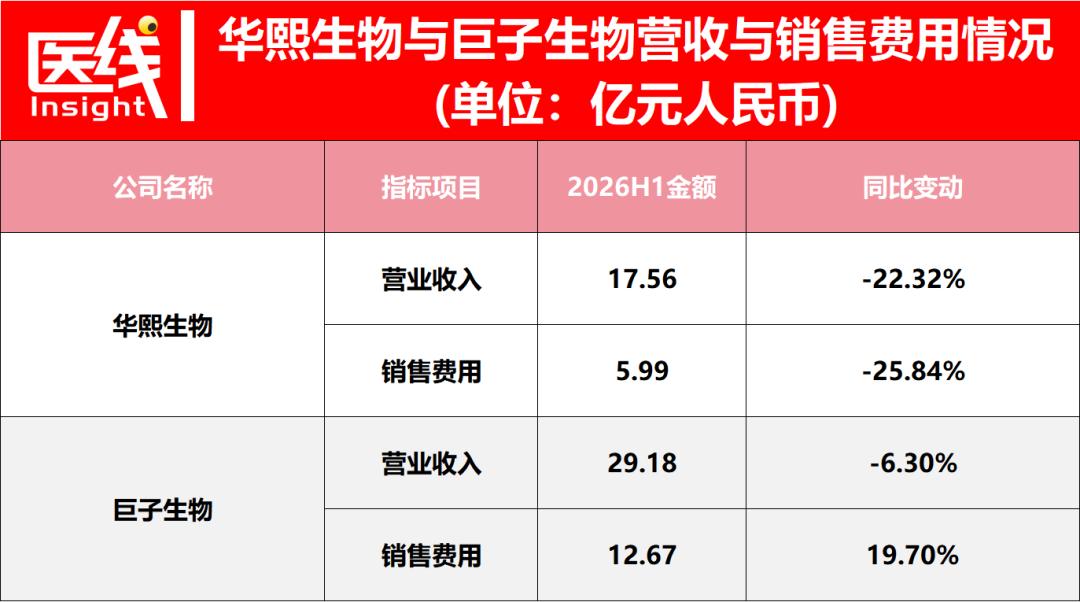
Data source: 2026 H1 financial reports of Bloomage Biotech and Giant Biotech
Price war, depreciation and traffic cost come from different links of the industrial chain, but all point to the change that the upstream medical aesthetic industry has entered the stage of operational quality competition.
The low efficiency that could be covered by high gross margins in the past will now be reflected in net profit faster.
02 The Only Outperformer Among the Eight Leading Enterprises: Two Key Moves of Sihuan Pharmaceutical
Among the eight sample enterprises, Sihuan Pharmaceutical presents the most distinct contrast.
In the first half of 2026, the company's medical aesthetic business revenue reached RMB 693 million, a year-on-year increase of 18.5%; the group's profit attributable to owners of the company was RMB 225 million, a year-on-year increase of 119.0%.
This report card cannot be regarded as a mere accidental exception in the headwinds of the industry. It at least provides two clues worth analyzing in depth.
First, how does the medical aesthetic business evolve from single product competition to portfolio operation?
Second, how does the group improve profit and cash flow through asset adjustment at the group level?
First look at the solution: the core is to shift from selling products to helping medical institutions make profits.
After basic materials enter the price comparison stage, relying solely on one injection to compete for institutional procurement will easily lead to homogeneous competition.
Sihuan Pharmaceutical summarizes the change of its medical aesthetic business in the financial report as having "completed the strategic transformation from a single product seller to a comprehensive medical aesthetic solution provider".
This transformation is first built on channel entry points. Sihuan Pharmaceutical takes the exclusive agent botulinum toxin brand Letybo as the high-frequency project entry point, and establishes continuous cooperation with B-end compliant medical aesthetic institutions by relying on high-repurchase projects such as botulinum toxin for wrinkle removal and face slimming.
On this basis, the company introduces regenerative materials and photoelectric equipment into the same product portfolio, including self-developed PLLA dermal filler, PCL dermal filler, and Sylfirm X dual-wave radiofrequency microneedle introduced from South Korea.
The financial report also mentions combined treatment plans such as "contour fixation + advanced anti-aging".
The value of the portfolio is that it shifts the focus of medical institutions from the procurement price of a single product to whether a complete course of treatment can increase customer unit price and repurchase rate.
Botulinum toxin serves as the high-frequency entry point, regenerative materials and photoelectric equipment provide higher customer unit price projects, and synergy is formed between products.
For medical aesthetic institutions facing increasingly expensive customer acquisition, increasing the value per customer is more important than simply adding new customers.
This also explains the commercial significance of Sihuan Pharmaceutical's "comprehensive solution": upstream enterprises begin to participate in the project design and profit model of medical institutions, rather than just acting as suppliers.
The more transparent the price of single products, the more opportunities enterprises that can provide combined treatment courses, training and product synergy will have to shift competition from price to service and efficacy.
Then look at asset restructuring: exchanging "subtraction" for cash flow and focus.
The 119.0% year-on-year increase in Sihuan Pharmaceutical Group's net profit also needs to be understood in combination with asset disposal. The traditional generic drug business recorded a loss of RMB 74.1 million during the reporting period, and this non-core business continued to drag down the group's performance under the pressure of price reduction from centralized drug procurement.
The company's choice is to clear non-core traditional pharmaceutical assets. The financial report shows that the disposal of a subsidiary during the period recognized a gain of about RMB 154 million. This non-recurring gain significantly improved the current income statement and offset part of the loss of the generic drug business.
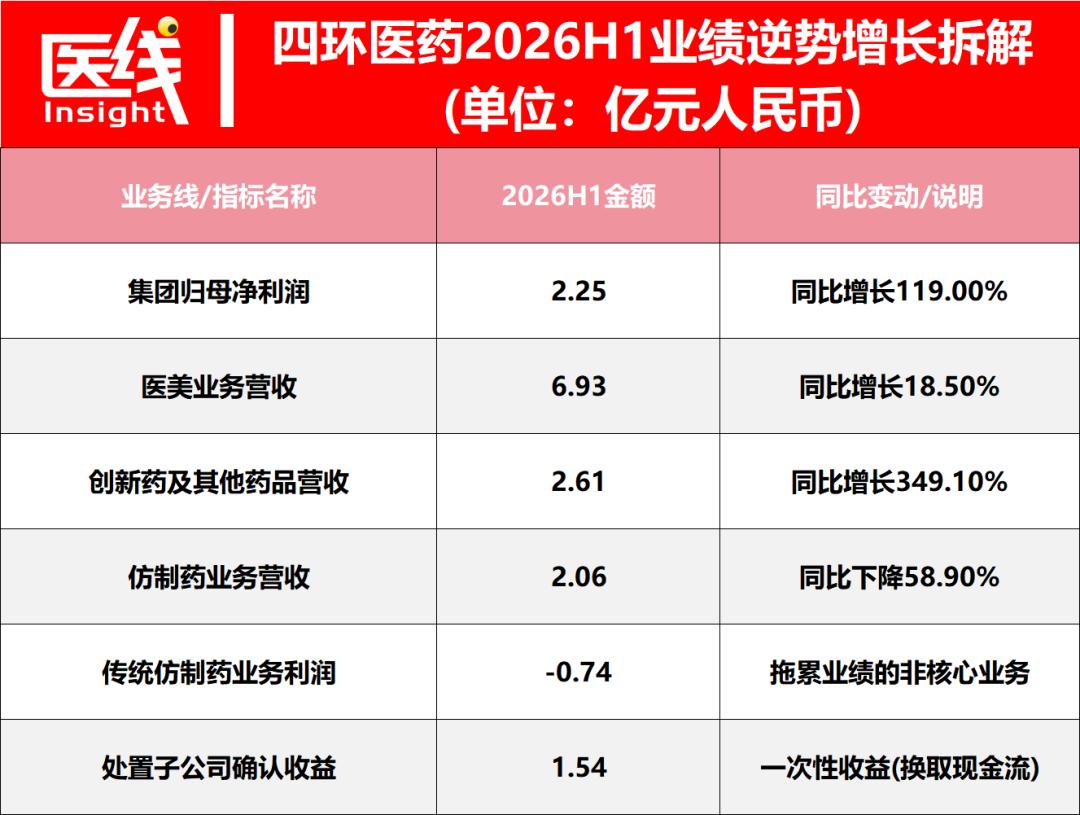
Data source: Sihuan Pharmaceutical 2026 H1 financial report
What is more noteworthy is the reallocation of resources after asset adjustment.
The withdrawal of inefficient assets means that cash, production capacity and management energy can be more concentrated on the two business lines of "medical aesthetics + innovative drugs".
For enterprises in the industry adjustment period, what determines the quality of profit is not only growth, but also which businesses are worthy of continued capital occupation.
Therefore, Sihuan Pharmaceutical's "outperformance" consists of two parts. The medical aesthetic business enhances the value of the institutional side through comprehensive solutions, and the group improves resource allocation by divesting inefficient assets.
The former answers how to achieve growth, and the latter answers how to maintain profit and cash flow.
02 The Second Half Race: Four Paths Leading to New Growth
The decline in the interim reports of leading enterprises has not stopped industry investment.
On the contrary, when the old models of basic materials, extensive capacity expansion and high-priced traffic begin to fail, leading enterprises are directing capital and organizational capabilities to new