Earnings Season: 70% of film and television companies are suffering from the "growing pains" of losses, is AI transformation the answer to the "life-and-death line"?
It is the annual financial reporting season again, and it is also the time to review this year's summer film schedule.
According to incomplete statistics, among more than a dozen film and television companies, about 70% posted "losses" in their mid-year reports, many of which turned from profit to loss. Only a few companies including Mango Super Media, Huace Film and TV, Light Chaser Media, Linmon Pictures and Shanghai Film avoided "negative profits".
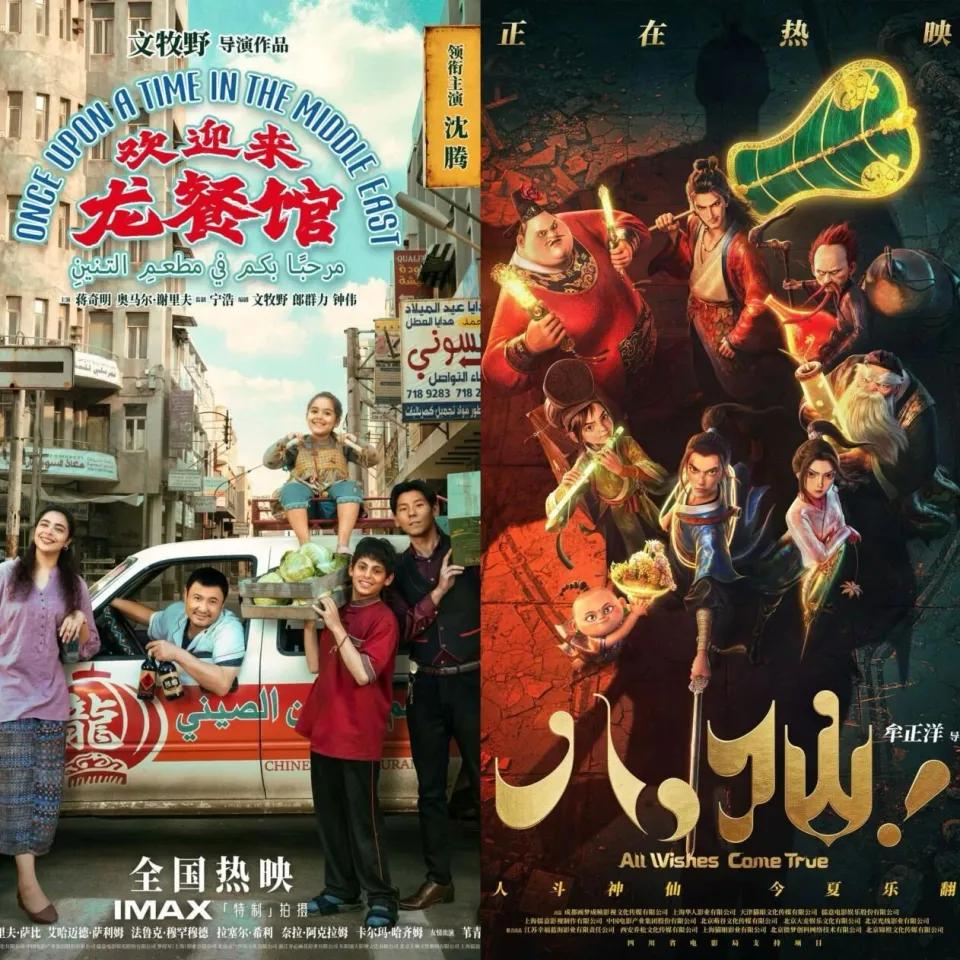
Due to the sluggish overall market in the first half of the year, most "film stocks" suffered varying degrees of capital loss. The release of the summer film *Welcome to Dragon Restaurant* once briefly boosted the share price of Beijing Culture, but it quickly fell back afterwards. For drama production companies, the procurement budget of platforms has been tightened, making it more difficult for long dramas to achieve breakout hits, with higher uncertainty and greater performance volatility than before.
The structural dilemma of the entire film and television industry has existed for a long time. Compared with short drama companies that have switched to AI comic dramas one after another, large companies are more difficult to adjust their direction. Reducing costs, increasing efficiency and making all-out transformation seem to be the only inevitable choice in this "headwind game".
Widespread Losses and Minority Profits
For most film companies, losses are basically a predictable result. Excluding the bonus of the exceptional case *Nezha 2*, the box office of the Q1 Spring Festival season dropped by half year on year. Coupled with the lack of blockbusters in Q2, the total national film box office in the first half of 2026 reached 173.54 billion yuan, down 40.6% year on year, and the number of moviegoers was 421 million, down 34.2% year on year.
In the current environment, the more "asset-heavy" the operation is, the more difficult it is to recoup costs. On the contrary, the more "lightweight" the operation mode is, the more room for maneuver there is.
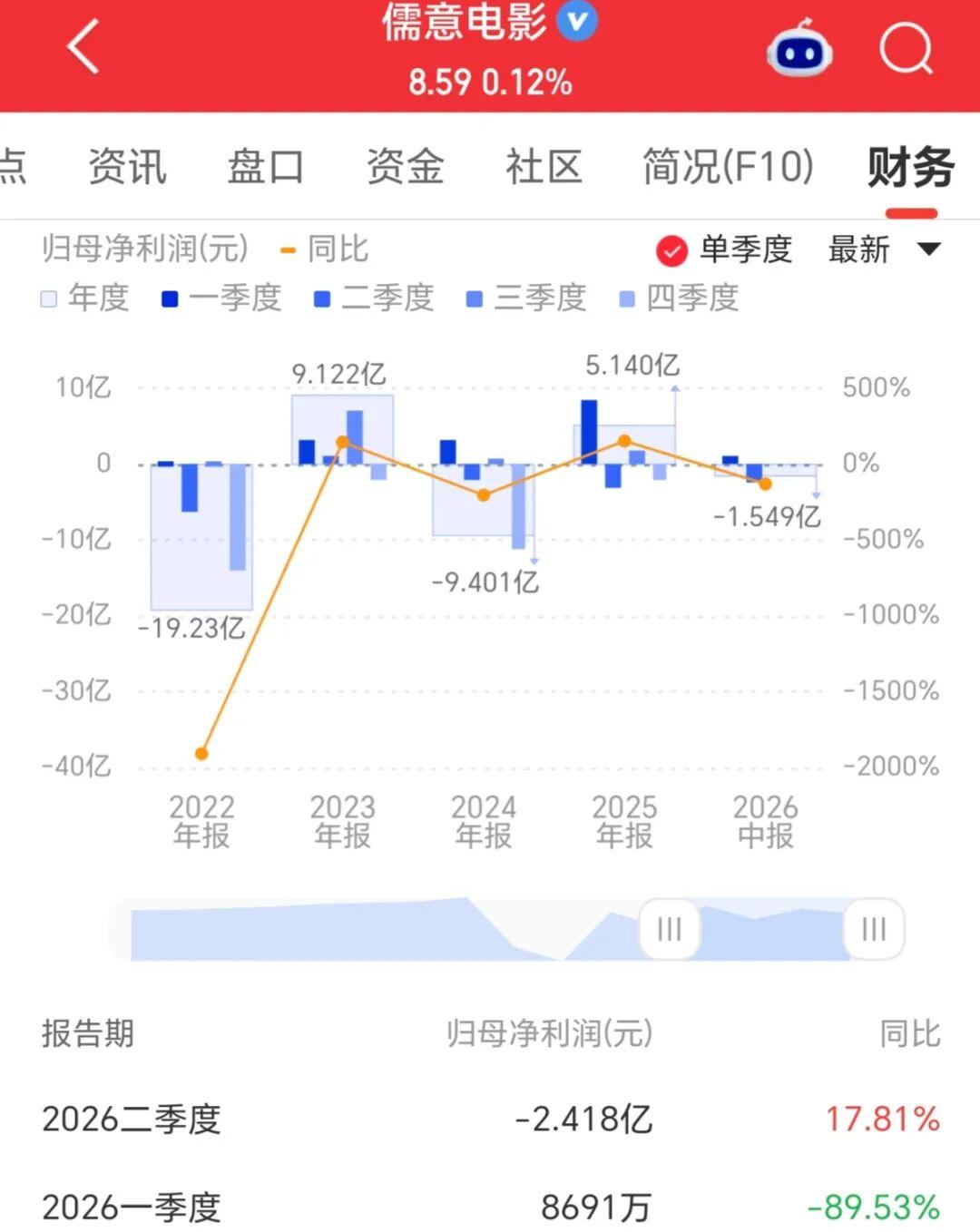
The collective turn to loss of leading companies reflects the degree of market downturn. Ruyi Pictures recorded a total revenue of 5.089 billion yuan, 1.6 billion yuan less than that of the same reporting period last year, down 23.92% year on year. The net profit attributable to shareholders was -155 million yuan, 691 million yuan less than that of the same reporting period last year, down 128.92% year on year. Although its market share increased by 2.1% year on year in the first half of the year, it still turned from profit to loss, and the financial report attributed the loss to its "theater business".
China Film, a central state-owned enterprise that also covers content production and distribution, achieved operating revenue of 1.512 billion yuan, down 11.93% year on year; the net profit attributable to shareholders was -110 million yuan, a slight increase of 0.28% year on year; the deducted non-recurring net profit attributable to shareholders was -213 million yuan, down 0.66% year on year.
Since rents, depreciation and energy consumption are fixed expenditures, theater stocks are under greater pressure. The revenue and profits of Happy Blue Sea, Jinyi Film and Television, Hengdian Film and Television all declined. Taking Hengdian Film and Television as an example, financial report data shows that during the reporting period, the company achieved operating revenue of 807 million yuan, down 41.20% year on year; the net profit attributable to shareholders was -62 million yuan, turning from profit to loss year on year; the deducted non-recurring net profit was -106 million yuan, down 163.44% year on year. During the reporting period, the film screening and related derivative revenue segment achieved operating revenue of 710 million yuan, down 45.90% year on year.
Performance fluctuations are still directly linked to individual blockbusters, and Bona Pictures successfully reduced losses. With the help of *Pegasus 3*, the top box office winner of the Spring Festival season in the first half of the year, the company "adopted a more rigorous approach in film investment strategy", achieving operating revenue of 458 million yuan, down 31.90% year on year; the net profit attributable to shareholders was -169 million yuan, with a year-on-year loss reduction of 84.00%; the deducted non-recurring net profit was -188 million yuan, with a year-on-year loss reduction of 82.75%. However, the summer film *Crossing the Chishui River Four Times* is expected to end up losing money.
In the first half of the year, Beijing Culture achieved operating revenue of 97.4686 million yuan, down 38.22% year on year; the net profit attributable to shareholders of listed companies was -39.2048 million yuan, compared with -233 million yuan in the same period of last year, the loss narrowed by 83.15% year on year. The reason for the loss reduction is not the improvement of performance, but "entirely relying on the more dismal performance of last year as a foil", that is, the poor performance of *Fengshen Part II* last year.
Maoyan Entertainment, listed in Hong Kong stock market, as a ticketing platform, was also affected by the market downturn. Its revenue in the first half of the year decreased by 27.6% year on year, its net profit turned from profit to loss, and the loss attributable to owners of the company was 27.59 million yuan.
Light Chaser Media, which has always "pursued stability", became one of the few survivors when its peers collectively suffered losses, but due to the disappearance of the dividend from *Nezha 2*, its decline was staggering. In the first half of the year, the company achieved operating revenue of 324 million yuan, down 90% year on year; the net profit attributable to shareholders was 33.0089 million yuan, down 98.52% year on year, compared with 2.229 billion yuan in the same period of last year; the deducted non-recurring net profit was 4.6368 million yuan, down 99.79% year on year.
For drama production companies, factors such as long production and distribution cycles and delayed revenue recognition caused by seasonal fluctuations still exist. In addition, long video platforms continue to reduce costs and increase efficiency, many actors have publicly stated that "there are no roles to play and they are looking for jobs", and the main business of long dramas has been greatly affected.
Huanrui Century fell into the situation of "expanding losses despite revenue growth". During the reporting period, the company achieved operating revenue of 248 million yuan, up 25.24% year on year; the net profit attributable to shareholders was -144 million yuan, with an expanding year-on-year loss; the deducted non-recurring net profit was -142 million yuan.
Ciwen Media disclosed that during the reporting period, it achieved operating revenue of 18.9226 million yuan, down 90.02% year on year. The net profit attributable to shareholders of listed companies was -33.2307 million yuan, with a 43.98% year-on-year expansion of loss compared with the same period of last year.
With the broadcast of *Double Shoot* and *The Growin Season 2* in the first half of the year, Linmon Pictures achieved revenue of 541 million yuan in the first half of the year, up 34.8% year on year; the adjusted net profit was 30 million yuan, up 106.9% year on year.
Huace Film and TV's half-year report is characterized by "profit growth without revenue growth". In the first half of 2026, the company achieved operating revenue of 685 million yuan, down 13.22% year on year; the net profit attributable to shareholders of listed companies was 167 million yuan, up 41.98% year on year.
As a representative of long video platforms, although Mango Super Media is profitable, it has entered a state of "revenue growth with profit decline". In the first half of 2026, the company achieved operating revenue of 6.194 billion yuan, up 3.86% year on year; the net profit attributable to shareholders was 202 million yuan, down 73.58% year on year. The reason may be the decline of membership income, as well as the continuous investment in variety shows and AIGC.
Transformation: AI, Derivatives and Interactive Live-Action Film Games
This year's summer film season ended with a total box office of 12.498 billion yuan, up 4.45% year on year, and the number of moviegoers was 340 million, up 5.86% year on year. *Kung Fu Women's Football*, *Welcome to Dragon Restaurant*, *Eight Immortals!*, *Spider-Man: Brand New Day* and *Odyssey* ranked top 5.
The average ticket price dropped to 36.8 yuan. "Low-price promotion" drove a number of data to rise significantly, while hidden worries emerged: last-minute scheduling and withdrawal of films have become the norm; the head box office standard has further dropped from "3 billion yuan" to the "2 billion yuan" level; except for the new generation of horror films such as *Bull Coming*, *Backrooms* and *Obsession* that sparked a carnival of memes, most films are facing the further loss of young audiences.
Looking at the long drama market, the situation does not seem very optimistic either. The basic audience base is draining, and the "national hit" has been missing for a long time. Last year there were popular dramas such as *The Hidden Sea Chronicles* and *All Things Grow*, but the most popular drama this year is *The First Half of My Life* which was released ten years ago.
From this point of view, the upcoming Q3 and the subsequent quarters are very likely to face severe tests.
Capital is always chasing the most popular concepts, while the traditional film and television industry has been far away from the trend for a long time, which is reflected in the sharp drop in the number of project starts. Yang Zhentian said in the first episode of her podcast that the start-up rate of drama projects this year may be only 30% of that of last year, many projects cannot start shooting even after the actors have signed the contracts, and investors can withdraw their capital at any time. The official data of Hengdian World Studios on August 18 showed that only 16 traditional long dramas were being filmed, which was cut by half compared with the summer peak season in previous years.
How to transform and save itself? Looking through a number of financial reports, many listed companies have mentioned their own AI content layout in the reports. Looking at the biggest trend at present, "AI+" is the first choice. On the one hand, the production capacity of live-action projects has been compressed, on the other hand, the production capacity of AI projects has exploded, followed by the reshuffle of the industry pattern.
Huace has pointed out the direction for its peers, and the key to the substantial increase in profits lies in the two-wheel drive of computing power business and brokerage business. In the AI business, Huace has implemented a full-link layout of computing power, models and applications, and provides "trade + cloud services" to the outside world. The revenue of computing power business increased by 184.03% year on year to 160 million yuan, accounting for 23.41% of the total revenue, becoming the company's largest source of revenue for the first time; the revenue of brokerage business reached 153 million yuan, accounting for 22.37%.
However, along with the new business growth points, the operating cash flow continues to be under pressure. The net cash flow generated from operating activities is -210 million yuan, with a year-on-year deterioration of 36.11%, which reflects that AI-related business is still a money-burning game.
As the "upstream of IP" closely related to film and television companies, many companies whose main business is online literature have become the main force of AI short dramas and short drama overseas distribution. The half-year report of IReader Technology shows that short dramas and other derivative businesses achieved operating revenue of 1.185 billion yuan, up 41.45% year on year, accounting for 66.41% of the company's total revenue.
In the first half of the year, the revenue of short dramas and IP derivatives business of ChineseAll reached 411 million yuan, a sharp increase of 108.72% year on year, and its flagship overseas short drama platform FlareFlow is actively embracing AI transformation.
In the first half of the year, China Literature's revenue reached 3.53 billion yuan, up 10.7% year on year. Under the guidance of the "IP+AI" strategy, the revenue of short dramas and AI comic dramas of China Literature in the first half of the year reached 430 million yuan, up 230% year on year.
The capital market has shown strong enthusiasm for AI-related concepts. On August 31, *The New Journey of the Monkey King*, the first AIGC long drama in China to land on the prime time of satellite TV, was launched on Mango TV and Hunan TV. From the day of its broadcast to the next day, Mango Super Media recorded two consecutive 20% daily limit gains, and its market value increased by more than 10 billion yuan within two days.

Another transformation direction is to bet on the development of IP derivatives, and lay out trendy toys and card games that the Gen Z generation pays attention to.
Ruyi Pictures has cooperated with various IPs such as "Little Self-deprecating Bear", *Eight Immortals!* and *The Cloud Dynasty* to launch co-branded products. Its own card business TimeCard Collection focuses on the collectible card and TCG track, and has cooperated with *Palworld*. Shanghai Film focuses on the commercial transformation of *Yao-Chinese Folktales 2* and *Little Monster from Langlang Mountain*. During the reporting period, it added 19 new head brand authorization projects such as Pepsi and Yili, with a total exposure of 3.62 billion, driving the terminal GMV of about 950 million yuan.
Other promising directions include breaking the dimensional wall and developing interactive live-action film games. This year, the total sales of *The Prosperous Dynasty* series exceeded 5 million sets, and the series revenue was about 150 million yuan, which once again ignited the enthusiasm of the industry.
In August 2026, the interactive live-action film game *Code: Lost* led by Huace Film and TV was officially launched. Huanrui Century is favored by the market for its AIGC and interactive film games business. *The River Goes North*, which was mainly produced and invested by its subsidiary Fenglin Interactive Entertainment, entered the top 10 of the Chinese mainland region after landing on Steam, and recently released *Code: Three Kingdoms - Dragon Rising*.
It is certain that film and television companies are facing unprecedented challenges, and there are also opportunities in the difficulties, including but not limited to the squeeze of users' entertainment time by short dramas, the reshaping of the content industry by AIGC... "If you can't beat them, join them" is probably the most realistic choice.