After the growth momentum shifts to a new gear, how can overseas-bound brands build a robust global growth foundation in the AI era?
"The global growth of Chinese brands is entering a gear-shifting period."
Over the past decade, driven by product innovation, supply chain efficiency and traffic dividends, a number of Chinese brands have achieved the leap from "selling products overseas" to "capturing overseas market share". However, as more and more brands have successfully expanded their first market and completed product verification, the focus of competition for overseas expansion is changing: whether growth can be sustained, replicated, and keep complexity under control while expanding, has become a more challenging problem than simply "selling products out".
The rapid development of AI technology has further accelerated this transformation. Consumers are starting to describe their purchase needs to AI assistants, compare different products, and ask AI for purchase recommendations, which has reshaped the logic of product discovery and recommendation. At the same time, AI has also been integrated into business operations including content production, data analysis, product management and marketing execution. While bringing new growth space and efficiency improvement, it also puts forward higher requirements for enterprises' data, system and operation capabilities.
On August 25, 36Kr and Shopify co-hosted a cross-border high-level closed-door meeting in Shenzhen, with discussions centered on "Brand and Customer Compound Interest After Hit Products: How Overseas Brands Can Stabilize Next-stage Growth in the AI Era". In the opening speech, Lv Zhong, Vice President of 36Kr, summarized this stage as "The global growth of Chinese brands is entering a gear-shifting period". This means that overseas brands need to re-examine the source of growth, and shift their focus from phased market breakthroughs to the construction of long-term operation capabilities.
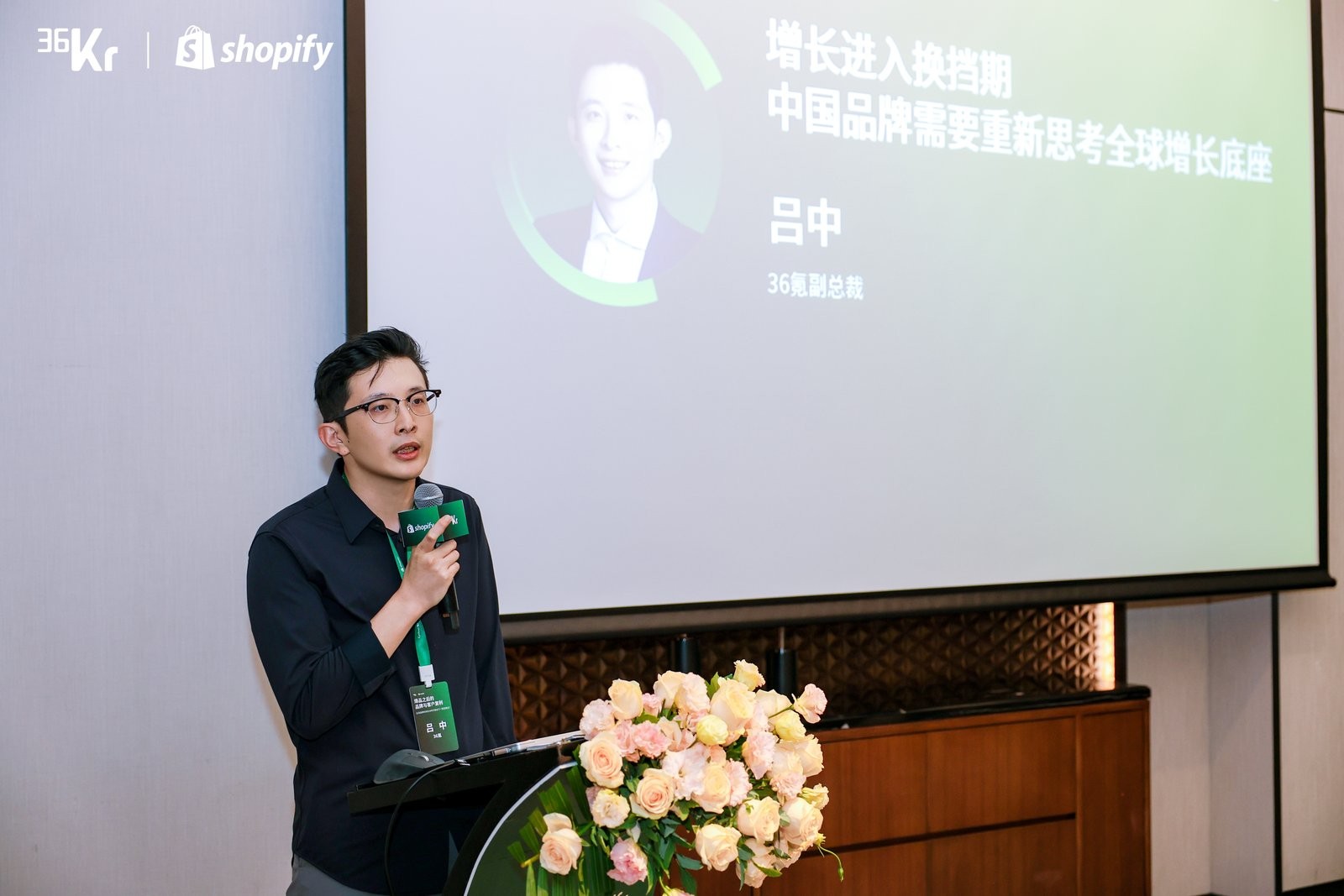
Lv Zhong, Vice President of 36Kr, delivered a speech titled "Growth Enters Gear-shifting Period: Chinese Brands Rethink the Foundation of Global Growth".
Based on this judgment, the on-site discussion further focused on three interrelated issues: when the traditional growth mode changes, how overseas brands that have completed product verification can precipitate products and traffic into brand and customer assets; how to replicate successful experiences to more markets at lower costs; and how to leverage unified business infrastructure and AI capabilities to control the increasing operational and technical complexity in global expansion.

01. AI reshapes product access, brands need to shift from acquiring traffic to "precipitating growth"
Over the past two decades, e-commerce growth has largely been built on the search logic: consumers enter keywords, and brands strive to appear at the top of the result page through advertising and SEO. Today, more and more consumers are starting to directly inform AI of their usage scenarios, budgets and preferences, and let AI complete product search, comparison and screening. Huang Nan, senior author of 36Kr Hardcore, summed up this change in one sentence: "Whether a brand's name appears in this answer or disappears outside the answer, is becoming a new watershed of traffic."
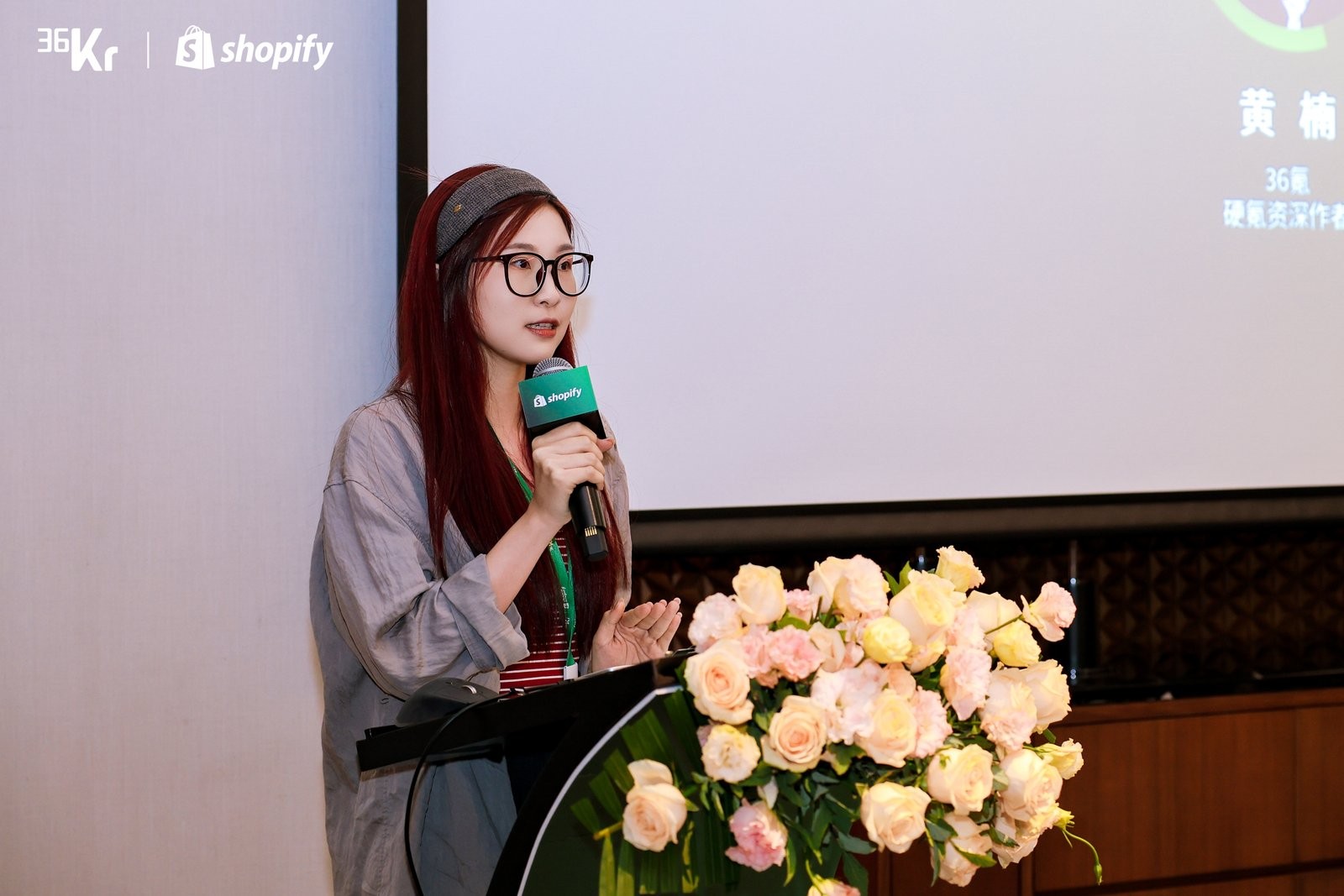
Huang Nan, senior author of 36Kr Hardcore, gave a special sharing titled "From Efficiency Tool to Operation System: How AI Enters the Core Link of DTC Enterprises".
For brands, being included in this answer is becoming as important as seizing the front page of search results in the early days.
Shopify data shows that in the first quarter of 2026, the number of orders from AI search increased by nearly 13 times year on year, the conversion rate of AI-referred visitors is about 49% higher than that of organic search, and the average order value is 14% higher; by the second quarter, the volume of AI-referred conversations increased by 197% year on year, and the number of orders brought by AI tripled. In addition, 50% of AI-referred visits will directly enter the product detail page. This means that before consumers reach the brand page, AI has completed part of the demand understanding and product screening, and the traffic it brings usually has clearer purchase intention.
But whether a brand can be selected by AI does not only depend on advertising investment. The completeness of product information, the clarity of brand value, as well as the authenticity and credibility of user reviews, third-party evaluations and other content, will all affect AI's understanding and judgment of the brand. When AI starts to screen products on behalf of consumers, the long-precipitated cognition, content and trust of brands have also become the information foundation that affects the recommendation results.
This further highlights the importance of brand building. Vivey Wan, Head of Sales for Asia at Shopify, believes that brands need to move from "selling products" to "being remembered, chosen and shared". Products and paid traffic can bring the first order, but the brand determines why consumers choose this product, whether they are willing to buy again, and whether they will actively speak for the brand in communities and reviews.
She took a mineral water brand as an example: through punk-style packaging, the slogan "Murder Your Thirst" and consistent content expression, the brand turned drinking water into a very cool lifestyle. This makes consumers remember not only the product functions, but also the attitude and experience represented by the brand.
Vivey Wan summarized brand building as: "A brand starts with clarity, succeeds with consistency, and wins with connection." Clear brand value needs to be delivered to different touchpoints such as websites, content, product experiences and communities, and transformed into user reviews, community discussions and real word-of-mouth through continuous interaction. These contents not only affect consumers' perception of the brand, but also become the information source for AI to understand and recommend the brand.

Vivey Wan, Head of Sales for Asia at Shopify, delivered a speech titled "Shifting from Short-term Growth Issues to the Construction of Long-term Operation Capabilities".
The practice of Yarbo shows how such assets are formed. Liu Bolin, Digital Marketing Director of Yarbo, recalled that the brand was first recognized by the market through crowdfunding, and the result of more than 3 million US dollars opened users' awareness of it. But he believes that "A hit product is a temporary popularity of a phenomenon, and turning it into a brand asset is a long process."
Today, there are hundreds of posts in Yarbo's Facebook community discussing real usage scenarios every week, the media takes the initiative to contact the brand, and users will share their usage experiences on social platforms. He said, "At the beginning, we were the ones telling the brand story, and later, customers and the media began to output our brand story in reverse." One-way product narration has become spontaneous discussions among consumers, and what the brand gains is no longer just one-time popularity, but continuously accumulated cognition, word-of-mouth and trust.
The next stage of growth is not just about acquiring more traffic, but making the brand understood, trusted and continuously chosen. And the independent store, which is closely associated with brands, content and customer relationships, is becoming the foundation of this set of capabilities.
02. The key to sustained growth is to turn single-point success into replicable global capabilities
When a brand completes product verification in one market, new problems arise: can this set of successful experiences be brought to more markets?
Yarbo's answer comes from the detours it has taken. When the brand expanded from the North American market to the European market, it once directly copied the content of the original store and cooperated with discounts, but the effect was not ideal. The team gradually found that different markets have obvious differences in climate, yard size, festivals and consumption habits: large yard products verified in the North American market may not be suitable for small and medium-sized yards in Europe; the seasons in the United States and Australia are opposite, so the marketing rhythm cannot be copied either. To this end, Yarbo launched the smaller M series for the European market, and readjusted the product mix and promotion rhythm. Based on these practices, Liu Bolin divided globalization capabilities into two parts: "reusable" and "must-adjust". The DTC links and systems such as product information, content materials, user reputation, independent store operation and marketing automation can be reused across markets; the specific product mix, marketing rhythm and consumer communication methods need to be reconfigured in combination with the local market.

Liu Bolin, Digital Marketing Director of Yarbo, participated in the roundtable sharing.
Rae Chang, Senior Business Consultant for Key Clients of Shopify Greater China, believes that enterprises should clarify the boundary between global unification and local adaptation at the beginning of expansion: brand stories, core visuals and overall experience should be kept consistent, while links that affect consumer trust such as fulfillment, payment, logistics and local culture need regional adaptation, and the system and maintenance costs brought by localization should be evaluated at the same time.
This upfront design will directly affect the complexity of subsequent expansion. Rae observed that some overseas enterprises that started from B2B in the early stage have their headquarters and regional division of labor gradually formed along with business development, and they tend to accumulate organizational and system burdens after scaling up; while enterprises that clarify the common capabilities of the headquarters and local responsibilities of regions in advance can reduce redundant construction and support subsequent expansion with a clear architecture.
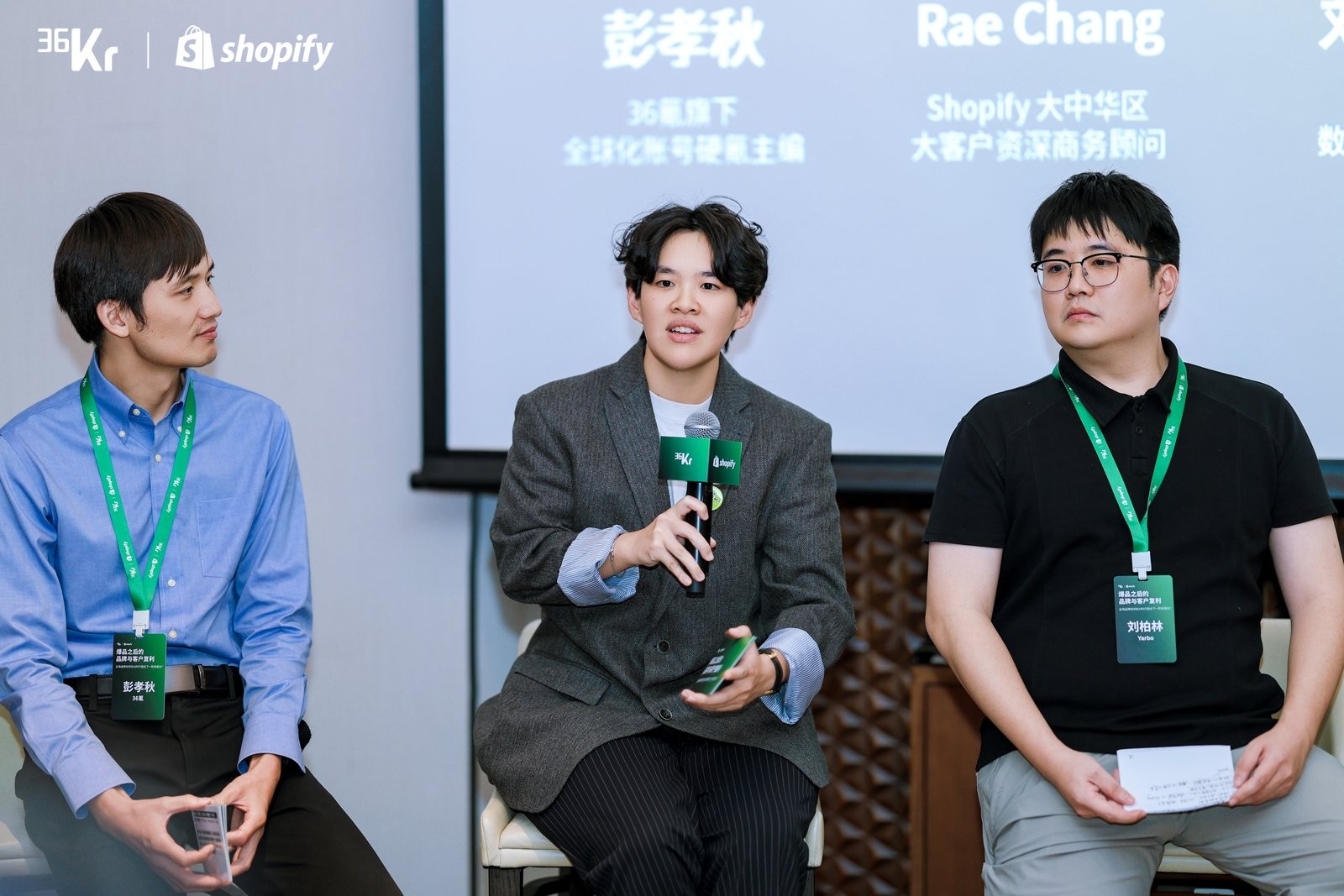
Rae Chang, Senior Business Consultant for Key Clients of Shopify Greater China, participated in the roundtable sharing.
From a technical perspective, globally shared capabilities also need to be implemented in unified data and systems. Liang Yan, Senior Solutions Engineer at Shopify, pointed out that product parameters, data architecture and core system connections can be reused across markets, and brands do not have to re-purchase a new set of ERP or OMS every time they enter a new market; languages, currencies, payment and logistics methods can be configured by region, and compliance is the hard boundary of localized operations.
A more reasonable globalization architecture is to build a stable "global shared core" and then overlay a flexible "local configuration module": the former precipitates brands, products, data, systems and operation processes, while the latter responds to the differences of different markets in product demand, payment fulfillment and compliance. The more stable the common capabilities are, the lower the repeated investment when entering new markets.

Liang Yan, Senior Solutions Engineer at Shopify, participated in the roundtable sharing.
However, faster replication does not mean that globalization operation has been successful. Wang Jing, Head of Intelligent Terminal Investment at Cowin Capital, reminded that globalization should not only focus on how many countries you have entered, but also on how many markets actually contribute revenue and profit, whether multi-regional layout effectively disperses risks, and whether costs such as compliance, local team and system construction are fully calculated. If the increase in the number of markets does not bring corresponding returns, expansion will instead increase the operating burden.
In the final analysis, what can be replicated is not a single store or a set of promotion plans, but the data, systems and operation capabilities precipitated by the brand. Only by standardizing common capabilities and modularizing regional differences can single-point success be transformed into sustainable and reusable global capabilities.

Wang Jing, Head of Intelligent Terminal Investment at Cowin Capital, participated in the roundtable sharing.
03. AI is not just a new channel, but an operating capability to control complexity
Liang Yan, Senior Solutions Engineer at Shopify, and Saw Chee Hong demonstrated on site how AI runs through the complete business link. For consumers, Shopify integrates information such as products, inventory, prices, logistics and transaction rules to help products be discovered, recommended and converted in AI channels; through the Universal Commerce Protocol U