AI companies will need to pay extra now if they want influencers to speak favorably on their behalf.
In the United States, speaking up for AI, especially getting paid to speak on behalf of AI companies, is turning into a deeply unpopular thing.
A national survey released in August by the Annenberg Public Policy Center of the University of Pennsylvania shows that 39% of U.S. adults expect AI to bring negative impacts to the country over the next decade, while only 18% hold positive views; 68% believe the government has done far too little to regulate AI.
The same survey also notes that the share of people opposing the construction of data centers near their homes rose by 12 percentage points in four months, reaching 61%. In another survey published in August by Pew Research Center, 71% of respondents believe AI will reduce the number of jobs in the United States.
The sentiment of the American public has begun to affect the creator partnerships of AI companies.
Since August, from OpenAI's brand trip to Anthropic's Claude and ByteDance's Dreamina, multiple creators have faced successive boycotts, with some issuing public apologies and others starting to explicitly draw their own boundaries for AI usage.
At the moment, AI is the most important narrative in the U.S. capital market, and AI companies are also among the few clients that are still spending heavily on traffic acquisition. Media interviews with talent agents show that top AI companies will allocate budgets ranging from five-digit to seven-digit U.S. dollars to compete for creators, and sometimes seek multi-month partnership contracts.
AI companies hope to gain public trust through creators, while creators need commercial collaborations to make money, which was originally a mutually beneficial arrangement. Now, taking on an AI commercial deal also means taking a public stance for AI, and bearing the risks of losing followers, facing boycotts, and damaging personal reputation.
Agents have started to put a price tag on this risk. One agent revealed that when dealing with well-funded large AI companies, he may add an extra 20% to 30% on top of the creator's standard quotation.
Commercial AI collaborations have started to carry a "public sentiment premium".
An ordinary AI commercial deal is evolving into a moral accusation
In China, it is very common for creators to take commercial deals from AI companies, and the most severe criticism is often just a comment saying "taking dirty money", with few people requiring creators to publicly state their stance for working with an AI company.
In the United States, an AI collaboration is evolving into a moral judgment. Getting paid to promote AI will get you attacked, attending brand events will get you attacked; even if there is no commercial deal at all, just using ChatGPT in your work may be called out by your followers.
The dramatic twists and turns of OpenAI's first brand trip "Summer Club" fully reflect the public's emotional outburst among American internet users.
In early August, OpenAI invited around 30 creators to stay at Wildflower Farms, a luxury resort in upstate New York, to experience ChatGPT Work, with organic meals, beekeeping and wellness activities arranged alongside.
The creators filmed the trip into typical lifestyle content. Grace McCarrick talked about her travel experience while running a bath; Nat Lucy filmed a deer passing by outside the cabin.
These videos themselves received little attention. At the early stage of the controversy, McCarrick's video had less than 300 likes, and Lucy's video had less than 15,000 views, but two critical videos made about the event gained a combined total of over 500,000 views.
In the creators' footage, this was a relaxing, decent brand trip. But in the eyes of opponents, the combination of the luxury resort, natural scenery and the OpenAI logo became an ill-timed public relations stunt.
The comment sections did not follow the creators to discuss ChatGPT Work. The rooms priced at around $2,000 per night were interpreted as payment for speaking on behalf of AI companies; the green space Lucy filmed was also mocked as a perfect site to build a data center.
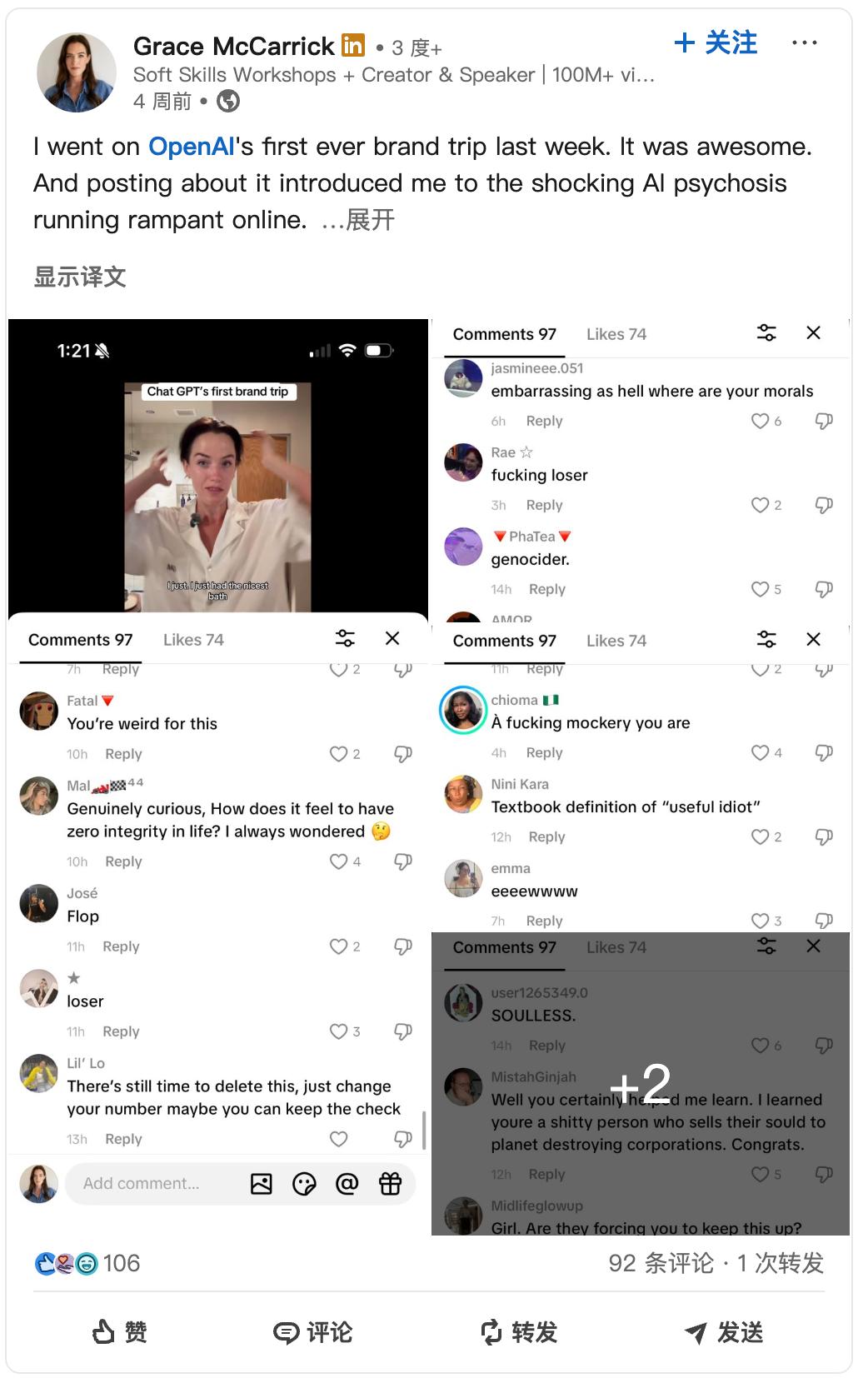
McCarrick responded afterwards that she never expected the event to spark controversy, and argued that some critics were overreacting to AI. She also questioned that those critics also use smartphones, Amazon, Instagram and TikTok, so why they only impose moral responsibility on the creators who attended the event.
However, this response did not reverse the trend of public opinion, but instead prompted netizens to keep asking: why a creator who focuses on workplace communication had almost no preparation for AI-related controversies before promoting for OpenAI.
In this round of anti-AI sentiment, the focus of the controversy has boiled down to one single thing: are you on the side of AI.
Emma Orhun, a creator who used to work at Shopify, was also boycotted for promoting Claude, and later had to explain that she accepts AI-assisted programming but opposes AI replacing human artistic creation.
Science popularization blogger Hank Green did not even take any commercial deal. He just used ChatGPT more often to search and organize materials when making videos, and was questioned by his followers that his content had lost its original personal voice. Green later apologized and set stricter AI usage rules for himself.
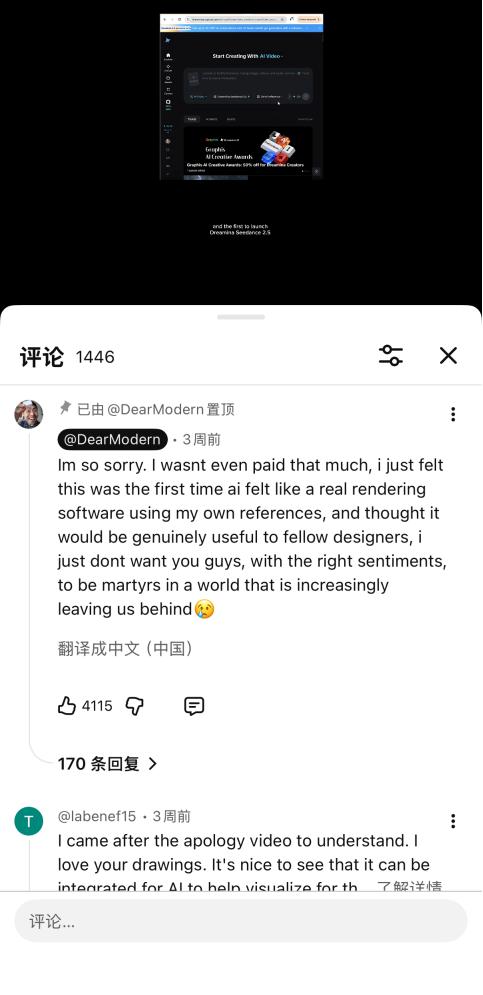
Even ByteDance's Dreamina in the U.S. has been impacted by this sentiment. Design blogger Cliff Tan has already emphasized in his ads that he does not like letting AI replace thinking, and only uses it to convert hand-drawn floor plans into animations. Still, some people in the comment section demanded that he "not sell himself out to AI".
Tan later apologized and left a message under the original video: "I didn't even get paid that much."
Creators get paid for one single ad, but the criticism they receive is borne on behalf of the entire AI industry.
Americans are already fed up with AI, and AI companies have done plenty to add fuel to the fire
AI is becoming the pillar of U.S. economic growth, while also creating new dividing lines of interests.
The government and the capital market regard it as the foundation of economic growth and national competition, but ordinary people care more about income, employment, electricity bills and pollution.
Calculations by the Federal Reserve Bank of St. Louis show that AI-related investments including software, R&D, information processing equipment and data centers contributed 39% of the U.S. real GDP growth in the first three quarters of 2025.
But the more AI investment there is, the more data centers need to be built. The pressure on electricity and water consumption rises accordingly, and opposition to AI has begun to move from online discussions to local policies. The Wall Street Journal reported in August that Governor Greg Abbott, who once announced that Texas would become an "AI development hub", has suspended the approval of a large number of data center projects due to power and water resource issues.
Another pressure comes from employment. Large model manufacturers keep emphasizing that AI can improve efficiency and replace part of the work, while tech companies are laying off employees on one hand and investing more resources in AI on the other. These actions keep reinforcing the impression that AI companies reap the growth, while employees bear the costs.
The public image of Silicon Valley is also declining sharply. AI companies hold capital, technology and political influence, but the narrative that "AI innovation will definitely bring progress" can no longer automatically win public favor.
Just as public resentment keeps building up, AI companies are still carrying out "questionable operations" trying to reinforce the impression that AI is already everywhere and will inevitably enter everyone's life. Creator collaborations and ads appear one after another, and after overreaching, they constantly remind the audience that the things they dislike are still expanding.
Among the 66 ads aired during the 2026 Super Bowl, 15 promoted AI companies or were produced using AI. Statistics from Meltwater show that nearly half of the related discussions are negative, and the audience has grown tired of "yet another AI ad".
Amazon's Ring also promoted its AI pet-finding feature during the Super Bowl, but was questioned by the audience for packaging community surveillance after showing all the neighborhood cameras turning on at the same time.
Anthropic and its founder Dario Amodei have always presented themselves as the odd one out in the industry: developing AI while publicly emphasizing AI's risks, safety and responsibility. But this reverse marketing can also backfire.
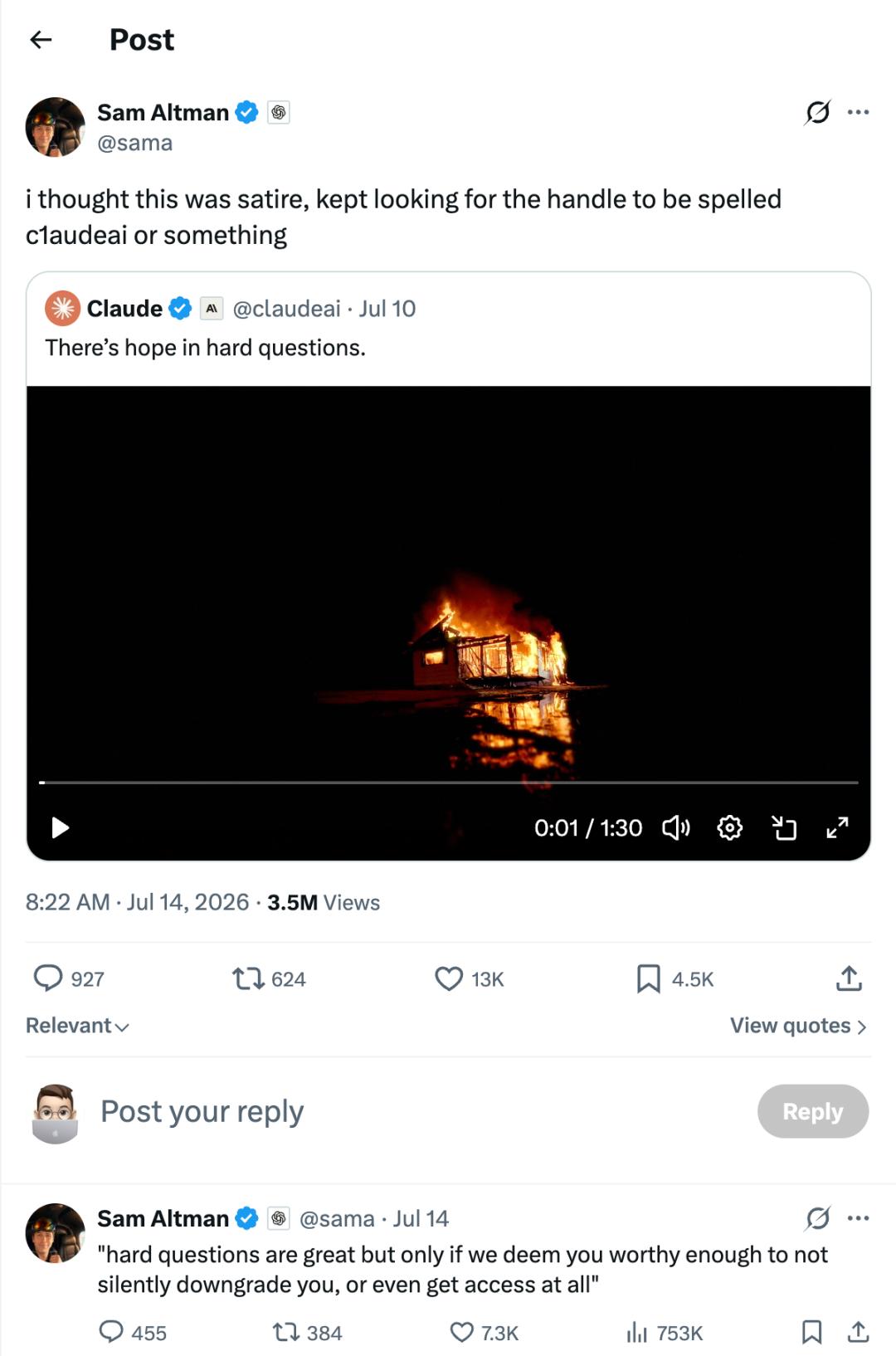
In July this year, Anthropic launched its brand film "There’s Hope in Hard Questions" during the World Cup. The ad jumps from burning houses, facial recognition, homeless people and rows of tombstones to mothers and daughters, whales and medical workers; it keeps asking whether AI can be trusted, but gives no answer. Sam Altman mocked that he initially thought he was watching an ad made by a satirical account.
Even some AI companies' marketing has started to use the anger mechanism of social platforms to drive traffic.
At the end of August, the serialized content called "Oreogate" went viral on Instagram. A creator made 13 videos telling the conflict that broke out in a kindergarten parent group because a child brought Oreos, and then used the AI music tool Suno to turn the chat records into songs. The plot kept escalating, the audience took sides and argued, and the first video gained more than 10 million views.
Later, people found out that the creator was a paid partner of Suno. She refused to clarify whether the chat records were real, and Suno acknowledged the commercial partnership but denied being involved in designing the plot.
A piece of controversial, ambiguous content that went viral eventually became an ad for an AI product.
The more AI manufacturers try to make AI look natural and ubiquitous, the more likely they are to bring the public's top concerns about privacy, unemployment and misinformation back to the table.
Creators cannot ignore the budgets of AI companies, nor can they avoid AI tools that have already been integrated into content creation and office workflows.
Turning down commercial deals means losing income, while accepting them means taking the heat on behalf of the manufacturers.
AI is impossible to avoid, but taking AI commercial deals is getting increasingly difficult.
People who cannot stop AI have started to besiege those who use AI
A recent comment piece in The Guardian points out that behind the U.S. backlash against data centers and big tech companies lies a broader sentiment: more and more people feel that major decisions affecting their lives are being controlled by a small group of people who hold capital and technology.
Ordinary people can decide whether to open ChatGPT today, but they cannot decide what data companies use to train models, where data centers are built, nor can they easily prevent their positions from being reassigned.
They do not necessarily reject the convenience brought by AI, but resent the fact that they cannot decide in what way AI enters their lives.
Unable to stop the expansion of data centers, nor influence corporate layoffs, the comment sections have become one of the few remaining places where they can express their rejection. Creators appear in public and rely on their reputation, making them more accessible than the management of AI companies, so they naturally become the first group to bear the pressure.
Social platforms will further amplify this pressure. Research from Northwestern University's Kellogg School of Management and other institutions finds that social media users often overestimate the level of anger from other people. Intense expressions are more likely to get interactions, and later participants will easily take that as the normal tone in comment sections.
As a result, "I don't like this product" escalates into "You betrayed your followers"; taking on an AI commercial deal will also be interpreted as supporting the entire AI industry.
Creators also need to make a living, so they can only "seek wealth amid risks". They can either reject the deal if they think the risk is too high, or if they are willing to take it, factor the potential loss of followers and reputation damage into their quotation.
AI companies need to use creators' personal images and follower trust to endorse themselves, but such partnerships will also consume the creators' own trust capital.
The so-called "public sentiment premium" means that creators either reject the deal, or make AI companies pay extra for this risk.
Marking up the price can compensate for the one-time public sentiment risk, but whether this business can sustain in the long run remains uncertain.
This article is from the WeChat public account "Letter AI", author: Si Bo, published with authorization from 36Kr.