The operational gap has widened! Seven overseas retail REITs are in seven distinct situations.
In the domestic consumer/commercial REITs sector, underlying assets are carefully selected, with these "top-performing players" owning core locations, mature investment attraction systems and high occupancy rates.
However, if you turn your attention to overseas retail REITs listed in Singapore and Hong Kong that hold mainland commercial properties, the harsh and real other side of the industry is revealed. Many of these assets are old stock projects. After removing the filter of listing packaging and facing the severe tests of the weak consumption cycle head-on, the operating performance of different players shows huge divergence.
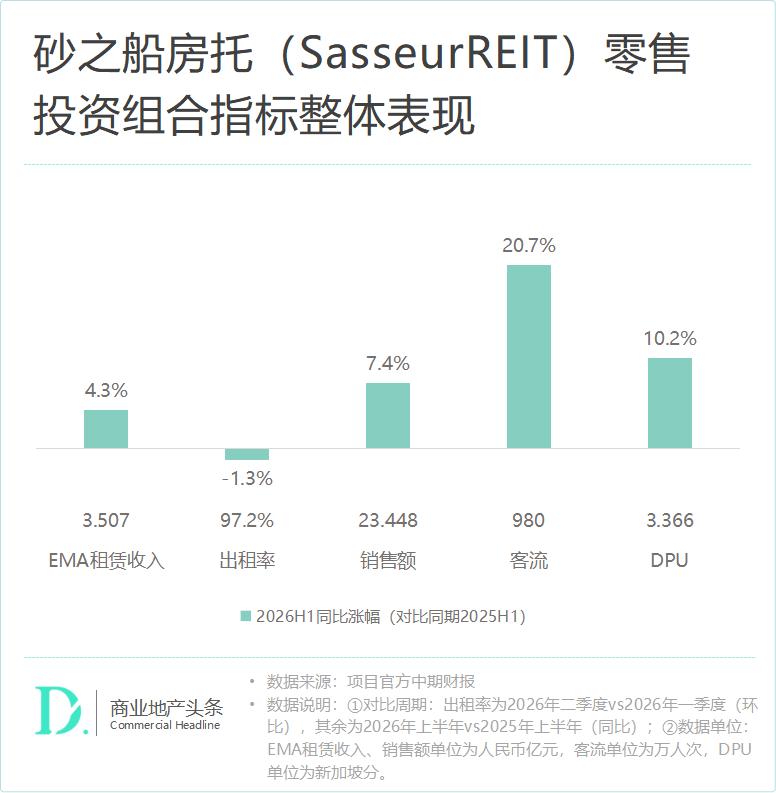
According to Winshang, in the 2026 semi-annual reports of 7 sample overseas retail REITs, the DPU (distribution per unit) growth rate of Sasseur REIT reached 10.2%, ranking first in dividend growth. In contrast, the DPU of CapitaLand China Trust declined slightly, and the DPU of BHG Retail REIT plummeted by 45.5%, making the contrast between strong and weak particularly distinct.
The outlet format with strong defensive attributes sees passenger flow, sales revenue and rental income rise simultaneously, and the 4 projects under Sasseur REIT rely on more than 5 million VIP members to drive over 60% of total sales, with a solid business foundation.
Of course, there are hidden worries behind the outstanding performance, and high dividends also come with the growing pains of asset renovation. Affected by the AEI (Asset Enhancement Initiative) project, the occupancy rate of Sasseur's Hefei project has declined periodically, and the sales revenue of its Kunming project has turned negative in the short term. Regional divergence and renovation pressure exist objectively. CapitaLand has achieved positive growth in retail income through small-scale and high-frequency renovations, BHG is constrained by leverage and can only rely on tenant adjustment to maintain stability with difficulty, while Yuexiu, China Merchants, Spring Real Estate and Hui Xian all have their own advantages and disadvantages.
The divergence of overseas retail REITs is not a distant prediction, but a mirror for domestic consumer REITs. When domestic commercial REITs gradually get rid of the protection of listing dividends, rental pressure, growing pains of renovation and performance divergence are all realistic issues that need to be faced directly in the future.
What REITs compete for has never been how glamorous the assets are at the time of listing, but the real ability to continuously generate cash flow in a weak cycle.
01.
7 Overseas Retail REITs, 7 Different Situations
Sorting out the 2026 semi-annual reports of 7 overseas retail REITs deployed in the mainland market, the operating situations of different players have already shown a gap. Sasseur has achieved a contrarian high growth in dividends relying on the outlet format, CapitaLand has stabilized its income through active renovation, BHG faces significant operating pressure, and the rest of the targets have their own gains and losses. The format, asset quality and operation capability have created completely different market performances.
Sasseur REIT: No.1 DPU Growth Rate, Coexistence of Renovation Pains and Regional Divergence
In the weak consumption cycle, outlets have become one of the most defensive formats. In the first half of the year, the financial report of Sasseur REIT shows that the sales revenue, passenger flow, rent and DPU (distribution per unit) of the investment portfolio all achieved growth.
What is more noteworthy is that Sasseur is the overseas retail REIT with the fastest DPU growth rate among the 7 targets, reaching 10.2%. What supports this business is a "highly sticky" membership system. The financial report discloses that VIP members contribute more than 60% of sales revenue, and the number of VIP members has exceeded 5 million.
Its strategy is to quickly respond to changes in consumption trends through the "short-term lease" strategy, and continuously optimize the space experience with the support of the Asset Enhancement Initiative (AEI). This flexibility of "moving forward in small but fast steps" is exactly what heavy-asset shopping malls can hardly achieve.
Chongqing Liangjiang Outlet, as a benchmark project, has been fully occupied, and has introduced brand co-creation activities such as "HAZZYS Atrium Pop-up" and "Li-Ning YOUNG Member Day";
The Hefei project launched the renovation of the 6,000-square-meter sports zone on the L1 floor in Q3 2025. As of July 2026, 90% of the public area works have been completed, and the areas will be delivered to tenants successively from August. 11 of the 13 leasing units have been pre-signed, and the first Hefei outlet store of high-end catering brand "Hulele Butter Baked Seafood" has been successfully introduced. The Kunming project saw its sales revenue under short-term pressure in the second quarter due to AEI works and tenant portfolio adjustment, but the occupancy rate still remained at a high level.
The decline in the occupancy rate of the Hefei project and the year-on-year negative growth of sales in Kunming reveal the growing pains of renovation and regional divergence. In the short term, the performance depends on the delivery of AEI and the actual effect of consumption policies, and in the long term, it depends on the positioning of "value retail" and membership barriers.
CapitaLand China Trust (CLCT): Dual Growth in Retail Income and NPI, "Small-Scale, High-Frequency" AEI Renovation Works
If Sasseur REIT wins by its format, then CapitaLand CLCT wins by active management.
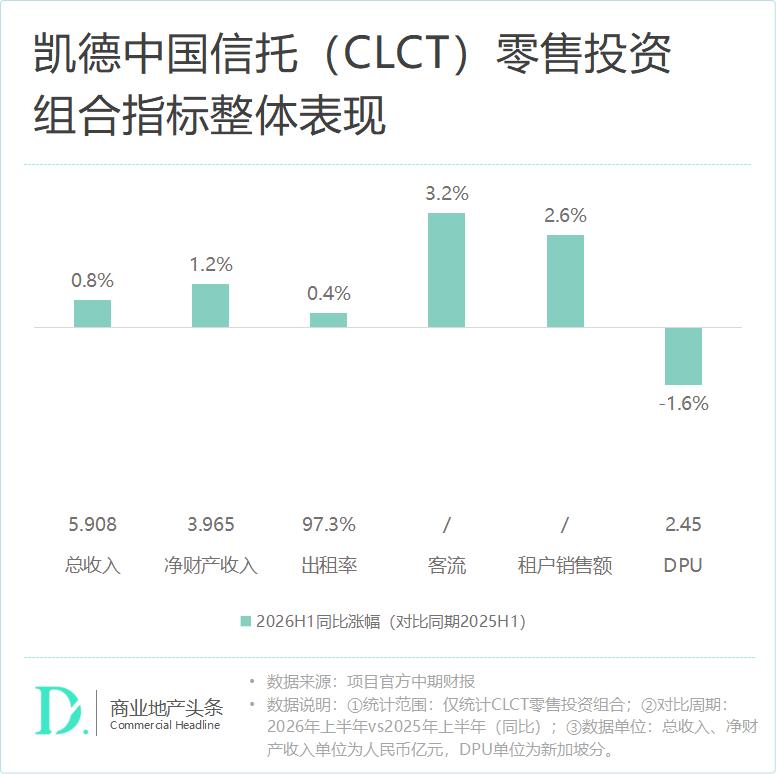
In the first half of the year, retail properties accounted for 70.6% of CLCT's total asset portfolio. Against the background of the overall weak consumer market and widespread rental pressure in the industry, its retail portfolio achieved dual growth in income and NPI (Net Property Income). The same-store retail income (excluding Yuhuating) increased by 0.8% year on year, NPI increased by 1.2% year on year, the occupancy rate reached 97.3%, passenger flow increased by 3.2%, and tenant sales increased by 2.6% (7.5% excluding automobiles).
The growth comes from the Asset Enhancement Initiative (AEI). CapitaLand CLCT focuses on "small-scale, high-frequency" partial renovations, transforms supermarkets into blocks, introduces first stores, and uses the "cost reduction and efficiency improvement" method to make the retail portfolio the only sector that achieves positive income growth.
CapitaMall Nuohemule introduced new anchor tenants, with sales revenue exceeding 10 million yuan in the first week, sales per unit area of about 8,500 yuan per square meter, and an occupancy rate as high as 99.9%. CapitaMall Wangjing has upgraded its tenant structure after the completion of AEI, with the proportion of experience-oriented formats increased. CapitaMall Xizhimen has achieved dual growth in passenger flow and sales through the renovation of "transforming the supermarket into a trendy play block".
BHG Retail REIT: Operation Under Pressure, Stabilizing Rent by Attracting Flow Through Tenant Adjustment and Community Activities
With the same mainland retail assets, BHG's situation is much more difficult.
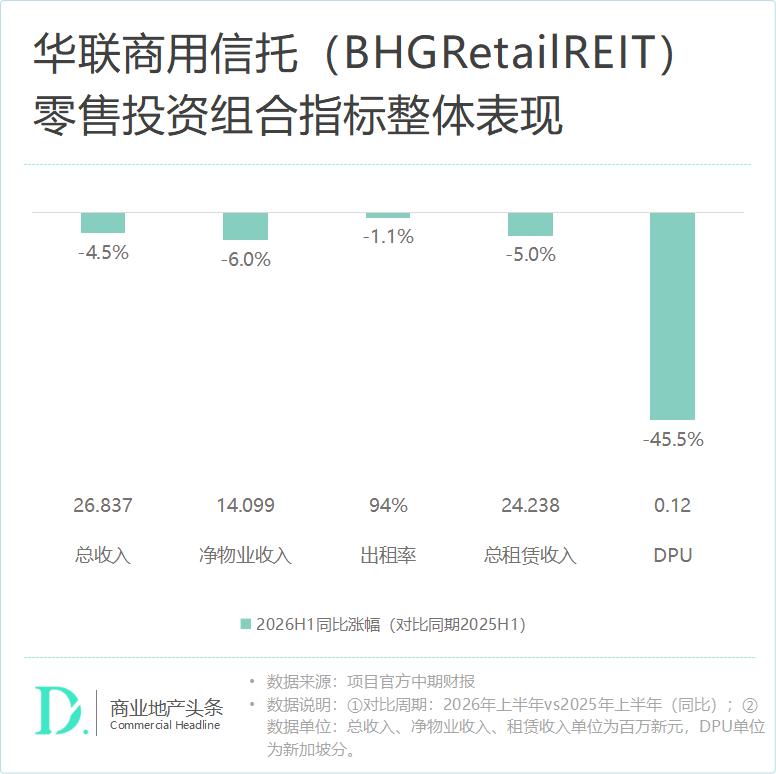
In the first half of the year, BHG's total revenue was SGD 26.8 million, down 4.5% year on year, net property income was SGD 14.1 million, down 6.0% year on year, and DPU was only 0.12 Singapore cents, down 45.5% year on year. Its core strategy is to maintain passenger flow by introducing new tenants and holding community activities.
What is more tricky is its balance sheet. Constrained by high leverage, BHG Retail REIT has very limited space for large-scale capital renovation (AEI) of its projects, so it can only focus on "tenant replacement" rather than "hardware renovation" in operation.
From the perspective of individual projects, the pattern shows obvious divergence. The Wanliu store in Beijing provides single-point support, the Airport project in Chengdu improves against the trend, the two underperforming stores in Hefei drag down the overall performance, and the two stores in Xining and Dalian maintain stability through "rent support" even though they are fully occupied. The key to reversing the situation lies in the tenant renewal and deleveraging progress of the underperforming stores in Hefei.
Yuexiu Real Estate Investment Trust: Dual Growth in Retail Revenue and Passenger Flow, Asset Renovation Focuses on "Scene Renewal"
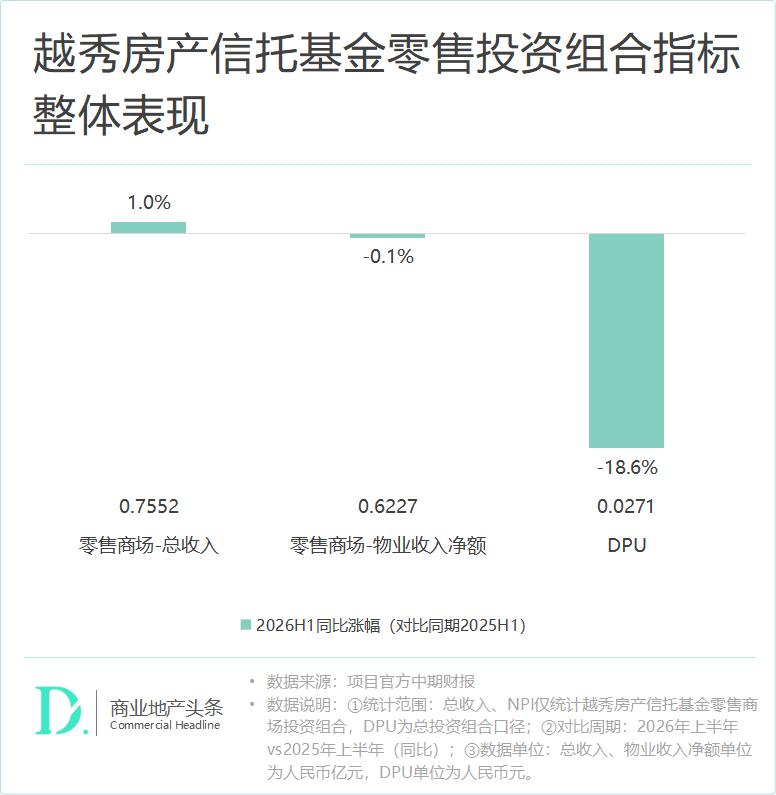
In the first half of 2026, the retail mall sector of Yuexiu Real Estate Investment Trust achieved operating income of 75.52 million yuan, a year-on-year increase of 1.0%. This sector accounts for about 9.8% of the fund's total operating income (767 million yuan). The occupancy rate of each project remains at a high level, with passenger flow and sales revenue achieving dual growth, showing strong operational resilience against the background of overall income pressure.
During the reporting period, the retail malls under Yuexiu Real Estate Investment Trust achieved basically flat NPI relying on renovation renewal and experience-oriented investment attraction. The "one store, one strategy" model is clear. Guangzhou International Finance Place (the retail podium of Guangzhou IFC) and Guangzhou Victory Plaza (VT101) focus on introducing urban first stores and creating characteristic blocks. Guangzhou International Finance Place has introduced 4 first stores in Guangzhou, and Victory Plaza has built the theme block "101PARK" to renew the outdoor scene experience. Wuhan Star Harbour Mall (the retail part of Wuhan property) focuses on renewing parent-child formats, while the wholesale market strengthens industrial docking and the upgrading of shopping guide services.
The specific performance varies from mall to mall. The volume and price of Guangzhou International Finance Place remain stable. Although the rent of Victory Plaza declined year on year, it maintained an occupancy rate of 94.1% with a 17% increase in passenger flow, 18% increase in sales and 80% renewal rate. The occupancy rate of Wuhan Star Harbour Mall reached 88.4% (up 6.0 percentage points year on year, the fastest improvement among the three malls), and it is still in the cultivation and climbing period.
It can be seen from the above that at present, Guangzhou International Finance Place is developing steadily and Wuhan Star Harbour Mall has improved significantly, making them the most resilient sectors in the mixed portfolio. However, the downward rent of Victory Plaza and the cultivation period of Wuhan Star Harbour Mall still bring short-term hidden worries.
China Merchants, Spring Real Estate, Hui Xian: Three Projects Have Different Performances, All With Declining Unit Rent
China Merchants' Shenzhen Shekou Garden City is the most stable core in the portfolio, which is almost fully occupied and sees dual growth in passenger flow and sales. Spring Real Estate's Huizhou Huamao Tiandi has a steady growth in fixed rent, but the floating rent decreased by 38.5% month on year, which is highly bound to the prosperity of retail sales. Hui Xian's Beijing Oriental Plaza, as a time-honored benchmark, saw its unit rent decrease by 8.0% month on month, and the rent for renewal and new leases generally went down, maintaining an occupancy rate of 90.1% by "reducing rent".
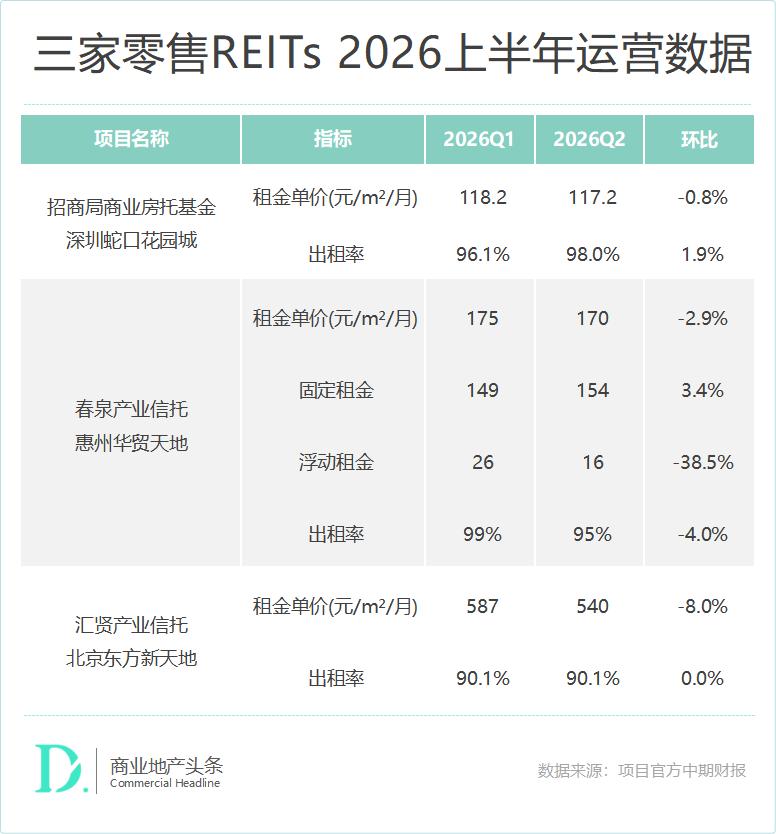
Looking at the 7 overseas retail REITs, a clear gradient of performance emerges: Outlet > Core Mall > Regional Department Store > Non-core Mall. Sasseur has the strongest counter-cyclical capability, CapitaLand's core malls achieve positive growth through active management, BHG's traditional department stores are most deeply impacted by format substitution, and Hui Xian's time-honored high-end malls maintain occupancy rate by cutting rent.
The decisive factor of performance is not simply the city tier, but the "core degree and age" of the assets. The time-honored malls in first-tier cities (such as Beijing Oriental Plaza) and the "non-core malls in new first-tier cities" (such as CapitaMall Xinnan, Changjiang West Road Hefei) are in the same vulnerable zone. On the contrary, the just-needed projects in third-tier communities (such as CapitaMall Nuohemule, with an occupancy rate of 99.9%) show higher risk resistance.
02.
Compare with Domestic Consumer REITs
Overseas Retail REITs Are a Mirror
If we compare overseas mainland retail REITs with domestic consumer REITs, the differences are clear. The overall occupancy rate of domestic assets remains at a high level, while the performance of overseas targets diverges significantly, with rental pressure and renovation pains occurring frequently.
The current situation of the overseas market is not the distant future, but a realistic reference that domestic consumer REITs need to face squarely after stepping out of the listing dividend period.
Occupancy Rate: Almost Full Occupancy in China, Severe Divergence Overseas
At present, the overall occupancy rate of domestic consumer REITs is much higher than that of overseas ones. Among the 12 projects of 11 domestic consumer REITs, 4 projects are in the almost full-occupancy tier. However, among the numerous asset packages of overseas REITs, except for a few projects such as Sasseur Chongqing Liangjiang and CapitaMall Nuohemule, the overall divergence is severe.
Rent Trend: "Peaking at a High Level" in China, "Continuous Decline" Overseas
At present, the rent feature of domestic consumer REITs is "rising year on year but generally falling month on month, having passed the inflection point", and the absolute rent value of leading projects still stays at a high level. The rent of overseas retail REITs shows the feature of "continuous decline, trading price for volume". Take Hui Xian's Beijing Oriental Plaza as an example, the unit rent dropped from 587 yuan in Q1 2026 to 540 yuan per square meter per month in Q2 2026, and the total rental income of BHG's investment portfolio in the first half of the year decreased by 5.0% year on year.
There is also an easily overlooked detail that the overseas market prices the "renovation pain" of projects more fully. Sasseur Hefei actively lowered its occupancy rate from a high level due to AEI