The second half of AI, the new narrative of applications
01
In August, quiet differentiation began within the AI sector.
SOXX, the ETF tracking the PHLX Semiconductor Index, hit its monthly peak on August 17 before turning downward, recording an 8.6% pullback by August 31. For the whole month, SOXX only posted a 0.7% gain, which was almost a wasted effort.
During the same period, the software sector took off. The IGV software index rose 12.9% for the full month. More importantly, the trend was distinct: after August 17, IGV rose an additional 7.8% against the overall market downturn.
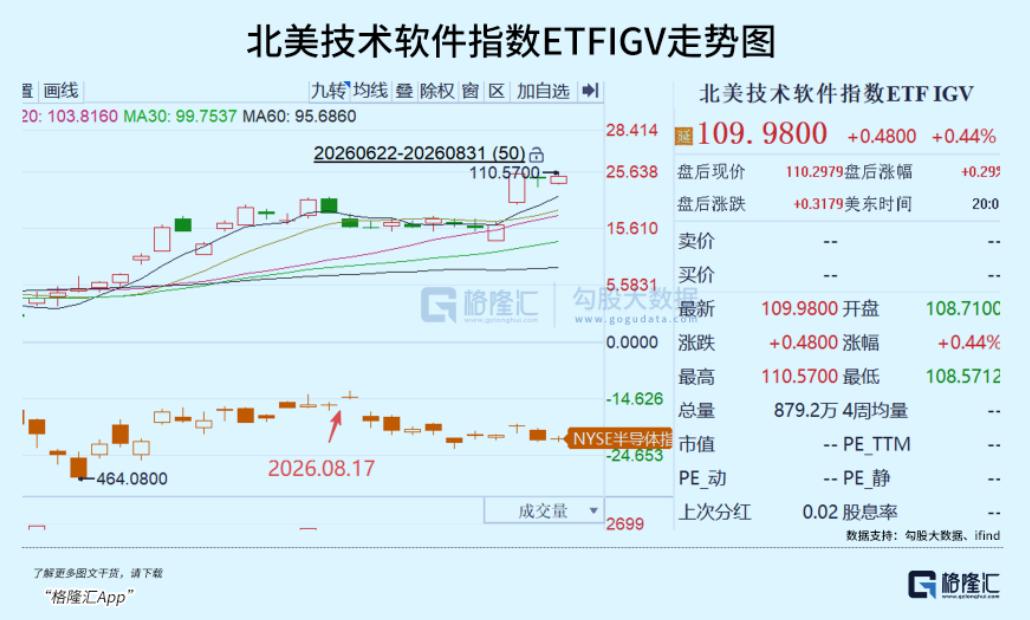
While chips surged then pulled back, the software sector kept moving upward steadily.
Both belong to the AI industry, why is their trend completely opposite to that in the first half of the year?
This is mainly driven by the combined effect of four factors.
First, the overcrowding degree at the trading level is being repaired.
In the first half of the year, global capital was highly concentrated in AI hardware, with NVIDIA, optical modules, and PCB sectors hitting new highs in turns. After the August earnings season, part of the gains from hardware positions were realized, and capital carried out a large rotation within the technology sector to rebalance into software assets that had underperformed previously.
Second, the earnings of software companies have begun to deliver AI-related revenue.
This is the essential reason.
The AI functions of overseas software companies are no longer just content on PPTs at press conferences, but have turned into figures in financial reports: existing customers are making additional purchases, renewal rates are improving, customer unit prices are rising, and formal orders are expanding.
The market narrative has completed three leaps: from the defensive stage of "Will AI subvert SaaS", to the stage of "The substitution risk is falsified", and then to the stage of "AI becomes a value-added layer that contributes to revenue growth".
Third, there are differences in interest rate sensitivity.
When the yield of long-term US Treasury bonds is at a high level, capital-intensive assets such as chips, which have upfront capital expenditure and delayed return, are longer-duration assets facing greater valuation pressure. In contrast, software companies are asset-light, release cash flow quickly, and have stronger risk resistance.
Fourth, the iteration of large models is accelerating, the price of homogeneous models is deflating, and the capability of domestic open-source models has improved significantly.
The more powerful and cheaper the models are, the expected profit distribution across the industrial chain will change - the market has begun to trade in advance on "who can truly turn computing power into chargeable products".
In other words, in the first half of the year, investors bought "shovels" because no one knew where the gold was. In the second half of the year, the outline of the gold mine has emerged, so capital naturally flows to players who can actually mine gold, sell water, and charge admission fees.
02
By breaking down overseas semi-annual reports, what marginal changes have taken place in AI software?
Palantir recorded an 89% year-on-year revenue growth in the first half of 2026, with a 93% year-on-year growth in Q2 alone, still accelerating. Its US commercial business grew 149% year-on-year in Q2, the remaining contract value of US commercial business increased 124% year-on-year, and the latest disclosed net dollar retention rate reached 157%.
This enterprise, which was previously regarded as a "government and military project company", proved one thing through the large-scale revenue growth in the enterprise market: AIP-related enterprise Agents have moved from POC (Proof of Concept) to formal procurement.
Another example is Salesforce. The annualized ARR of Agentforce has exceeded 1.5 billion US dollars, with a year-on-year increase of about 240%. The total ARR of Agentforce and Data 360 is about 3.9 billion US dollars, representing a year-on-year increase of about 210%.
What is more noteworthy is the business structure: more than half of the new Agentforce orders come from existing customers.
The business focus of these two companies is not the model itself, but the "last mile" of implementation: private data, business rules, workflows, permission systems, and industry know-how.
General large models can complete a large number of general tasks and easily reach the passing line. But what enterprises need is a score between 95 and 99, where accuracy, stability and controllability are all indispensable.
This gap is exactly the accumulated advantage that mature software service providers have built over ten or twenty years - they know exactly what their customers' processes look like, how to manage permissions, and where the data is stored.
As a result, the business model has also changed, shifting from unit-based subscription to a hybrid billing model of "seat subscription + pay-as-you-go consumption + AI value-added modules".
AI is not here to take away existing seats, but to add an extra floor on top of the original seat system, charging extra fees for the new value it brings.
This falsifies the pessimistic narrative in recent years: AI will not kill SaaS, instead, it will increase the average revenue per user of SaaS.
At the same time, it also tells domestic players not to compete in the underlying model track, but to focus on who holds private data, customer relationships and business processes.
These three assets cannot be taken away by model companies, nor can they be easily copied by industry giants.
03
Looking at the semi-annual reports of major domestic AI application vendors, a long-awaited fundamental resonance has also emerged.
On the enterprise AI track:
MeiFuShi recorded a year-on-year revenue increase of about 110% in the first half of the year, with AI-related business growing by 123.7%, the number of large customers tripled, and the profit in the first half of the year exceeded 200 million yuan.
The revenue from AI-native products of Kingdee International increased by 189% year-on-year, of which AI subscription revenue increased by about 283%.
Sangfor posted a 32.85% revenue growth in the first half of the year, and its cloud computing and AI infrastructure business grew by 58.60%.
The organizational-level AI products of Kingsoft Office have shown an obvious additional purchase trend among existing enterprise customers.
These performances reflect that the domestic application end is no longer purely driven by valuation game, and the revenue has begun to form positive feedback along with the development of AI.
On the other track, AI content.
On August 31, the first domestic AIGC long drama "Post Journey to the West" that landed on prime time of satellite TV was launched on Hunan TV and Mango TV, with 30 episodes in the first season.
The symbolic significance of this event is greater than the content itself - AI content has officially moved from small-screen test products such as short videos and manhua dramas to long dramas and large-scale TV broadcast schedules.
Industrial data is also accelerating: the domestic manhua drama sector grew by more than 100% year-on-year in the first half of the year; the AI short drama platform of Kunlun Wanwei recorded a revenue growth of about 160% in the first half of the year, and more than 90% of the newly added content is generated by AI; the short drama and IP derivative business of Chinese All Digital grew by about 110% year-on-year, and its overseas platform has achieved monthly break-even.
How fast did the capital market react?
Looking at the market on September 1st: Mango Excellent Media hit the 20% daily limit, rising 44.85% in 5 trading days; Chinese All Digital rose 4%, up 23.87% in 5 days; Kunlun Wanwei rose 5%.
Why is AI content attracting capital attention?
Because it is exactly the opposite of enterprise software: enterprise software is led by overseas markets and then mapped to the domestic market, while China is moving faster in AI content production.
China has a complete domestic AI short drama industrial chain, mature short video infrastructure, and high user acceptance. There is a feasible path of "expanding the scale domestically first, then replicating the model overseas" in the future.
Therefore, in terms of investment opportunities, for enterprise AI Agents, we should focus on software service providers that have accumulated deep customer resources and business processes; for AI content, we should give priority to overseas-facing short drama platforms - where four favorable factors resonate: high industry prosperity, AI-driven cost reduction, rising user acceptance, and still low penetration rate.
As for hardware, the investment logic has not failed, but the sustainability of capital expenditure after 2028 needs to be endorsed by the revenue growth from the application end.
The healthiest development path for the industry is naturally the alternating upward trend of software and hardware.
Looking back at the decade of mobile Internet, it is easy to understand: operators that built 4G infrastructure did not make huge profits, Nokia that sold mobile phones lost all its gains, and finally the profits were taken by WeChat and Meituan that ran business on the network.
Risk Warning:
The risk that the commercialization of AI applications falls short of expectations; the risk that the recovery of enterprise IT budgets is lower than expected; the risk of intensifying industry competition; the risk of overseas macroeconomic and exchange rate fluctuations.
Note: The industries involved in this article are only for industrial case analysis and do not constitute any investment advice. The market is risky, and investment needs to be cautious.
Disclaimer: The copyright of this article belongs to the research team of Beijing Gelonghui Investment Consulting Co., Ltd. (Duan Yuehan, Certificate No. A0160625050003). This report is produced based on the principles of independence, objectivity, impartiality and prudence. All information is sourced from public materials, and has been collected, abstracted and edited legally, reasonably and appropriately.
The stock market is risky, and entering the market requires caution. Any investment advice in this article shall not be used as the basis for your investment transactions. You must make independent investment decisions and bear your own risks. Any entity or individual who unauthorizedly publishes, copies, disseminates or reposts this article online without the permission of the company shall be deemed as infringement, and the company will pursue legal responsibility for the infringement.
This article is from the WeChat official account "Gelonghui Finance Hotspot" (ID: glh_finance), author: Gelonghui Editor, 36Kr is authorized to release it.