Two giants in the large model track have handed in their latest performance transcripts: the business scale of Zhipu AI's open platform and APIs has surged 27 times, and MiniMax has recorded a net loss of about 2.1 billion yuan.
Two listed large model companies have almost the same overall performance, but their market value differs by more than 400 billion yuan. At the peak, the market value of one of them even exceeded the trillion-yuan mark.
This is a spectacle in this year's capital market.
On the evening of August 31, Zhipu released its 2026 interim performance report. A few days earlier, MiniMax had taken the lead in releasing its results.
Looking at the financial data of the two companies side by side, it can be found that the overall performance of the two companies is at the same level.
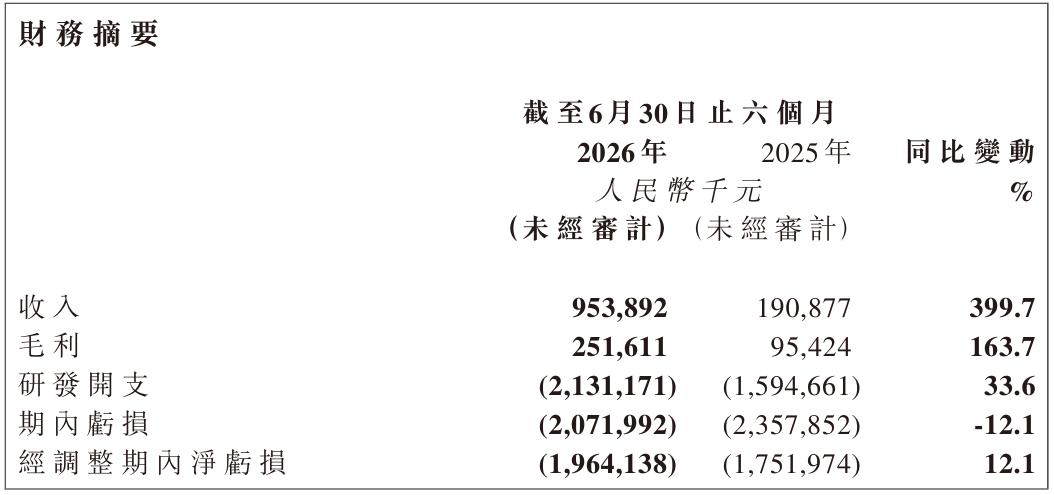
Source: Zhipu Semi-Annual Report
In the first half of the year, Zhipu recorded a revenue of 954 million RMB, and MiniMax recorded a revenue of 117 million USD (about 840 million RMB), with a difference of less than 15% after conversion. Zhipu posted a loss of 2.07 billion RMB during the period, while MiniMax recorded an adjusted net loss of 293 million USD (about 2.1 billion RMB).
The two companies are equally matched, both struggling on the verge of loss.
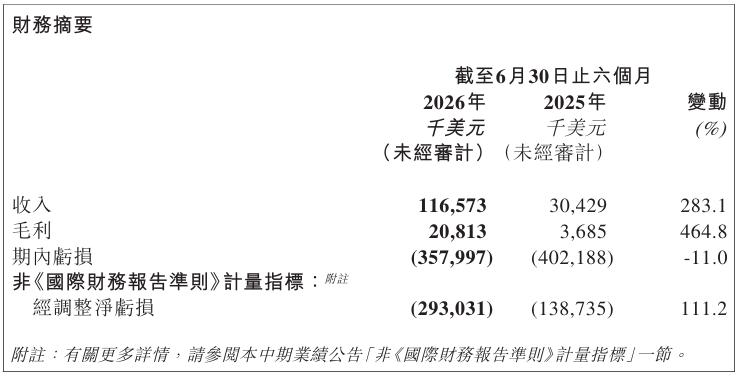
Source: MiniMax Semi-Annual Report
In terms of revenue sources, APIs have become the core revenue source for both companies, which is a business model where developers pay based on call volume.
But looking back a year ago, the two companies took almost completely opposite paths, yet today they have reached the same destination and converged in the same direction.
Zhipu: Transforming Business Structure, "Selling API Calls" Becomes the Core
Last year, Zhipu was more like a project-based software company. According to its 2025 annual report, the revenue from localized deployment reached 534 million RMB, up 102.3% year on year, accounting for 73.7% of the total revenue. This was equivalent to packaging models for customers and delivering them on a project-by-project basis.
However, in the first half of this year, the revenue of the localized deployment business was 129 million RMB, accounting for 13.5% of the total revenue. Compared with the same period of the previous year, the figure was 161 million RMB, down 20.5% year on year. Zhipu stated that against the backdrop of explosive growth in cloud deployment, it is now placing more emphasis on the quality of localized business and industry selection.
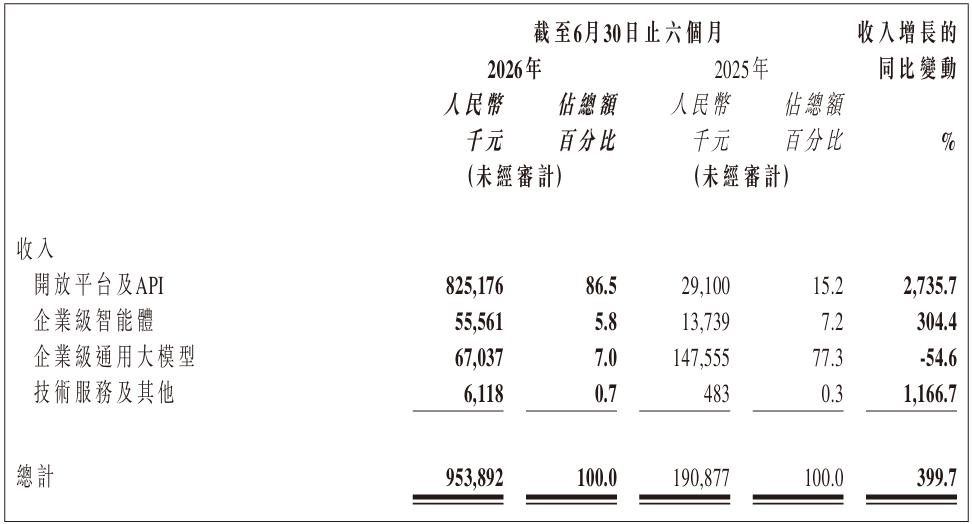
Source: Zhipu Semi-Annual Report
Meanwhile, "selling API calls" has become the core. In the first half of the year, the revenue from Zhipu's open platform and API business reached 825 million RMB, up 2735.7% year on year, with its proportion in total revenue jumping from 15.2% in the same period of last year to 86.5%.
In the same period of last year, the largest revenue source was enterprise-level general large models, with a revenue of 148 million RMB, accounting for 77.3% of the total. In the first half of this year, this figure dropped to 67.03 million RMB, accounting for 7%.
In other words, within one year, Zhipu's revenue structure has been completely transformed.
Zhipu explained that this is "an inevitable outcome after the leap of model capabilities". Roughly speaking, when the model capability is strong enough, customers are willing to pay per use instead of paying a large sum to buy the full set of models outright.
MiniMax: Reaching the Same Goal with Different Paths, Focusing on the B-end
MiniMax's initial products were mainly targeted at ordinary users. Although C-end revenue declined in the first half of this year, the revenue from AI-native products reached 42.644 million USD (about 308 million RMB), still accounting for 36.6% of the total revenue.
The bigger highlight lies in the other side of its business.
In the first half of the year, the revenue from MiniMax's open platform and other AI-based enterprise services reached 73.929 million USD (about 534 million RMB), compared with 9.206 million USD (about 66 million RMB) in the same period of last year, representing a sharp year-on-year increase of 703.1%, which has become the largest revenue source of MiniMax.
In other words, MiniMax's revenue has also been dominated by the B-end. (Refer to "MiniMax Semi-Annual Report: Revenue of 117 million USD, Loss of 358 million USD, Gross Profit of 20 million USD")
It is quite interesting that one company started from "selling projects", while the other started from "selling products". But in less than a year, they moved towards each other and met at the same intersection.
It is worth noting that both financial reports illustrate one point: the revenue of AI companies is changing from project and subscription modes to pay-as-you-go mode just like utilities such as water, electricity and gas. The model has become an infrastructure, and API calls are like water flow, you pay for the amount you use.
In the long run, this is in line with the industry development trend. From selling models, to selling API calls, then to selling subscriptions, and finally to selling end-to-end task results, the more complete the tasks that the model can independently complete, the closer the products customers purchase are to the results themselves, the unit of measurement of revenue will change accordingly, and the revenue structure of enterprises will also be adjusted.
Behind the growth rate, the quality of growth also needs to be taken into consideration.
For example, Zhipu's open platform and API business saw a year-on-year growth of 2735.7% in the first half of this year. At first glance, the growth rate is very impressive, but it is based on an extremely low base in the same period of last year — only 29.1 million RMB.
In terms of price, the average selling price of Zhipu's APIs increased by about 101% in the first half of the year, indicating that the revenue growth is not achieved by lowering prices to boost volume.
Large Model Enterprises Are Converging to the Same Track
Looking overseas, we can find that overseas peers are also following the same path, with more than 80% of Anthropic's revenue coming from enterprise APIs and developers.
In other words, Chinese large model companies are moving towards the same set of proven business models.
At the capital level, although Zhipu and MiniMax have almost the same revenue, their market values are vastly different.
At the close of trading on September 1, the total market value of Zhipu was 554.1 billion Hong Kong dollars, and the total market value of MiniMax was 121.3 billion Hong Kong dollars. It seems that Zhipu is more "valuable" than MiniMax, with a gap of more than 430 billion Hong Kong dollars.
From the perspective of the peak period, the total market value of Zhipu once exceeded one trillion Hong Kong dollars, the irrational performance of the market has reached the extreme.
Market sources said that Anthropic may go public in late September or early October, with a valuation of more than 2 trillion USD.
There is no highest valuation for AI enterprises, only higher ones. A reasonable explanation may be summed up in one sentence: the market does not follow the conventional rules.
In addition to positive financial data, there are two other indicators worthy of attention.
The first is R&D investment. In the first half of the year, Zhipu's R&D expenditure reached 2.13 billion RMB, up 33.6% year on year. This R&D investment intensity has exceeded its total revenue in the same period.
MiniMax is in a similar situation. In the first half of the year, MiniMax's R&D investment reached 296 million USD (about 2.137 billion RMB), while its revenue in the same period was 117 million USD (about 840 million RMB). "Exchanging capabilities at the cost of losses", this arms race is far from over.
The second is on the profit side. In the first half of the year, Zhipu's overall gross margin was 26.4%, while MiniMax's gross margin in the same period was 17.9%. Compared with the gross margin of the traditional software industry, selling API calls is more like "making up for low unit price with high volume", and this business is not "comfortable" at all.
Overall, AI large model companies have achieved the "selling API calls" model in their financial statements, which can be clearly seen from the data. The next question to be answered is how to convert "API calls" into profits, which is the real test.
This article is from the WeChat official account "Yiou" (ID: i-yiou), written by Wang Yuanlei, published with authorization from 36Kr.