Three Tsinghua alumni have rung the listing gong at the Hong Kong Stock Exchange.
Following Unitree, another robotics company is making its IPO debut.
As learned from Investment Insider, today (September 1), Mech-Mind (Xiong'an) Robotics Technology Co., Ltd. officially listed on the Hong Kong Stock Exchange. The issue price is HK$101.7 per share, with total fundraising of approximately HK$2.353 billion, and the opening market value exceeds HK$12 billion.
This time, 37-year-old Tsinghua alumnus Shao Tianlan is standing on the stage.
Ten years ago, he returned to China from Germany to start his business, choosing a niche direction at that time: to equip industrial robots with "eyes" and "brains", using AI and 3D vision to help robotic arms perceive the environment, identify objects, and then complete decision-making and planning. Starting a business is full of hardships. Shao Tianlan once flipped through his first version of the business plan and said it was "too embarrassing to look at". He often mocks himself as the company's "No. 1 customer service" and "startup workaholic".
Riding the wave of the embodied intelligence listing boom, Mech-Mind successfully struck the gong. But behind it, peers are still lined up in a long queue, waiting anxiously.
Three Tsinghua Alumni, Ten Years, Finally Ring the IPO Bell
The story starts with a department transfer at Tsinghua University.
When Shao Tianlan was admitted to Tsinghua, he studied in the Department of Electronic Engineering. Later, by chance, he joined the software department of the Science and Technology Association of the Department of Electronic Engineering, and stayed up late with his classmates to write programs and work on projects. After that, he found that what he was really interested in was software, so he transferred to the School of Software of Tsinghua University in his sophomore year.
When he graduated with a bachelor's degree in 2012, he did not enter the then most popular Internet industry, but chose to study robotics at the Technical University of Munich. "Since I decided to work in robotics, I will go to the place with the strongest robotics industry."
But after really entering this industry, the robots he saw were not those in sci-fi movies. During his postgraduate study, a team of seven or eight people often had to program for a week to make the robot complete a simple task that humans could understand after listening to one or two sentences. This made Shao Tianlan realize that what restricts the application of robots may not be the mechanical body, but the capabilities of perception, understanding and planning.
In the summer of 2016, when China's entrepreneurship boom was in full swing, 27-year-old Shao Tianlan returned to China and founded Mech-Mind.
Before officially starting his business, Shao Tianlan spent nearly three months intensively visiting factories and system integrators, and finally decided to cut in from the handling scenarios with the most direct demand. For example, in some brick factories in Tangshan, the workshops are hot and full of dust, and brick handling is a tough heavy physical labor. Equipped with 3D vision, the robotic arm can identify the position and shape of bricks, then complete grasping and stacking, liberating workers from the harsh working environment.
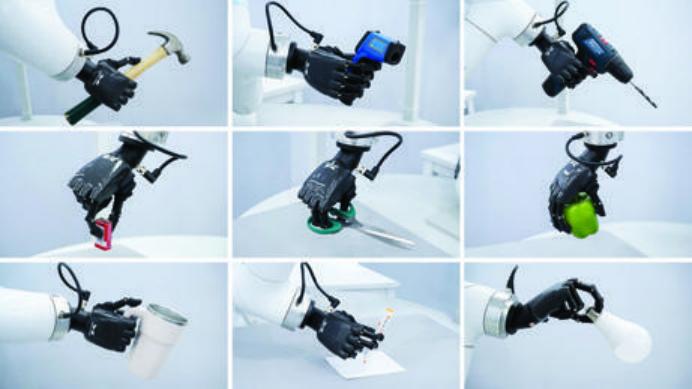
Mech-Hand Bionic Five-Finger Dexterous Hand Source: Prospectus
Soon, three young Tsinghua people got together and formed the founding team of Mech-Mind: Shao Tianlan is in charge of software and algorithms; Fu Ao graduated from the Department of Precision Instrument of Tsinghua University and has working experience at ABB, familiar with mechanics and mechatronics; Ding Youshuang is a doctor from the Department of Electrical Engineering of Tsinghua University, proficient in robot control algorithms.
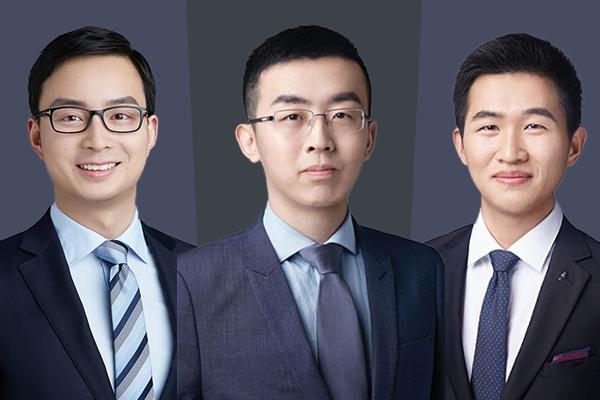
From left: Fu Ao, Shao Tianlan, Ding Youshuang
Industrial robotics is a business that cannot be rushed. For a set of products to enter a factory, it must first pass on-site tests, then go through the customer's internal procurement process. After official delivery, it must run in with different equipment, processes and production lines one by one. Any insignificant problem may stop the entire system, such as a spider blocking the lens, a network cable broken, power not connected, the label of the box facing the wrong direction... In those years, Shao Tianlan often traveled to factories.
Gong Yuan, partner of HSG, is the same age as Shao Tianlan, and the two have known each other for 9 years. Gong Yuan remembers that once they arranged to meet at HSG's office in Shanghai Plaza 66. Early that day, Shao Tianlan just came back from a factory in another city: holding breakfast in his left hand, carrying a toiletry bag in his right hand, and dragging luggage behind him.
"At that time, he lived in the customer's factory for product implementation, looking very haggard with unshaven beard. So he went to the bathroom of Plaza 66 to wash his face and shave before sitting down in the meeting room," Gong Yuan recalled.
Later, Gong Yuan simply stopped asking Shao Tianlan to meet in office buildings, and tried to arrange meeting places closer to factories.
In the first few years of starting the business, the difficulty was to develop the product. After scaling up, how to make the product stably replicable became a new problem. The supply chain, algorithms, on-site debugging and customer service all need to be rebuilt amid growth. Shao Tianlan later described this stage as the plane has taken off, but new problems are constantly being discovered, so you can only repair it while flying.
It is in this way that the products are iterated in rounds of on-site running-in. In 2021, Mech-Mind's self-built factory was put into operation, and the deep learning software Mech-DLK was launched; in 2023, the company launched the multimodal large model Mech-GPT; in 2025, it released the bionic five-finger dexterous hand Mech-Hand, gradually forming the component combination of robot "eye, brain and hand".
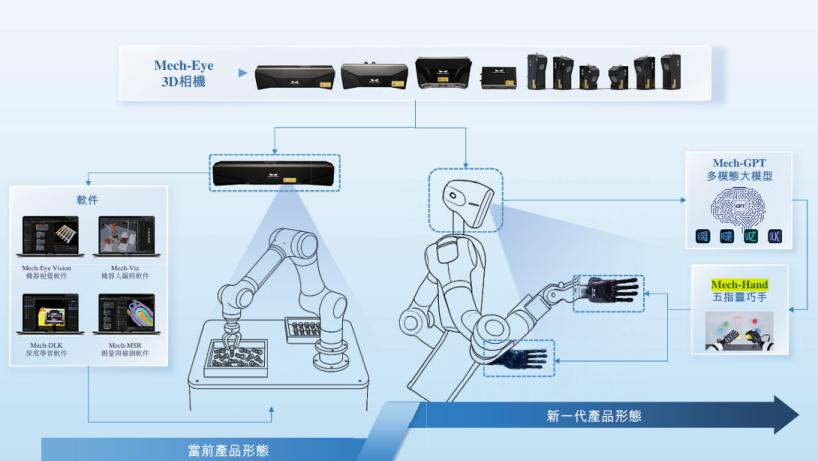
"Eye, Brain and Hand" Product Portfolio Source: Prospectus
Ten years of hardships are finally written into the prospectus.
From 2023 to 2025, Mech-Mind's revenue was RMB 181 million, RMB 269 million and RMB 389 million respectively. In the first quarter of 2026, the company's revenue reached RMB 107 million, a year-on-year increase of about 73%.
Among them, what really supports the revenue is still the robot "eyes" and "brains" that the company relied on in its early days. In 2025, the revenue of intelligent robot guidance products was RMB 361 million, accounting for 93% of the company's total revenue; intelligent inspection and measurement products contributed RMB 23.07 million, accounting for 5.9%.
According to statistics from CIC Consulting in the prospectus, calculated based on 2025 revenue, Mech-Mind accounts for about 22.1% of the global market share of "AI + 3D Vision Guided General Intelligent Robot Components", ranking first.
Well-Known VCs Gathered, Unveiling the Investment Stories Behind
Along the way, Mech-Mind has assembled a long list of investors.
At the end of 2016, when Mech-Mind was still in an incubator located in Wudaokou, its first financing was several million yuan from PreAngel, and the angel round investors also included Galileo Capital, etc.
In the following years, which was the key precipitation period for Mech-Mind to move from technical prototypes to large-scale implementation, recognition from investors gradually came — in 2017, Mech-Mind completed a RMB 15 million Pre-A round of financing, exclusively invested by China Growth Capital; in 2018, it obtained the Series A round led by Delian Capital.
It was not until 2019 that Qiming Venture Partners decided to invest. Zhou Zhifeng, Managing Partner of Qiming Venture Partners, revealed that the final decision was made based on three reasons:
First, from the perspective of intelligence, a closed loop has not been formed between the robot's "brain" and the robot's movements, and a large number of devices are still essentially operating "blindly". This is the key bottleneck for the evolution of intelligence, and it is not the strength of established Japanese, European and American robotics and technology companies;
Second, Mech-Mind's innovation is not only to endow robots with environmental perception capabilities using deep learning technology, but also to build robot brains with full-stack AI software and hardware, open up the closed loop of environmental perception, intelligent decision-making and robotic arm execution, and use technology and products to create an incremental market with a multi-fold increase in demand;
Third, the core team of Mech-Mind has never changed their determination to stick to the technical vision and the downstream industrial automation market — this has been consistent for the past seven years, which is the most appreciated entrepreneurial trait of Qiming.
In the end, Qiming Venture Partners exclusively led the Series A+ financing of Mech-Mind, becoming the core booster in the early stage of its commercialization, holding 7.38% of the shares before the IPO. For this IPO, Qiming is also one of the two leading senior independent investors for the company's Hong Kong listing.
Also in this year, Mech-Mind started its overseas expansion, and obtained strategic investment from Intel.
In 2020, HSG came on board. At that time, robotics was still a typical "non-consensus" track, and "embodiment" was not a common term. The industry generally remained in the stage of traditional programmed robotic arms, and the market had no awareness of AI hand-eye coordination and scenario generalization capabilities.
But Gong Yuan, partner of HSG, captured Mech-Mind's core advantage — its products already had extremely strong scenario generalization in the "pre-embodied intelligence era", which could break the limitations of fixed operations of traditional industrial robots, adapt to complex and disordered scenarios in multiple industries, and have long-term growth space for generalized products.
To verify the authenticity of the technology and implementation capabilities, HSG's investment team spent two months visiting pilot factories including steel mills, logistics factories, automobile factories and garment factories in 10 cities across the country, completed interviews with dozens of industry experts, and confirmed through on-site investigation: in the early stage of Technology-Market Fit (TMF), Mech-Mind already ranked first in the industry in market share and had formed a good market reputation, which fully consolidated the investment judgment.
Founder Shao Tianlan is the key for HSG to make long-term heavy investment. As Gong Yuan said, Shao Tianlan's technical background matches the direction he is working on, and he is very down-to-earth, willing to squat in factories, which is a rare trait among returnee AI entrepreneurs.
"There is one sentence he said that impressed me a lot: Starting a business is like driving a car rushing towards a cliff, and the competition is to see who can get closer to the cliff without falling, so the control of the accelerator and the brake is particularly important. Over the past years, robotics and embodied intelligence have experienced many highlights and troughs. We have seen many companies either 'step on the accelerator too hard' and die, or 'step on the brake too early' and fail to break through. Those who are too radical and too conservative cannot laugh last." Gong Yuan recalled.
In this way, HSG invested in 4 consecutive rounds, becoming the largest external institutional shareholder of Mech-Mind before IPO, holding 13.63% of the shares.
Source Code Capital made its first investment six years ago, on the eve of the formation of a huge consensus in the embodied intelligence track. At that time, Source Code did not dwell on the current revenue volume of the enterprise, but focused on three long-term core issues: whether AI + robotics is a deterministic industrial direction, whether standardized perception and planning components can be replicated across industries, and whether the team can adhere to the long-term product route. After in-depth research, Source Code judged that Mech-Mind's product route of "generalization, standardization, cross-body" is completely different from the industry's fragmented customization model, and has extremely strong large-scale growth potential.
Based on this, Source Code Capital jointly led the Series B+ financing of Mech-Mind with HSG in 2020, and then successively participated in the Series C and Series C+ rounds of financing, holding 5.49% of the shares before the listing.
"Our company met Source Code Capital shortly after its establishment, and we have been in contact throughout the entrepreneurial process. When the company developed to the right stage, we immediately thought of Source Code, because we have similar styles and a good trust foundation, just like an old friend joining in the entrepreneurial process, which feels very good." Shao Tianlan said emotionally.
In 2021, IDG Capital led the Series C financing of Mech-Mind, and continued to follow up the investment afterwards. Niu Kuiguang, Partner of IDG Capital, said: "We are very glad to see Mech-Mind grow from a technical team to a leading enterprise in the global 3D vision and embodied intelligence field. This listing is a market verification of its long-term technical investment and industrialization capabilities, and also reflects the competitiveness of its technology and products in the global market. We will continue to support such enterprises to achieve long-term growth."
In addition, Mech-Mind's investors also include Meituan, Coatue, GIC, CICC Porsche Fund, Dayang Motor, Tianchuang Capital, as well as state-owned shareholders such as China Xiong'an Group, Hebei Provincial State-owned Enterprise Reform and Development Fund, and Xiong'an Fund. After years of companionship, the investors have ushered in the moment of return.
Following Unitree, Competing for the Hong Kong Stock Exchange IPO Window
As you can see, the robotics listing boom is coming.
On August 19, Unitree officially listed on the Sci-Tech Innovation Board of the Shanghai Stock Exchange, becoming the first "humanoid robotics stock" in A-share market, with its market value once approaching RMB 450 billion on the first day of listing.
Since the day after listing, Unitree's stock price has started to fall, and in recent days it has nearly halved — the listing of Unitree has brought the anchor of pricing for the embodied industry, but the market is still testing for the best answer.
But in any case, with the successful IPO of Unitree, the "landing moment" for China's embodied intelligence industry has officially begun.
According to incomplete statistics, more than 20 embodied intelligence companies have clarified their listing plans since the beginning of this year, including Agibot, Deep Robotics, Leju Intelligence, etc.; in addition, Starsea, Whip Motion, Robust Robotics, Songyan Dynamics, Star Age, Stardust Intelligence, Fourier Intelligence have completed share reform to prepare for subsequent IPO; there are also CrossVision, Zhipingfang, Zibianliang, etc. that are also preparing for Hong Kong IPO...
Everyone hopes to get the next quota. But no one can deny that the capital market's screening of embodied enterprises will become more and more stringent, and this IPO road with thousands of troops crossing a single-plank bridge will inevitably become narrower.
Witnessing this listing boom, Zhou Zhifeng put forward the latest judgment. He believes that many enterprises rushing for IPO are, to a certain extent, seizing the scarcity dividend of early listed targets in the track, but the valuation premium brought by scarcity is only an additional item, not the core support of enterprise value. Whether an enterprise can be successfully listed and what kind of differentiation will occur in the secondary market performance after listing depends on several key points:
First, the capability of large-scale commercial implementation.