Brands are scrambling to capture the back-to-school season market, how will campus marketing compete in the highly intense rat race?
Every September marks the highly anticipated "Back-to-School Season" that excites both parents and students alike.
Data from Ocean Engine shows that the search volume of keywords such as "back to school", "new semester" and "exam preparation" on Douyin has tripled in the past two years, and the number of views of topics related to "back-to-school season" has exceeded 100 billion; on Weibo, the total views of the #BackToSchoolSeason# hashtag have reached 23.6 billion, with more than 50 million discussions. From sharing photos of new student gear to daily military training updates, from back-to-school anxiety to new semester plans, relevant discussions run through the entire month of September.
Driven by the siphon effect of massive traffic, major brands and platforms have already flocked to this track:
Content platforms cater to young people's desire for self-expression. For example, Bilibili has launched a series of activities including collective operations of official university accounts, the micro-variety show *Back to School with Big Moves*, and campus life content collection campaigns.
E-commerce platforms demonstrate their "spending power": Tmall and JD.com have successively launched dedicated back-to-school season zones. Tmall offers multiple benefits such as 88VIP consumption coupons and category-wide discounts, while JD.com provides a 1,000-yuan coupon package for groups of three and official direct cuts as low as 50% off, striving to meet all back-to-school consumption needs in one stop.
Brands are also vying to increase their exposure: Chenguang has launched new co-branded back-to-school products in collaboration with Snoopy and sponsored the variety show *Universe Helpers*; Watsons has partnered with Saky to launch a "three-in-one" set and held multiple offline pop-up events; Jinmailang has launched co-branded Anhui style noodles with Capibara...
In this all-in back-to-school season marketing competition, what brands and platforms are targeting is far more than short-term popularity: the ultimate goal is to complete brand positioning and mind penetration among young student groups through the back-to-school node, create personas with emotional resonance, and then anchor long-term growth potential.
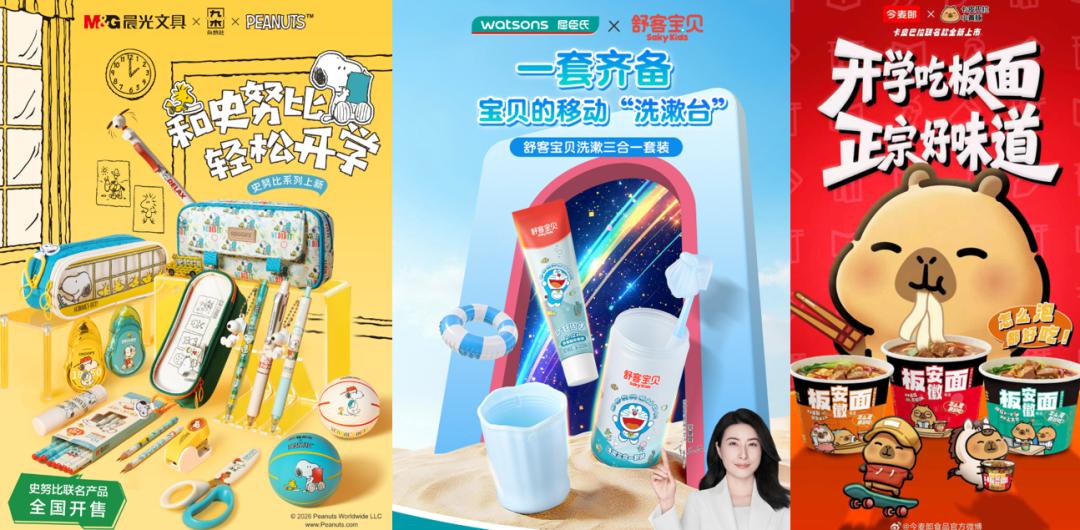
Chenguang & Snoopy, Watsons & Saky, Jinmailang & Capibara
Brands' Strategy: Strive for Popularity, Conversion and Mind Assets All at Once
The appeal of the back-to-school season is multi-layered: while the national topic popularity and traffic siphon effect are undoubtedly attractive, the high conversion certainty from traffic to transactions, the long-term commercial potential of campus scenarios, and the advance layout of the younger generation's mind assets are also core driving forces for brands.
First of all, traffic popularity has always been the underlying demand of brands, and the back-to-school season is one of the few public communication nodes in the whole year that can gather attention from multiple parties at the same time.
Different from man-made promotion nodes such as Double 11 and 618 that come with strong inherent commercial attributes, the back-to-school season naturally carries deeply rooted social and cultural consensus: the younger generation values the "sense of ritual for starting school", parents attach great importance to education investment, and the general public also has widespread emotional resonance for the "new semester, new starting point" concept.
This means that the back-to-school season can cover the attention of students, parents and the public at the same time, and has the inherent potential for cross-circle communication. By leveraging this high-profile public topic, brands can achieve a concentrated burst of brand voice at lower communication costs, and fully accumulate momentum for subsequent consumer conversion.
Secondly, if traffic popularity solves the problem of "brands being seen", the concentrated release of rigid consumption in the back-to-school season directly responds to the "conversion certainty" problem that brands care most about.
Different from the pulse consumption driven by discounts at man-made promotion nodes, the back-to-school season caters to the natural rigid needs of student groups and parent-child families. For new students, the back-to-school season is a comprehensive reconstruction of the entire learning and living scenario; for senior students, the sense of ritual of the new semester and the experience of self-growth also generate a large number of renewal and replacement demands.
From digital products, daily necessities, stationery, to beauty and skincare products, sports shoes and clothing, trendy toys and figurines, almost all mass consumer categories can find corresponding demand scenarios in the back-to-school season.
JD.com data shows that the turnover of 3C digital AI categories increased by 360% year-on-year during this year's back-to-school season; according to statistics from Douyin Local Life Service, on the eve of the new semester, the platform's catering group-buying orders and service retail orders increased by 50% and 45% respectively, among which consumption in DIY craft workshops surged by 933%, consumption of transportation tools such as electric vehicles increased by 236% year-on-year, and books & culture, parent-child shopping also increased by 172% and 141% respectively.
This rigid demand driven by real life scenarios has the characteristics of concentrated time, clear demand and short decision-making cycle, which can undoubtedly greatly reduce the uncertainty of marketing conversion.
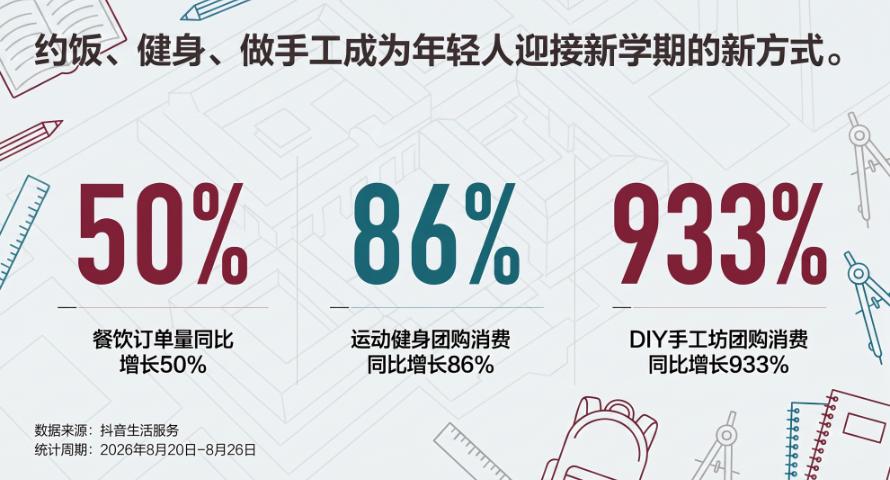
Douyin Local Life Service Back-to-School Season Consumption Statistics
If the short-term sales surge is just an "appetizer", for more brands, taking root in campus scenarios, penetrating student circles and laying out long-term incremental markets is the "long-term dividend" of increasing investment in back-to-school season marketing.
As the traffic dividend of traditional online channels gradually peaks, brands are in urgent need of finding new "low-cost customer acquisition depressions".
The campus market with clear user portraits, stable demand and huge consumption potential is exactly a rare incremental position. The *2025 China University Blue Book* released by Palm University predicts that the consumption scale of the national university market will increase to 1.6 trillion yuan in the next 4 years.
To truly penetrate campus scenarios and integrate into student circles, the back-to-school season is a window that cannot be missed. Because the student group is not only large in scale, but also has strong social communication attributes. For example, "sharing photos of new school gear" has always been one of the most popular social topics among young people. The Blue Book shows that 45.83% of college students yearn for "emotional consumption", and 92% of college students believe that sharing order photos is an important way to maintain their social image.
By integrating into the back-to-school season atmosphere through product placement and scenario interaction, brands are not only taking a "shortcut" to build good relationships and connections with young people, but also can amplify their circle influence, build brand awareness, and lay a good foundation for subsequent word-of-mouth fission and mind precipitation.
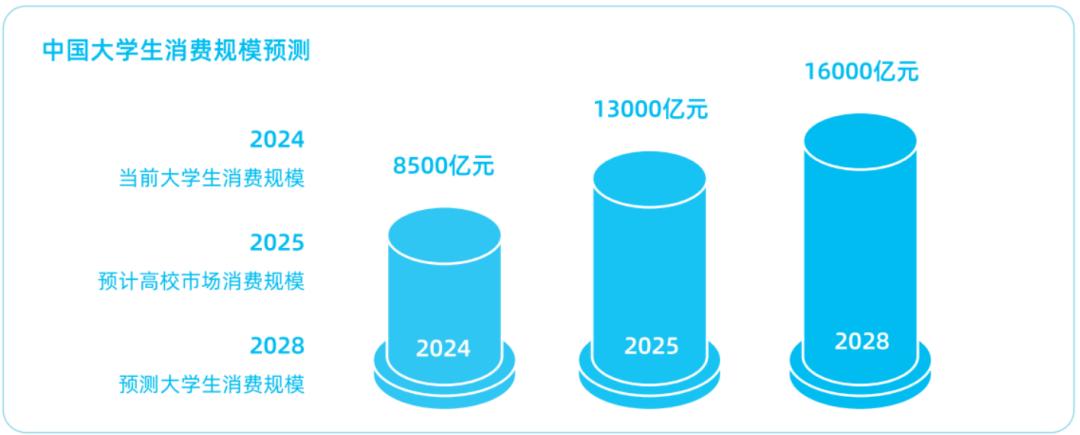
Consumption Scale Forecast in *2025 China University Blue Book*
In addition, the systematic boost from the platform side further releases the commercial potential of the back-to-school season.
In recent years, major platforms have begun to build the back-to-school season as an "S-level project", tilting traffic resources, linking more merchants, launching multiple supporting tools, and continuously amplifying the commercial value of the back-to-school season.
Kuaishou Magnetic Engine provided a large number of supports including cashback red envelopes, traffic support and talent matching in last year's back-to-school season "New Start with Back-to-School Gear" campaign, with a total exposure of 515 million and more than 800 participating merchants; the number of newly created active new products reached 10,000, an increase of 21% month-on-month.
Ocean Engine also launched marketing IPs such as "Vibrant New Semester", "Free Back-to-School Season" and "Level Up with Back-to-School Gear" during the back-to-school season to help brands seize the back-to-school season dividend. Among them, the overall market expansion rate of the education industry reached 158% during last year's back-to-school season, second only to Double 11 among all marketing nodes in the second half of the year.
It can be seen that platforms and brands have a mutually beneficial relationship where each takes what they need: platforms need to drive GMV growth and improve user activity and stickiness through node marketing; brands rely on the platform's traffic, tool support and user scale to achieve more efficient reach and conversion. The combined force of the two has jointly shaped the back-to-school season into an annual marketing arena with both strong voice and high sales.
From Traffic Harvesting to Mind Penetration: Four Evolutions of Back-to-School Season Marketing
After clarifying the underlying motivations of brands, returning to the specific marketing practice level, we can find that back-to-school season marketing has long been out of the primary stage of discount promotion and hard advertisement spamming. In the continuous iteration of gameplay, brands have gradually established four new trends.
First, shift from "online bombing" to "in-depth offline cultivation", continuously sinking marketing positions to win the full trust of young people.
In the past, most brands doing back-to-school season marketing had "online dependency syndrome": they invested heavily in traffic delivery and coupons, taking the "traffic harvesting" route. But in the past two years, more and more brands have begun to sink their marketing positions offline and carry out "in-depth experience".
For example, Thermos organized a pop-up market at the "Little Star" Art School of Shanghai Oriental TV, launching a series of parent-child activities such as check-in stamp collection lottery and mini-game interaction, targeting kindergarten and primary school family users; Bawang Chaji continued the tradition to organize university campus tours, and posted on social media to let users nominate universities to be toured, mobilizing students' enthusiasm in advance.
Xiaohongshu took a different approach, instead of entering the campus, it built a "Big Can't Fall Island" in Shanghai Expo Cultural Park: invited stars such as Guo Xiaoting, Xie Keyin, Zhang Yifan and Qu Ying to help out, and invited college students to "go to the island" to participate in a series of activities including talk shows, debates, art performances and DIY handicrafts.
Whether it is building an island around young people or entering public fields such as campuses, the scenario selection is highly targeted, which can help brands achieve more accurate crowd reach and avoid resource waste.
More importantly, the sinking of marketing positions responds to the "trust economics" principle that young people attach great importance to.
Generation Z, who grew up in an information-exploded environment, has long been insensitive to the flooded online hard advertisements, and even has a rebellious mentality. On the contrary, offline close scenario experience and face-to-face interaction can truly build mutual trust between brands and users, and make the abstract brand image concrete and perceptible.
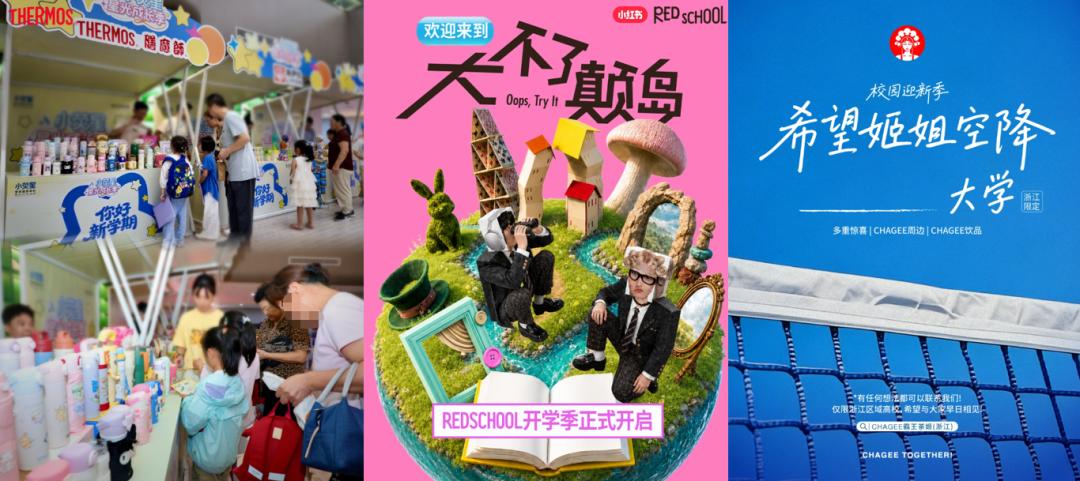
Thermos, Xiaohongshu, Bawang Chaji Offline Activities
Second, move from "fighting alone" to "cross-border cooperation" to penetrate young people's lives in all aspects.
Cross-border collaboration and co-branding are very common in brand marketing, and the biggest change in back-to-school season marketing in recent years is that the linkage boundary is constantly widening.
For example, the cooperation between technology digital brands and tea & coffee brands has become increasingly popular: Honor jointly launched the theme activity "The First Cup of Milk Tea for Back to School" with Hushang Ayi, and users who purchase Honor Life Clip-on Earphones 3i can get a free order coupon from Hushang Ayi; OPPO linked with Mixue Ice City to create the "Back-to-School Sweet Partner" activity, users who complete OPPO student certification can go to the store to get Mixue ice cream and draw co-branded peripherals.
The core value of this kind of cross-border linkage lies in scene complementarity and mutual penetration of circles.
On one side are low-frequency high-unit-price tech products, on the other side are high-frequency low-unit-price daily consumption. Their core user groups highly overlap, and their consumption scenarios are completely complementary. Through linkage, tech brands can strengthen user reach frequency with the help of offline tea drinking scenarios, while tea brands can enhance their own tone with the high-end attributes of digital brands, and continuously strengthen circle cognition.
Moreover, different from the conventional co-branding of consumer brands + entertainment IP, this larger-span combination comes with inherent topic and social attributes, which is easier to stimulate users' willingness to check in and share, and often achieves a 1+1>2 effect in both communication and conversion.
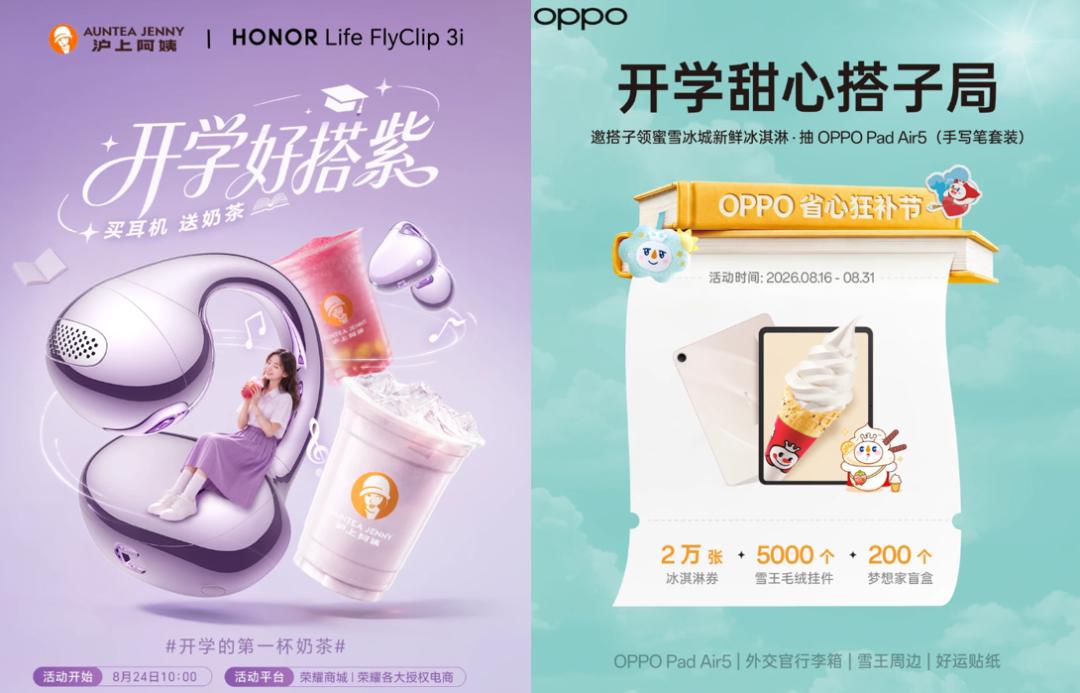
Honor & Hushang Ayi, OPPO & Mixue Ice City
Third, shift from "selling products" to "building personas", replace functional preaching with emotional resonance, and grasp the pain points of young people.
If the sinking of marketing positions and the widening of cooperation boundaries belong to tactical level optimization, then the transformation of brand communication logic is a deeper cognitive upgrade: from selling products to building personas, brands are accurately grasping the emotional pain points of Generation Z.
Generation Z's consumption decisions have long gone beyond the practical value of the product itself, and they pay more attention to the emotional value and identity recognition behind consumption. For students, the back-to-school season is not just a consumption window, but also a typical emotional node: the uneasiness and freshness facing the new environment, the anxiety and motivation in the face of academic pressure, the expectation for self-growth... Multiple emotions are intertwined.
In this emotional atmosphere, blunt product promotion is difficult to resonate, but empathetic content such as "sense of relaxation" and "sense of healing" can better touch people's hearts.
For example, Chenguang jointly launched the back-to-school season co-branded series with Snoopy, focusing on "relaxed back to school", using cute IP images, products that are both interesting and practical, and offline immersive theme experience spaces to dispel young people's anxiety about the back-to-school season; Vivo collaborated with Line Friends Dog to launch a theme short film, and initiated the "First Frame of Back to School" collection activity, encouraging users to temporarily put aside academic pressure and record the little beauty in life.
Obviously, brand marketing is transforming from "function-oriented" to "emotion-oriented": no longer insisting on preaching high-end concepts and product selling points, but first finding the emotional entry point that resonates with young people, and then gaining deep empathy.
When a brand shapes itself from a "merchant selling goods" into a "like-minded friend who understands you", what it gains is not just a one-time purchase conversion, but longer-term user loyalty and emotional connection.